The Empty Chair by the River
By the time Meera realized Reema had stopped answering her, she had already sent six messages.
The first had been casual.
Hey, are you okay?
The second came three hours later.
Did I do something?
Then, after staring at the screen for almost twenty minutes:
Please just tell me if you’re mad at me.
She had deleted two more messages before sending the last one.
I miss you.
No reply came.
Meera placed the phone facedown on the kitchen counter and tried to concentrate on dinner. The apartment was small, with a window overlooking a narrow street where scooters passed every few minutes. Rain from the afternoon still clung to the pavement.
She opened the refrigerator, forgot why she had opened it, and shut it again.
At twenty-seven, Meera had become good at pretending she wasn’t waiting.
Waiting for a text.
Waiting for an invitation.
Waiting for someone to notice she was hurt without making her explain why.
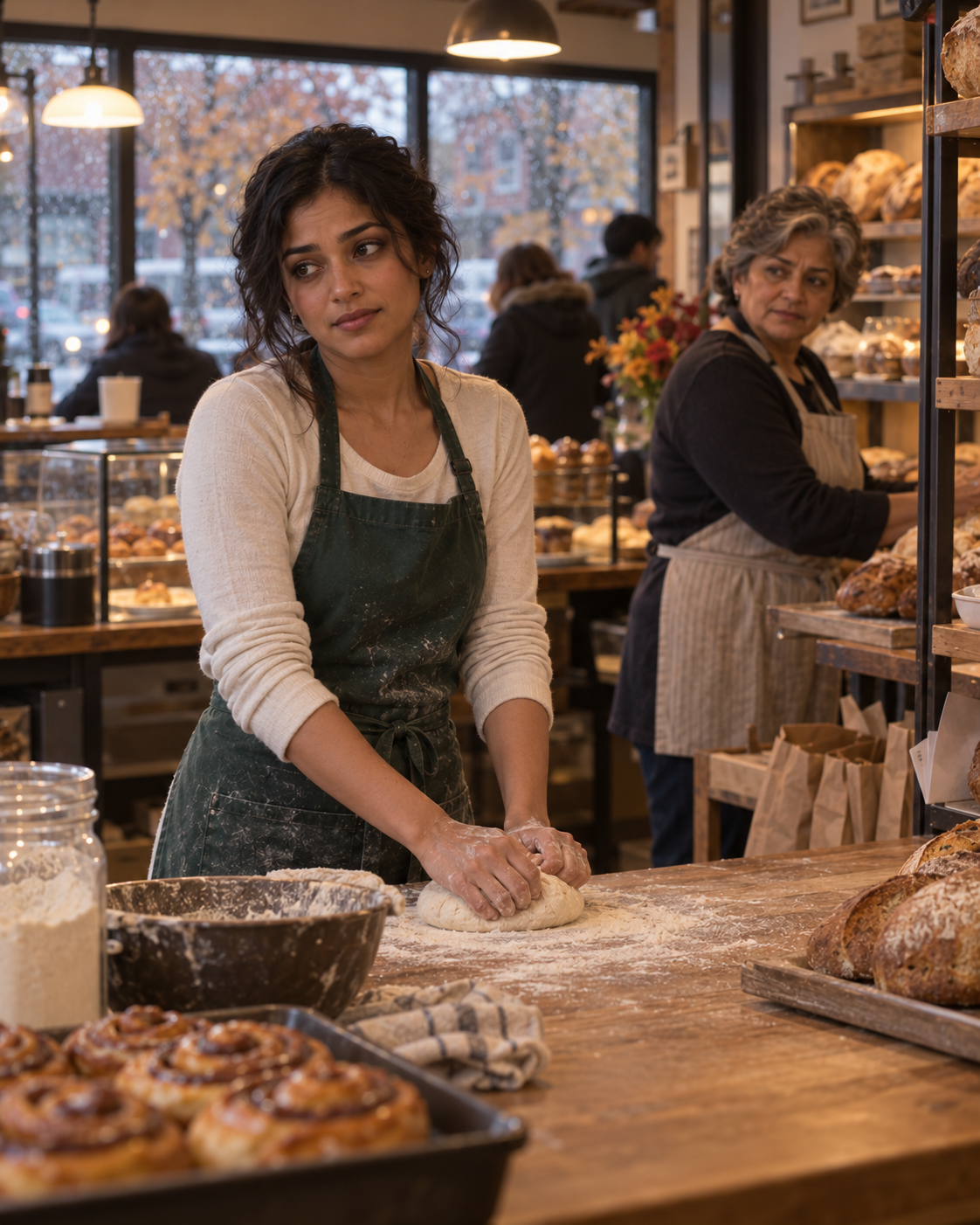
She worked mornings at a family-owned bakery called Raela’s, a warm little place on a busy corner where people stopped for coffee, sourdough loaves, cinnamon rolls, and pastries wrapped in brown paper. Aunt Raela, who wasn’t actually her aunt but had employed her since she was nineteen, liked to say that Meera could make strangers feel like old friends in under five minutes.
Meera knew that was true.
She also knew she had no idea how to make herself feel the same way.
Meera’s habit had started long before Reema.
As a child, she had learned to work for closeness.
When her father left, he didn’t slam doors or make threats. He simply stopped coming home regularly. Then he stopped calling. Eventually, he became a name that appeared occasionally on birthday cards with ten-dollar bills tucked inside.
Her mother rarely spoke badly about him.
That almost made it harder.
Meera grew up believing that people could disappear without explanation, and that the person left behind had to figure out how to bring them back.
So when friends became distant, she chased.
When boyfriends pulled away, she apologized before she even knew what she’d done.
When someone treated her carelessly, she found a reason for it.
They’re stressed.
They’re busy.
They don’t mean it.
She could forgive almost anything except being left.
And that was why Reema’s silence felt unbearable.
They had been friends for four years. Reema knew Meera’s coffee order, her mother’s favorite flower, and the story behind the tiny scar on Meera’s left wrist from a childhood bicycle accident.
Then, almost overnight, something changed.
No argument.
No explanation.
Just absence.
What Meera Overheard
Three days later, Meera saw Reema outside the Saturday farmers market.
Reema was standing beside a flower stall with two women from the neighborhood. She was laughing.
Meera’s first instinct was relief.
She’s okay.
She walked toward them with a smile already forming.
“Reema?”
The laughter stopped.
Reema turned.
“Oh. Hey.”
There was something in the way she said it that made Meera slow down.
“Are you upset with me?” Meera asked.
One of the women looked at the other and quietly stepped away.
Reema sighed. “Meera, I’m just busy.”
“You haven’t answered any of my messages.”
“I’ve seen them.”
“Then why didn’t you—”
“Because I didn’t want to.”
The words hung there.
Meera swallowed.
“Did I do something?”
Reema crossed her arms. “You’re always asking that.”
“I just want to understand.”
“And that’s the problem.”
Meera stared at her.
Reema lowered her voice, but not enough.
“You make everything so intense. Every friendship doesn’t need to be a full-time job.”
Meera felt heat rise into her face.
“I thought we were close.”
“We were.”
The past tense landed harder than anything else.
Reema picked up her shopping bag.
“Look, I don’t want to have this conversation in the middle of the market.”
“Then when?”
Reema hesitated.
“Maybe just give me some space.”
She walked away.
Meera stood there with people moving around her, carrying tomatoes and flowers, talking about weekend plans.
She wanted to call after her.
She wanted to follow.
Instead, she went home.
That evening she drove to the river.
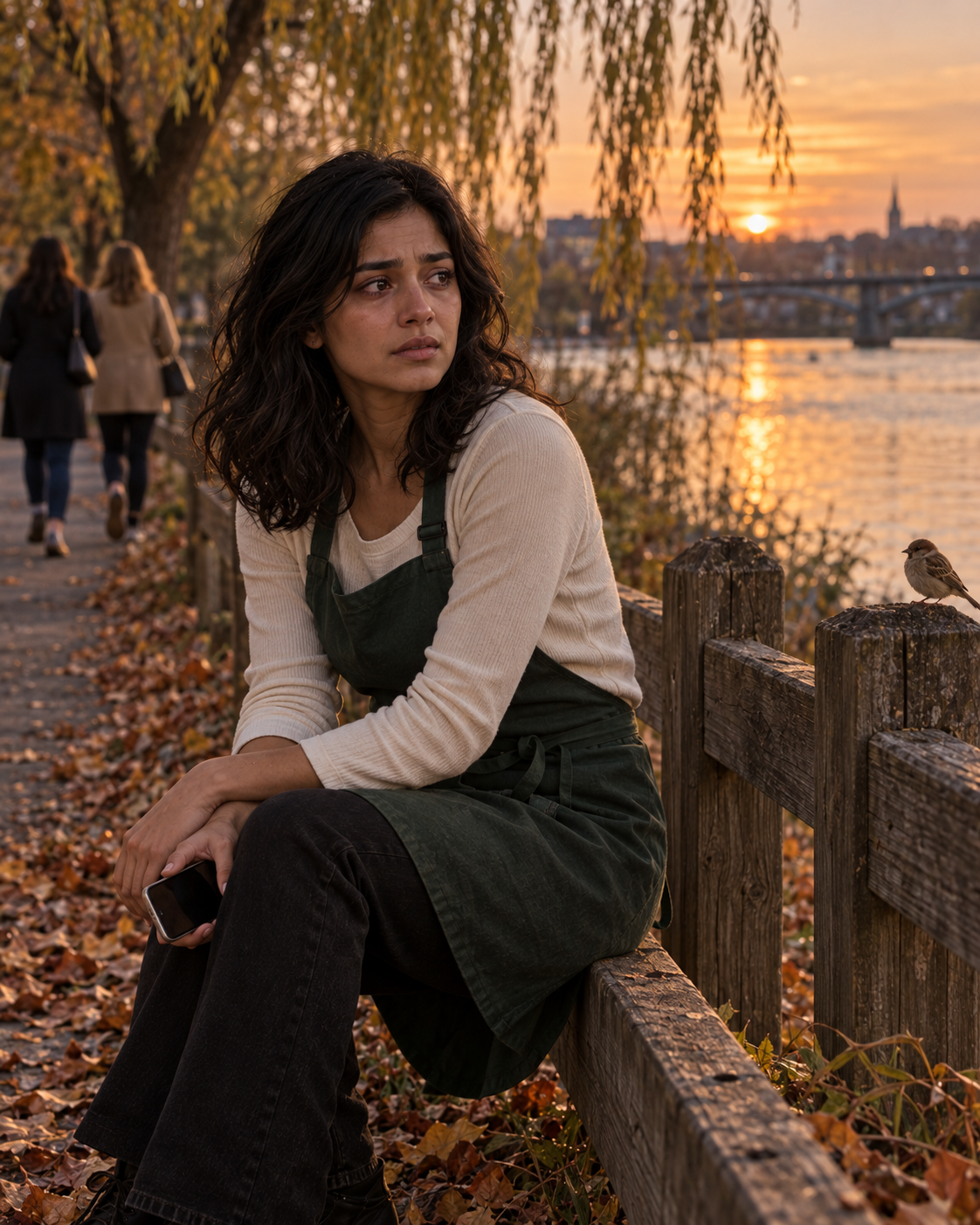
It was a habit she’d picked up during difficult weeks. Twenty minutes outside town, there was a quiet stretch along a walking trail where the river widened and moved slowly beneath a line of willow trees. There were benches, a cracked wooden fence, and an old footbridge farther downstream.
Meera sat on the grass with her knees pulled to her chest.
She cried for a while.
Then she heard a familiar sound.
A soft chirp.
She looked toward the fence.
The little brown sparrow was back.
Weeks earlier, she had found the bird there with one wing held awkwardly against its body. She had left bread crumbs beside the fence every morning until one day the bird disappeared.
Now it was standing three feet away, hopping along the damp grass.
Meera laughed through the tears.
“You again?”
The sparrow tilted its head.
“You know,” she whispered, “I think I understand you.”
She stayed until sunset.
Then, as she stood to leave, voices floated down the trail behind her.
Two women were walking slowly toward the bridge.
Meera recognized one of them.
She froze.
“…I’m telling you, Reema said she’s exhausting,” one woman said.
The other laughed quietly.
“She follows her everywhere.”
“I know. Like she’s afraid Reema’s going to disappear.”
Meera stepped backward.
Neither woman saw her.
“Apparently Meera sends these long messages whenever Reema doesn’t answer.”
A pause.
“That’s sad.”
“It is.”
Their footsteps continued toward the bridge.
Meera remained beside the river.
She couldn’t hear anything after that.
She looked at her phone.
Six messages.
Her thumb hovered over Reema’s name.
For a moment, she imagined sending one more.
I heard what you said.
Then:
I’m sorry.
Then:
Please don’t be angry.
Her hand began to shake.
She locked the phone instead.
For the first time, she let the silence remain untouched.
The Rule She Had Never Tried
At the bakery the next morning, Meera arrived twenty minutes early.
She tied her apron.
Washed her hands.
Started the coffee.
She reached automatically for her phone, then stopped.
She left it inside her bag.
Aunt Raela noticed.
“You’ve checked that thing a thousand times every morning for years.”
Meera smiled faintly. “I’m trying something different.”
Raela slid a tray of dough toward her.
“Good.”
That was all she said.
For the next week, Meera did something that felt almost unnatural.
She stopped pursuing people who were pulling away.
She didn’t send Reema another message.
She didn’t ask mutual friends what Reema was saying.
She didn’t check social media.
She didn’t invent excuses to pass by Reema’s workplace.
At first, it felt less like self-respect and more like withdrawal.
Every time her phone stayed silent, she felt the urge to reach for it.
Every time she saw two friends laughing together, she wondered whether she had somehow failed some invisible test of being lovable.
But slowly, something else began to happen.
She started noticing people who had been there all along.
Nina from the tailor shop began stopping at the bakery around three every afternoon.
“You always give me the burnt cinnamon roll,” Nina complained one day.
“You keep coming back for it.”
“Because free burnt cinnamon rolls build character.”
Meera laughed.
They started having coffee together.
A regular customer named Daniel asked one Saturday whether she liked painting. When she admitted she’d always wanted to learn, he told her his sister taught a small weekend class at the community center.
And Mr. Alvarez, who lived in the apartment above the bakery, started bringing his old terrier downstairs because the dog liked sitting near the bakery door.
None of them required Meera to prove anything.
Nobody made her chase.
Nobody disappeared to see whether she’d follow.
The realization was so simple that it almost embarrassed her.
There were people who enjoyed being around her without needing to be convinced.
She had been so focused on the people walking away that she hadn’t noticed who was standing still.
The Conversation She Didn’t Chase
Two months passed.
One windy Thursday evening, Reema came into the bakery.
Meera was carrying a tray of bread.
Their eyes met.
Reema looked older somehow. Not physically. Just tired.
“Hey,” she said.
“Hey.”
Meera placed the tray on the counter.
Reema glanced around.
“Do you have a minute?”
Meera nodded.
They stood near the front window.
“I owe you an apology,” Reema said.
Meera said nothing.
“I handled everything badly.”
“Yes,” Meera said.
Reema winced.
“I should have just told you how I felt instead of talking about you to other people.”
Meera folded her arms loosely.
“Why did you stop wanting to be my friend?”
Reema looked down.
“I think I got overwhelmed. You were always checking in. When I didn’t answer, you’d send more messages. Sometimes you wanted reassurance about things I’d already explained.”
“I know.”
“I didn’t know how to tell you without hurting you.”
“So you hurt me anyway.”
Reema nodded.
“I did.”
The bakery was quiet except for the refrigerator humming behind them.
Meera looked at her former friend and noticed something unexpected.
She didn’t feel the old panic.
She didn’t feel the need to repair the moment.
She didn’t feel responsible for making Reema comfortable.
“I’m glad you came,” Meera said.
Reema seemed surprised.
“Does that mean we’re okay?”
Meera took a breath.
“It means I don’t hate you.”
Reema gave a small, sad smile.
“I understand.”
“I cared about you a lot,” Meera continued. “But I don’t think we should go back to what we were.”
Reema nodded slowly.
“I understand.”
And that was it.
No dramatic reunion.
No perfect apology that erased everything.
Reema bought two blueberry scones and left.
Meera watched her walk down the sidewalk.
Then she turned back to the bakery.
She didn’t run after her.
What Stayed
Spring came slowly that year.
The river rose with the rain, the willows turned green, and the muddy trails filled with people walking dogs and pushing strollers.
Meera still had bad days.
Sometimes she still stared at a silent phone and wondered why being ignored could make her feel twelve years old again.
She still had moments when she wanted to send one more message.
But now she knew the difference between reaching out and begging to be chosen.
One evening, after closing the bakery, she drove to the river.
The same wooden fence stood beside the path.
The same bend in the water caught the last light of the day.
Meera sat on the grass and opened her sketchbook.
Daniel had taught her how to draw simple landscapes. She wasn’t very good yet. The trees came out uneven, and the river looked more like a crooked gray ribbon.
She didn’t care.
A shadow moved across the page.
She looked up.
The little brown sparrow landed on the fence.
Meera smiled.
“You’re still here.”
The bird hopped closer.
She held out her hand, though she knew it wouldn’t land there.
“That’s okay,” she said softly. “You don’t have to.”
The sparrow chirped and flew to a nearby branch.
Meera watched it go.
For years, she had believed that love meant holding on tightly enough that nobody could leave.
Now she was learning something quieter.
People could leave.
Friends could change.
Some doors could close without a final explanation.
And none of that required her to shrink, plead, apologize for existing, or chase someone down the road.
She closed the sketchbook and stood.
Across the river, the sun was dropping behind the trees.
Her phone vibrated once in her pocket.
She looked at the screen.
It was Nina asking whether they were still getting coffee Saturday morning.
Meera smiled.
“Absolutely,” she said to the empty riverbank.
Then she slipped the phone back into her pocket and started walking home.
The sparrow lifted from the branch behind her, crossed the fading sky, and disappeared into the trees.
This time, Meera watched it leave without following.