The Last Light on Lake Mercer
By six o’clock on Friday evening, seventeen-year-old Claire Dalton had decided the campsite was perfect.
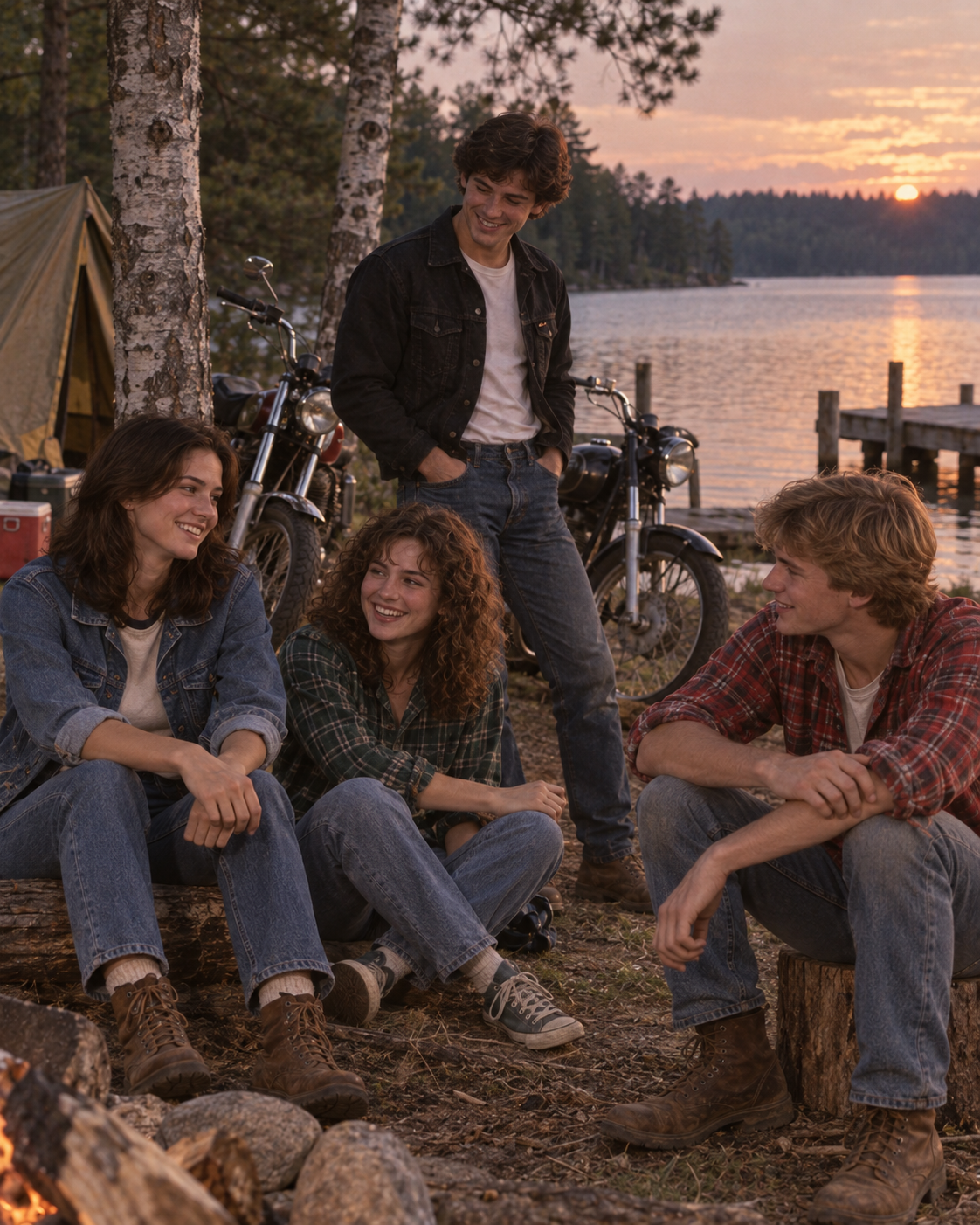
She stood at the edge of Lake Mercer with both hands tucked into the pockets of her denim jacket, watching the last orange light stretch across the water. Behind her, two small motorcycles leaned against a stand of birch trees, and beyond them, the canvas tent Claire had helped pitch sagged slightly where one of the ropes had been tied too loosely.
“Worth the forty-minute drive,” she said.
Her best friend, Rachel Moore, tossed a beer into the cooler. “You said that about the last place.”
“The last place had mosquitoes.”
“This place has mosquitoes.”
Claire turned and smiled. “Not yet.”
Their boyfriends, Mark and Danny, were farther down the dock arguing about whose motorcycle was faster. They had been arguing about it since they left town.
The four of them had known one another since sophomore year. Claire and Mark had been dating for five months, long enough for Claire to know his good moods and his jealous ones. Mark was eighteen, restless, funny when he wanted to be, and strangely sensitive about being embarrassed in front of other people.
Rachel and Danny had been together longer.
This weekend was Claire’s birthday trip. No parents. No school. Two nights in the woods.
For a little while, it felt like they had managed to step outside ordinary life.
On the way into the campground, they stopped at a little wooden concession stand beside the main road.
The woman behind the counter was probably in her fifties. She had gray-blond hair pinned tightly behind her ears and a cigarette burning in an ashtray near the register.
Claire smiled.
“Could we get four sodas and some ice?”
The woman stared at her.
Then she looked past Claire toward the motorcycles.
“You camping out here?”
“Yeah.”
“How long?”
“Just the weekend.”
The woman’s face changed.
Not dramatically. Just enough for Claire to notice.
“Then don’t set up near the water.”
Claire glanced toward the lake.
“Why?”
“Because I said so.”
Behind her, Rachel made a tiny snorting sound. Danny looked down to hide a grin.
The woman heard it.
“You kids think everything’s funny.”
“No, ma’am,” Claire said.
“Yes, you do.”
She pushed the sodas across the counter.
“Stay out of the north woods after dark. And don’t come back here bothering me.”
They left carrying their supplies.
Once they were out of earshot, Danny whispered, “Friendly lady.”
Rachel laughed.
Claire did not.
She looked back once.
The woman was still watching them through the service window.
The Woman by the Concession Stand
By sunset, Claire had forgotten about her.
The four friends swam until the water turned cold. They ate sandwiches beside the tent, traded stories, and passed around a small radio that struggled to hold a station.
Mark sat beside Claire on the dock.
“You having a good birthday?”
“Best one yet.”
He smiled.
Then Danny made some joke about Mark’s motorcycle being held together with wire.
Claire laughed.
Mark’s smile disappeared.
It lasted only a second.
But Claire saw it.
“You okay?” she asked quietly.
“Yeah.”
“You sure?”
“I’m fine.”
He stood up and walked toward the tent.
Claire watched him go.
Rachel nudged her shoulder. “He’s jealous.”
“He is not.”
“He absolutely is.”
Claire rolled her eyes, but when she looked back toward Mark, she saw him staring into the trees.
The sun had nearly disappeared.
Something about the expression on his face made her stop smiling.
Later, all four crawled into the tent.
It was cramped. Their sleeping bags overlapped, and someone’s shoe always seemed to be under somebody else’s arm.
Outside, the forest settled into darkness.
Claire listened to the wind move through the birches.
She thought about the concession-stand woman.
About the way she’d looked at them.
About the warning.
Then she heard something.
Scrape.
A pause.
Scrape.
Claire opened her eyes.
Nobody else moved.
She lifted herself onto one elbow.
The tent flap was partly open.
Beyond it, the trees were only black shapes against a pale moonlit sky.
“Rachel?” Claire whispered.
Rachel stirred.
Then a shadow passed the opening.
Claire froze.
Someone was standing outside.
A hand touched the tent rope.
The canvas suddenly jerked sideways.
Rachel screamed.
The tent collapsed.
Everything became noise—fabric, shouting, bodies scrambling in the dark.
Claire felt Mark grab her arm.
Then something struck him.
Once.
Hard.
The world went silent for a second.
And then Claire heard Rachel scream again.
The Morning No One Could Explain
At 6:20 the next morning, two brothers named Evan and Luke Harris were fishing from the far side of the lake.
Evan was thirteen.
Luke was ten.
They noticed a man coming out of the woods.
He was tall and blond.
He moved quickly along the trail without looking at the lake.
“Who is that?” Luke asked.
Evan shrugged.
The man disappeared behind a row of trees.
Neither boy thought much of it.
An hour later, a father and his two sons walked toward the campsite looking for a better place to swim.
The father saw the collapsed tent first.
He stopped.
Then he saw the shoes.
Then the bodies.
He grabbed both boys by their shoulders and pulled them backward.
“Don’t look.”
They returned to the main campground and called the police.
By late morning, the trail was full of officers.
Claire was alive.
Barely.
Rachel and Danny were dead.
Mark was motionless beneath the canvas.
Then one of the paramedics heard something.
A breath.
Mark’s eyes opened.
He tried to speak.
Nothing came out.
At the hospital, Claire woke three days later with a broken wrist and a dozen stitches.
The first thing she asked was, “Where’s Rachel?”
Nobody answered.
She already knew.
The police questioned Claire as soon as doctors allowed it.
She remembered the shadow.
She remembered hearing Mark shout.
She remembered something bright outside the tent.
But her memory broke apart after that.
When investigators asked what she meant by something bright, Claire stared at the floor.
“Eyes,” she said.
“Whose eyes?”
“I don’t know.”
“What color?”
Claire swallowed.
“Amber. I think.”
What the Police Found in the Woods
The crime scene raised more questions than answers.
The motorcycles were still there.
Wallets were missing.
Mark’s denim jacket was gone.
So were his boots.
Police found one of the boots nearly a quarter mile from the campsite under wet leaves.
There was blood on it.
None of it belonged to Mark.
A second search turned up cigarette ashes near the trail.
They were the same brand sold at the concession stand.
That was enough for detectives to question the woman who owned the store.
She was cooperative.
Almost too cooperative.
She said her husband had been home all night.
Their daughter confirmed it.
So did a neighbor.
And the woman insisted she’d warned the teenagers to stay away from the north woods because she was worried they would get lost.
“I don’t like trouble,” she told investigators.
No charges were filed.
The case dragged on for months.
Then years.
Claire eventually left town.
Mark survived, but his injuries changed him. He married young, worked construction, and rarely spoke about that night.
When reporters asked him what he remembered, he always gave the same answer.
“Someone was outside the tent.”
Nothing more.
The sheriff’s department eventually stopped releasing updates.
The murders became one of those local tragedies people mentioned quietly, usually when summer returned.
For decades, there was no answer.
Then, in 2001, one arrived.
At least, someone claimed there was.
The Man Who Said He Did It
A former campground caretaker named Walter Keene was dying in a nursing home seventy miles away.
According to his daughter, he had become increasingly agitated during his final weeks.
One afternoon, while she was helping him drink water, he grabbed her wrist.
“You need to listen,” he said.
She did.
He told her he’d been at Lake Mercer that night.
He said he’d seen four teenagers camping illegally.
He said he’d gone into the woods to scare them.
He said the confrontation became violent.
His daughter asked if he had killed them.
Walter closed his eyes.
“I did something unforgivable.”
She contacted the police.
The investigators listened carefully.
But Walter’s story contained problems.
He described details never released to the public.
Yet he also got important things wrong.
He claimed Claire had been killed.
She hadn’t.
He said the bodies had been dragged to the shoreline.
They hadn’t.
And when detectives asked what happened to Mark’s missing boots, Walter said he had burned them.
They had been found decades earlier.
In the end, Walter’s confession could not be corroborated.
He died before prosecutors could decide whether to pursue charges.
The case remained officially unsolved.
Claire learned about the confession from a reporter.
She drove back to Lake Mercer alone.
The concession stand was still there, though freshly painted.
The old woman had died years earlier.
The lake looked smaller than Claire remembered.
She walked down the same trail.
At the campsite, there was nothing left.
No tent.
No motorcycles.
No blood.
Just trees.
She stood there for a long time.
Then she noticed something caught beneath the roots of a birch.
A small piece of metal.
She knelt and pulled it free.
It was the broken buckle from Mark’s old denim jacket.
Claire closed her hand around it.
She had spent most of her life imagining that the answer would change everything.
That someday someone would explain the shadow outside the tent.
That one face would appear, one voice would confess, and the years of uncertainty would finally have somewhere to go.
But standing there beside the lake, she realized something stranger.
The place had not kept the night alive.
She had.
The forest had grown back.
The dock had been rebuilt.
The path had nearly vanished beneath the grass.
Even the wind sounded ordinary.
Claire slipped the broken buckle into her pocket.
Then she walked back toward the lake.
She stopped at the end of the dock, where she and Rachel had once watched the light fade across the water.
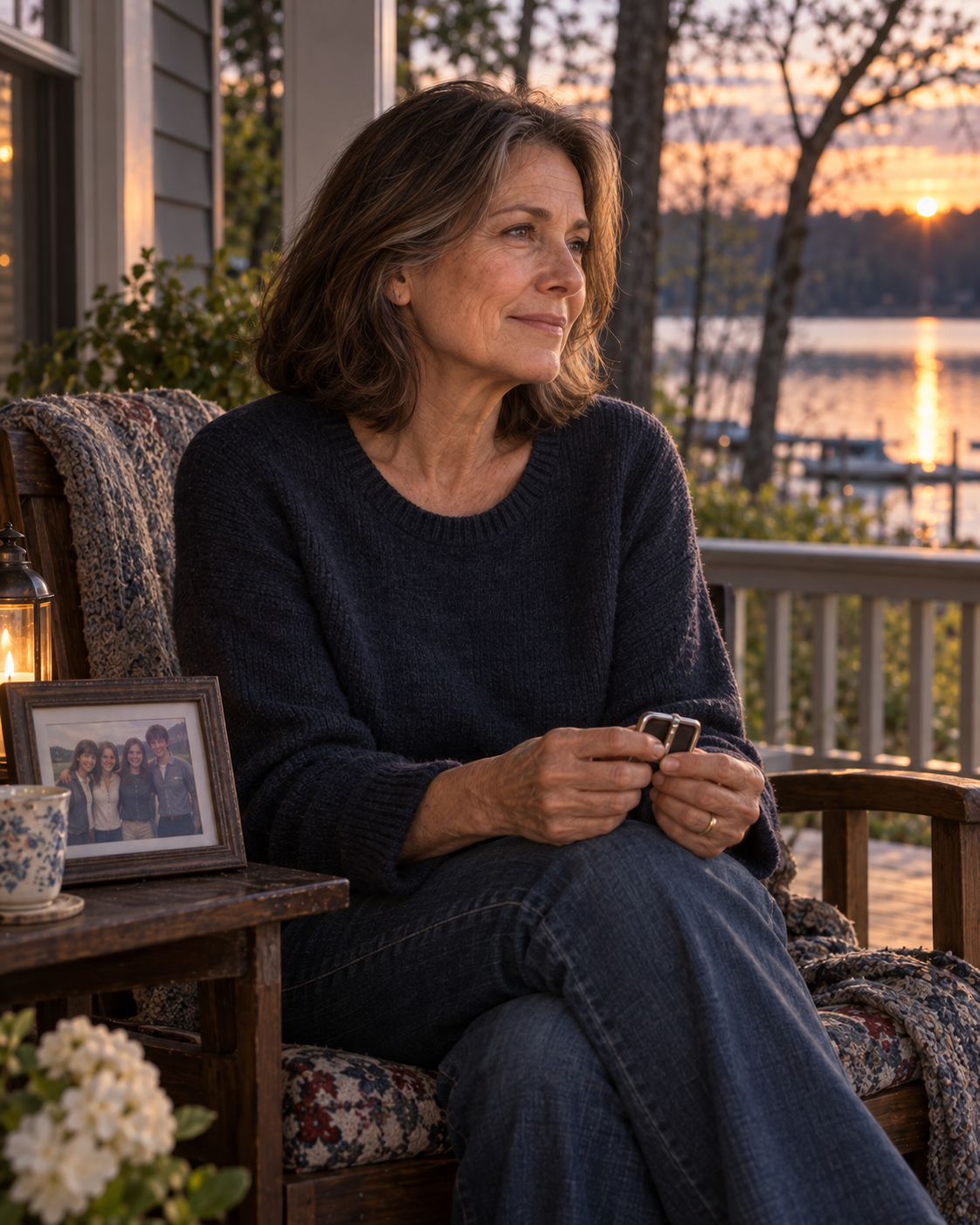
For the first time in forty-three years, she let herself remember Rachel laughing.
Not screaming.
Not the sound of the tent collapsing.
Just laughing.
Claire stood there until evening settled over the trees.
Then she turned toward the road and left the lake behind.
This time, she did not look back.
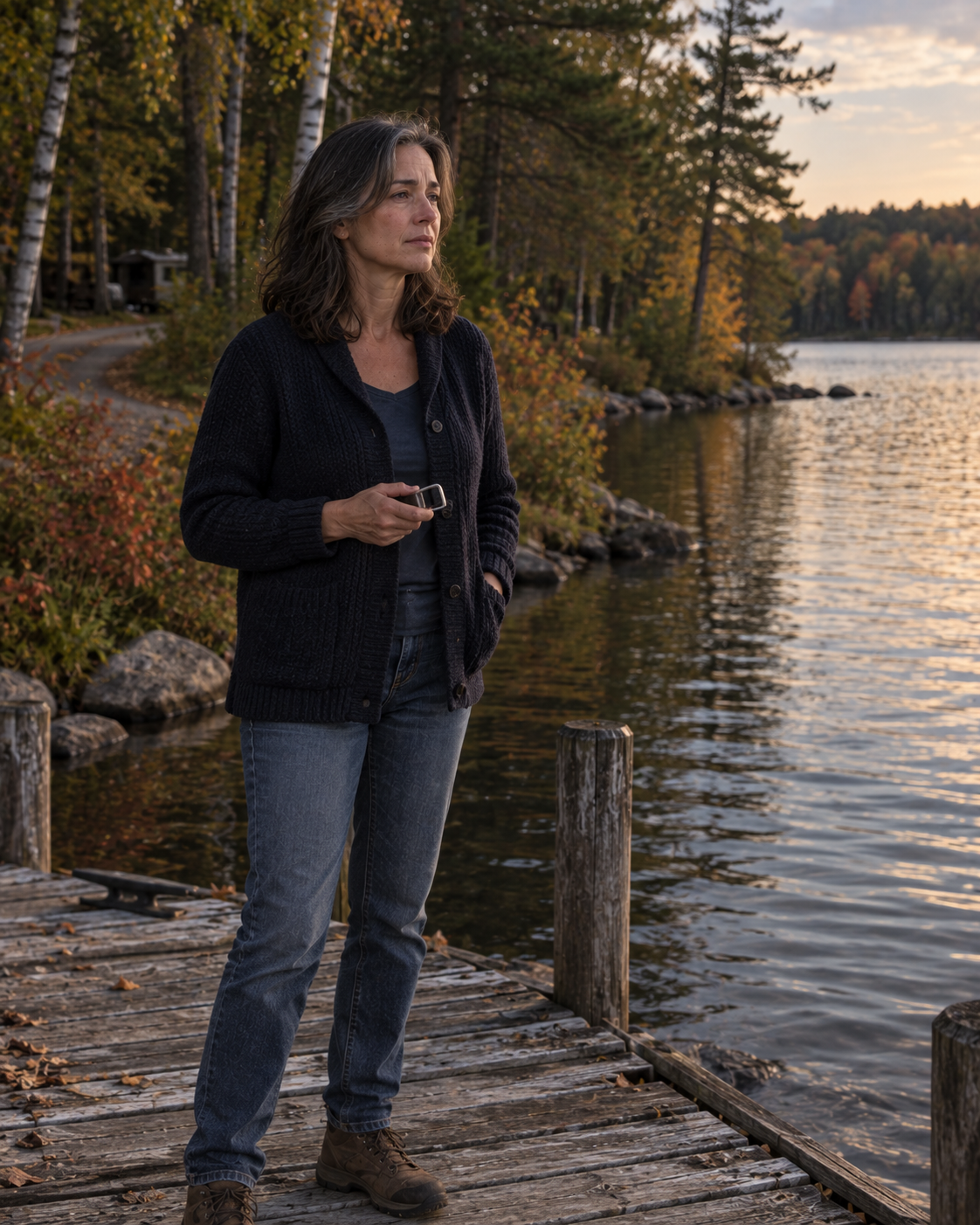
The Lake After All These Years
Claire never learned who stood outside that tent.
Maybe the dying man’s confession had been a lie.
Maybe it had been a distorted memory.
Maybe the person who ran through the trees that morning was connected to the killings, or maybe he’d simply been another stranger passing through a crowded campground.
There were theories.
There always would be.
But Claire stopped needing every missing piece.
Years later, when she told her granddaughter about Lake Mercer, she left out most of the frightening details.
She talked about the dock.
The white moonlight on the water.
The way Rachel used to laugh so hard she couldn’t finish a sentence.
And once, when her granddaughter asked whether she was ever afraid to return, Claire smiled.
“A little,” she said.
Then she looked out the window toward the evening sky.
“But the lake didn’t do anything to us.”
Her granddaughter waited.
Claire turned the old metal buckle over in her fingers.
“People did.”