The Day Hazel Lost Her Home
At eighteen, Hazel Jenkins learned that a person could lose everything without anyone raising their voice.
The rain had started before sunrise and never really stopped. By six that evening, the driveway outside her childhood home looked like a sheet of black glass.
Hazel stood beside the curb with two garbage bags at her feet.
One held clothes. The other held books, toiletries, and the old blue sweatshirt her grandfather had given her when she was twelve.
On the porch, her stepmother, Jasmine, folded her arms against the cold.
“You can’t stay here anymore.”
Hazel stared at her. “You said I could have until the weekend.”
“I said that before I realized you were planning to make this a habit.”
“My birthday was yesterday.”
“I know.”
Hazel looked back at the house.
Her father’s house.
The narrow upstairs window had been hers since she was nine. The maple tree beside the garage was the one she used to climb when she was little. There were pencil marks inside the kitchen pantry measuring her height from first grade through high school.
All of it was still there.
She simply wasn’t.
Her father, Daniel, had died six months earlier from a heart attack while driving home from work. The funeral had been followed by paperwork, phone calls, and a rapid education in how quickly money could disappear when nobody was watching closely.
Jasmine had handled the insurance claim. She had sold Daniel’s old truck. She had closed accounts Hazel didn’t even know existed.
Whenever Hazel asked about the estate, Jasmine told her the same thing.
“Your father barely left anything.”
Hazel had believed her because grief made arguing feel exhausting.
Then, three weeks ago, a letter arrived from an attorney Hazel had never heard of.
Thomas Reed, a probate lawyer in Tacoma, informed her that her grandfather, Arthur Jenkins, had left instructions concerning “a personal asset held in trust until Hazel’s eighteenth birthday.”
The letter contained an address.
It wasn’t a bank.
It wasn’t a house.
It was a salvage yard.
Hazel slipped the letter into her coat pocket.
Now, standing in the rain with nowhere to go, she suddenly understood that the strange letter wasn’t optional.
It was all she had.
She picked up the bags.
Jasmine opened the door only once more.
“Hazel.”
Hazel turned.
“You really should learn how the world works.”
Then the deadbolt clicked.
Hazel walked away.
Three miles later, she reached a fenced salvage yard on the edge of Tacoma.
The sign over the gate read Omali’s Auto Wrecking.
An older man in grease-stained coveralls stepped out from a metal shed.
“You Arthur’s granddaughter?”
Hazel nodded.
He studied her face.
“You’re Hazel.”
“Yes.”
The man sighed.
“My name’s Frank Ali. Your grandfather paid me five years in advance.”
Hazel blinked.
“For what?”
Frank pointed toward the far corner of the lot.
“There.”
Behind a wall of rusted trucks and tangled blackberry vines sat a faded blue 1978 Blue Bird Wanderlodge.
Its tires had sunk into the mud.
A strip of moss ran along the roof.
One window was covered with plywood.
Hazel stared at it.
“That’s what he left me?”
Frank gave a small shrug.
“That’s what he told me to keep.”
He handed her a ring of heavy keys.
“He said you’d come looking for it when you were eighteen.”
Hazel looked at the bus again.
For a moment, she almost laughed.
Then she looked down at the two garbage bags beside her.
“Where am I supposed to sleep?”
Frank’s expression softened.
“Inside, I guess.”
He walked her to the bus.
“It’s ugly,” he admitted. “But the roof mostly holds.”
Hazel climbed the metal steps.
When she opened the door, a stale smell of dust, mildew, and old upholstery drifted into the rain.
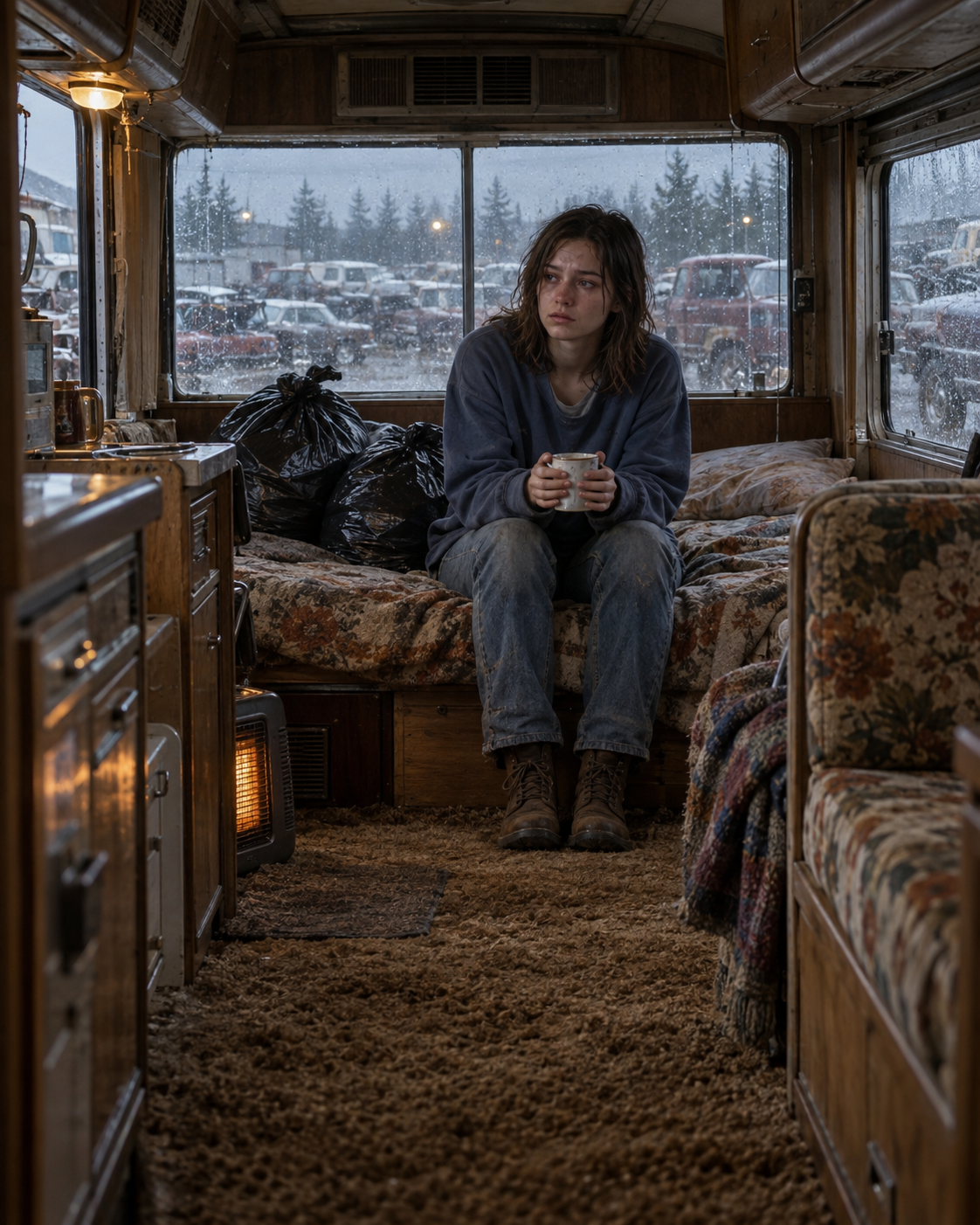
Inside was a frozen time capsule.
Brown carpet.
Faux wood cabinets.
Faded floral curtains.
A cracked dining table.
No heat.
No running water.
No electricity except what Frank later rigged from his shed.
Hazel set down her bags and sat on the narrow rear bed.
For ten minutes, she simply stared at the wall.
Then she cried.
Not loudly.
Not dramatically.
She buried her face in her hands and let the tears run until there was nothing left.
She was an honor student who had planned to start community college in January. She had a part-time job lined up at a bookstore.
Now she was sleeping in a dead bus in a salvage yard.
Sometime after midnight, she pulled the old blue sweatshirt around her shoulders and stretched out beneath a thin blanket.
Her foot struck something beneath the mattress frame.
Clank.
Hazel frowned.
She kicked it again.
Clank.
That didn’t sound like wood.
It sounded like metal.
She reached down in the darkness.
Then stopped.
She was too tired to care.
“Tomorrow,” she whispered.
Outside, rain tapped against the bus like fingers.
Tomorrow would have to be enough.
The Compartment Beneath the Bed
The next morning, Hazel woke with a stiff neck and twenty-nine dollars in her checking account.
She washed her face with bottled water.
Then she opened the curtains.
Frank was already outside, working beneath the hood of an old pickup.
He glanced toward the bus.
“Morning, kid.”
“Is there any chance this thing has heat?”
“Only if you’re willing to call a space heater a heating system.”
Hazel smiled despite herself.
Frank tossed her an extension cord.
“I got power running to you.”
“Thanks.”
“Don’t thank me yet. The bathroom situation is still embarrassing.”
Hazel laughed.
It was the first laugh she’d had in days.
She spent the morning cleaning.
There were dead bugs in the window tracks, dust under every cabinet, and enough mildew in the rear compartment to make her cough.
But work helped.
Work always had.
Around noon, she remembered the sound beneath the bed.
She knelt on the carpet and began examining the wooden trim surrounding the mattress platform.
The trim was newer than everything around it.
That bothered her.
Her grandfather had been a structural engineer. Before retiring, he’d spent decades designing bridges and inspecting municipal infrastructure.
He hated temporary fixes.
Hazel found a screwdriver in a toolbox beneath the kitchen sink.
She worked the edge of the trim loose.
A section popped off.
Beneath it was a rectangular steel plate secured with four heavy bolts.
Hazel stared at it.
“Okay, Grandpa.”
She sat back on her heels.
“What did you do?”
A vehicle rolled slowly past the salvage yard gate.
Hazel watched through the window.
A black SUV stopped across the street.
It stayed there for almost a minute.
Then it drove away.
She told herself it was nothing.
An hour later, a man in a charcoal overcoat walked through the open gate.
He looked completely out of place.
Mid-forties.
Neat haircut.
Expensive shoes.
Leather briefcase.
He stopped beside the bus.
“You’re Hazel Jenkins.”
She didn’t answer.
“My name is Gregory Harrison.”
The name meant nothing to her.
“I knew your grandfather.”
Hazel opened the bus door but kept the chain latched.
“How?”
“We worked together years ago.”
“What do you want?”
Gregory smiled politely.
“I understand Arthur left you this vehicle.”
“He did.”
“I’d like to buy it.”
Hazel glanced at the rust peeling from the side panel.
“You collect broken buses?”
“Some people collect cars. I collect unusual restoration projects.”
“How much?”
“Five thousand.”
Hazel nearly stopped breathing.
Five thousand dollars.
She thought about rent.
Food.
Tuition.
A used car.
A room with a lock.
Then she looked down at Gregory’s shoes.
They were spotless.
Not a drop of mud on them.
Yet he’d walked nearly a hundred yards across a salvage yard to reach a bus that barely ran.
“Why this one?”
His smile tightened.
“Sentimental value.”
“For you?”
“Not personally.”
Hazel didn’t move.
Gregory sighed.
“You’re young. You don’t need this headache. Take the money.”
He opened his briefcase.
There was an envelope inside.
“I can make this simple.”
Hazel thought about Jasmine telling her how the world worked.
Then she thought about her grandfather paying for this bus to be stored until her eighteenth birthday.
She closed the door.
“No.”
Gregory’s pleasant expression disappeared.
“You should reconsider.”
“No.”
He leaned slightly closer.
“Your grandfather had a talent for making complicated decisions look romantic.”
Hazel said nothing.
His eyes moved past her shoulder.
Toward the rear of the bus.
His gaze lingered there for less than a second.
Then he stepped back.
“I’ll give you until tomorrow.”
Frank appeared behind him carrying a wrench.
“She said no.”
Gregory looked at Frank.
Frank didn’t blink.
Gregory turned and walked away.
Hazel watched until he disappeared through the gate.
Then she locked the door.
“Who was that?”
Frank set the wrench down.
“Arthur’s last big problem.”
“What does that mean?”
“It means he called here plenty.”
“Why?”
Frank looked at the steel plate beneath the bed.
“I figured you’d find out.”
Hazel’s heart began pounding.
She returned to the compartment and removed the bolts.
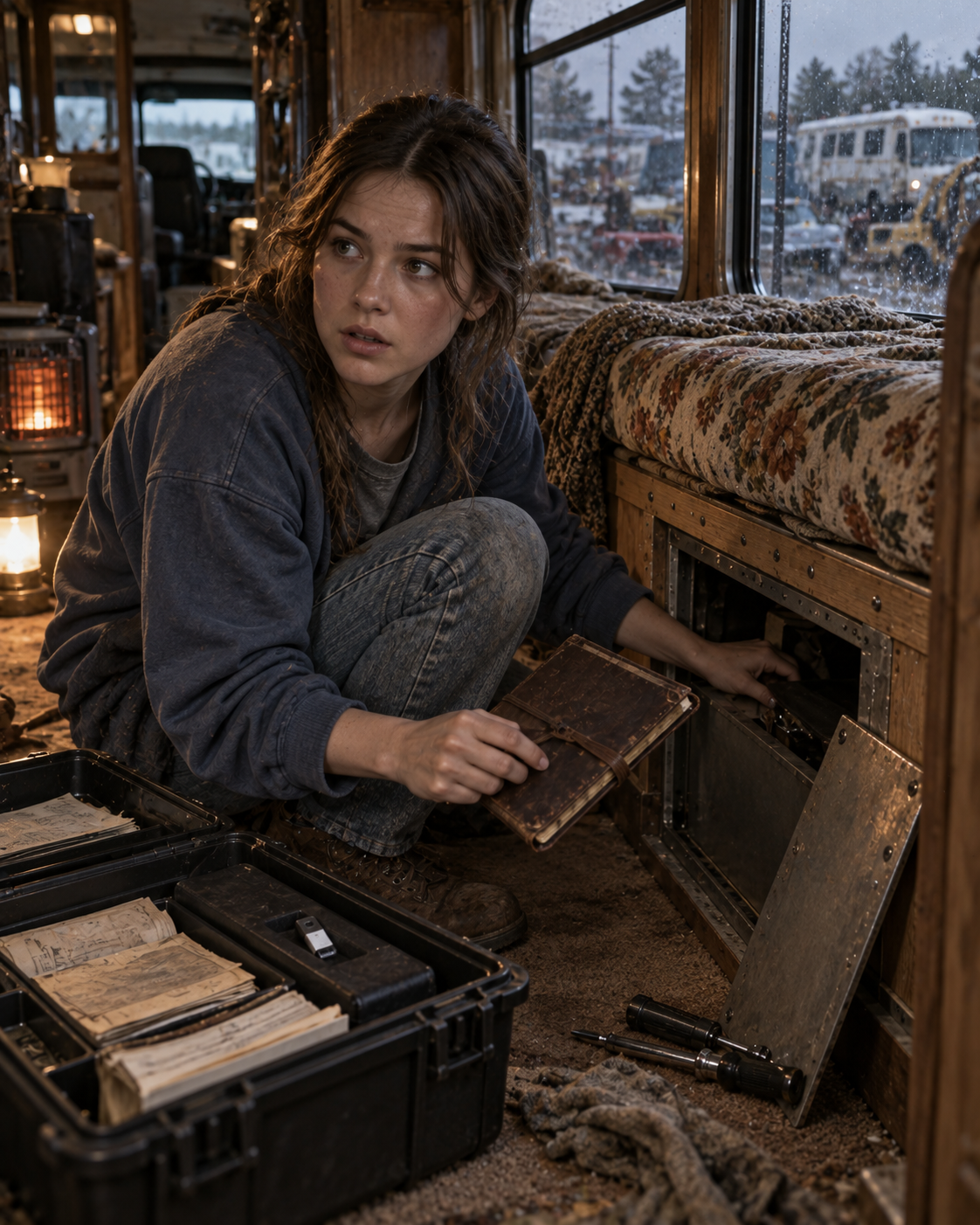
Inside the cavity was a black waterproof case.
No money.
No weapons.
Just a thick leather notebook, a flash drive sealed inside plastic, and several handwritten pages.
On the first page Arthur had written her name.
Hazel,
If Gregory Harrison has found you, do not trust anything he offers.
Hazel read the sentence twice.
The next page explained why.
Years earlier, Arthur had worked as a structural auditor for Harrison Infrastructure, a regional engineering contractor involved in public bridge and road projects.
Arthur had discovered something wrong in the company’s records.
Invoices for materials that had never been delivered.
Inspection reports that had been altered.
Subcontractors paid for work that did not exist.
Most troubling of all, several bridge projects had used cheaper steel than their specifications required.
Arthur had reported the discrepancies internally.
Nothing happened.
Then one of the engineers who helped him investigate died in a late-night car accident.
Arthur became convinced someone was warning him to stop.
He copied the records.
He left the company.
And before he died, he built a private archive of the evidence.
The final paragraph was the one Hazel couldn’t stop reading.
I could not prove everything by myself. You can.
Inside the bus are the original inspection records, contracts, payment trails, and a duplicate digital archive. Do not sell the bus. Do not take anything to someone connected to Harrison Infrastructure. Take it to a federal attorney or investigator who is independent of the local system.
Hazel sat very still.
The rain began again.
For the first time since her father died, she didn’t feel helpless.
She felt scared.
But fear was different when it had a direction.
The Man Who Came Back After Dark
Hazel called Thomas Reed from the tiny kitchen table.
The lawyer listened without interrupting.
When she finished, he asked, “Do you still have the original documents?”
“Yes.”
“Do not move them.”
“I thought you said the estate was simple.”
“It was supposed to be.”
“You knew about this?”
“I knew Arthur was concerned about Harrison Infrastructure. I did not know he had kept a private archive.”
Hazel looked toward the windows.
“The man who came here yesterday knew exactly where to find me.”
Reed was quiet.
“Hazel, I need you to do something for me.”
“What?”
“Take photographs of every page. Keep copies in at least two places. And tomorrow morning, I’ll meet you at my office.”
“Okay.”
“Do not confront Harrison.”
“I wasn’t planning to.”
The line went silent.
Then Reed said, “And Hazel?”
“Yes?”
“Your grandfather trusted me enough to write my name in his instructions. That’s the only reason I’m telling you this next part.”
Her hand tightened around the phone.
“What part?”
“If someone offers you money for that bus again, call me before you answer.”
The line clicked off.
Hazel barely slept.
At 11:40 that night, headlights crossed the curtains.
She sat upright.
The salvage yard was supposed to be locked.
She looked outside.
The same black SUV was parked near the gate.
Two men stepped out.
Gregory Harrison climbed out of the passenger side.
This time he wasn’t smiling.
Hazel’s stomach dropped.
Frank’s shed was dark.
She grabbed the journal and flash drive and shoved them into her backpack.
A man’s voice carried through the rain.
“Harrison says we check the bus first.”
A crowbar struck the folding door.
Hazel backed away.
She had one phone with a dying battery.
One exit.
And three men outside.
She called 911.
No signal.
She moved to the rear of the bus.
The old diesel engine was dead, but Arthur’s diagrams had shown one feature Hazel hadn’t understood.
A hidden mechanical release.
She found a red-handled lever near the driver’s seat.
She pulled.
Nothing.
She pulled harder.
Something beneath the floor clicked.
Then the bus’s exterior emergency lights flickered on.
The men outside froze.
Hazel grabbed the emergency door release at the back.
The rear door opened into darkness.
She climbed down into the mud just as the front door was struck again.
She ran.
Not toward the gate.
Toward Frank’s shed.
Frank had already heard the noise.
He came out holding a heavy flashlight.
“Hazel!”
“They’re here.”
Frank looked toward the bus.
Then at the men.
His expression changed.
“Go behind the shed.”
“What about you?”
“Just go.”
Hazel ran.
Frank stepped into the open yard and shouted.
“Tacoma Police are already on the way!”
He was bluffing.
But one of the men hesitated.
The hesitation bought Hazel enough time.
She crouched behind the shed and dialed 911 again.
This time the call went through.
Within minutes, red and blue lights appeared at the end of the road.
The men ran.
Gregory didn’t.
He stood beside the bus as officers approached.
When they searched the vehicle, they found the crowbar, damaged locks, and the remains of the concealed compartment.
Gregory kept repeating the same sentence.
“That bus belongs to me.”
It didn’t.
The title was in Hazel’s name.
And the documents hidden inside it weren’t his either.
They belonged to the truth.
What Hazel Refused to Give Away
The investigation lasted months.
Hazel learned that real investigations were rarely dramatic.
There were boxes.
Interviews.
Subpoenas.
Accountants.
Long meetings in conference rooms with bad coffee.
Federal investigators eventually took custody of Arthur’s archive.
The evidence was stronger than Hazel had realized.
Some of the records proved financial fraud. Others showed that safety reports had been altered. A few former employees were willing to talk once they knew someone outside the company was listening.
Harrison Infrastructure did not collapse overnight.
Nothing happened that neatly.
But people started getting charged.
Contracts were reviewed.
Old projects were inspected.
Several executives hired lawyers.
Gregory Harrison was eventually indicted on fraud and obstruction charges related to the financial records Arthur had preserved.
Hazel never testified as a victim of some grand conspiracy.
She testified as a witness who had found documents.
That distinction mattered to her.
She also discovered something else.
Jasmine had lied about Daniel’s life insurance.
Not all of it.
Enough.
There had been a second policy Daniel had kept through work. Jasmine had quietly claimed it without telling Hazel, then used part of the money to pay debts attached to the house.
Hazel’s attorney helped recover what she was legally entitled to.
There was no movie-style showdown.
No screaming match in a driveway.
Instead, Hazel received a settlement.
It was enough to pay tuition, buy a modest home, and establish a savings account that made her feel strange the first time she looked at the balance.
She didn’t become careless with it.
She didn’t become cruel, either.
Six months after the night at the salvage yard, Hazel drove back to Jasmine’s house.
She didn’t arrive in a luxury car.
She drove an old silver Honda she’d bought herself.
Jasmine opened the door.
For a few seconds, neither spoke.
“You look different,” Jasmine said.
Hazel nodded.
“I feel different.”
Jasmine looked away.
“I heard about the case.”
“So did I.”
“I didn’t know your grandfather had left you all that.”
“He didn’t leave me money at first.”
Jasmine looked at her.
“What did he leave you?”
Hazel thought about the bus.
The cold nights.
The steel compartment.
Frank’s flashlight cutting through the rain.
Her grandfather’s handwriting.
“He left me a chance to find out who I was without anyone telling me.”
Jasmine swallowed.
Hazel didn’t come to punish her.
She had already spent too much of her life trying to earn fairness from people who had no intention of giving it.
“I’ve moved on,” Hazel said.
Jasmine nodded slowly.
Hazel stepped back down the porch.
Before she reached her car, Jasmine called after her.
“Hazel.”
She turned.
For the first time, Jasmine’s voice sounded small.
“I’m sorry.”
Hazel stood in the driveway.
The apology wasn’t enough to fix anything.
But it didn’t need to.
“Take care of yourself,” Hazel said.
Then she walked away.
The Bus Stayed
By summer, the Blue Bird had been restored.
Hazel kept the original blue paint, even though the body still carried scars from years in the salvage yard.
Frank helped her rebuild the interior.
Thomas Reed kept the first recovered page from Arthur’s journal in his office.
And Hazel kept the bus.
Not because it was worth money.
Not because it contained a secret.
She kept it because it was the place where the story had changed.
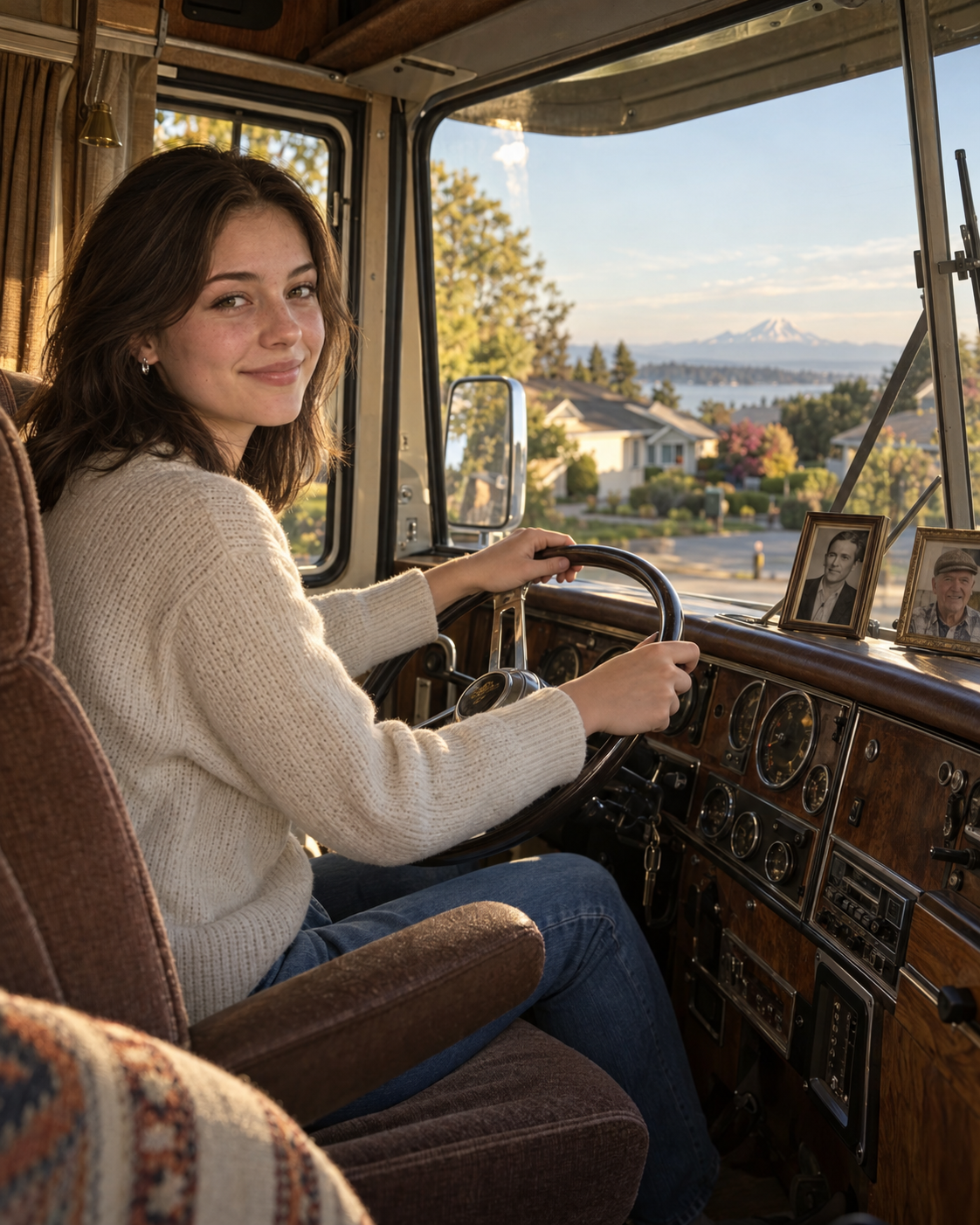
One evening, Hazel sat alone behind the wheel with the windows open.
The Tacoma air smelled faintly of rain and cedar.
On the dashboard was a photograph of her father.
Beside it was another of Arthur, grinning into the sun with one hand raised as if he had just told a joke nobody else understood.
Hazel turned the key.
For a second, the engine coughed.
Then it came alive.
The old bus shook beneath her.
Hazel smiled.
She rested both hands on the wheel and looked through the windshield.
She had once thought the bus was the thing her grandfather had left behind when he died.
She understood now that she had been looking at it backward.
He hadn’t left her a fortune.
He hadn’t left her a perfect escape.
He had left her something harder and more useful.
A door.
She just had to be brave enough to open it.