The Job He Thought Was Beneath Him
Daniel Mercer was twenty-four when he turned down the job he had spent three weeks trying to get.
He had rehearsed for the interview in his bedroom mirror, polished his only good pair of shoes, and borrowed his older brother’s blue sedan to drive nearly an hour to Riverton, a growing town where Mercer & Sons Distribution had recently expanded.
By the time Daniel stepped into the warehouse that morning, he had already imagined himself walking out with a supervisor’s title.
Instead, Edward Mercer, the company’s owner, offered him an entry-level position in shipping and inventory.
Daniel stared at him.
“You’d be starting on the floor,” Edward said. “Loading, receiving, counting inventory, learning the system.”
“I applied for operations management.”
“I know.”
Daniel glanced through the office window at the warehouse below. Men and women in safety vests moved pallets with forklifts. Boxes climbed toward the ceiling. Someone shouted a loading number across the floor.
“I’m capable of more than that,” Daniel said.
Edward leaned back in his chair.
“Probably.”
Daniel was surprised by the answer.
“Then why put me there?”
“Because being capable of something isn’t the same as being ready for it.”
Daniel left the office angry.
His father, Samuel, had said almost the same thing for years.
Samuel was a carpenter who had spent most of his life repairing porches, building kitchen cabinets, and fixing things other people had decided were no longer worth saving. He believed good work took time, and he had a habit of making simple observations sound like rules carved into stone.
A week before Daniel’s interview, while sanding the edge of a dining table, Samuel had told him, “A river doesn’t reach the ocean by rushing. It gets there by continuing.”
Daniel had laughed.
“That sounds nice, Dad. It also sounds like something people say when they don’t want to admit they’re stuck.”
Samuel had looked at him over the top of his glasses.
“You’ll understand eventually.”
Now, standing in a warehouse he considered a temporary inconvenience, Daniel remembered those words and immediately pushed them away.
He accepted the job anyway.
The first few days went badly.
Daniel hated the early mornings. He hated the dust that settled on his sleeves. He hated double-checking shipment numbers when he believed he should have been making decisions instead.
On Friday afternoon, Edward found him in the loading area.
“You’re rushing,” Edward said.
“I’m trying to finish.”
“That’s not the same thing.”
Daniel exhaled.
“I know how to work hard.”
“I didn’t say you didn’t.”
“Then what’s the problem?”
Edward pointed toward a pallet Daniel had just wrapped.
“Come here.”
Daniel followed him.
Edward pulled one loose corner of the plastic wrap.
“See that?”
“A loose section?”
“Your shortcut. You wrapped it twice instead of checking whether the boxes were balanced. That means the pallet may shift during transport.”
Daniel stared at it.
“So I fix it.”
“Yes.”
Edward walked away.
Daniel stood there, irritated but silent.
That evening, he stayed late.
He rebuilt the pallet.
He checked the labels.
Then he checked them again.
It was the first small thing he did well without being told.
He didn’t know it yet, but that mattered.

The Box in the Garden
Three weeks into the job, Daniel was still waiting for something to happen.
He arrived early.
He worked hard.
He learned quickly.
Yet every Friday, when Edward reviewed staffing assignments, Daniel saw his name exactly where it had been the week before.
Still on the warehouse floor.
Still counting.
Still learning.
Still waiting.
One rainy Tuesday, Edward called him into the office.
Daniel expected criticism.
Instead, Edward handed him a small wooden box.
“What is this?”
“Open it.”
Inside was a single seed.
Daniel looked up.
“That’s it?”
“That’s it.”
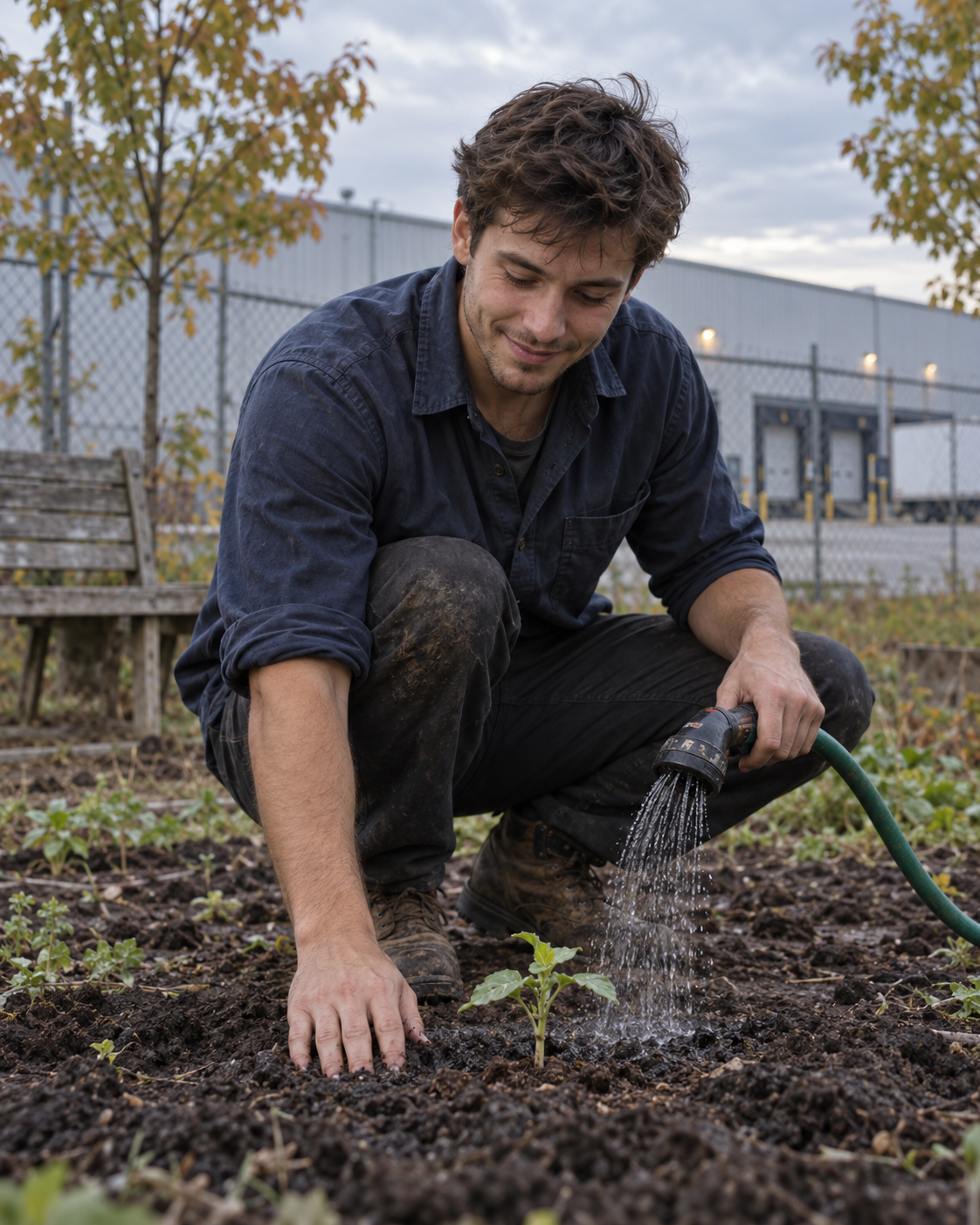
Edward pointed through the office window toward a narrow patch of grass behind the warehouse. Beyond the loading docks sat an old garden that had probably belonged to the property’s previous owner. It had a few weathered flower beds, two young maple trees, and a wooden bench with peeling paint.
“Plant it there,” Edward said. “Water it every morning.”
Daniel frowned.
“For how long?”
“Until it grows.”
Daniel almost smiled.
“Seriously?”
“Seriously.”
“Am I being punished?”
“No.”
“Then what’s the point?”
Edward folded his hands on the desk.
“Do the job.”
Daniel carried the box outside.
The rain had stopped, leaving everything wet and dark. He knelt in the soft soil, pressed the seed beneath the surface, covered it, and poured water over the spot.
He stood.
Nothing happened.
He looked down at the dirt.
“Great,” he muttered.
The next morning, he watered it.
Nothing.
The next morning, the same.
After seven days, the patch of soil looked exactly as it had before.
At lunch, one of Daniel’s coworkers, Marcus, caught him walking back from the garden.
“You really doing that every day?”
“Apparently.”
Marcus laughed.
“What’d you do to deserve gardening duty?”
“Nothing.”
“That’s worse.”
Daniel laughed despite himself.
By the second week, he had started checking the ground before anyone asked.
By the third week, he knew which parts of the garden stayed damp after rain.
He noticed that the fence blocked sunlight in the afternoon.
He noticed that the soil near the old bench was firmer than the rest.
He noticed ants.
He noticed worms.
He noticed how quickly the ground dried on windy mornings.
One Saturday, he caught himself thinking about whether the seed might need more sunlight.
He stopped and shook his head.
“This is ridiculous.”
But Monday morning, he moved the hose slightly closer.
At work, something else was changing too.
Daniel began asking questions.
Not the kind he had asked at first—questions designed to prove he already knew the answer.
Real questions.
Why did some customers receive partial shipments?
Why were returns taking so long to process?
Why did certain products sit in the back for months?
Why did the inventory software sometimes disagree with the handwritten receiving logs?
An older employee named Linda showed him how the warehouse really worked.
She had been there for eleven years and knew which suppliers were reliable, which drivers tended to arrive late, and which customers changed orders at the last minute.
Daniel started listening.
That was new.
He also began seeing the connection between small mistakes and expensive consequences.
One wrong number could delay a shipment.
One missed email could create a week of confusion.
One rushed decision could force ten people to clean up the mess.
The warehouse no longer looked like a place where Daniel was being held back.
It looked like a place where he was learning how everything fit together.
Still, the seed did not grow.
On the forty-second morning, Daniel stood over the patch of soil longer than usual.
He looked around to make sure no one was watching.
Then he crouched down.
Maybe it was dead.
Maybe it had rotted.
Maybe Edward had forgotten about it.
Daniel pushed his fingers into the soil.
He could dig it up in ten seconds.
He could prove once and for all that nothing was happening.
His hand hovered.
Then he pulled it back.
He remembered the exact words.
Don’t dig it up to see whether it’s growing.
Daniel stood.
For once, he let himself not know.
The Green Shoot
The breakthrough came on a cold morning in late May.
Daniel arrived before sunrise.
The parking lot was nearly empty, and the air smelled like wet pavement after overnight rain.
He walked toward the garden carrying the hose.
At first, he saw nothing.
Then he noticed a tiny curve of green breaking through the soil.
He stopped.
His hand tightened around the hose.
Daniel crouched.
There it was.
A single delicate shoot, no taller than the first joint of his thumb.
He stared at it with an expression so soft that, if someone had asked him what he was feeling, he probably would have struggled to explain.
For nearly two months, nothing had appeared.
Yet the seed had not been doing nothing.
It had been doing the part of its work Daniel could not see.
He smiled.
Then he laughed once under his breath.
“You stubborn little thing.”
At seven fifteen, Daniel walked into Edward’s office.
“It’s growing.”
Edward looked up from his computer.
“What is?”
“The seed.”
Edward smiled.
“I assumed you’d tell me eventually.”
Daniel sat down.
“Why did you make me do that?”
Edward nodded toward the office door.
“Come with me.”
They walked to the garden.
Edward crouched beside the shoot.
“A plant spends a lot of time underground before it gives you anything to look at,” he said.
Daniel nodded.
Edward turned toward him.
“People do too.”
Daniel didn’t answer.
“You’ve been frustrated because you thought the lack of a promotion meant nothing was happening.”
Daniel looked toward the warehouse.
“I guess I did.”
“But I watched you learn.”
Daniel looked at him.
“You noticed how receiving works. You learned the customers. You fixed the pallet problem without being told. You stopped blaming other people when a mistake happened.”
Edward stood.
“You’ve changed.”
Daniel looked back at the tiny green shoot.
For the first time, the word waiting didn’t feel like an insult.
It felt like work.
That week, Edward made Daniel a team lead.
It wasn’t the promotion Daniel had once imagined.
It came with more responsibility, more paperwork, and a modest raise.
But something was different.
Daniel didn’t stare at the title.
He stared at the work.
He arrived early.
He asked for input.
He taught new employees what Linda had taught him.
When someone made a mistake, he didn’t immediately assume they were careless.
He asked what had happened.
The warehouse became more efficient over the next several months.
Orders went out faster.
Errors dropped.
Returns were handled more cleanly.
Daniel still wanted more.
But now he understood that wanting more and being ready for more were two different things.
The Storm
That winter, Daniel had almost forgotten how impatient he used to be.
Almost.
The lesson was tested on a Tuesday in January.
A major storm rolled across the region, closing roads and slowing freight traffic. One of the company’s largest shipments was stranded two states away.
Three customers had urgent orders tied to construction projects.
Their deadlines were fixed.
The phones started ringing before ten in the morning.
By noon, everyone was talking at once.
“We should split the shipment.”
“That truck is not making it through.”
“Call another carrier.”
“They’re all booked.”
Daniel stood at the center of the shipping floor listening.
A younger supervisor suggested sending whatever goods were available immediately, even though the paperwork was incomplete.
“That’ll create a bigger problem,” Daniel said.
“We need to do something.”
“We are.”
Daniel went to the office and pulled the previous six months of shipping records.
He looked at customer patterns.
He called Linda.
He called two drivers.
He called the freight broker.
Then he started calling customers himself.
The first conversation was difficult.
The customer was angry.
“I don’t care whose fault it is,” the man said. “My crew is waiting.”
“I understand,” Daniel replied. “I can’t promise the original delivery time. But I can promise I’ll give you an honest update every two hours, and I have another option I want to discuss.”
Daniel rearranged available inventory between three locations.
He found a smaller carrier willing to make a partial run once the roads reopened.
He contacted another customer who could tolerate a one-day delay and negotiated a revised shipment.
By evening, the panic had settled into a plan.
It wasn’t perfect.
It wasn’t fast.
But it worked.
No one lost a major account.
No one made an expensive decision just because they were afraid of falling behind.
Late that night, after most employees had gone home, Daniel was standing over a revised delivery schedule when Edward walked into the office.
“You handled it well.”
Daniel leaned back.
“I was scared.”
“Good.”
Daniel smiled.
Edward picked up the schedule.
“You used to think being in charge meant moving faster than everyone else.”
Daniel looked toward the dark warehouse.
“I know.”
“What do you think now?”
Daniel considered it.
“Maybe it’s knowing when not to rush.”
Edward nodded.
“Now you’re ready.”
The promotion came the following month.
Operations manager.
This time, Daniel didn’t celebrate by buying a new watch or telling everyone he had finally made it.
He went home, called his father, and said, “I got it.”
Samuel was quiet for a second.
“Got what?”
“The manager position.”
“About time.”
Daniel laughed.
“You could at least pretend to be surprised.”
“I knew you were going to get there.”
“How?”
Samuel’s voice softened.
“Because you finally stopped measuring every day by what you had to show for it.”
Daniel sat on the edge of his bed.
For once, he had no argument.
Years later, the little seed had become part of a much larger story than either man expected.
What Had Been Growing All Along
Daniel eventually left the company and started a distribution business of his own.
He became successful.
Not overnight.
Not even quickly.
There were years when the business barely broke even.
There were months when a major contract fell through.
There were hiring mistakes, equipment failures, long nights, and mornings when Daniel wondered whether he had mistaken persistence for stubbornness.
But he learned to tell the difference.
He stopped asking, Why isn’t this happening yet?
He started asking, What should I be building while I wait?
When his own employees became frustrated by slow promotions or projects that seemed stuck, Daniel never gave them speeches.
He took them to the garden behind the old warehouse.
The little seedling had grown into a young tree.
He would stand beside it and let them look.
Then he’d say, “I don’t know when your opportunity will come.”
Sometimes that disappointed them.
Sometimes it made them angry.
But he never promised shortcuts.
He understood too well what shortcuts cost.
One spring, after nearly fifteen years had passed, Daniel drove back to his hometown.
His father was sitting outside the old workshop, repairing the handle of a hand plane.
Daniel parked his truck and walked up the gravel driveway.
Samuel looked up.
“You’re getting older.”
“So are you.”
“Cheeky.”
They laughed.
Inside the workshop, the familiar smell of sawdust filled the air. Daniel noticed the same wooden workbench he had seen as a boy. The same dented coffee mug sat beside a stack of sandpaper.
They talked for an hour.
Eventually, Daniel told his father about the seed.
Samuel smiled.
“So Edward finally found a way to explain it to you.”
Daniel laughed.
“I guess he did.”
Samuel went back to sanding.
“You were always in a hurry.”
“I know.”
“You thought everybody who slowed you down was against you.”
Daniel looked toward the open workshop door.
“I thought delays meant I was failing.”
Samuel nodded.
“And now?”
Daniel was quiet.
Across the yard, late-afternoon sunlight moved slowly across the grass.
“I think some things were happening before I had any proof,” he said.
Samuel stopped sanding.
Daniel continued.
“I just couldn’t see them yet.”
His father didn’t answer.
He didn’t need to.
They sat together while the light shifted and birds moved through the trees beyond the property.
Daniel looked at his hands.
They were different from the hands he’d had at twenty-four.
There were small scars along his fingers, a faint callus near his thumb, and the subtle marks of years spent working instead of merely planning to work.
He thought about that first tiny shoot.
How small it had been.
How easy it would have been to dismiss.
He had spent much of his early life believing progress had to be visible to count.
The truth had been waiting beneath the surface.
On the drive home, Daniel stopped at a garden center.
He bought a packet of seeds.
That evening, he planted them in the narrow strip of soil beside his porch.
His daughter watched from the steps.
“How long until they grow?”
Daniel smiled.
“I don’t know.”
She frowned.
“Can you check?”
“Not yet.”
“Why?”
Daniel pressed the last bit of soil gently over the seeds.
“Because some things need time to work where we can’t see them.”
She thought about that.
Then she handed him the watering can.
Daniel took it.
Together, they watered the soil.
Nothing changed.
Not that evening.
Not the next morning.
But before he went inside, Daniel looked once more at the dark patch of earth.
For the first time in his life, he didn’t need it to prove anything.
He knew something could be happening there without asking to be seen.
And that was enough.