The Morning Nobody Was Watching
Daniel woke before the alarm because hunger had become better at keeping time than any clock.
The house was still dark. In the kitchen, a refrigerator clicked and went quiet again. His father, Marcus, was already dressed for work, sitting at the table with both hands wrapped around a mug of coffee that had gone lukewarm.
“You’re up early,” Marcus said.
Daniel shrugged. “Got a test.”
“You studied?”
“All night.”
Marcus looked at him for a moment. Daniel was sixteen, thin from years of stretched groceries and growing too fast, with dark hair he never had time to keep neat. His school shirt had been washed so many times that the collar had gone soft. One of his sneakers had a crack along the side.
Marcus glanced down at it.
“I’ll take a look at that when I get home.”
Daniel smiled. “It’s okay.”
His father didn’t argue. They both knew what “okay” meant in their house.
Outside, the September air was cold enough to wake him completely. Daniel pulled his backpack over one shoulder and started walking.
It was nearly three miles to Jefferson High School, mostly along a narrow road without sidewalks. He knew every broken patch of pavement, every house with a barking dog, every corner where the morning buses hissed past him.
He could have taken the bus if his family had the money for the transportation fee.
So he walked.
By the time he reached school, his socks were damp from the morning grass. He slipped into his classroom just before the bell.
That morning, his teacher, Ms. Reynolds, wrote one question across the whiteboard.
What do you want to be when you grow up?
The answers came easily.
“Doctor.”
“Engineer.”
“Teacher.”
“Professional athlete.”
Ms. Reynolds pointed toward Daniel.
“What about you?”
He stood.
There was a pause.
“I want to be successful,” he said. “Not just for me. I want to make sure my family doesn’t have to worry about money anymore.”
A few students laughed.
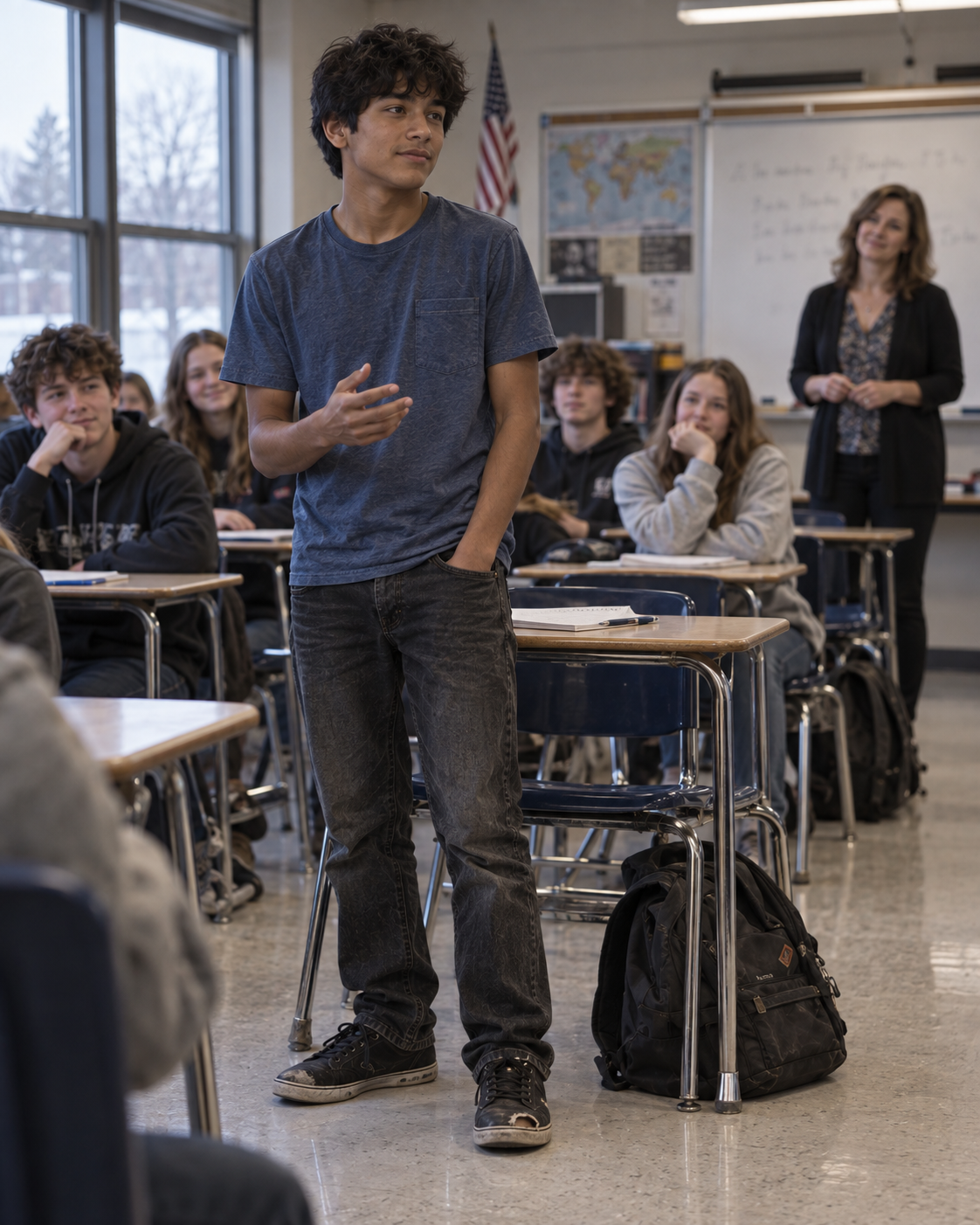
Then a boy in the back looked at Daniel’s shoes.
“You want to be successful?” he said. “Maybe start with buying yourself a pair of shoes.”
More laughter.
Daniel looked down at the cracked sneaker, then back at the class.
His face felt hot, but he didn’t sit down.
“Maybe I will,” he said.
He paused.
“But when I do, I’m going to remember what it felt like not to have them.”
When Daniel sat down, Ms. Reynolds continued the lesson.
But she watched him for the rest of the period.
At lunch, she caught him before he left the room.
“You meant that, didn’t you?”
Daniel nodded.
“You really want to change your family’s life?”
“Yes, ma’am.”
“Then don’t make the mistake of thinking success is one big moment.” She handed him a paperback book from her desk. “It’s usually a thousand small ones nobody sees.”
Daniel took the book.
He never forgot that.
The Years That Added Up
After school, Daniel worked beside his father whenever there was work to do.
Marcus repaired appliances, installed ceiling fans, hauled broken washers out of basements, and did whatever else neighbors were willing to pay him for. Some weeks he came home exhausted with barely enough money to cover groceries and the electric bill.
Daniel learned quickly that hard work did not automatically make life easier.
Sometimes it simply kept life from becoming impossible.
At night, Daniel studied at the kitchen table beneath a lamp with a crooked shade. His mother, Elena, would leave a bowl of rice and beans beside him and tell him to stop pretending he wasn’t hungry.
“You can’t study on an empty stomach,” she said.
“We don’t have much.”
“We have enough for you.”
He knew that was not always true.
One winter night, the heat went out.
The family gathered in the living room wearing coats and wrapped in blankets while Marcus waited for a repair technician he couldn’t afford.
Daniel kept his textbook open in his lap.
Elena watched him shiver.
“Go to bed.”
“I have an exam.”
“You need sleep.”
“I need a better grade.”
She smiled.
“You think the grade is going to save you?”
Daniel looked up.
“No.”
“What will?”
He thought about it.
“Me.”
Elena nodded slowly.
“Good answer.”
He graduated near the top of his class.
Then came the first problem he could not solve with determination alone.
College.
The tuition letter sat on the kitchen table for three days.
Daniel stared at it every night.
The numbers looked impossible.
Marcus sat across from him.
“We’ll figure something out.”
Daniel shook his head.
“With what?”
Marcus was silent.
Daniel looked down at his hands.
“I think I should just work.”
His father leaned back.
“Work where?”
“Anywhere.”
“That isn’t the same thing as having a future.”
Daniel laughed once, without humor.
“Future seems expensive.”
That night, after everyone went to bed, Daniel filled out scholarship applications until two in the morning.
Weeks passed.
Then an envelope arrived.
He opened it standing beside the front door.
He read the first paragraph twice.
Full scholarship.
Tuition covered.
A small housing stipend.
Daniel sat down hard on the stairs.
His mother came running from the kitchen.
“What happened?”
He handed her the letter.
She read it.
Then she covered her mouth.
Marcus came over, took the paper from her, and read it in silence.
Daniel looked at both of them.
“Well?”
Marcus smiled.
“We’re going to have to get used to calling you a college student.”
Daniel laughed.
Then he cried.
Nobody made a big speech.
Marcus simply pulled him into a hug.
For the first time, Daniel let himself believe the road ahead might actually lead somewhere.
The Part Nobody Saw
College was not the escape Daniel had imagined.
It was another kind of struggle.
He worked evenings at a grocery store and weekends unloading delivery trucks. He ate cheap meals. He learned to sleep with noise around him. He borrowed textbooks whenever he could and spent long hours in the library because it was warm and free.
His classmates talked about internships and networking.
Daniel talked about rent.
Still, he kept learning.
He became fascinated with small businesses, especially the ones that could not afford expensive software or consultants.
One afternoon, a neighborhood mechanic complained to him about losing customers because appointments were constantly getting mixed up.
Daniel spent a weekend building a simple scheduling system.
“It’s nothing,” Daniel said when the mechanic thanked him.
“It isn’t nothing to me,” the man replied.
That sentence stayed with Daniel.
After graduation, Daniel got a modest job at a technology company. He was grateful for the paycheck, but he wanted to build something of his own.
He started a small software business at his kitchen table.
The first year was brutal.
One client backed out.
Another never paid.
A third told him his product was useless.
Daniel once stared at his bank account for so long that his phone went dark.
He nearly quit.
He called Elena.
“Mom?”
“Yes?”
“I think I made a mistake.”
There was a long silence.
“Do you want me to tell you that you didn’t?”
Daniel smiled faintly.
“No.”
“Good,” she said. “Because maybe you did. But a mistake isn’t the same as a dead end.”
He closed his eyes.
She continued.
“You’re allowed to change how you get there. Just don’t confuse changing the plan with giving up on yourself.”
The next morning, Daniel went back to work.
He changed the product.
He listened to customers.
He learned how to sell.
He hired one person.
Then another.
Five years later, his company employed twenty-three people.
Ten years later, it was several hundred.
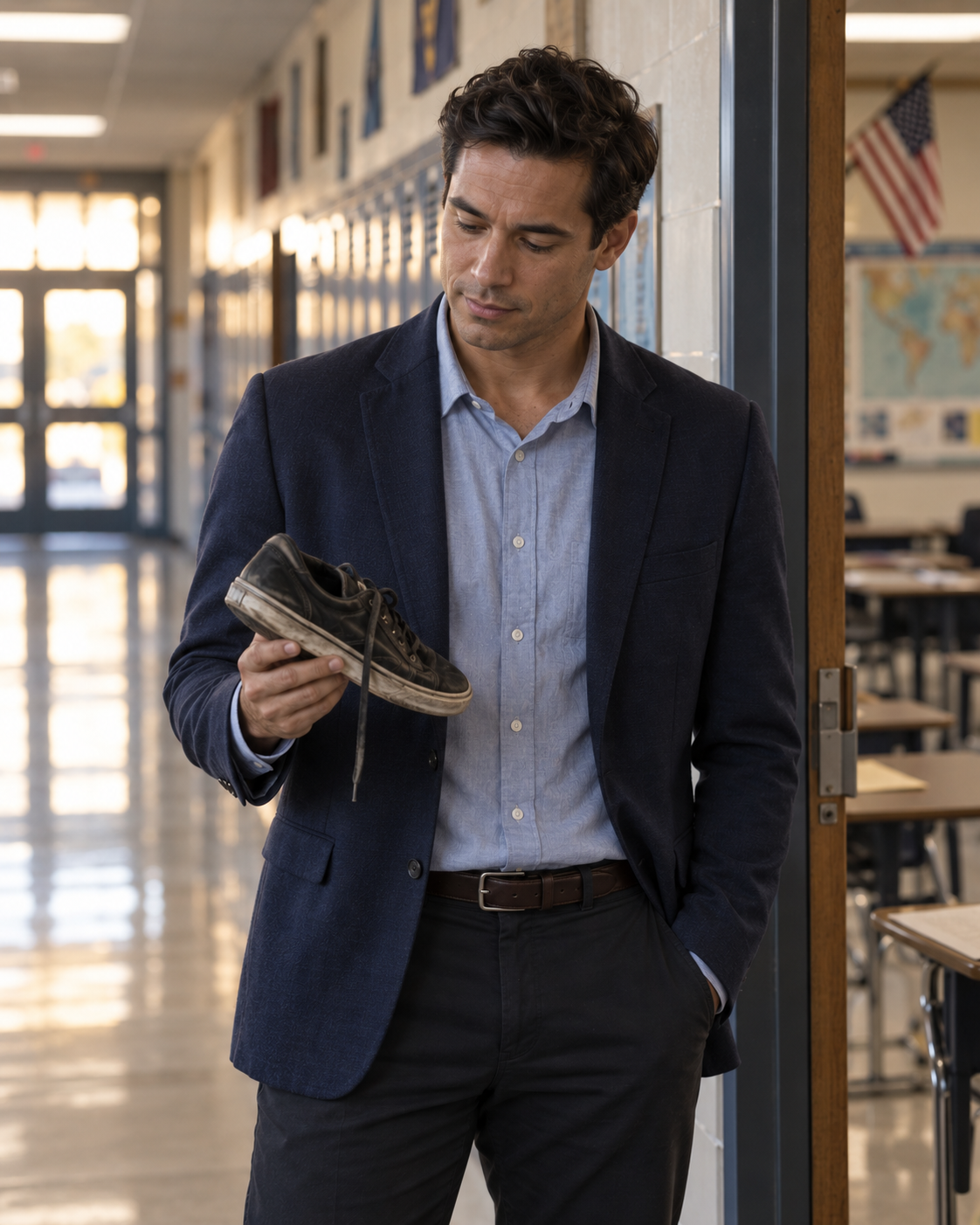
Daniel never became the kind of businessman who forgot his beginnings. His office was comfortable, but he still kept an old cracked sneaker in a box in his desk drawer.
He had carried it with him for years.
He couldn’t explain exactly why.
He simply wasn’t ready to throw it away.
The House He Refused to Forget
When Daniel finally bought his parents a house, Elena walked through every room twice.
“You realize we don’t need this many bedrooms,” she said.
Marcus opened the garage.
There was a new pickup truck inside with his name on the paperwork.
He stared at it.
“Daniel.”
“I know.”
“You didn’t have to.”
“I know that too.”
Marcus looked down at the keys in his hand.
“You remember when I told you I’d fix your shoe?”
Daniel laughed.
“You never did.”
“I was going to.”
“Sure.”
“I was.”
They stood there smiling.
Marcus finally said, “I wish I had.”
Daniel looked at him.
“You gave me a lot more than shoes.”
His father looked away.
For a moment, neither of them spoke.
The old house was eventually sold.
Daniel thought he would feel relieved.
Instead, the first time he drove past it after the sale, he slowed down.
The windows were dusty.
The porch leaned slightly to one side.
The front steps were the same ones he had climbed every day after school.
He remembered his mother cooking dinner there.
His father’s work boots by the door.
His own backpack on the floor.
So many years of wanting to escape that little house.
Now he missed it.
Not because he wanted to go back.
Because he understood what had happened there.
They had been poor.
But they had not been empty.
The Classroom Again
Years later, Daniel returned to Jefferson High School.
Ms. Reynolds had retired, but the principal still remembered him.
They invited him to speak to a room full of students.
Daniel stood at the front of the same kind of classroom where he had once been the boy everyone laughed at.
He had expected to feel proud.
Instead, he felt strangely nervous.
A student in the second row raised her hand.
“Were you always confident?”
Daniel laughed.
“No.”
“Then how did you do it?”
He looked around the room.
He thought of the cracked shoe.
The kitchen lamp.
The scholarship letter.
The grocery store.
The first failed business deal.
His mother’s advice.
His father’s silence.
“I didn’t,” he said.
The students waited.
“I wasn’t confident all the time. I was tired a lot. I was scared a lot. I made bad decisions. I wanted to quit.”
A boy near the window leaned forward.
“So what kept you going?”
Daniel considered his answer.
“I got very good at doing the next thing.”
Nobody laughed.
Daniel smiled.
“You don’t have to know how your whole life is going to turn out. You just have to be willing to take the next step when you don’t.”
After the talk, Daniel walked alone through the nearly empty hallway.
The floors had been replaced.
The lockers were newer.
The classroom walls had been painted.
But when he reached the front doors, he stopped.
Outside, a group of students were crossing the parking lot.
One boy was carrying a backpack with a torn strap.
Daniel watched him adjust it and keep walking.
He reached into his coat pocket and touched the small metal key to his parents’ house.
Then he thought about the shoe in his desk drawer.
He smiled.
Not because he had finally proved the boy in that classroom wrong.
That no longer mattered.
What mattered was that the boy with the broken shoes had kept moving long enough to become someone who could open doors for others.
Daniel pushed the school door open and stepped into the evening.
For years, he had believed success meant finally getting far enough away from where he started.
Now he understood something different.
Sometimes success was coming back without shame—and realizing you had never needed to be ashamed in the first place.
What He Carried Forward
That evening, Daniel drove home instead of going out to celebrate.
He parked outside his parents’ house and sat in the car for a minute.
The porch light was on.
Through the front window, he could see Elena moving around the kitchen and Marcus sitting at the table reading the newspaper.
Daniel looked at his hands on the steering wheel.
Then he smiled.
He thought about everything he had once been embarrassed by.
The old clothes.
The long walk to school.
The cheap meals.
The nights when the heat didn’t work.
The classmates who laughed.
None of those things had disappeared.
They had simply become part of the road.
Daniel opened the door and stepped out.
Inside, his mother called from the kitchen.
“Is that you?”
“Yeah.”
“You’re late.”
“I know.”
“You hungry?”
Daniel smiled as he closed the door behind him.
“Yeah, Mom.”
He walked toward the kitchen.
For all the years he had spent chasing a different life, there was something comforting about hearing that question again.
You hungry?
There was something even better about knowing the answer could finally be yes without anyone worrying whether there was enough.
And in the drawer beside his desk, thousands of miles from that old classroom and years beyond that cold morning walk, a cracked black sneaker remained where Daniel had kept it all along.
Not as proof that he had escaped.
As proof that he had started.