The Apartment That Was Always Too Quiet
At 6:17 every morning, Robert Hale woke before his alarm.
He would lie still for a few seconds, staring at the ceiling of his one-bedroom apartment, waiting for the familiar sounds that had once started every day of his life.
A kettle.
A cabinet closing.
Someone calling from another room.
Nothing came.
Robert reached for the alarm and shut it off before it could ring.
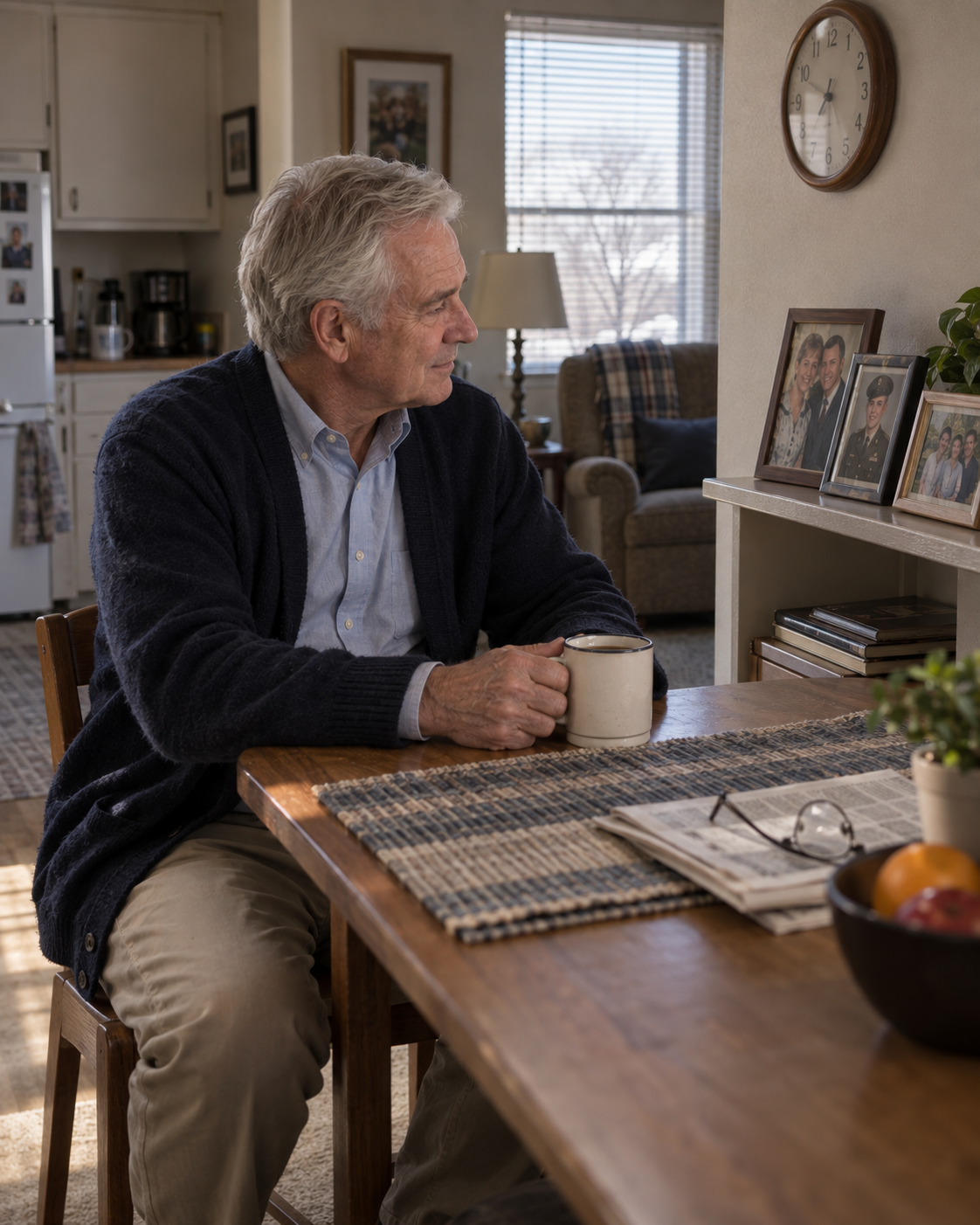
The apartment was clean in the way a hotel room was clean. His shoes sat beneath the bench by the door. The mail was stacked neatly on the counter. Three framed photographs stood on the same shelf they had occupied for years, all slightly faded by the afternoon sun.
In one, Robert was thirty-eight, grinning beside his wife, Linda, at a Fourth of July cookout.
In another, their daughter, Megan, was eight years old and missing both front teeth.
The third showed Megan at college graduation, standing between her parents in a black cap and gown.
Robert looked at that one every morning.
Then he made coffee for one.
Linda had been gone for four years.
Megan lived in Denver, where she had a demanding job, a small apartment of her own, and a life that moved at a speed Robert could no longer follow. She called every Sunday.
Usually.
Sometimes Monday.
Robert never mentioned the difference.
After retiring from thirty-two years as a postal carrier, he had expected retirement to feel like freedom. Instead, the days stretched strangely. He had discovered that a job could give a person more than a paycheck. It could give the day its shape.
Now Tuesday looked a lot like Thursday.
He began finding reasons to leave the apartment.
He bought bananas when he still had seven at home. He wandered through the hardware store without needing anything. He went to the grocery store at four in the afternoon because it was busy then.
Once, a cashier named Tasha asked, “How’s your day going?”
Robert smiled.
“Can’t complain.”
She started scanning the next customer’s groceries.
For some reason, Robert wanted to tell her about the rain that morning, how it had smelled like wet pavement and leaves outside his window.
Instead, he moved his cart forward.
That night he sat in his recliner with the television on low.
At nine, he muted it.
At ten, he turned it off.
The silence returned immediately.
Robert looked toward the kitchen.
For one brief second, he could almost hear Linda saying, “You’re going to fall asleep in that chair again.”
He smiled before he realized there was no one there.
Then he rubbed both hands over his face.
The Bench in the Cold
On Saturday afternoon, Robert drove to Willow Creek Park.
It was ten degrees warmer than the day before, which was enough to bring a few people outside.
He took his usual place on a bench near the walking path.
A father in a red knit hat chased a toddler across the grass.
Two teenagers shared a pair of headphones.
A woman around Robert’s age scattered birdseed near the pond.
She wore a tan coat and red gloves. She moved slowly, bending at the waist as she sprinkled the seed.
The birds gathered around her shoes.
Robert watched for a while.
Then the woman glanced at him.
“You’re not feeding them,” she said.
Robert looked down at his empty hands.
“No.”
She nodded toward the birds.
“They don’t seem to mind.”
Robert laughed softly.
“No, I guess they don’t.”
The woman sat at the opposite end of the bench.
For several minutes, neither spoke.
Robert found that he liked the silence beside another person more than the silence of his apartment.
“My name’s Evelyn,” she said eventually.
“Robert.”
“You come here often?”
“Sometimes.”
That was how it started.
Not with a grand revelation. Not with a dramatic rescue.
Just two strangers sitting on a cold bench.
Over the next few weeks, Robert began seeing Evelyn every Saturday.
He learned that she had been widowed six years earlier. She had a son in Arizona and a granddaughter she saw twice a year.
He learned that she hated grocery shopping, loved old detective shows, and carried birdseed in a plastic container inside her purse.
Evelyn learned that Robert had worked for the post office, that he once drove through a blizzard to deliver a birthday card because he knew how much it mattered to the recipient, and that his daughter had moved across the country.
“You sound proud of her,” Evelyn said one afternoon.
“I am.”
“But?”
Robert stared at the pond.
“But I miss being needed.”
Evelyn did not rush to answer.
Instead, she opened her purse and poured birdseed into his palm.
“Then start where somebody needs something small.”
Robert looked at her.
“What does that mean?”
“You’ll figure it out.”
The following Monday, Robert saw a flyer at the public library.
VOLUNTEERS NEEDED.
The library needed people to help children with reading.
Robert almost walked past it.
He had never taught anyone anything.
He had spent his working life delivering things, not explaining them.
Still, he took a flyer.
Three days later, he showed up.
A librarian named Carla handed him a stack of easy-reader books and introduced him to a nine-year-old boy named Marcus.
Marcus sat across from Robert with his elbows on the table.
“I don’t like reading,” the boy announced.
Robert nodded seriously.
“That’s okay.”
“You like it?”
“Some of it.”
Marcus narrowed his eyes.
“What kind?”
“Anything with a map.”
That got his attention.
They found a book about national parks.
Marcus read slowly. He stopped often.
Robert never corrected him too quickly.
When Marcus finished the first page, he looked up.
“I did it.”
“You did.”
The boy grinned.
Robert noticed something strange on the drive home.
He was smiling, too.
The Call He Nearly Didn’t Make
That evening, Robert found an old photograph in a kitchen drawer.
It was from 2004.
Megan was thirteen, standing in the driveway beside a beat-up bicycle she had just learned to ride without training wheels.
Linda was laughing in the background.
Robert remembered the afternoon perfectly.
Megan had fallen twice.
She had scraped her knee.
She had cried.
Then, on the third try, she had taken off down the driveway.
Robert had chased after her even though she kept yelling, “Dad, stop!”
He sat at the kitchen table with the photograph in his hand.
Then he picked up his phone.
Megan answered on the fourth ring.
“Hey, Dad.”
“Hi, honey.”
Her voice sounded tired.
“Everything okay?”
Robert almost said yes.
Instead, he said, “I started volunteering at the library.”
There was a pause.
“That sounds nice.”
“It is.”
“You actually like it?”
“I do.”
He could hear typing in the background.
“What else?”
Robert looked at the photograph.
“I’ve been thinking about you.”
Another pause.
“I think about you all the time, Dad.”
“I know.”
He swallowed.
“I just didn’t want to make you feel guilty for being busy.”
The typing stopped.
“I don’t feel guilty.”
“You don’t have to.”
“Dad.”
“I mean it.”
He looked toward the dark living room.
“I don’t need you to fix my life. I just wanted you to know I miss you.”
Megan was quiet for so long that Robert thought the call had dropped.
Then she said, “I miss you too.”
Her voice cracked on the last word.
Robert closed his eyes.
“I should’ve told you that sooner,” he said.
“Me too.”
They stayed on the phone for nearly an hour.
Not every minute was profound.
They talked about her boss. His neighbor’s barking dog. A restaurant near her apartment. A broken kitchen faucet.
Ordinary things.
Robert realized how much he had missed ordinary things.
Before hanging up, Megan said, “Can I come next month?”
Robert smiled.
“I’d like that.”
After the call, the apartment was still quiet.
But it no longer felt like the silence was waiting for him.
The Day Robert Wasn’t on the Bench
One Saturday, Evelyn did not show up.
Robert waited twenty minutes.
Then forty.
He told himself she might have slept late.
The next Saturday, she wasn’t there either.
Robert called the park office and learned nothing.
He checked the bench the following Tuesday.
Empty.
On Wednesday, he called the local senior center.
No Evelyn.
By Friday, worry had taken over.
Robert finally drove to the apartment building Evelyn had once mentioned casually.
He stood outside for several minutes before knocking.
An older man answered.
“Yes?”
“I’m Robert. I know Evelyn.”
The man’s expression softened.
“I’m her son, Daniel.”
Robert’s stomach tightened.
“Is she okay?”
Daniel opened the door wider.
“She had a stroke two weeks ago.”
Robert gripped the doorframe.
“She survived. She’s in rehab now.”
He exhaled.
“I didn’t know.”
Daniel studied him.
“You must be Robert.”
Robert nodded.
“She talks about you.”
That surprised him.
“She does?”
Daniel smiled.
“She says you always sit on the left side of the bench because you like being able to see the whole pond.”
Robert laughed quietly.
“I didn’t know she noticed.”
“She noticed everything.”
Before Robert left, Daniel gave him the name of the rehabilitation center.
Robert visited the next afternoon.
Evelyn looked smaller in the hospital bed, her silver hair brushed neatly away from her face.
When she saw him, she smiled.
“You took your time.”
Robert pulled a chair beside the bed.
“You were supposed to be at the park.”
“I had a scheduling conflict.”
He laughed.
For a while they said nothing.
Then Evelyn looked at him.
“Are you still volunteering?”
“Every Wednesday.”
“Good.”
“You were right.”
“About what?”
“That somebody needs something small.”
Evelyn smiled.
“I usually am.”
Robert laughed again.
Then she reached for his hand.
Her fingers felt cool and surprisingly strong.
“Robert,” she said, “don’t go back to disappearing.”
He looked at her.
“I won’t.”
She squeezed his hand once.
“Good.”

The Table by the Window
Evelyn spent two months in rehabilitation.
Robert visited every Thursday.
Megan came in March, just as promised.
She arrived carrying an overnight bag and a cardboard box filled with pastries from a bakery she insisted was worth the twenty-minute drive.
Robert met her at the airport.
For a moment they simply stood there.
Then Megan hugged him.
Robert held on longer than usual.
“You look thinner,” she said.
“You look tired.”
“I am tired.”
“Good.”
She laughed.
“Good?”
“Means you came.”
At home, Megan noticed the changes.
The refrigerator now had a small weekly calendar.
There were library flyers on the counter.
A child’s drawing of a mountain sat beneath a magnet on the refrigerator door.
“What is that?” she asked.
“Marcus drew it.”
“Who’s Marcus?”
Robert told her.
She listened while he talked.
Not politely.
Really listened.
Megan had never heard her father speak with that much animation about something so small.
The next morning, she found a handwritten list on the kitchen table.
Robert’s Saturday plan.
Park.
Groceries.
Visit Evelyn.
Read with Marcus’s book recommendation.
Walk.
Call Megan.
Four things were ordinary.
One was impossible.
“What’s this?” Megan asked, tapping the last line.
Robert looked over.
“What?”
“Call Megan.”
He shrugged.
“It’s on the list so I don’t forget.”
She smiled.
“Dad.”
“What?”
“Leave it there.”
He did.
The Bench Was Never Empty Again
By spring, Evelyn was walking with a cane.
Not far.
Not quickly.
But on a Saturday morning, Daniel drove her back to Willow Creek Park.
Robert was already there.
So was Megan.
And Marcus, who had begged his mother to let him come because he wanted to show Robert something.
They gathered around the old bench.
Evelyn sat first.
Robert lowered himself beside her.
Megan sat on Evelyn’s other side.
Marcus stood in front of them holding a folded sheet of paper.
“I drew something,” he said.
Robert looked at the boy.
“What is it?”
“A map.”
Robert smiled.
“A map of what?”
“Here.”
Marcus opened it.
It was a rough drawing of the park, the pond, the walking path, the bench, and the library several blocks away.
At the bottom, in uneven handwriting, was a list of places.
Park.
Library.
Bakery.
Rehab.
Home.
Robert studied the drawing.
“That’s a pretty good map.”
Marcus grinned.
“I made extra copies.”
“For who?”
“You.”
Robert laughed.
Around them, people walked dogs. A jogger passed. A little girl in pink boots dropped a cracker near the pond and watched three ducks fight over it.
The park had not changed.
Robert had.
He had spent years thinking loneliness was something that happened after people left.
Now he understood it differently.
Sometimes it began when you stopped walking toward people.
He looked down the path.
Megan was talking to Evelyn.
Marcus was asking Robert whether he had ever been to Yellowstone.
Robert said yes, once, many years ago.
Marcus immediately had twenty questions.
Robert answered every one.
Later that evening, he returned home.
The apartment was still small.
The furniture was still neat.
The clock still ticked above the kitchen.
But there were more things on the refrigerator now.
Marcus’s map.
A photo Megan had taken at the park.
A reminder from the library.
A note from Evelyn that simply said, “Thursday.”
Robert stood there for a while.
Then his phone rang.
Megan.
He answered.
“Hi, Dad.”
“Hey.”
“What are you doing?”
Robert looked around the room.
For years, that question would have been difficult to answer.
Now he smiled.
“I’m making tea.”
There was a pause.
“Want to talk?”
Robert looked toward the window.
Outside, a man was walking his dog beneath the streetlamp. Somewhere in another apartment, someone laughed.
Robert filled the kettle.
“Yeah,” he said. “I do.”
And while the water began to warm, the apartment no longer sounded empty.
It sounded like a place where someone lived.