The Morning Everything Was Still Normal
At 6:10 on a warm September morning, Ryan Mercer was arguing with his coffee maker.
“You’re either broken or dramatic,” he muttered, pressing the button again.
The machine sputtered, clicked, and finally produced half a cup.
Ryan sighed, grabbed it anyway, and headed toward the kitchen table.
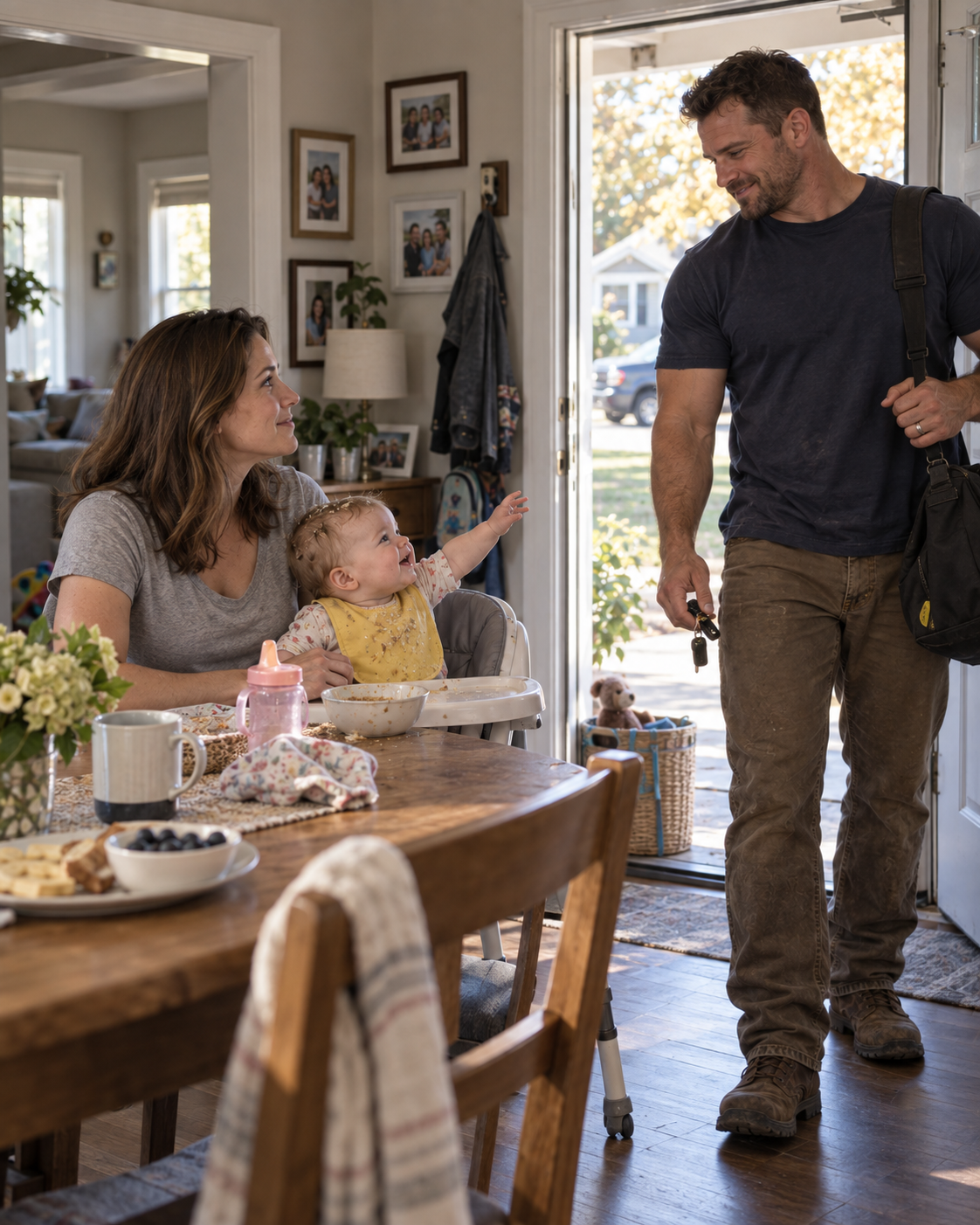
His wife, Claire, was already there, scrolling through her phone with one hand while feeding their ten-month-old daughter, Emma, with the other. Emma wore a yellow bib and had somehow gotten oatmeal into her hair.
Ryan smiled.
“How’d she even get it up there?”
Claire looked at their daughter.
“I stopped asking questions months ago.”
Ryan laughed and leaned over to kiss Emma’s forehead.
He was thirty-seven, broad-shouldered, strong from years of weight training, and the kind of man who carried grocery bags in one trip even when Claire told him not to. He worked as a commercial electrician and spent several evenings a week lifting at a neighborhood gym.
Their life wasn’t glamorous. It was better than that.
It was familiar.
They had a mortgage, a minivan with a stubborn sliding door, daycare drop-offs, laundry that seemed to reproduce overnight, and a running list of home repairs they kept promising to finish on the weekend.
Claire was a physical therapist at a rehabilitation clinic. She understood bodies for a living. She knew how muscles healed, how balance returned, how repetition could turn an impossible movement into an automatic one.
That morning, though, she had no reason to think her knowledge would become the most important thing in her life.
At breakfast, Ryan checked the time.
“I’ve got to go.”
“You said that ten minutes ago.”
“I was emotionally preparing.”
“You were staring at your coffee.”
“That’s part of the preparation.”
Claire rolled her eyes.
Ryan grabbed his keys.
He stopped at the front door and looked back at her.
“See you tonight.”
It was an ordinary sentence.
Neither of them knew how terrifying those words would become.
The Call From the Hospital
By midmorning, Claire was at work when her phone rang.
The number was unfamiliar.
She almost let it go to voicemail.
Then she answered.
“Is this Claire Mercer?”
“Yes.”
“This is St. Matthew’s Medical Center. We need you to come in immediately. Your husband was brought here by ambulance.”
For a second, Claire didn’t understand the sentence.
“Husband?”
“Ryan Mercer.”
Her chair scraped backward.
“What happened?”
There was a pause on the other end.
“He had a serious hemorrhagic stroke.”
Claire stood so quickly that her knees bumped the desk.
“How serious?”
Another pause.
“Very serious.”
She was already moving.
Later, she would remember almost nothing about the drive. Only fragments: red lights, both hands locked around the steering wheel, a gas station sign flashing in the distance, and the strange sensation that every other driver was moving much too slowly.
At the hospital, a doctor met her before she reached the intensive care unit.
Ryan had suffered bleeding in his brain. The pressure was dangerous. The medical team was working to stabilize him.
“He’s critically ill,” the doctor said carefully.
Claire stared at him.
“Can he hear me?”
“We don’t know.”
“Is he going to live?”
The doctor hesitated.
“We can’t tell you that yet.”
Ryan was taken into surgery and then moved to the ICU.
A ventilator breathed for him.
Machines surrounded the bed.
Claire stood beside him and looked at the man who had spent that morning complaining about a coffee maker.
Now his eyes were closed.
There was a small scrape on one knuckle from the gym.
Claire touched it with one finger.
“I’m here,” she whispered.
For the next several weeks, the hospital became their world.
Ryan spent roughly seven and a half weeks under medical care, including close to four weeks in intensive care. Claire slept badly. She learned the rhythm of monitors. She learned which nurses had night shifts and which doctors liked to explain things with drawings.
Their daughter came when she could.
Sometimes Claire held Emma beside the hospital bed and said, “Daddy’s right here.”
Ryan never answered.
Still, Claire kept talking.
She told him about Emma’s new laugh.
She told him the dishwasher was leaking.
She complained about the neighbor’s leaf blower.
She told him she had saved him a parking space.
Normal things.
Things that belonged to a life outside the room.
Doctors warned her about what might happen if Ryan survived.
He could have severe neurological limitations.
He might not walk independently.
He might not return to work.
No one could promise how much of the man she knew would come back.
Claire listened.
She nodded.
Then she went back into his room.
The Smallest Victories
Ryan’s first signs of recovery were so tiny that another person might have missed them.
A finger moved.
An eyelid fluttered.
His hand tightened for half a second around Claire’s fingers.
She noticed every one.
When rehabilitation began, Claire understood something that felt different from everything happening in the hospital.
Recovery wasn’t going to look dramatic.
It was going to look boring.
Painfully boring.
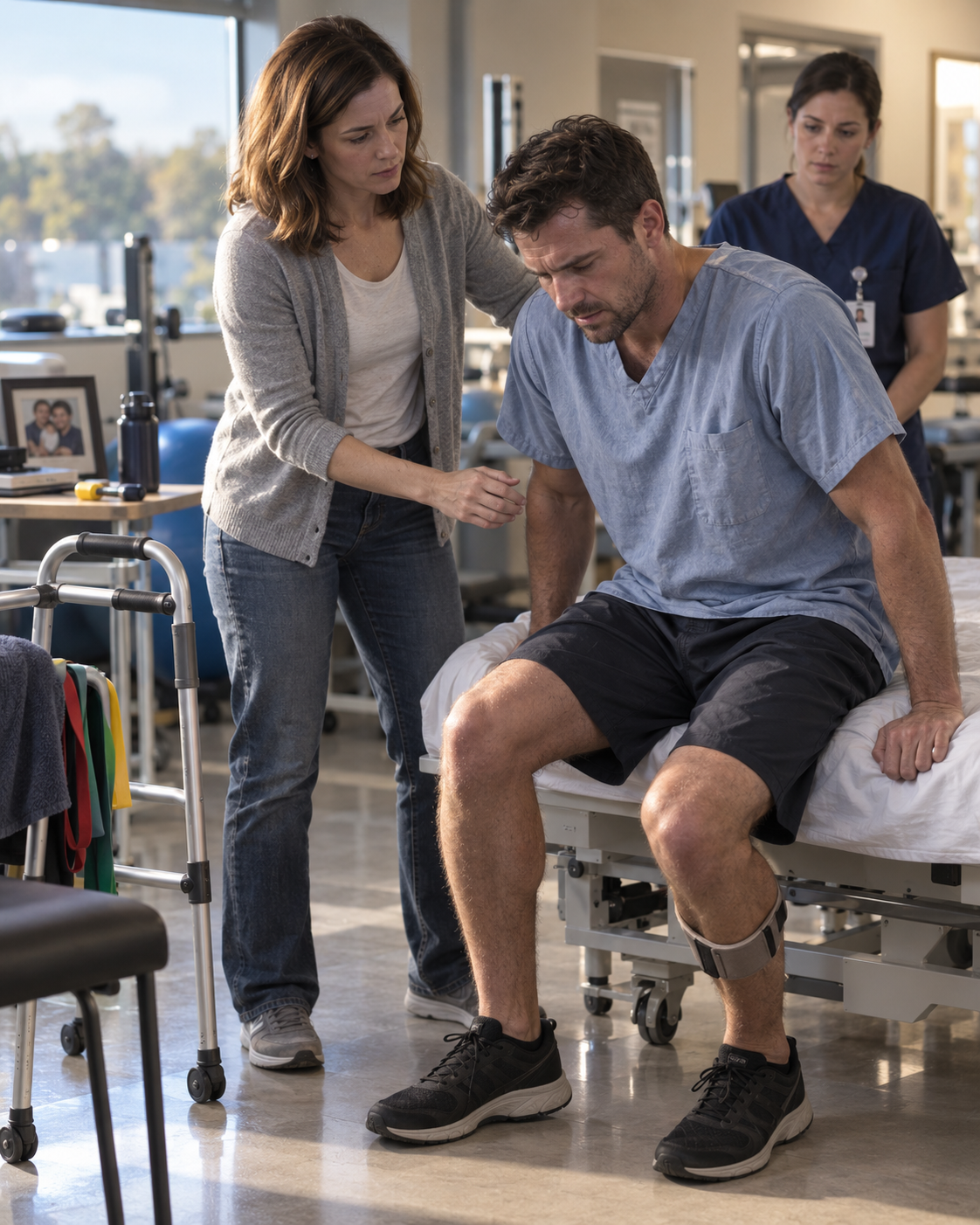
A therapist would help Ryan sit.
Then they’d stop.
The next day, they’d try again.
His body had lost enormous amounts of strength. The muscles that had once lifted heavy weights struggled with movements most people never noticed.
Rolling over.
Holding his head up.
Sitting without falling.
Standing for a few seconds.
Taking one step.
Claire never compared him with the man he had been before the stroke. She tried to keep him focused on the body in front of them.
One afternoon, Ryan managed to lift his left leg several inches.
Claire smiled.
“That counts.”
He frowned.
“It was like two inches.”
“It was two inches more than yesterday.”
He looked at her.
“Don’t make it sound inspirational.”
Claire laughed for the first time in days.
“Fine. It was two extremely unimpressive inches.”
Ryan smiled.
That was another victory.
Claire used what she knew as a physical therapist, but she was careful not to become his only therapist. She supported the medical and rehabilitation team and brought familiar sensory cues into their routine.
Music Ryan liked played quietly in the room.
She massaged his hands.
They worked through gentle stretches.
When his clinicians approved it, they used exercises that challenged his balance and coordination.
None of it produced a miracle.
It produced repetition.
And repetition slowly produced change.
Coming Home Was Another Beginning
When Ryan finally came home, Claire had prepared the house as if they were moving into a new apartment.
Handrails had been installed.
Furniture had been rearranged.
A temporary ramp led to the front door.
The living room looked strangely open, as though half the room had been erased.
Ryan stopped in the doorway.
“Feels smaller,” he said.
“It probably is,” Claire replied.
He looked at her.
She shrugged.
“I moved everything.”
He nodded.
There was no need to say more.
Being home was wonderful.
It was also hard.
Ryan couldn’t move through the house the way he once had. He tired easily. Some tasks that used to take seconds now required planning.
And Emma was still a baby.
She wanted to be carried.
She wanted to be chased.
She wanted to crawl into her father’s lap, pull his glasses off, and immediately laugh when he tried to get them back.
Ryan couldn’t always keep up.
One afternoon, he sat on the floor while Emma crawled across a blanket toward him.
When she reached his legs, she grabbed his pant cuff.
Ryan looked down.
“Hey, peanut.”
Emma slapped both hands on his knee.
He reached for her carefully.
For a moment, he held her close.
Then his eyes closed.
Claire stood in the kitchen and quietly turned away.
Five months after the stroke, Ryan returned to work.
It wasn’t a triumphant entrance.
There was no applause.
There were forms to fill out, limitations to work around, and days when he came home exhausted.
But he went back.
That mattered to him.
He wanted pieces of his old life—not because he believed he could simply rewind time, but because he wanted to build something recognizable again.
The gym took longer.
At first, Ryan refused to call it training.
“It’s rehab,” he said.
Claire raised an eyebrow.
“It’s a gym.”
“It’s rehab with better music.”
He was right.
For weeks, he worked with light weights.
Movement before load.
Control before speed.
Consistency before pride.
Pride was the hardest one.
He had been a strong man. Now he had to be patient with weights that once would have barely counted as warm-ups.
One evening, Ryan put down a bar and sat on a bench.
“I hate this,” he said.
Claire sat beside him.
“I know.”
“I used to be able to do so much more.”
“I know.”
He stared at the floor.
Then he stood again.
“Okay.”
Claire smiled.
“Okay what?”
“Again.”
The Weight on the Bar
Nearly a year after the stroke, Ryan walked into the gym without a walker.
That alone would have been enough.
Instead, he headed toward a squat rack.
A few people there knew him from before the stroke. They had watched him rebuild slowly, week after week.
Ryan loaded the bar.
Not the weight he used to lift.
Not even close.
But enough to matter.
He stepped under it.
Claire stood several feet away, watching.
“Ready?” she asked.
Ryan took a breath.
“Ready.”
He squatted.
Slowly.
His knees trembled.
He pushed upward.
And stood.
The people around him stayed quiet.
Ryan looked at the bar.
Then at Claire.
“That counts?”
She folded her arms.
“That definitely counts.”
Months later, his working squat had climbed to around 200 pounds, and his deadlift had passed 250.
The numbers were impressive.
They just weren’t the most important numbers anymore.
The biggest change was harder to measure.
Ryan trusted his body again.
Not completely.
Not blindly.
But enough to use it.
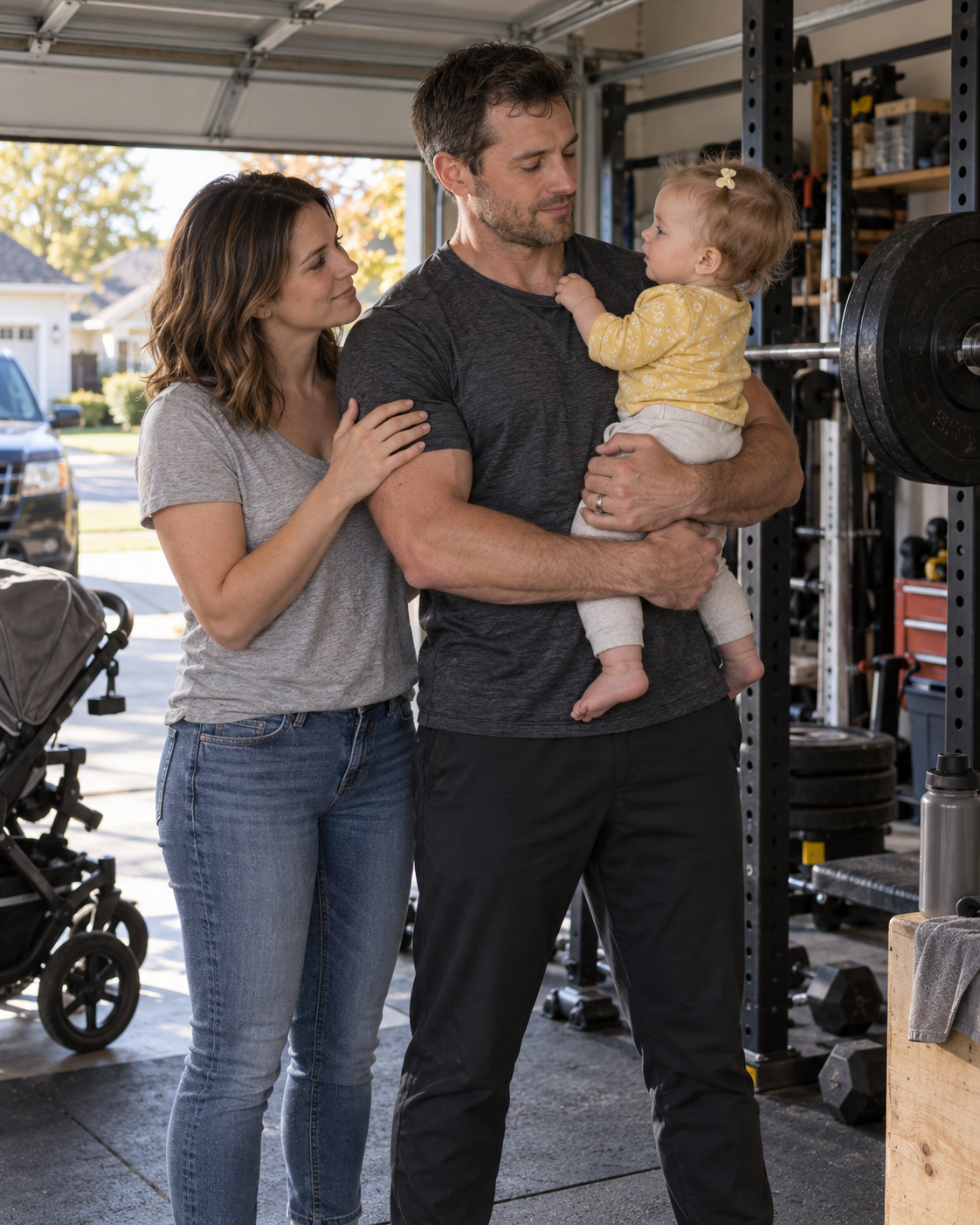
One Saturday morning, Claire found him in the garage adjusting the plates on a barbell.
Emma sat nearby in a stroller, holding a stuffed rabbit.
“What are you doing?” Claire asked.
Ryan glanced at the weight.
“Trying something.”
“That’s usually how trouble starts.”
He smiled.
Then he lifted the bar.
Nothing dramatic happened.
No music swelled.
No one outside the garage knew.
Ryan simply stood there under the weight, steady on both feet.
Claire watched him for a few seconds.
Then Emma began clapping for no reason at all.
Ryan laughed.
“See?” he said. “She gets it.”
Claire walked over.
Emma reached toward her father.
Ryan bent down and scooped her up.
A year earlier, that movement would have been impossible.
Now he held their daughter against his chest while she grabbed the collar of his shirt and tried to pull herself higher.
Ryan looked at Claire.
“I thought I’d never do this again.”
Claire didn’t answer right away.
She reached out and touched his shoulder.
“You’re doing it now.”
Ryan looked down at Emma.
The little girl rested her head against him, completely unaware that there had ever been a question about whether her father would be strong enough to hold her.
Ryan stood there in the garage with a barbell behind him and his daughter in his arms.
The strongest thing he had lifted that year wasn’t on the rack.
It was the life he had almost lost, carried carefully, one ordinary moment at a time.