The Boy in the Field
By eight in the morning, the sun had already burned the dew off the rows of corn behind the Harper family’s house in rural Iowa.
Eli Harper was supposed to be out there.
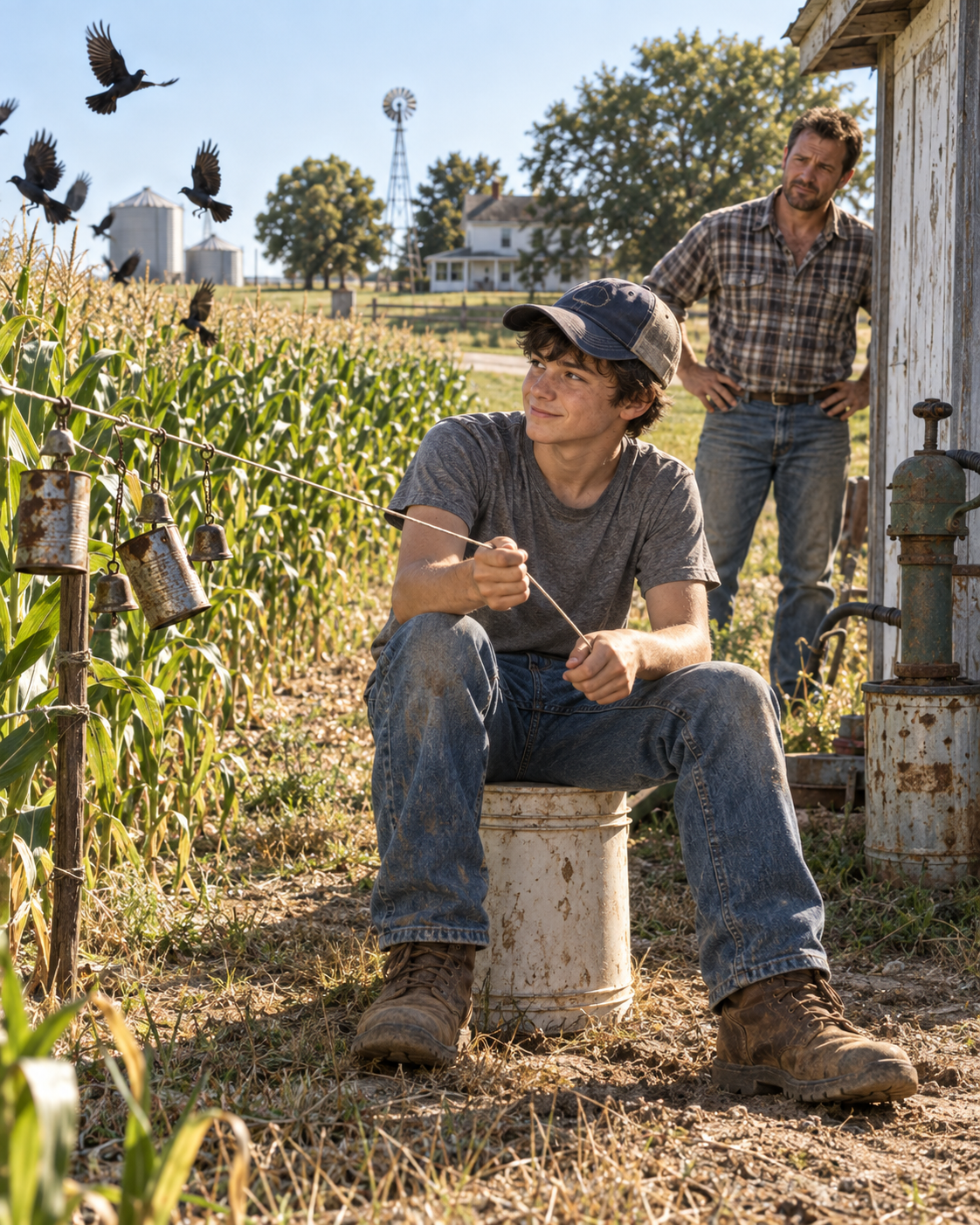
Instead, he was lying on an overturned five-gallon bucket beside the pump shed, a baseball cap pulled low over his eyes, watching three crows hop between the rows.
His father, Daniel, spotted him from across the field.
“Eli.”
One eye opened.
“Yeah?”
“You planning on scaring those birds away today?”
“They’ve got plenty of corn,” Eli said.
Daniel stopped walking.
“They do not have plenty of corn. They have our corn.”
Eli sat up and glanced toward the field. “That’s what I meant.”
Daniel shook his head, but the corner of his mouth twitched.
That was the problem with Eli. He was hard to stay mad at.
He was sixteen, thin and long-limbed, with dark brown hair that never stayed under his cap and an expression that always suggested he had already thought of three answers before you finished the question. He wasn’t lazy in the way people sometimes imagined.
He simply hated doing things the hardest possible way.
While the other farm kids ran through the fields waving their arms at birds, Eli had built a homemade system out of fishing line, old soda cans, and small metal bells. The lines ran from the edge of the field to a folding chair under the shade of the pump shed.
Whenever birds landed, Eli pulled one line.
The cans rattled.
The bells rang.
The birds scattered.
Daniel had watched the contraption work for two weeks before finally saying, “You realize most people would call that lazy.”
Eli had smiled.
“Most people are still out there chasing birds.”
Daniel had laughed despite himself.
For all the teasing he got at school, Eli had never really minded being called lazy.
His teachers had another word for him.
“Underachiever,” Mr. Collins, his physics teacher, once said.
That one bothered him more.
Eli knew he was good at figuring things out. He just didn’t always know what he wanted to do with that ability.
His older sister, Megan, had left for community college the year before. His mother worked mornings at the county clinic. His father spent nearly every daylight hour on the farm.
Eli helped when asked.
He just preferred finding ways to make “helping” take less time.
Then August came, and everything changed.
When the Field Started Dying
The drought began quietly.
First, the creek behind the property narrowed to a muddy ribbon. Then the grass turned pale. Within weeks, the ground in the cornfield had split into thin cracks that ran like veins through the soil.
Daniel stopped joking.
He checked weather reports every night at the kitchen table, rubbing his forehead with the heel of his hand.
“No rain for ten days,” he said one evening.
His wife, Laura, put a plate in front of him.
“You’ve said that every night.”
“This time they’re saying another heat wave.”
Eli sat across from them, pushing peas around his plate.
“Could we pump from the pond?”
Daniel looked at him.
“Pond’s almost gone.”
“What about rationing the irrigation?”
“We’re already rationing.”
Eli didn’t answer.
Two mornings later, Daniel collapsed beside the tractor.
The hospital called it exhaustion complicated by dehydration and a blood pressure problem. He was ordered to stay home and rest.
For the first time in Eli’s life, nobody told him what needed to be done.
He had to figure it out himself.
He woke before sunrise. He checked the irrigation lines. He moved hoses. He pulled weeds. He hauled supplies. He stood in the field until his shirt stuck to his back.
And for once, there was no clever shortcut.
The corn kept drying.
One afternoon, Eli walked to the far end of the property and stopped between two rows.
The leaves had curled inward. Some stalks were already brown.
He crouched and touched the dirt.
It crumbled between his fingers.
His father’s old warning came back to him.
What happens when I can’t work anymore?
Eli stayed there a long time.
That night, he opened the drawer beside his bed and found a folded county newspaper. A headline caught his eye.
YOUTH FARM INNOVATION CHALLENGE OFFERS $25,000 PRIZE
The county fair’s annual competition was usually a parade of homemade tractors, livestock projects, and agricultural displays.
This year, one category had been added: practical solutions to farming problems.
Eli read the article twice.
Twenty-five thousand dollars.
Enough to repair the irrigation system.
Enough to keep the farm from slipping further into debt.
He carried the newspaper downstairs.
His father was sitting at the kitchen table.
“I want to enter this.”
Daniel looked at the headline.
Then he looked at Eli.
“It’s not a science fair.”
“I know.”
“You’ll be competing against kids who have been doing this their whole lives.”
“So have I.”
Daniel leaned back slowly.
“You’ve never wanted anything this badly.”
Eli looked toward the dark window over the sink.
“I do now.”
The Idea Nobody Took Seriously
The county fairgrounds were crowded the morning of the competition.
Fourteen young people had entered.
There were agricultural students, farm kids, a robotics club team, and a seventeen-year-old named Cody Barnes who had already won two regional competitions.
The first event tested problem-solving.
Contestants were given a small plot, basic materials, and three hours to move water from a barrel to a series of dry planting beds.
Most grabbed hoses and started building.
Eli walked around the setup.
He looked at the barrels.
He looked at the slope.
Then he looked at the empty beds.
A judge called out, “You starting soon?”
“I’m thinking.”
Cody laughed.
“You’ve got three hours.”
“I know.”
Eli finally went to the supply table and chose plastic tubing, several short wooden stakes, a hand drill, and an old wheel rim.
He drilled holes into the tubing.
The judges watched.
Cody shook his head.
When the timer started, everyone rushed.
Eli didn’t.
He laid the tubing down the slope, secured it with stakes, connected one end to the barrel, and positioned the other over the planting beds.
Then he tilted the barrel onto the wheel rim.
Water began flowing slowly downhill.
The judges gathered around.
One of them frowned.
“Gravity?”
Eli shrugged.
“It’s free.”
By the end of the first hour, water was reaching every bed.
Cody’s system pumped water much faster, but it required constant manual work.
Eli’s moved steadily without anyone touching it.
When the round ended, the judge announced the top scores.
Cody finished first.
Eli finished second.
He was still in the competition.
That night, Laura called him.
“How did you do?”
“Second.”
There was a pause.
“Your father is smiling.”
In the background, Daniel yelled, “I’m not smiling.”
Laura laughed.
Eli did too.
For the first time in weeks, the house felt lighter.
The next morning was the final.
There was only one challenge.
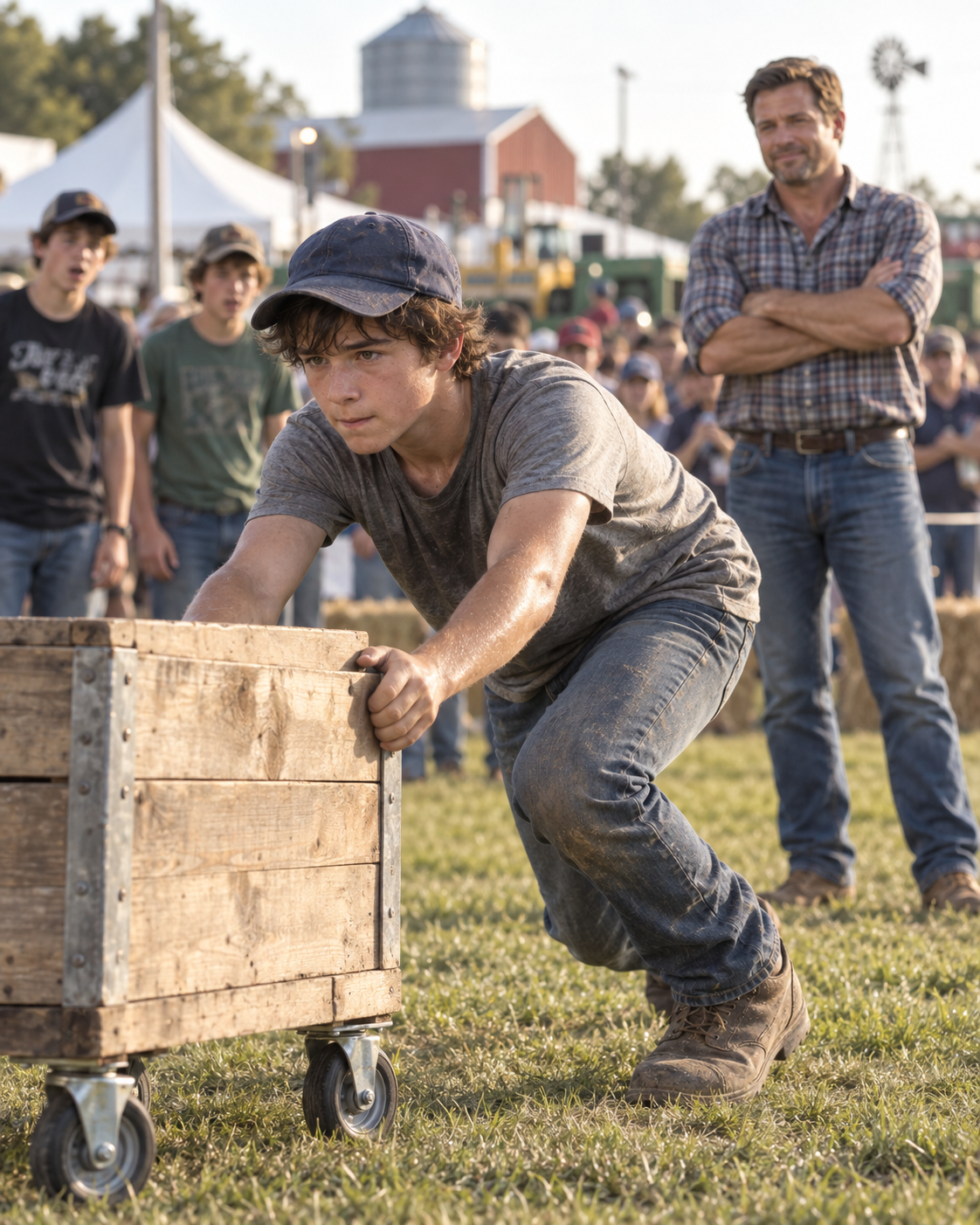
Each contestant was given a large wooden crate weighing nearly 300 pounds. They had to move it across an open field, around a series of markers, and through a finish gate.
They could choose one tool from a table.
Most contestants picked thick ropes.
Cody chose a heavy steel lever.
Eli stared at the crate.
Then he stared at the grass beneath it.
A judge blew the whistle.
Everyone began pulling.
Eli walked to the table.
He picked a small cordless drill.
The crowd laughed.
Someone shouted, “He’s serious?”
Eli didn’t look up.
The Trick Hidden Inside the Crate
He knelt beside the crate.
The drill buzzed.
He removed several wooden slats from the bottom.
Then he found the crate’s four solid corners and drilled holes through them.
Cody, already halfway across the field, glanced back.
“What is he doing?”
Nobody knew.
Eli reached under the crate and attached four small salvaged caster wheels from the supply pile.
The rules hadn’t said the tool had to move the crate directly.
They said contestants could use one tool to help complete the task.
Eli stood.
He grabbed the crate’s edge.
It moved.
Not easily.
But it moved.
The wheels rolled across the grass with a low, uneven rumble.
Eli pushed.
One wheel caught on a patch of dirt.
He stopped, backed up, and adjusted it.
A few people in the crowd had stopped laughing.
Cody was nearing the last marker.
Eli pushed again.
Sweat ran down his temples.
He was still working.
That mattered.
For all his shortcuts, for all the times he’d chosen the easier path, Eli had learned something during those long weeks beside the dying corn.
A shortcut was not the same as avoiding work.
Sometimes it meant doing the work differently.
He kept pushing.
Cody reached the final turn.
Eli was behind him by nearly twenty yards.
Then one of Cody’s hands slipped on the rope.
The crate swung sideways.
He tried to correct it, but the heavy wooden box dragged across the grass and jammed against a marker.
Eli kept going.
Ten yards.
Five.
His legs were shaking now.
He pushed the crate through the finish gate just before Cody could free his own.
The crowd erupted.
Eli bent over, hands on his knees, breathing hard.
He looked across the field at his father.
Daniel was standing despite doctor’s orders.
Eli straightened.
Their eyes met.
Daniel didn’t clap.
He simply nodded.
That meant more.
The judges conferred for several minutes.
Then the head judge stepped to the microphone.
“The winner is Eli Harper.”
Eli didn’t move at first.
The applause reached him in pieces.
Then Laura grabbed his shoulders from behind.
Daniel walked onto the field more slowly than everyone else.
“You okay?” Eli asked.
“I’ve been better.”
Eli smiled.
Daniel looked at the wooden crate with its crooked little wheels.
“Ugliest invention I’ve ever seen.”
Eli laughed.
“It worked.”
“That,” Daniel said, “it definitely did.”
What Eli Did With the Money
Three weeks later, a new irrigation system was being installed on the Harper farm.
It wasn’t glamorous.
There were pipes, fittings, trenches, and long arguments over measurements.
Eli was there for all of it.
He still looked for easier ways to do things.
That never changed.
What changed was what he did with the idea.
He started fixing equipment before it broke.
He built a simple sensor system that warned them when sections of the field were getting too dry.
He learned how to repair the pump instead of waiting for his father to do it.
He even started waking up before seven without anyone calling his name.
One Saturday morning, Daniel found Eli in the barn, covered in dust, tightening a bolt beneath an old cultivator.
“You know,” Daniel said, “you could probably find a more complicated way to do that.”
Eli looked up.
“Why would I?”
Daniel smiled.
“Just checking.”
The farm didn’t suddenly become easy.
The next season brought new problems. Prices dropped. A storm damaged part of the roof. The family still worried about money.
Winning the competition hadn’t transformed Eli into a different person overnight.
He still left laundry on the floor.
He still procrastinated on homework.
He still occasionally disappeared for an hour when there was work to be done.
But now, when someone called him lazy, he didn’t automatically laugh.
Because he understood the difference.
Lazy was refusing to move.
Clever was asking whether there was a better way to move.
One evening, months after the competition, Eli sat at the edge of the cornfield with his father.
The sky was turning orange over the rows.
Daniel handed him a cold bottle of water.
“You ever think about what would’ve happened if you hadn’t entered that competition?”
Eli looked across the field.
“Yeah.”
“And?”
Eli was quiet for a moment.
“I would’ve kept trying to do everything the way everybody else did.”
Daniel nodded.
The wind moved through the corn in a long, soft wave.
Eli watched it.
Then he smiled.
“I’m glad Dad got sick.”
Daniel turned sharply.
“What?”
Eli laughed.
“Not sick-sick.”
“I should hope not.”
“I mean…” Eli paused. “I’m glad I had to figure things out.”
Daniel looked back toward the field.
“Me too.”
They sat there without talking.
For years, Eli had thought the easiest way through a problem was to find a way around it.
Now he knew something better.
Sometimes the smartest thing you can do is stop, look closely at the problem everyone else is fighting, and ask one simple question:
What if there is another way?
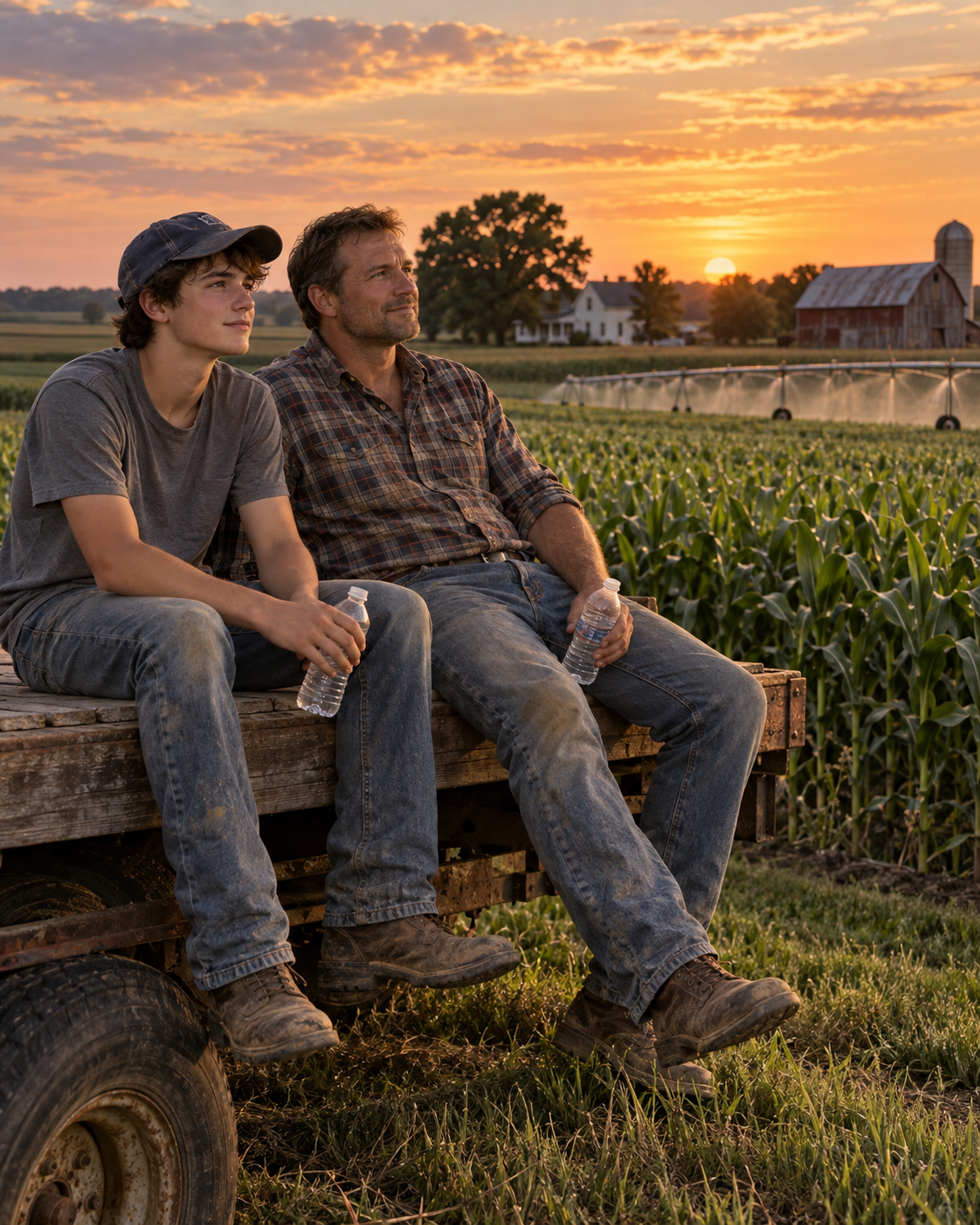
That summer, the corn grew taller than Eli had ever seen it.
And every morning, before anyone could call him lazy, he was already outside finding a better way to get the work done.