The Old Depot
The first time Brandy Parker threatened me, I was standing knee-deep in weeds beside a dead railroad track.
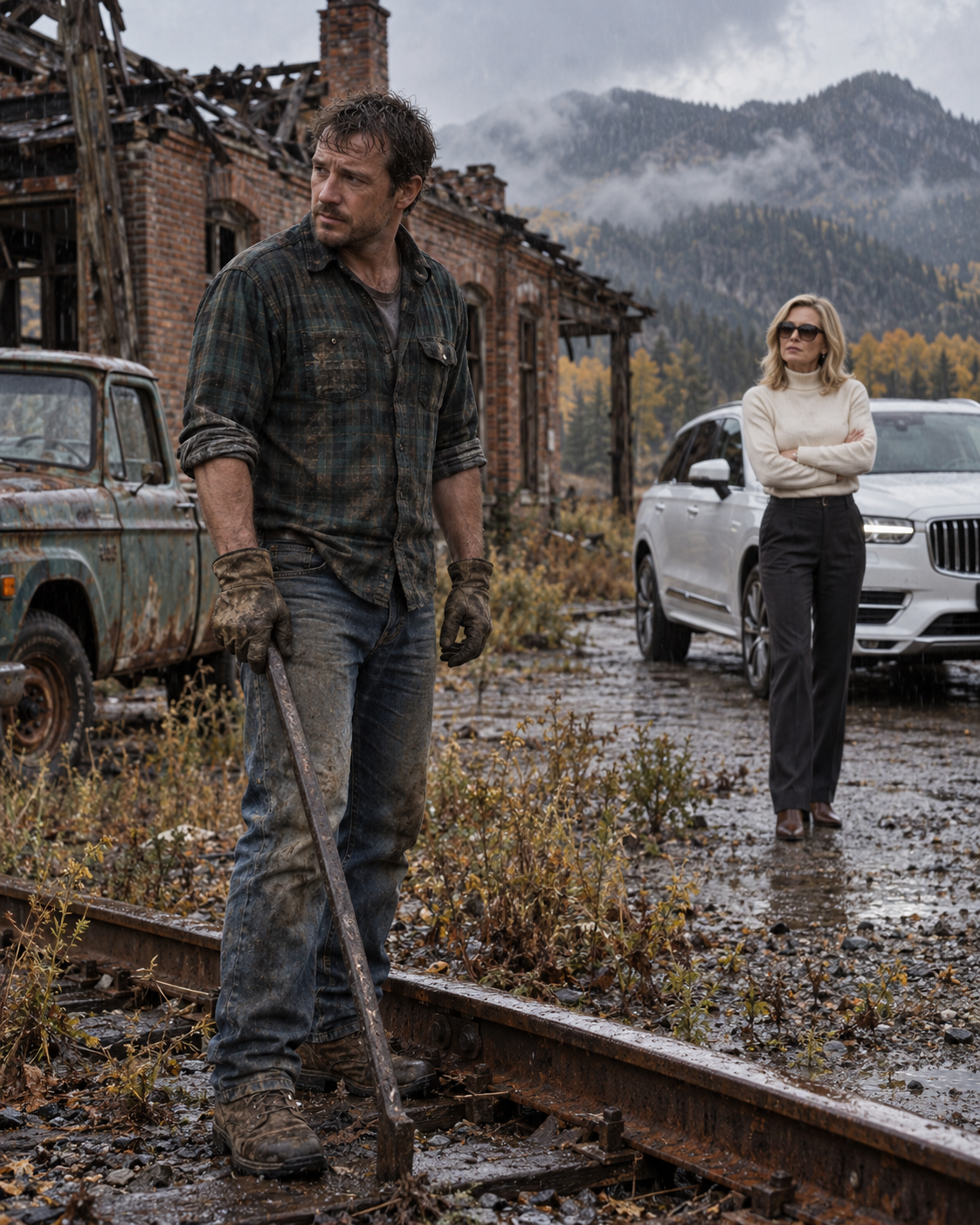
It was raining hard enough to turn the gravel around the old Copper Creek Depot into mud. I had a pry bar in one hand and a rusted section of rail in the other when a pearl-white Range Rover rolled onto my property.
I knew immediately it didn’t belong there.
The woman who stepped out wore a cream cashmere sweater, spotless boots, and sunglasses despite the rain. She looked at the collapsed brick depot as if she’d discovered a dead animal on her front porch.
She stopped several feet away from me.
“Who is the site supervisor?”
I laughed before I could stop myself.
“I’m the owner.”
She lowered her sunglasses.
“The owner?”
“Archer Russell.”
She studied my muddy flannel shirt.
“I’m Brandy Parker. President of the Whispering Pines Homeowners Association.”
That explained the car.
Whispering Pines sat above my property on the mountainside, a private enclave of enormous homes with glass walls, heated driveways, stone gates, and views people paid millions to wake up to.
My grandfather used to call the place “the castle colony.”
I had inherited a modest amount of money from him a few months earlier. Instead of putting it into a stock account I barely understood, I had spent $42,000 at a county tax auction on twenty acres containing the abandoned depot.
I was a high school history teacher. I wasn’t looking for a business.
I wanted a place where I could restore something that mattered.
The depot had been built in the 1920s. Its roof had collapsed in one corner, the windows were gone, and raccoons had apparently claimed the ticket office as their ancestral home.
But the bricks were still there.
So was the history.
Brandy held out a thick envelope.
“You are in violation of Whispering Pines’ scenic standards.”
“I’m not in Whispering Pines.”
Her smile tightened.
“The entire valley falls under our visual easement.”
“I don’t think it does.”
“You have fourteen days to remove the debris, submit architectural plans, and bring this parcel into compliance.”
I looked at the envelope.
“And if I don’t?”
“Five hundred dollars a day.”
She placed the notice on the hood of my old pickup.
Then she got back into her Range Rover and drove away.
I stood in the rain, watching her disappear uphill.
I didn’t know it yet, but she’d just made the most expensive mistake her neighborhood had ever made.
The Line on the Map
The next morning, I went to the county records office.
The clerk assigned to old property records was named Martha. She was in her sixties, wore reading glasses on a chain, and had the particular patience of someone who had spent thirty years watching people make expensive mistakes because they refused to read paperwork.
I showed her the HOA notice.
She barely glanced at it.
“Where’s your deed?”
I handed it over.
For three hours, we worked through plats, easements, development filings, and records dating back decades.
Then Martha stopped turning pages.
“Archer.”
“What?”
She pointed at a faded line on a county plat.
“Do you see this?”
A narrow black line ran from my depot property up the mountain.
It continued straight through Whispering Pines.
“That’s an old railway right-of-way,” she said.
“The tracks are gone.”
“The tracks are gone. The right-of-way isn’t.”
She pulled another document from the stack.
When Whispering Pines was developed in the late 1990s, the builders had paved part of the abandoned rail corridor into a service road. Their elegant entrance bridge couldn’t support construction trucks, so heavy equipment had been routed through the back.
The developer later went bankrupt.
The temporary access arrangement had never transferred ownership.
Martha leaned back.
“They’ve been using your road.”
I stared at her.
“For how long?”
“About twenty years.”
“Does the HOA own it?”
“No.”
She smiled.
“You do.”
The realization was almost too strange to absorb.
The road I had driven past without noticing—the road carrying deliveries, garbage trucks, construction equipment and maintenance vehicles up toward those mountain mansions—was on my deed.
I drove home that afternoon thinking about what to do.
My first instinct was to leave it alone.
I didn’t want a fight with forty wealthy homeowners.
I certainly didn’t want a lawsuit.
But Brandy didn’t leave it alone.
Four days later, a process server walked into my classroom during third period.
Twenty teenagers watched him hand me a thick legal packet.
The Whispering Pines HOA was suing me for $2 million.
They claimed my restoration work threatened the hillside and endangered property values. They wanted an emergency injunction stopping me from working and ultimately demanded that I sell the depot to the HOA.
I made $60,000 a year teaching history.
Their attorney probably charged more per hour than I earned in a day.
Then my pickup tires were slashed.
An anonymous environmental complaint brought inspectors to the property for an entire day. They found nothing wrong, but the inspection cost me money and delayed my work.
That was when I stopped hoping the situation would simply disappear.
I hired David Higgins, a state-licensed land surveyor known for being painfully thorough.
“I want every boundary marked,” I told him.
“Every boundary?”
“Every inch.”
Three days later, David and I stood beside the service road.
Bright orange survey stakes appeared on both sides of the pavement.
David looked at his tablet.
“The old right-of-way includes the road and five feet of clearance on either side.”
I stared uphill.
“All the way to the gate?”
He nodded.
“All the way.”
A golf cart appeared around the bend.
Gary, one of Whispering Pines’ security guards, jumped out.
“What are you doing?”
“Marking my property.”
He kicked one of the stakes.
I looked at him.
“Do that again and you’re trespassing.”
He reached for his radio.
Ten minutes later, Brandy came flying down the road.
She barely acknowledged me.
“Remove these immediately.”
David calmly showed her his survey.
“These stakes represent the legal boundary.”
Brandy’s face changed.
“You people are trying to extort us.”
“No,” I said. “You sued me.”
She stared at the orange stakes.
Then at the road.
For the first time, she seemed to understand what she had overlooked.
When Winter Came
I spent the next week researching something I’d never expected to care about.
Propane.
Whispering Pines wasn’t connected to the municipal gas system. Every enormous house depended on large propane tanks for heat, generators, pools, and heated driveways.
And propane tankers were heavy.
Very heavy.
The front entrance bridge was beautiful—an enormous timber structure spanning a gorge—but county engineering records listed its maximum load well below the weight of a fully loaded commercial tanker.
The back road was different.
That road belonged to me.
I sat at my kitchen table with the documents spread around me.
I didn’t smile.
Not yet.
I ordered a reinforced iron gate and heavy steel posts.
They were installed across the road.
The sign was simple.
PRIVATE PROPERTY. NO UNAUTHORIZED ACCESS.
Then I waited.
November arrived brutally.
A wet mountain storm dumped more than two feet of snow over the foothills. Temperatures dropped into the teens, then lower.
I was living in a small rented RV beside the depot while the restoration continued. My heater was barely adequate.
Up on the mountain, however, the homes were designed to stay seventy-two degrees year-round.
Then, one freezing Tuesday morning, I heard the diesel engine.
A propane tanker sat at the bottom of my road.
The driver climbed down from the cab.
“Hey,” he called. “You own this gate?”
“I do.”
“I’ve got deliveries up there.”
“I know.”
He pointed toward the mountain.
“Three houses are nearly empty.”
I shook my head.
“Can’t let you through.”
He looked at the gate.
“I can’t take this truck across that bridge.”
“I understand.”
He stared at me for another second.
Then he climbed back into the cab.
The tanker turned around.
Forty-five minutes later, Brandy arrived.
The Emergency
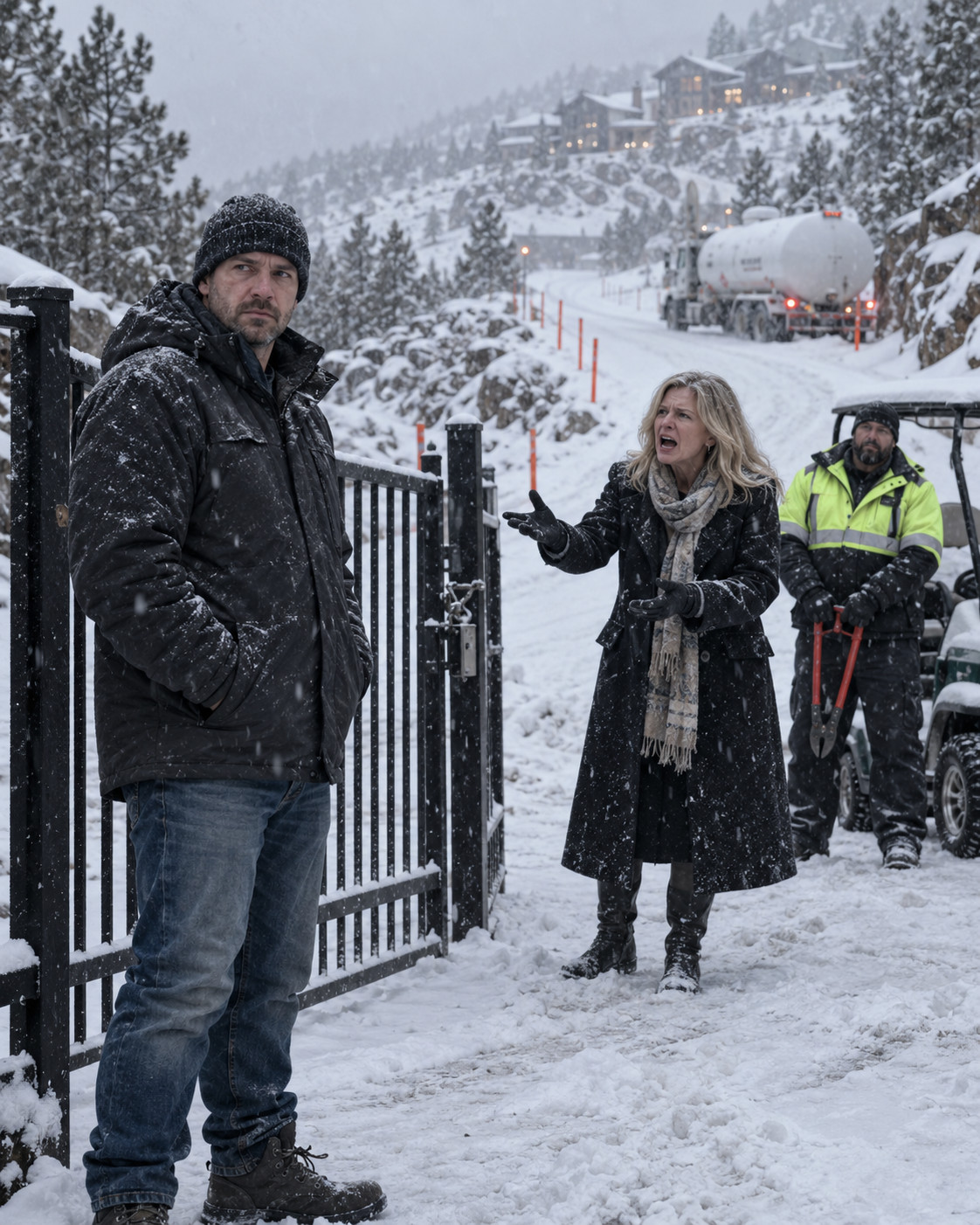
Brandy was carrying bolt cutters.
“Open it!”
I held up my phone.
“I’m recording.”
“You are holding an entire community hostage!”
“I’m protecting my property.”
“There are elderly people up there!”
“Then your HOA should have thought about emergency access before suing the property owner.”
Her face reddened.
“You have no idea what you’re doing.”
“I know exactly where my property line is.”
She called the sheriff.
Twenty minutes later, two deputies arrived.
Brandy did most of the talking.
I handed the older deputy my deed, David’s certified survey, the county records, and the lawsuit filed by the HOA itself.
He looked through everything.
Then he looked at the gate.
“Ma’am,” he said, “this appears to be Mr. Russell’s property.”
Brandy’s voice rose.
“They’re going to freeze!”
The deputy shook his head.
“This is a civil dispute. I can’t order him to open his private property.”
That night, the temperature fell to five degrees.
The next morning, Whispering Pines began having problems.
Pipes froze.
A clubhouse flooded when a line burst.
Heated driveways went dark.
Residents struggled to get vehicles down the icy roads.
The same people who had spent years looking down on the old depot were suddenly trapped above it.
By Monday, Brandy was gone from the picture.
A new HOA president named Thomas Abernathy arrived at my RV with the attorney who had filed the lawsuit.
Thomas looked nothing like Brandy.
He was a venture capitalist in his sixties, tall and composed, wearing a cashmere overcoat over several layers of clothing.
“My house is forty-one degrees,” he said.
I poured myself more coffee.
“I’m sorry to hear that.”
“We need access.”
“Your attorney has a lawsuit against me.”
The attorney stepped forward.
“The lawsuit has been dismissed.”
“With prejudice?”
“Yes.”
“And the harassment complaints?”
“We’ll reimburse the expenses.”
I shook my head.
“That’s not enough.”
Thomas studied me.
“What do you want?”
I’d spent the previous night writing it down.
First, the HOA would reimburse the surveying and inspection costs caused by their actions.
Second, they would sign a long-term commercial access agreement for the road.
Third, they would pay to restore the old depot.
The attorney stared at me.
“You want a ninety-nine-year lease?”
“Yes.”
“At ten thousand dollars a month?”
“Adjusted annually.”
He laughed once, disbelievingly.
Thomas didn’t.
He was looking at the mountain.
He understood leverage.
“Anything else?”
“That’s it.”
The attorney opened his mouth.
Thomas raised a hand.
“How much for the restoration?”
“I’ll select the contractors. You pay the invoices.”
Thomas looked at the ruined depot.
Then at the locked road.
Then back at me.
“Agreed.”
The Gate Opens
He signed the agreement on the hood of his Mercedes.
I read it twice before signing my side.
Then I walked to the gate.
For months, I’d imagined what it would feel like to win.
It didn’t feel like victory.
It felt like relief.
I unlocked the chain.
The gate swung open.
Within an hour, the first propane truck came through.
Then another.
Then another.
The drivers gave me puzzled looks as they passed.
One finally raised his hand in thanks.
I waved back.
By evening, the road was busy with tankers.
Up on the mountain, lights slowly returned to the houses.
The next few months changed everything.
The HOA paid for the depot’s restoration.
The collapsed roof was replaced with slate. Damaged brick was repaired by craftsmen who knew how to preserve historic masonry. The old ticket office became a warm, sunlit living room with original beams and wide windows facing the mountains.
I eventually left teaching.
Not because I hated it.
I simply didn’t need to work sixty hours a week anymore.
The road lease gave me enough income to live comfortably and care for the property.
Brandy, meanwhile, was removed from the HOA board. An internal investigation uncovered how much money had been spent pursuing the lawsuit and the complaints against me.
She eventually sold her house and left Whispering Pines.
I never saw her again.
And that was fine.
The Road I Almost Ignored
I still keep the original county plat framed inside the depot.
Not because it made me rich.
Not because it defeated an HOA.
I keep it because of how easily I could have missed it.
When I bought the depot, I thought I was purchasing twenty acres of forgotten history.
I never imagined that the most valuable thing on the property wasn’t the brick building, the land, or even the old railway memories.
It was the narrow strip of pavement running quietly through the trees.
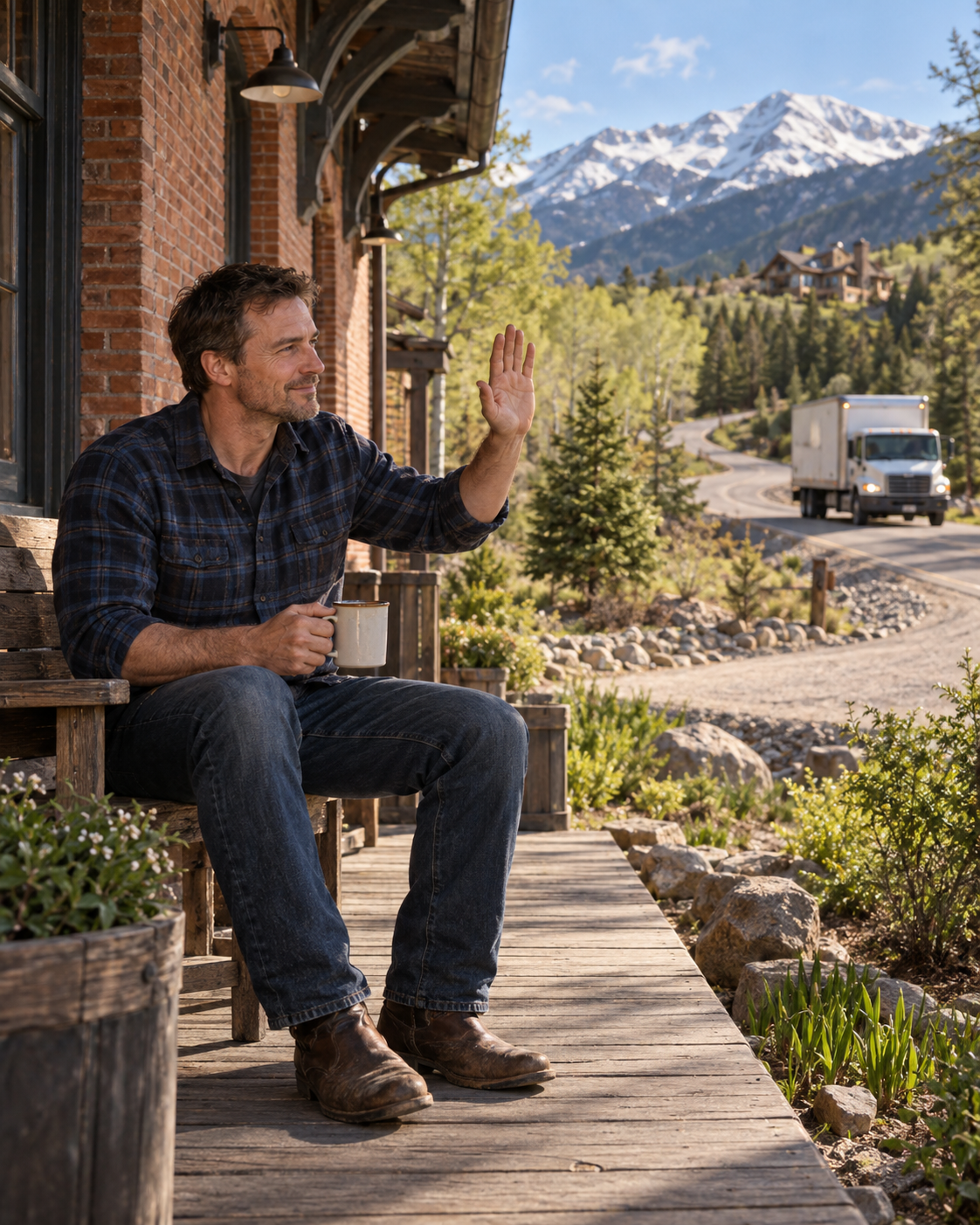
Every few days, a delivery truck passes my porch.
The drivers know me now.
They honk.
I raise my coffee mug.
And sometimes, when I watch those trucks disappear uphill toward the mansions, I think about that rainy October afternoon when Brandy first stood in my driveway and told me I didn’t belong.
She was right about one thing.
I didn’t belong to Whispering Pines.
I never wanted to.
I just happened to own the road they had forgotten they needed.