Rain slid off the rusted roof of the storage yard and ran in thin streams across the pavement.
Sam Turner stood beneath the auction tent with one hand wrapped around his cane and the other gripping the frayed leash of his dog, Baxter. His coat had once been brown, though years of weather had faded it toward gray. One sleeve was torn at the wrist. His boots were wet through.
He had thirty-eight dollars in his pocket.
That was everything.
The auctioneer was already moving through the last row of abandoned units. People in work boots and ball caps leaned forward whenever something looked remotely useful—tools, appliances, furniture. Sam stayed near the back, mostly because he didn’t want anyone asking why he was there.
He hadn’t planned to come.
He’d been looking for a dry place to wait out the storm when he noticed the crowd.
Then the auctioneer raised his clipboard.
“Unit 117. Thirty bucks to start.”
Nobody moved.
The auctioneer waited.
“Thirty?”
Silence.
Sam looked at the dented metal door.
Something about it bothered him. Not because it looked valuable. It didn’t. The paint was blistered, the lock was orange with rust, and a strip of old tape hung loose from the handle.
Still, he raised his hand.
“Thirty-eight.”
Heads turned.
A man near the front laughed.
“You’re bidding on that?”
Sam didn’t answer.
“Thirty-eight,” the auctioneer repeated. “Anybody got forty?”
No one did.
The hammer came down.
“Sold.”
Baxter gave a single bark.
Sam looked at him.
“Yeah,” he murmured. “I know.”
The lock snapped open.
A smell of mildew and dust rolled out.
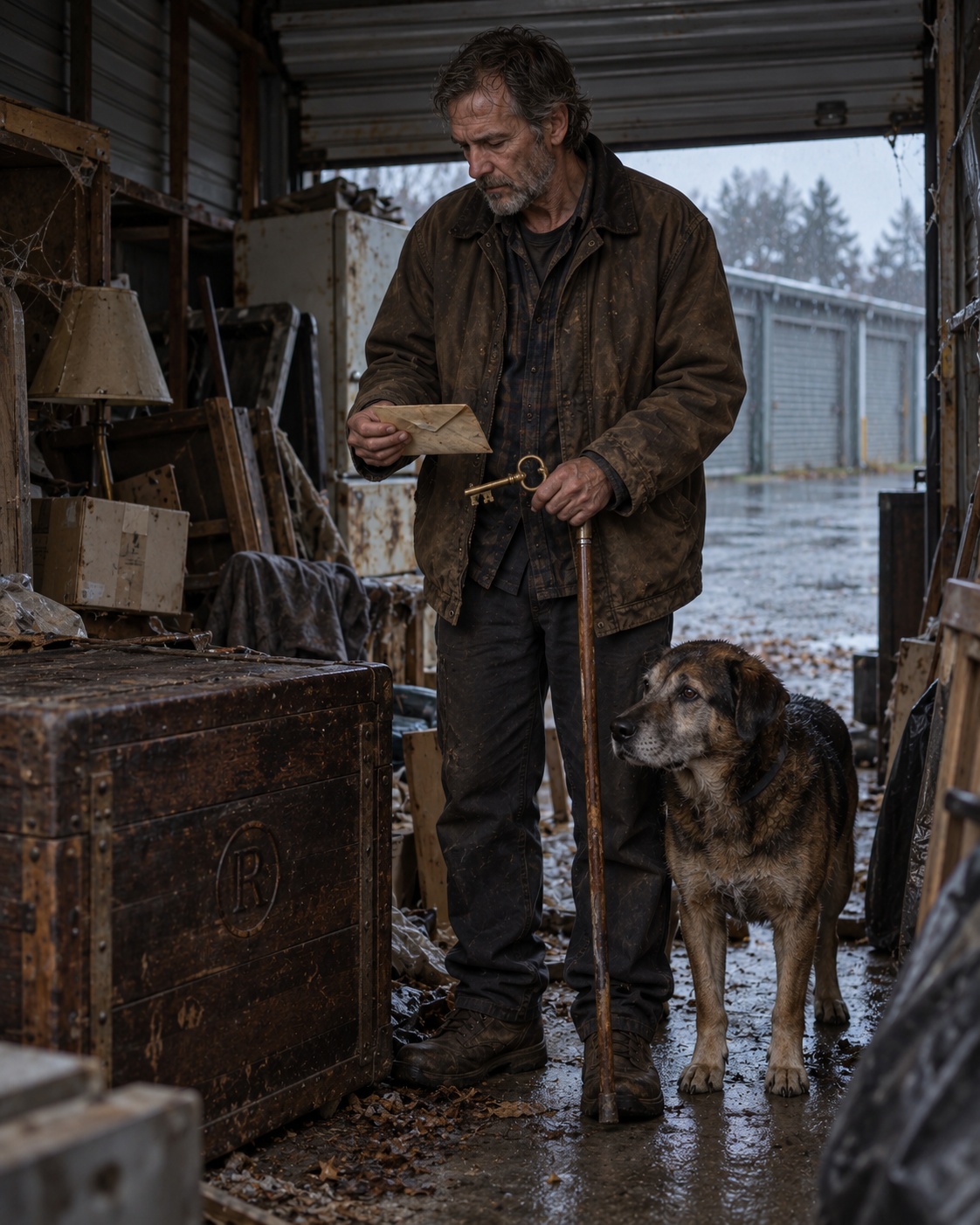
Sam stepped inside and swept his flashlight across stacks of broken boxes, a refrigerator with the door hanging crooked, an old bicycle, and a wooden trunk wedged behind a collapsed shelf.
“Some jackpot,” he said.
Baxter sniffed the floor, then stopped.
His ears lifted.
He stared at the trunk.
Sam followed his gaze.
The wood was blackened with age. Someone had carved a circle with an R through its center into the lid.
“Easy,” Sam said.
He dragged the trunk forward, found a bent crowbar, and worked the latch until the metal finally gave.
The lid groaned.
Inside were envelopes tied with faded string, several old photographs, and a heavy brass key.
The name on the top envelope made Sam forget about the rain.
Eleanor Reeves.
He knew that name.
Almost everybody in the city did.
Eleanor Reeves had once owned apartment buildings, warehouses, office blocks, and parcels of land all over town. Then, thirty years earlier, everything had collapsed around her. Her properties had been transferred to other companies. Lawsuits followed. Rumors multiplied.
And Eleanor disappeared.
Sam picked up the first letter.
The handwriting was careful and unmistakably human, the kind written slowly with a fountain pen.
He read the first line.
If you’re reading this, then they never wanted the truth found.
He read it twice.
Baxter nudged his knee.
Sam looked toward the open door.
Nobody stood there.
Still, for the first time that day, he had the uncomfortable feeling that someone knew exactly where he was.
The Name in the Envelope
That night, Sam and Baxter slept beneath an overpass.
Traffic rolled above them while rain tapped steadily against the concrete supports. Sam sat with his back against a pillar and spread the papers across an old piece of cardboard.
Most were property records.
Some were contracts.
One document had been stamped REVOKED.
He kept reading.
The Reeves properties had not simply been lost.
They had been transferred through a chain of companies, each one apparently unrelated to the last. Several signatures appeared on the records. Two looked suspiciously similar.
At the bottom of one page was a handwritten note.
They will say I abandoned everything.
Sam stared at the words.
He remembered Eleanor Reeves from another life.
Back when Sam had worked as a mechanic, he had spent six months repairing elevators in one of her buildings. She used to walk through the construction site without an entourage, carrying a paper cup of coffee in one hand and a stack of folders in the other.
Once, when Sam had worked through lunch, she’d set a sandwich beside his toolbox.
“You’re going to pass out if you keep doing that,” she’d told him.
He’d laughed.
“Can’t afford to pass out.”
She had looked at him for a long second.
“Then eat.”
He never saw her again.
Sam rubbed his face.
“This isn’t my business,” he said.
Baxter rested his chin on Sam’s boot.
Sam sighed.
“You’re no help.”
The next morning, he went to the public library.
For several hours, he traced Eleanor’s history through archived newspapers and property records. The story everyone knew was simple: Eleanor Reeves had made bad decisions, lost her fortune, and disappeared.
The documents told a different story.
As Sam left the library, a woman in a gray suit hurried past him. A folder slipped from her hand.
“Hey,” Sam called.
She didn’t turn around.
He picked up the folder.
On the cover were the words Reeves Estate Holdings.
His stomach tightened.
That afternoon, he found an address in one of Eleanor’s letters.
The building was now home to the Reeves Foundation for Community Development.
Sam stood outside for almost ten minutes before going in.
The receptionist looked him over.
“Can I help you?”
“I’m here about Eleanor Reeves.”
The receptionist’s expression changed.
A moment later, a tall woman in a charcoal suit stepped from a hallway.
She was in her early forties, composed and sharp-eyed, with dark blond hair pulled neatly behind her shoulders.
“I heard my grandmother’s name,” she said.
Sam swallowed.
“You’re Margaret Reeves.”
“Yes.”
He took the letters from his backpack.
“I’m Sam Turner.”
Margaret stared at him.
“What are those?”
“Something your grandmother left behind.”
She opened the top envelope.
The color drained from her face.
“Where did you get these?”
“Storage unit auction.”
“What unit?”
“One-seventeen.”
Margaret looked up.
For a moment neither of them spoke.
“My family has spent thirty years looking for the original property records,” she said quietly.
Sam nodded.
“Then I guess I found them.”
Margaret looked at the papers again, her fingers trembling slightly.
“Do you understand what this could mean?”
“Not completely.”
“It could prove she was framed.”
Before she could say more, the front doors opened.
Two men walked into the lobby.
Sam recognized them immediately.
They were the men from the alley.
One smiled politely.
“Mr. Turner. We were hoping to have another conversation.”
Margaret stepped forward.
“Who are you?”
“Private investigators.”
Sam shook his head.
“You’ve got a strange way of investigating.”
The man’s smile disappeared.
His gaze settled on the backpack.
“What you’re carrying doesn’t belong to you.”
Sam tightened his grip on the strap.
“Neither does the rest of this city, apparently.”
The men left without another word.
Margaret watched the doors close.
Then she looked at Sam.
“You can’t go back outside.”
What Eleanor Hid
Margaret gave Sam and Baxter a room in one of the foundation’s staff apartments.
Sam slept badly.
A mattress was too soft after years of concrete and park benches. Every hallway sound woke him. At three in the morning, he sat on the edge of the bed and stared at the brass key on the nightstand.
The number 12 was engraved into it.
The next day, Margaret arranged for a lawyer to examine the documents.
That should have been the end of Sam’s involvement.
It wasn’t.
One of the letters contained a hand-drawn map of an industrial district near the river.
At the center was another circle around a warehouse marked Reeves & Co.
Margaret frowned when she saw it.
“That building has been empty for years.”
Sam held up the key.
“Maybe not empty enough.”
They went together.
The warehouse door opened with the brass key.
Inside, dust hung in the pale light coming through broken windows.
Baxter moved ahead, nose close to the ground.
A minute later he barked.
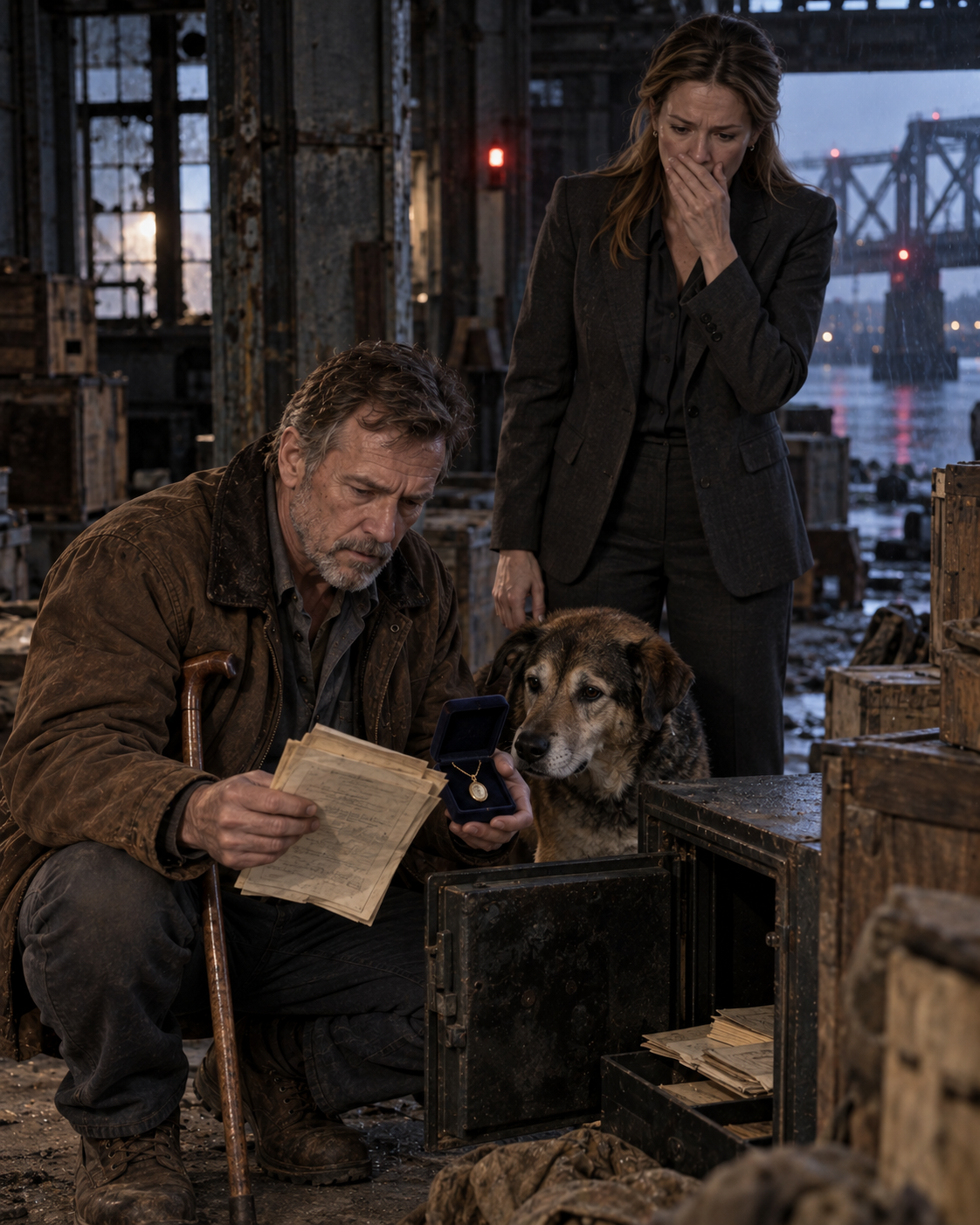
Behind a collapsed stack of crates sat an old metal safe.
It had the same circular R symbol.
Sam inserted the key.
The lock turned.
Inside were bound ledgers, several sealed envelopes, a velvet box, and a small stack of gold coins wrapped in cloth.
Margaret stared.
“Oh my God.”
Sam opened the velvet box.
Inside lay a simple gold necklace engraved with Eleanor’s initials.
But beneath it was something more important.
A photograph.
Eleanor stood in front of the first Reeves building with a group of construction workers. Sam was barely visible at the edge of the frame, younger by decades, wearing a hard hat.
He stared at it.
Margaret looked over his shoulder.
“That’s you.”
Sam’s throat tightened.
“I didn’t know she kept that.”
He remembered Eleanor walking down the construction floor with a sandwich in her hand.
For a moment the years disappeared.
Then a red light blinked on the wall.
Sam froze.
Motion sensor.
He grabbed the documents.
“We need to leave.”
Outside, an SUV turned into the street.
Margaret’s face went pale.
“How did they find us?”
Sam didn’t answer.
He took Baxter’s leash.
“Run.”
Beneath the First Foundation Stone
They lost the SUV before reaching downtown.
Margaret drove hard through side streets while Sam watched the mirror.
Finally, the black vehicle turned away.
For several minutes, neither spoke.
Then Margaret said, “You could’ve sold the necklace.”
Sam looked out the window.
“Didn’t feel like mine.”
“What would have?”
He shrugged.
“Nothing in that box did.”
That evening, Sam reread Eleanor’s last letter.
One sentence stopped him.
The necklace is not the treasure. It is the key. The truth lies beneath the city where the first foundation stone was laid.
Margaret knew immediately.
“The original Reeves building.”
“There’s a basement?”
“More than that. An old service level beneath it. Sealed decades ago.”
They went the following night.
The building was mostly empty, its lower entrances closed for renovations. Margaret used her access card to get them inside.
Sam carried a flashlight.
Baxter stayed close.
At the far end of the basement stood a steel door.
Beside the handle was a narrow slot.
Margaret looked at the necklace.
“It can’t be.”
Sam took it.
The pendant fit perfectly.
The lock clicked.
Beyond the door was a narrow staircase disappearing beneath the building.
At the bottom was a concrete chamber.
Crates lined the walls.
In the center sat a metal box marked with the year 1958.
Sam opened it.
The contents were not gold.
They were worse.
Blueprints.
Contracts.
Land surveys.
Bank records.
And photographs showing officials meeting with executives from companies that had later acquired the Reeves properties.
The documents showed a coordinated scheme to seize land from working-class neighborhoods, transfer ownership through shell companies, and eventually blame Eleanor for financial misconduct.
Margaret covered her mouth.
“She knew.”
“She knew all of it.”
Sam turned a page.
There were hundreds of names.
Families.
Tenants.
Small business owners.
People whose property had disappeared into paperwork.
Margaret’s eyes filled with tears.
“My grandmother wasn’t trying to save her fortune.”
“No.”
Sam closed the folder.
“She was trying to stop theirs.”
Footsteps sounded above them.
Both froze.
Baxter’s head snapped toward the stairs.
A man’s voice drifted down.
“Mr. Turner.”
Sam shut off the flashlight.
“Come out slowly,” the voice called.
Several shadows appeared on the stairwell.
Margaret whispered, “How did they know?”
Sam looked at the papers.
“Someone at the foundation.”
The first man stepped into the chamber.
“You should have walked away.”
Sam stood.
“I tried.”
“You found something that doesn’t belong to you.”
Sam gave a tired smile.
“Seems to be everybody’s favorite line.”
The man reached inside his jacket.
Sam pulled Margaret behind a concrete pillar.
A single gunshot cracked through the chamber and struck a metal pipe.
Baxter barked.
Steam hissed from the damaged valve.
The room filled with white vapor.
Sam grabbed a loose wrench from the floor and moved through the fog.
One man stumbled.
Sam shoved him aside and knocked the weapon from his hand.
Another man rushed forward.
Baxter barked furiously, distracting him just long enough for Margaret to pull the emergency alarm.
Sirens began to howl above them.
The men froze.
Sam backed away, breathing hard.
Within minutes, police flooded the basement.
This time, the evidence was too large to disappear.
There were too many documents.
Too many signatures.
Too many names.
The Things That Stay
The story broke three days later.
Then it became a national story.
Investigators traced the shell companies. Lawyers reopened decades-old cases. Former executives who had been untouchable for years began hiring attorneys.
Eleanor Reeves was formally cleared of the accusations that had destroyed her reputation.
The city had spent thirty years remembering her disappearance.
It finally remembered why she had vanished.
Margaret held a press conference.
Reporters crowded around her.
“Who found the documents?”
Margaret looked toward the back of the room.
Sam stood beside the door with Baxter.
She smiled.
“A man who didn’t have much,” she said, “but understood that owning something and deserving it are not the same thing.”
Sam shook his head.
Margaret ignored him.
Later, she found him outside.
“You could have been famous.”
“Would’ve been uncomfortable.”
“You could have been rich.”
Sam scratched Baxter behind the ears.
“So could my dog.”
Margaret laughed.
“I’m serious.”
“So am I.”
She handed him an envelope.
Inside was a deed to a small workshop and apartment near the river.
Sam stared at it.
“I can’t take this.”
“You can.”
“I didn’t do any of this for money.”
“I know.”
Margaret folded his fingers around the envelope.
“That’s why you can take it.”
Months passed.
Sam repaired radios, small engines, and old appliances. He built Baxter a dog bed from scrap lumber. He started leaving bags of food outside the shelter down the road whenever he had extra.
He kept the brass key in a small box on his workbench.
The necklace stayed with Margaret.
The original letters went into the Reeves Foundation archives.
Sometimes Sam still thought about the storage yard.
Thirty-eight dollars.
That was what it had taken to open a door nobody else wanted.
One summer evening, he and Baxter sat by the river as the sun went down.
Baxter’s muzzle had gone almost completely gray.
Sam rubbed behind his ears.
“You know, boy,” he said, “we never did get around to figuring out why the key had to be number twelve.”
Baxter opened one eye.
Sam smiled.
“Probably would’ve just gotten us into more trouble.”
A breeze moved across the water.
Across the river, the city lights came on one by one.
For years, Sam had believed that being forgotten was the same as being finished.
Now he understood there was a difference.
Some things could be buried.
Some names could be erased.
Some doors could stay locked for decades.
But every once in a while, someone came along with nothing to lose, a stubborn old dog, and thirty-eight dollars in his pocket.
Sam leaned back on the bench.
Baxter rested his head against his leg.
This time, when the city disappeared into the dark, Sam didn’t feel like he was disappearing with it.
He simply sat there and watched the lights come on.
And for the first time in a long time, he knew exactly where he belonged.