The Gate
Walter Hale knew every gate on his family’s ranch by the sound it made.
The north gate groaned when the wind came from the river. The cattle gate near the old cottonwoods had a loose hinge that gave a metallic chirp whenever he pushed it open. The west gate had always been the simplest: two weathered posts, a sagging wooden bar, and a chain Walter could wrap around the post with one hand.
At seventy-six, he still drove his old Ford pickup across the ranch himself.
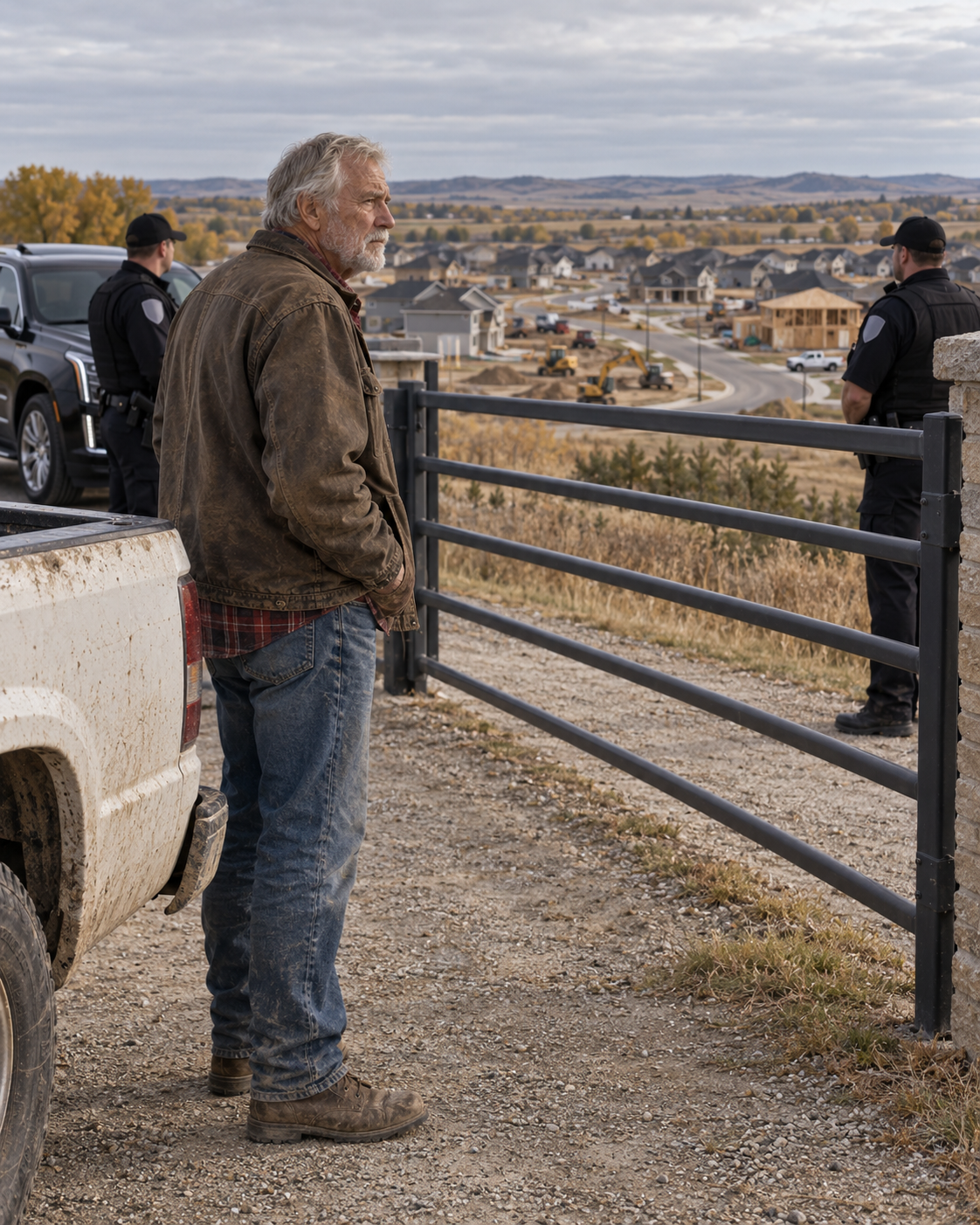
So when he reached the west entrance one cold October morning and saw a steel gate where his father had left a wooden one, he slowed without knowing why.
Then he hit the brakes.
Two men in dark jackets stepped out from a small security booth.
Walter lowered his window.
“What happened to the gate?”
“Can’t let you through,” one of the men said.
Walter looked past him.
Beyond the steel bars were paved streets, rows of nearly identical houses, construction trailers, and a line of young maple trees planted along a sidewalk.
For a second, he thought he had turned onto the wrong road.
Then a black SUV came around the corner inside the development and stopped at the gate.
The man who stepped out wore a charcoal suit and no coat despite the cold.
“Mr. Hale,” he said.
Walter recognized him immediately. Daniel Mercer, president of North Prairie Bank.
Mercer came to the gate carrying a thick folder.
“You’ve been busy,” Walter said.
Mercer smiled faintly. “We’ve been operating here for a long time.”
Walter looked over the man’s shoulder.
His family’s western pasture was gone.
Not changed. Gone.
The hills were still there, but between them and the horizon sat 286 houses.
“You built all this on my land.”
Mercer opened the folder.
“Not your land in the way you’re suggesting.”
Walter said nothing.
Mercer turned several pages and tapped one with a finger.
“Your father signed a seventy-five-year agricultural management and development agreement in 2014. It gave the bank control over this portion of the property, including development rights.”
“My father would’ve told me.”
“Perhaps he didn’t think he needed to.”
Walter held out his hand.
Mercer hesitated, then gave him the document.
The rancher turned the pages slowly.
Forty pages.
Dense paragraphs. Legal definitions. Development clauses. Assignment rights.
Then he reached the signature page.
His father’s name stared back at him.
Walter stopped breathing for a moment.
He knew that signature.
Or he knew what it was supposed to look like.
His father had signed with long, connected strokes, leaning slightly forward, as though the pen itself were being pulled across the paper. The signature on the agreement looked hesitant. Broken. Several letters were shaped differently from any signature Walter had seen on his father’s checks, tax forms, equipment contracts, or Christmas cards.
Walter closed the folder.
“When was this recorded?”
Mercer’s expression barely changed.
“It was handled properly.”
“I didn’t ask that.”
“You have the document.”
Walter handed it back.
Mercer folded his arms.
“Mr. Hale, you’ve inherited a name on a piece of paper. We’ve spent more than a decade investing in this property.”
Walter looked once more through the bars.
A little girl’s bicycle leaned against a driveway at the end of the street.
Someone had left a plastic pumpkin on a front step.
Laundry moved in a backyard three houses down.
People lived here.
People who had no idea why Walter was standing outside their neighborhood staring at them.
Mercer said, “You should think carefully before you interfere with something this large.”
Walter nodded.
“I intend to.”
He got back in his truck.
He didn’t say anything else.
The drive home took twenty minutes.
At the kitchen table, he turned the 2014 agreement over in his hands again.
Then he opened the drawer where his father had kept old receipts and pulled out an envelope.
On the back of a feed-store receipt, Walter wrote three questions.
Was the agreement actually recorded?
Could Dad understand it?
Who witnessed the signature?
The Boxes in the Barn
Three days later, North Prairie Bank sent Walter two letters.
The first warned him to stop interfering with lawful business operations.
The second said he could be held financially responsible for delaying a $96 million commercial project planned inside the development.
The third was delivered by certified mail to his house.
It wasn’t addressed to him.
It was addressed to the residents of Red Willow Estates.
Walter read it standing at his kitchen counter.
The bank described him as someone making a “questionable ownership claim.”
Within hours, the neighborhood’s private social-media group was filled with comments.
Some people called him greedy.
One person wrote that old landowners should not be allowed to “pull the rug out from under working families.”
Another asked why Walter didn’t just sell whatever claim he thought he had.
Walter read every message.
He answered none of them.
Instead, he took screenshots.
His daughter, Erin, called that evening.
“Dad, somebody contacted me.”
Walter looked up from the phone.
“Who?”
“He said he was a financial investigator. He asked whether I’d helped you create false inheritance papers.”
Walter sat back.
“Did he give you a case number?”
“No.”
“Agency?”
“No.”
“Anything in writing?”
“No.”
“Then don’t talk to him.”
Erin was quiet.
“Dad, what are you getting into?”
Walter glanced toward the window.
The ranch went dark beyond the glass.
“I don’t know yet.”
That was the truth.
The next morning, Walter drove to Lincoln to see attorney Mara Vance, who had spent two decades handling agricultural land disputes.
Mara listened without interrupting.
She studied the agreement.
She studied the inheritance documents.
She studied the letters.
Then she looked up.
“Where’s the original?”
“That’s what I’m trying to find.”
“No,” Mara said. “Where’s the original agreement from your father’s file?”
Walter stared at her.
“I don’t know.”
“Then we start there.”
He called his younger brother, Ross, who still helped maintain the old tractor shop behind the ranch.
“Go through Dad’s storage building.”
Ross laughed once.
“You mean the museum?”
“The boxes with his land papers.”
“You think I can find anything in there?”
“You’re the one who married a woman who labels her spice jars.”
A pause.
“I’ll look.”
Two days later, Ross arrived at Mara’s office with six dusty cardboard boxes.
Walter stood over the first one as Mara opened it.
Inside were tax records, equipment leases, survey maps, canceled checks, and letters written in his father’s blocky handwriting.
They spent most of the afternoon going through them.
Then Mara stopped.
She pulled out a letter dated 2013.
She read it once.
Then again.
“Walter.”
He leaned over her shoulder.
The letter was from his father to North Prairie Bank.
The bank had asked about managing and eventually developing the western part of the ranch.
His father had refused.
He had written that the western acreage would remain agricultural and that the family had no intention of granting development rights to a financial institution.
Walter sat down.
“He never told me about this.”
“He may not have thought he needed to.”
Mara placed the letter beside the disputed agreement.
One year separated the two documents.
Then they found something else.
Medical records.
Walter’s father had suffered a mild stroke several months before the alleged 2014 signing.
The records did not say he was legally incompetent.
They did, however, describe difficulties with memory, dates, and understanding complicated written material.
Mara leaned back in her chair.
“This doesn’t prove fraud.”
Walter nodded.
“I know.”
“But it gives us a reason to ask exactly what happened.”
A week later, the official land-record search came back.
There was no matching registration for the seventy-five-year agreement that clearly established development control over the 720 western acres.
The paper existed.
The bank had it.
But the county and state records did not show what North Prairie Bank claimed they showed.
Walter stared at the report.
“So they built a town on a contract nobody properly recorded.”
Mara shook her head.
“We don’t know that yet.”
She tapped the table.
“But we know their explanation has a hole in it.”
That afternoon, Walter drove back to the ranch.
He passed the west gate without stopping.
For the first time in his life, he found himself looking at the old fields as if they belonged to someone he had never met.
The People Behind the Houses
The first person from Red Willow Estates to contact Walter was a man named Luis Bennett.
Luis had served on the neighborhood finance committee when the development was still new. He had a wife, two teenagers, and a mortgage from North Prairie Bank.
He asked to meet in a coffee shop outside town.
“I don’t want my name anywhere,” Luis said.
“You don’t have to give it.”
Luis slid a folder across the table.
“I kept copies.”
Inside were neighborhood financial records.
Management fees.
Special assessments.
Invoices.
A line item called “community infrastructure services.”
Mara spent several hours comparing the records.
Then she found something strange.
Nearly $430,000 collected from residents over eight years had been labeled as community management expenses.
But many of the corresponding invoices were for legal work involving the bank’s control of the property.
Walter frowned.
“They used homeowners’ fees to defend their right to use the land?”
“It appears that way,” Mara said.
Luis looked sick.
“My neighbors think you’re trying to take their houses.”
Walter folded the papers carefully.
“I’m not.”
“That’s what I told them.”
“I wouldn’t blame them.”
Luis looked at him.
Walter went on.
“They paid for those houses. They raised their families there. I’m not going to make them homeless just because the bank may have broken the law.”
Luis leaned back.
“Then what do you want?”
Walter looked through the coffee-shop window at the traffic moving down the highway.
“I want the truth about what my father signed.”
The pressure continued.
A local feed-store owner told Walter that the bank had called about his credit line.
A family member received another suspicious call.
Then an envelope arrived at Walter’s house with no return address.
Inside was an aerial photograph of the ranch.
His barn.
His pickup.
The back pasture.
On the back of the photograph, someone had written:
Sell the rest of the land, and this will all be over.
Walter stared at the words for several seconds.
Then he put the photograph back into the envelope.
He did not sleep much that night.
At six the next morning, he drove to Lincoln.
Mara was waiting for him.
“We have two choices,” she said.
“Which ones?”
“We can spend the next few years arguing privately over signatures and paperwork.”
Walter waited.
“Or we can force the bank to tell the same story in public that it’s telling behind closed doors.”
Walter gave her a tired look.
“How?”
“Red Willow Hall.”
The bank had scheduled a community meeting to reassure residents about the stalled commercial project.
Mara knew something Walter didn’t.
The bank president was going to speak.
She smiled without humor.
“Let him explain the agreement himself.”
The Question in Red Willow Hall
The hall was packed Thursday night.
Walter arrived early.
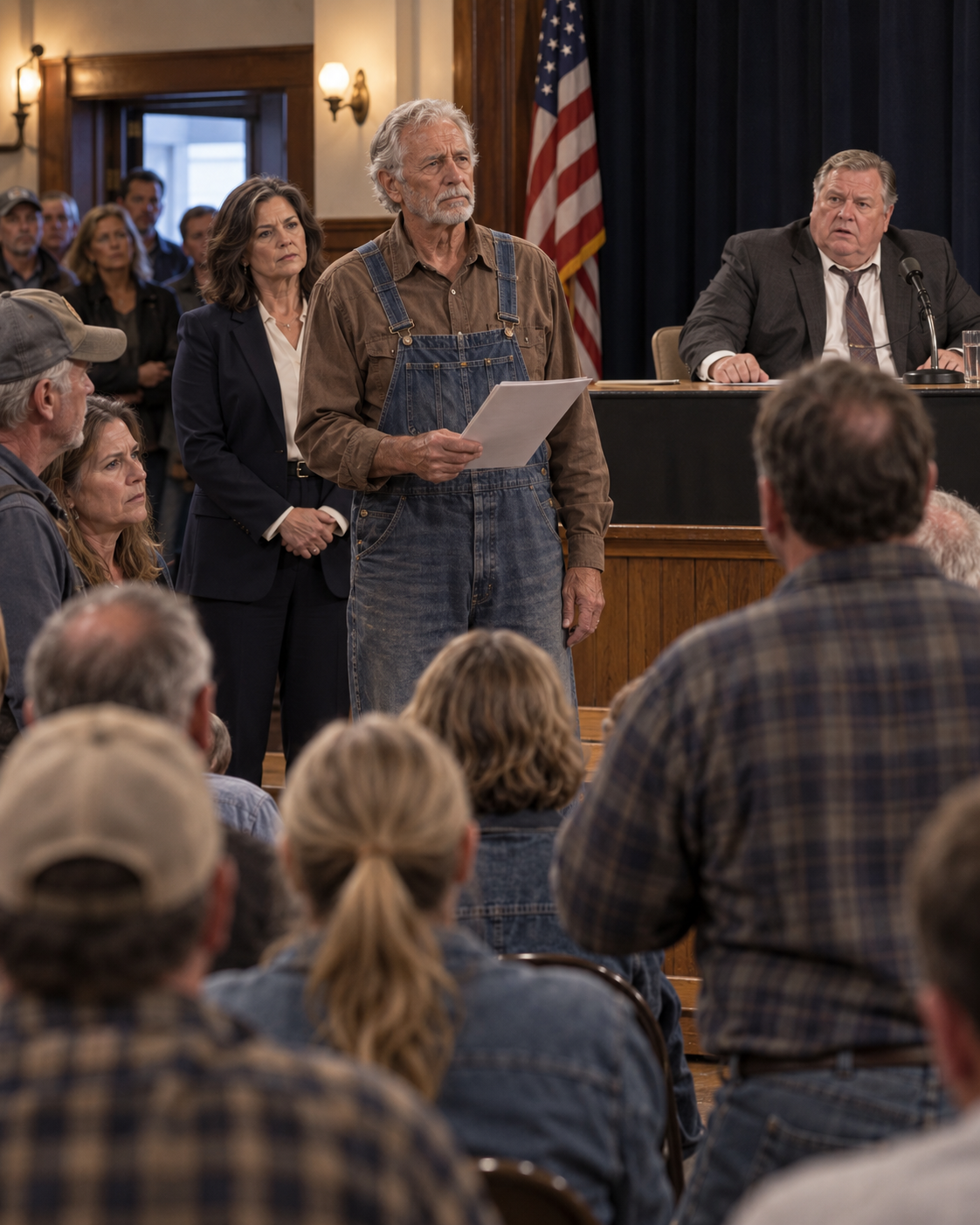
He wore faded blue overalls and the brown work shirt he’d worn repairing a fence that morning.
Mara sat three rows behind him.
Luis stood near the back.
The bank president walked onto the stage to polite applause.
Daniel Mercer looked comfortable.
He spoke about investment, jobs, neighborhood stability, and the company’s commitment to Red Willow Estates.
Then he reached the subject everyone had come to hear.
“The ownership dispute,” he said, “is based on a misunderstanding of a legitimate long-term agreement.”
Walter watched him carefully.
Mercer said North Prairie Bank had operated under the agreement for more than ten years.
He said the bank had followed every required procedure.
He said the development rights had been properly established.
Then a resident stood.
A woman Walter had never met held up a sheet of paper.
“Does the county have the agreement recorded?”
Mercer nodded.
“Yes.”
Another resident stood.
“My mortgage company says it can’t confirm that.”
Mercer smiled.
“There are administrative records that don’t appear in public searches. We’ve handled this correctly.”
Walter lowered his eyes.
Mara was writing something down.
Then Mercer said it clearly.
“We have a seventy-five-year development agreement signed in 2014, and I personally supervised its proper recording.”
The room went quiet.
Walter stood.
He did not raise his voice.
He simply walked toward the stage.
Mara met him halfway and handed him a certified document.
Walter turned to face the room.
“This is what the county and state search found.”
He held it up.
“The record shows no matching registration for the agreement Mr. Mercer just described.”
Someone near the front whispered, “Then what are we paying for?”
Mercer stepped toward the microphone.
“Mr. Hale, you’re misrepresenting—”
“Am I?”
Walter placed the document on the podium.
Mara stood.
“We also have the 2013 letter from Mr. Hale’s father rejecting development rights,” she said. “We have medical records concerning his condition shortly before the alleged signing. And we have independent evidence questioning the signature.”
Mercer’s face had changed.
He no longer looked annoyed.
He looked cornered.
For months, the dispute had been described as an old man making an uncertain claim.
Now hundreds of homeowners were hearing a different question.
What exactly had the bank relied on?
And why?
What the Signature Could Not Explain
The hearing began four days later.
Mara did not arrive with a grand argument.
She arrived with boxes.
The first contained the 2014 agreement.
The second held the certified land-record searches.
The third held letters, medical records, and eighteen confirmed signatures from Walter’s father.
A document examiner compared the signatures one by one.
The differences were subtle.
The disputed signature pressed harder in some places and weakened abruptly in others. Several letters connected differently. One character had been formed in a way Walter’s father had never used in the eighteen confirmed examples.
The expert did not declare a spectacular forgery.
He said something more careful.
The signature contained several unusual features, and the circumstances surrounding it required further explanation before the document could be treated as reliable evidence of his father’s intent.
Then Luis testified.
He turned over meeting records showing that legal expenses related to the land dispute had been classified under community fees.
The bank’s attorneys argued that ten years of development and management should count for something.
The judge asked a question that seemed almost too simple.
“Where is the deed?”
Nobody answered.
“The purchase agreement?”
Silence.
“The payment to the Hale family for the 720 acres?”
Nothing.
Everything returned to the same document.
The seventy-five-year agreement.
A document whose signature was disputed.
A document whose registration could not be established as the bank had claimed.
A document signed, allegedly, by a man whose medical records raised questions about whether he understood what he was signing.
The judge issued a preliminary ruling in Walter’s favor.
North Prairie Bank could no longer claim unrestricted control over the disputed land.
Construction stopped.
Financial records were ordered into an independent audit.
The commercial project was put on hold.
The development did not disappear.
The families did not vanish.
But the wall of certainty around the bank finally cracked.
Over the next several months, investigators reviewed the development’s records.
The bank’s board suspended Mercer’s authority over major transactions.
He was later fired.
The audit found unexplained fees and transactions that required further investigation.
Nothing happened overnight.
Walter learned that real victories rarely did.
Some mornings he still drove past Red Willow Estates and saw construction workers standing idle beside unfinished buildings.
Other mornings he saw parents walking children to school.
Those were the mornings he remembered why he’d refused to turn his anger toward the people living there.
Eventually, the settlement came.
The family’s ownership of the ranch was confirmed.
Millions of dollars in improperly collected community fees were returned.
The stalled commercial project was restructured under new legal agreements.
And the western acreage was placed under a new residential arrangement that gave homeowners a voice in the community’s finances.
The families stayed.
So did Walter.
The Field at the End of the Road
A year after the first meeting, Walter stood at the edge of what had once been his father’s western pasture.
It was early spring.
The old development road still carried traffic, but now there was a wide strip of native grass along its edge.
Beyond it, workers were planting cottonwood trees.
Mara had convinced Walter to reserve part of the land for a public green space.
A walking trail ran toward the low hills.
There would be a community garden near the old fence line.
Walter watched a group of residents unloading lumber for raised garden beds.
Luis waved from across the field.
Walter lifted a hand in return.
Erin came up beside him carrying two paper cups of coffee.
“You ever imagine this?” she asked.
“What part?”
“That you’d still be standing here.”
Walter looked toward the houses.
“No.”
She handed him a cup.
“You could’ve sold everything.”
“I know.”
“You could’ve fought them until every homeowner hated you.”
Walter shook his head.
“My father would’ve hated that.”
Erin smiled.
“You keep saying you know what Grandpa would’ve done.”
Walter looked down at the field.
“I’m not sure I do.”
The wind moved through the dry grass.
For decades, Walter had believed inheritance meant receiving what someone before you had protected.
Now he understood it differently.
Sometimes what you inherit is a responsibility to decide what should happen next.
A few minutes later, a little boy from the neighborhood rode past on a red bicycle.
He stopped near the trail.
“Mr. Hale?”
Walter turned.
“Yeah?”
“Is this your land?”
Walter looked at the houses, the trail, the young trees, and the broad field stretching toward the hills.
Then he smiled.
“Some of it.”
The boy nodded, apparently satisfied.
“Can I ride here?”
Walter took a sip of coffee.
“As long as you don’t tear up my grass.”
The boy grinned and pedaled away.
Walter watched him disappear around the bend.
The western sky was turning gold.
For years, the pasture had belonged only to his family.
Now houses stood where cattle once grazed, children played where tractors had passed, and people who had once been strangers were building something that none of them had expected.
Walter put one hand on the old fence post beside him.
The wood was cracked and gray.
His father’s handwriting was still visible on a small metal tag nailed beneath it, faded almost beyond recognition.
Walter ran his thumb over the edge of the tag and looked out across the field.
The land was still his.
But standing there, he realized that ownership had never been the part he had been trying hardest to protect.
It was the choice of what to do with something after someone else tried to decide its future for you.
He left the fence post where it was.
Then he walked toward the people waiting to plant the first garden.