The Door That Wouldn’t Open
At 6:47 on a Tuesday evening, Dorothy Hastings was standing over a pot of chicken and dumplings when her daughter left a voicemail asking her not to come to the lake house that summer.
Dorothy knew the exact time because she’d glanced at the microwave before answering the phone.
She listened once.
Then again.
“Hey, Mom. Kevin and I were talking, and we think it might be better if you don’t come up this summer. The kids want to bring friends, and Kevin’s parents are coming from Denver. It’s just…there isn’t enough room. You understand, right? We’ll figure out another time. Love you.”
The message ended.
Dorothy stood very still, wooden spoon in hand.
On the stove, the dumplings bobbed in the broth.
She turned off the burner.
Her husband, Samuel, had taught her that recipe forty-one years earlier. He always said the secret was patience.
“Stir slow,” he’d told her. “Good things don’t like to be rushed.”
Samuel had been gone six years.
Dorothy was sixty-eight, retired after thirty-four years as a nurse in Atlanta, and she had spent most of those years being useful to somebody.
Patients.
Coworkers.
Her children.
Her grandchildren.
Samuel.
Especially Samuel.
After he died, she had taken the money he’d left behind, combined it with her retirement savings, and built the lake house they had talked about for years.
It sat near Lake Oconee, tucked between tall pines, with a wraparound porch and a stone fireplace. The front door was painted sage green because Samuel had always said green was the color of home.
He had sketched the place on restaurant napkins.
Dorothy had turned those sketches into walls.
And now her daughter was telling her there wasn’t enough room for her.
The first summer at the lake house had been everything Dorothy imagined.
She’d filled the refrigerator until the shelves groaned. There were fishing rods leaning against the porch, board games stacked in the living room, beach towels in every bedroom, and homemade peach jam in the pantry.
Her grandchildren ran barefoot through the grass.
Lorraine, Dorothy’s daughter, read novels on the porch swing.
Kevin grilled ribs beside the fire pit.
Dorothy’s son, David, played guitar after dark.
Her sister Pauline sat beside her in an Adirondack chair, laughing about the time their mother had shaved both girls’ heads after they caught lice at summer camp.
Above the fireplace hung a photograph of Samuel.
Nobody questioned it.
Nobody moved it.
For one beautiful summer, the house belonged to everyone.
Dorothy thought that was what Samuel had wanted.
She didn’t realize how quickly “everyone” could become “some people.”
The House Slowly Became Theirs
The second summer, Kevin began offering suggestions.
The dock needed to be longer.
The fire pit should be converted to gas.
The guest room would make a better office now that he worked remotely.
Dorothy listened.
She told herself he was simply making the house more comfortable.
Then Lorraine stopped asking Dorothy to sit on the porch in the mornings.
She and Kevin began taking the children out on rented boats.
Dorothy would sometimes stand behind the screen door holding a pitcher of lemonade.
No one would ask for it.
At Thanksgiving, Lorraine pulled her mother aside after dinner.
“Mom, Kevin and I were thinking about something.”
Dorothy dried her hands on a dish towel.
“What kind of something?”
“Since we use the lake house more than anybody, maybe it makes sense for us to take over the property.”
Dorothy stared at her.
“For tax reasons,” Lorraine added quickly. “And upkeep. It would simplify everything.”
“It’s in my name.”
“I know.”
“And it stays in my name.”
Lorraine smiled.
“Okay. Just a thought.”
It wasn’t.
Two weeks later, a letter arrived from an attorney.
It suggested Dorothy voluntarily transfer ownership of the lake house to Lorraine and Kevin.
Dorothy read the letter three times.
Then she folded it carefully and placed it in the bedside drawer where she kept Samuel’s wedding ring and his old reading glasses.
She didn’t call Lorraine.
She didn’t argue.
Instead, she began paying attention.
The phone calls became shorter.
The lake house was mentioned as though Dorothy had no connection to it.
“Kevin’s parents are staying there over Easter.”
“We had the dock repainted.”
“It’s easier if we handle things ourselves.”
Then, in April, Kevin changed the locks.
He gave Dorothy a new key.
When she drove up in May, it didn’t work.
She stood on the porch she’d designed, staring at the sage-green door.
She tried the key twice.
Nothing.
She called Lorraine.
“Oh, Kevin must have changed the lock again,” her daughter said. “I’ll get you a copy.”
Dorothy waited.
No copy came.
That evening, she sat in her car beneath the pine trees.
She could see Samuel’s photograph through the window.
For years, he’d talked about having a place where the family could gather.
He had never imagined Dorothy would someday need permission to enter it.
She drove back to Atlanta in silence.
The next morning, she opened the filing cabinet in her study.
The deed was exactly where she’d left it.
Dorothy Hastings.
Sole owner.
No transfer.
No co-owner.
No amendment.
The house was hers.
The question was what she wanted to do with it.
The Decision She Didn’t Announce
Dorothy called her attorney, Grace, before she called her daughter.
Grace listened to everything.
The letter.
The locks.
The conversations.
The missing key.
When Dorothy finished, Grace was quiet for a moment.
“Dorothy,” she said, “they can’t take your property from you because they’ve decided they use it more.”
Dorothy closed her eyes.
“I know.”
“Then what are you going to do?”
Dorothy looked across her study at Samuel’s photograph.
“I don’t know yet.”
She called Lorraine one last time.
“I’m thinking about coming up next weekend,” Dorothy said. “I’ll bring some of the peach jam the kids like.”
There was a pause.
“Mom, Kevin’s parents are staying through the month.”
“Oh.”
“Maybe August?”
Dorothy looked down at her hands.
“August,” she repeated.
“Yeah. We’ll figure it out.”
After they hung up, Dorothy sat for several minutes.
Then she opened her laptop.
She searched for real estate agents near Lake Oconee.
She didn’t tell anyone.
The house sold quickly.
The buyers were an older couple from Savannah who wanted a place where their grandchildren could spend Christmas.
They loved the porch.
They loved the fireplace.
They loved the dock.
Most of all, they loved the idea of having everyone around one table.
Dorothy accepted their offer.
The closing was scheduled for early July.
She never told Lorraine.
Not because she wanted to punish her.
Because she had spent too many years explaining herself to people who had already decided what she owed them.
On the day she signed the papers, Grace slid the documents across the desk.
“Are you sure?”
Dorothy looked at the signature line.
“Yes.”
She signed.
The house was no longer hers.
And, strangely, she felt lighter.
The Call on the Fourth of July Weekend
Lorraine called the day before the holiday.
Her voice was frantic.
“Mom, what happened?”
Dorothy was sitting at her kitchen table.
“What do you mean?”
“There’s another family at the lake house.”
Dorothy said nothing.
“Kevin’s parents just got there. There’s a moving truck. The people there said they bought the house.”
Another silence.
“Mom?”
“I sold it.”
“What?”
“I sold the lake house.”
“You can’t do that!”
Dorothy almost laughed.
The sentence was so familiar.
Not How could you?
Not I’m sorry.
Not Why did we hurt you?
Just:
“You can’t do that.”
Dorothy looked at the wooden spoon beside her.
“Lorraine, it’s my house.”
“But we had plans.”
“So did I.”
“Mom, the kids were expecting—”
“I know.”
Her daughter began crying.
Dorothy waited.
Then she said quietly, “You told me there wasn’t enough room for me.”
“That wasn’t what we meant.”
“You changed the locks.”
“Kevin handled that.”
“You had an attorney send me papers.”
“We were trying to be practical.”
“And you told me to come back in August.”
Lorraine stopped speaking.
Dorothy took a slow breath.
“I spent years believing love meant making myself smaller whenever somebody needed more room.”
“Mom—”
“I won’t do that anymore.”
Kevin’s voice could be heard somewhere behind Lorraine.
Dorothy didn’t need to hear the words.
She knew that voice.
“I love you,” she said. “But loving you doesn’t mean handing you the right to decide where I belong.”
Then she ended the call.
The phone rang again.
She didn’t answer.
Then again.
She turned it face down.
David called that evening.
His voice was gentle.
“Mom, are you okay?”
Dorothy looked toward the window.
“Yes.”
“You sure?”
She smiled.
“For the first time in a while.”
There was a pause.
“Dad would’ve understood.”
Dorothy pressed her lips together.
That was all it took.
Her eyes filled.
Not because she regretted selling the house.
Because, for once, someone understood why.
The Women Who Came Instead
The money sat untouched for nearly two weeks.
Dorothy didn’t buy a new car.
She didn’t move.
She didn’t spend it on herself.
Instead, she made a list.
At the top she wrote:
Women who stayed.
Hattie, seventy-three, who had raised four grandchildren after her daughter disappeared from their lives.
Ernestine, seventy, who had driven the church van every Sunday for fifteen years.
Claudette, sixty-nine, who had never seen the ocean.
Rosalyn, sixty-six, a retired school principal who lived alone in a house that had become too quiet.
Pearl, seventy-one, who had buried almost everyone she loved and still showed up early to church dinners to help set the tables.
Dorothy called each one.
“I want to take you somewhere.”
“Where?”
“Somewhere with an ocean.”
There was laughter.
Then disbelief.
Then silence.
Dorothy rented a large beachfront house on Hilton Head Island.
Six bedrooms.
A long dining table.
A wide porch facing the water.
No one had to cook if they didn’t want to.
No one had to wake up early.
No one had to be useful.
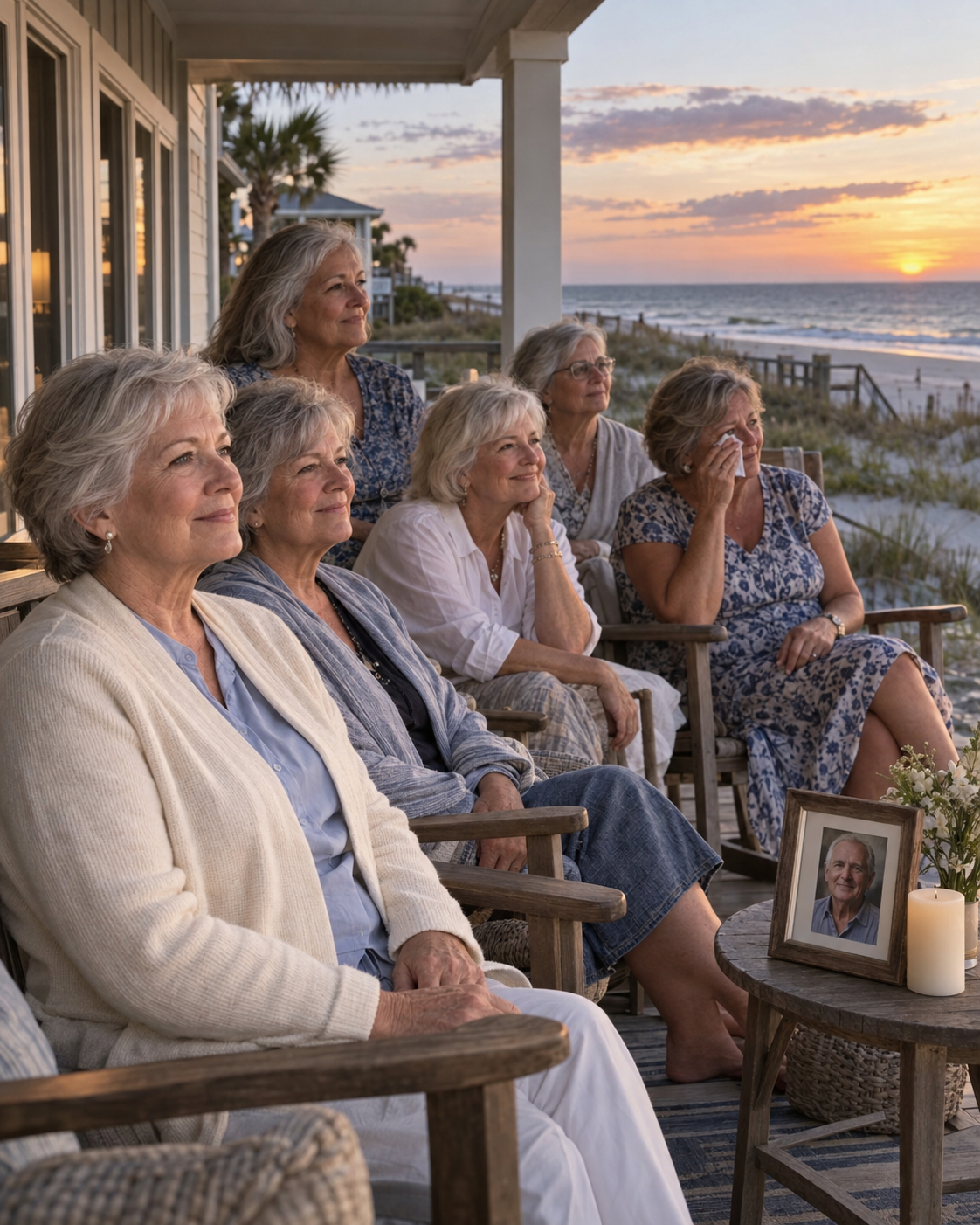
On the first evening, Dorothy placed Samuel’s photograph in the center of the dining table.
The women gathered around it.
Ernestine touched the frame.
“He looks happy,” she said.
“He was,” Dorothy replied.
Later, they sat outside in rocking chairs.
The ocean moved in darkness beyond the porch.
Claudette listened for several minutes.
Then she whispered, “I can hear them.”
Dorothy turned.
“The waves.”
Claudette smiled through tears.
“They sound like applause.”
Nobody corrected her.
Nobody told her she was being sentimental.
They simply listened.
They spent the week doing ordinary things.
They walked barefoot on the beach.
They cooked breakfast together.
They took pictures.
They argued over who made the best coffee.
Hattie built a sandcastle and refused help.
Pearl went swimming for the first time in her life.
Rosalyn sang after dinner until the neighboring porch applauded.
Every night, they lit the candle beside Samuel’s photograph.
Nobody called it healing.
They simply enjoyed being together.
On the final evening, Dorothy stood at the edge of the water with the others.
The tide reached their ankles.
For a while, nobody spoke.
Then Hattie said, “You know what I wish I’d understood sooner?”
“What?” Dorothy asked.
“That being needed isn’t the same thing as being loved.”
Dorothy looked at her.
No one answered.
They didn’t have to.
The Email
Three weeks after Dorothy returned to Atlanta, she was making peach jam when her laptop chimed.
The subject line read:
Can We Talk?
It was from Lorraine.
Dorothy wiped her hands on a towel and opened it.
Her daughter wrote that everything had been difficult since the lake house was sold.
The children had been disappointed.
Kevin’s parents had needed a hotel.
Kevin admitted that changing the locks “could have been handled differently.”
The attorney letter had perhaps been “too much.”
Then came the part Dorothy had expected.
Money was tight.
Kevin’s bonus hadn’t arrived.
School tuition was due.
Could Dorothy help with $15,000?
“We’re still family,” Lorraine wrote.
Dorothy read the email twice.
Then she closed the laptop.
She didn’t slam it.
She didn’t cry.
She simply stood there for a moment with her hands resting on the counter.
The kitchen smelled like peaches and sugar.
Samuel’s recipe.
Patience.
Stir slow.
She looked through the window at her quiet backyard.
For years, Dorothy had believed a home was something you built for other people.
A porch for children.
A guest room for relatives.
A stocked refrigerator.
A door that was always open.
She had built all of that.
But she’d forgotten one thing.
A home needed a place for the person who built it.
Dorothy finished the jam and poured it carefully into six small Mason jars.
One for each woman who had gone with her to the ocean.
The next morning, she would mail them.
She found a stack of small cards and wrote the same sentence on each one.
A sentence Samuel had once said to her before leaving for work, back when neither of them knew how much time they had.
You are my favorite place.
Dorothy set the jars in a row on the kitchen counter.
Then she opened the back door.
Warm evening air moved through the house.
She left the door that way while she cleaned the dishes.
She didn’t need a lake anymore.
She didn’t need a house big enough for people who only wanted her when she was giving something away.
She had finally learned what an open door was supposed to feel like.
Not an invitation to everyone.
A choice.
And for the first time in years, Dorothy was the one deciding who came through it.