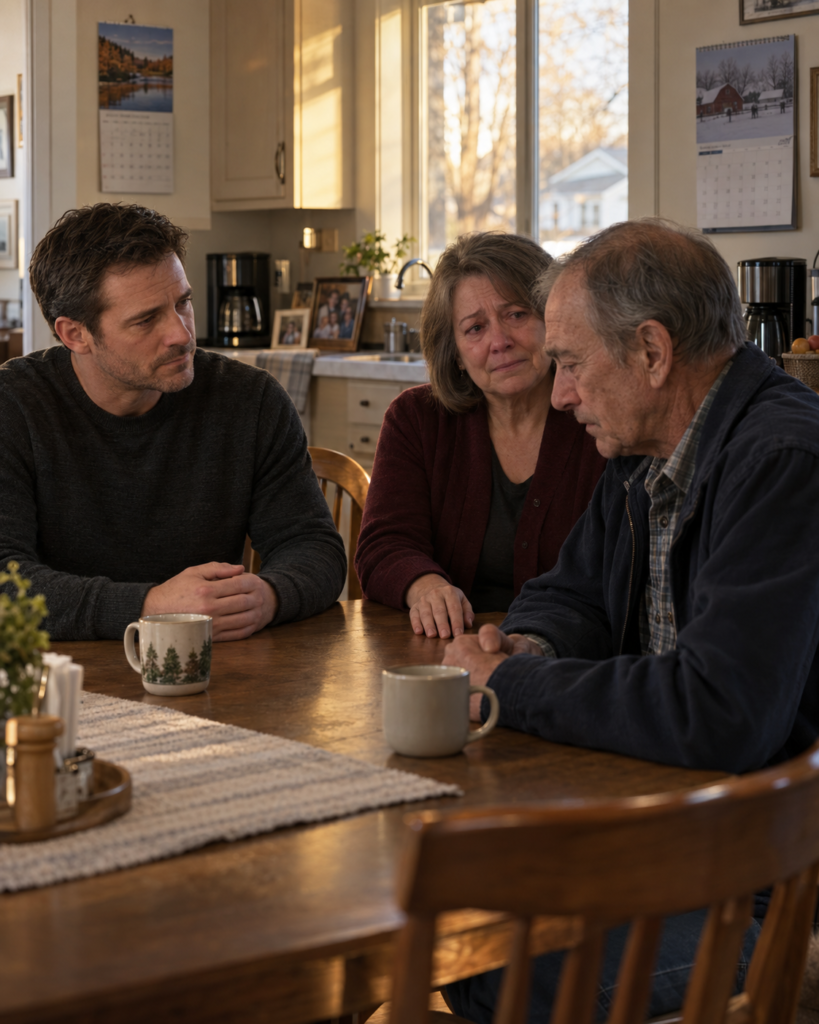
The call came at 2:47 a.m., which was exactly the kind of hour when Colby liked to pretend nothing bad could happen.
Deputy Aaron Vale was halfway through a lukewarm coffee when dispatch broke the silence.
“Possible trespassing. Windsor Mill property. Owner says he heard voices.”
Aaron looked through the windshield at the empty county road. Beyond the patrol lights, the prairie disappeared into darkness.
“Any description?”
“Negative. Owner reports three or four people. Says there was shouting.”
Aaron sighed and put the truck in gear.
He had worked nights for seven years. Most of Colby’s crimes came with broken beer bottles, bad decisions, or somebody’s boyfriend refusing to leave. The abandoned mill was different only because it had a reputation.
A fire had gutted Windsor Mill fourteen years earlier. Four workers died. The owner, Ralph Windsor, had never sold the property, even after the county condemned the building.
Teenagers dared each other to sneak inside.
Homeless travelers sometimes sheltered there.
Local kids swore they heard voices beneath the concrete.
Aaron had never believed any of it.
Then he saw the open gate.
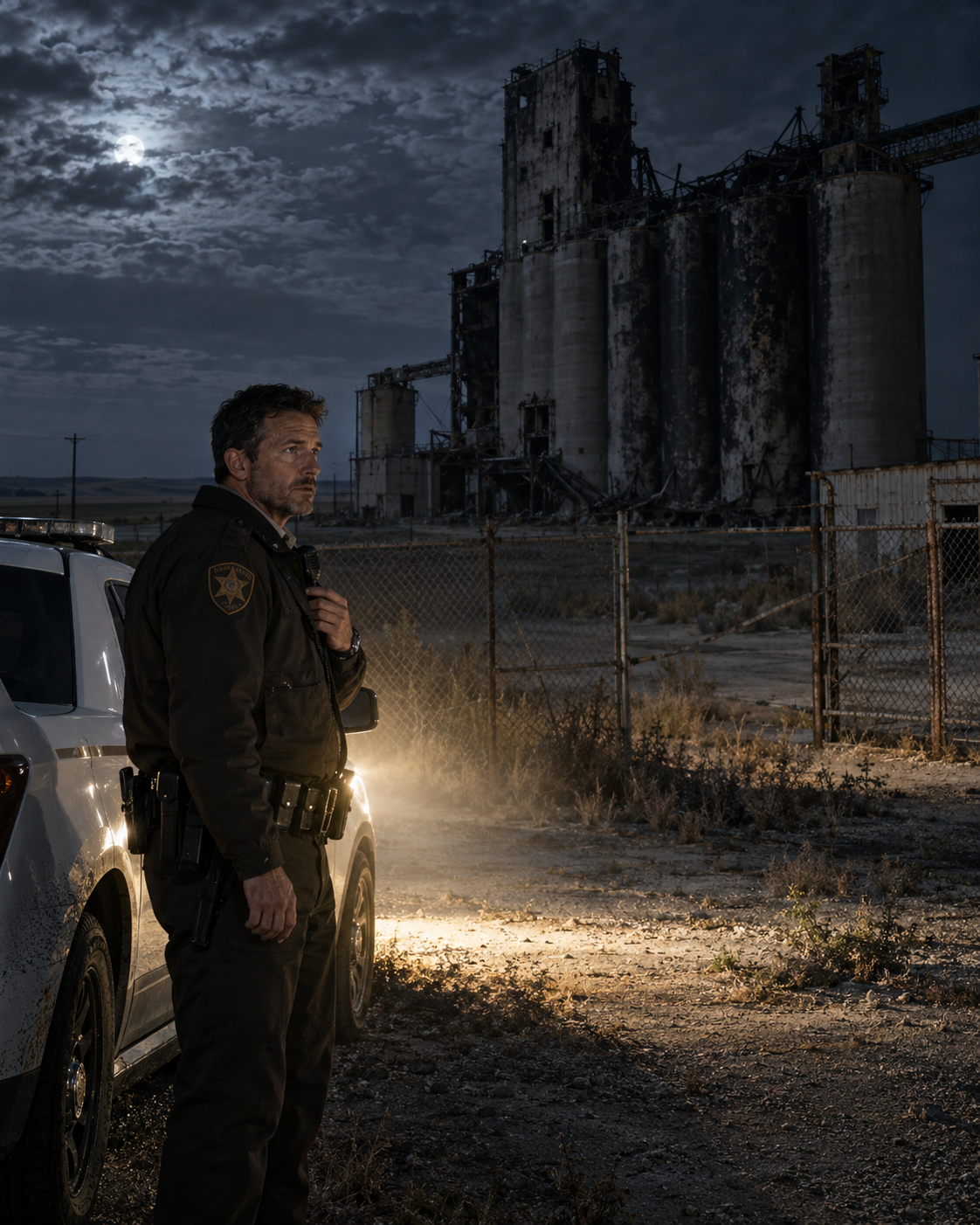
Aaron killed the engine and stepped out.
Ralph Windsor stood beside an old pickup near the fence, hunched inside a heavy coat.
“You hear them again?” Aaron asked.
Ralph nodded.
“Down below.”
“You went inside?”
“I’m eighty-three, not stupid.”
Aaron smiled faintly.
Ralph pointed toward a hole in the concrete wall.
“They weren’t kids.”
“What makes you say that?”
“Kids yell. These people were whispering.”
Aaron slipped his flashlight from his belt.
“Stay here.”
Ralph grabbed his sleeve.
“Aaron.”
The older man’s hand was surprisingly strong.
“Whatever they’re doing down there,” Ralph said, “they don’t want anybody hearing it.”
Aaron looked at him for a second, then pulled free.
“I’ll be back.”
He crawled through the opening.
The smell hit first: wet earth, old grain, and something sour underneath.
His flashlight swept across machinery, pipes, collapsed beams, and walls blackened by the old fire.
Then he heard a sound.
Not shouting.
A soft, rhythmic knocking.
Three knocks.
Pause.
Three knocks again.
Aaron followed it down a narrow service corridor.
He found the first body twenty yards later.
A man in a gray sweatshirt lay against the wall, one leg twisted beneath him. There was dried blood across the concrete and a deep wound beneath his ribs.
Aaron stopped breathing for a moment.
Then training took over.
He drew his weapon.
“Sheriff’s office! Anybody else down here, make yourself known!”
Something moved in the adjoining room.
Aaron stepped around the doorway.
A second man was on the floor.
Another man stood over him, gripping a chunk of concrete.
The attacker froze.
He looked no older than thirty.
His wrists were bound with plastic restraints. Blood covered his shirt. His eyes were huge.
“Don’t shoot,” he whispered.
Aaron kept his weapon trained on him.
“Drop it.”
The man released the concrete.
It hit the floor with a hollow crack.
Aaron cuffed him, called for backup, and checked the second victim. Nothing.
The suspect kept whispering.
“They told me the fire was a door.”
Aaron glanced at him.
“What?”
“They said the fire opens it.”
“Who said that?”
The man looked toward the back wall.
Aaron followed his gaze.
A strange circular symbol covered the concrete.
Six rings inside one another.
Around them were dozens of cramped markings, all drawn by hand in a dark reddish substance.
Aaron felt the first real chill of the night.
“What’s your name?”
The suspect swallowed.
“Daniel.”
“Daniel what?”
Daniel shook his head.
“They said names don’t matter downstairs.”
A sharp metallic sound came from somewhere deeper in the tunnel.
Aaron turned.
When he looked back, Daniel was staring directly at him.
“They’re still here,” he said.
A blue flame appeared on Daniel’s shoulder.
Aaron thought it was a trick of the light.
Then Daniel screamed.
The Mark on the Concrete
Aaron had seen people burn themselves before.
Gasoline accidents.
Electrical fires.
House fires.
This was nothing like those.
The flame spread without smoke at first. It traveled across Daniel’s coat as if following invisible lines stitched into the fabric.
Aaron tried to grab him, but heat drove him backward.
“Get down!”
Daniel stumbled into the wall.
The circular symbol behind him seemed brighter.
Aaron called for fire equipment, but his radio only hissed.
Daniel fell.
Aaron dragged a fire extinguisher from the corridor and emptied it over him.
The flames shrank.
For three seconds, Aaron thought he had stopped it.
Then Daniel stood.
Aaron stared.
Daniel’s clothes had burned away in places. His skin was blackened, yet he remained upright.
Worse, he was smiling.
Not a wild smile.
A calm one.
As if somebody had finally told him good news.
Aaron raised his gun.
Daniel looked past him toward the symbol.
“They’re waiting,” he said.
Then he walked toward the wall.
Aaron fired twice.
Daniel staggered but did not fall.
He reached the symbol, touched it with one burned hand, and seemed to collapse inward.
His body broke apart into a fine layer of ash.
Silence returned.
Aaron stood alone, gun shaking in his hand.
A few minutes later, deputies arrived.
The official report called Daniel’s death a suicide.
Aaron hated the word.
He hated every word of it.
The scene made no sense, but reports were supposed to make sense. Reports gave supervisors something orderly to file away.
So Aaron wrote what could be explained.
Two dead men.
One unidentified suspect.
Possible narcotics.
Possible suicide.
He left out the part about the body standing after being shot.
He left out the symbol.
He left out the fact that he could still smell burned cloth on his uniform three days later.
A week afterward, Aaron requested a transfer.
He never told anyone why.
Then a woman came into the station carrying a photograph.
The Woman in the Photograph
Her name was Elise Harper.
She was thirty-six, exhausted, and holding a picture of her younger brother.
Aaron recognized the face immediately.
Daniel.
Or at least the man from the mill before the fire.
“He disappeared nine years ago,” Elise said.
Aaron looked down at the photograph.
“Are you sure?”
“I’ve been sure for nine years.”
She sat across from him.
“He was involved with a group in Colorado. They called themselves the Renewal Circle. Not officially. That was just what Daniel called it.”
Aaron felt the room narrow around him.
“Did they use this?”
He sketched the six-ring symbol on a sheet of paper.
Elise stared at it.
Then she covered her mouth.
“Where did you see that?”
Aaron said nothing.
She reached into her bag and removed a second photograph.
It showed a burned church surrounded by snow.
The same symbol had been painted across its foundation.
“My brother said the people in that group believed suffering could change a person,” Elise said. “They talked about fire like it was a cleansing process.”
Aaron leaned back.
“What happened at the church?”
“They burned it.”
“Accident?”
“No.”
She looked directly at him.
“Daniel was one of three people who escaped.”
Aaron felt his stomach tighten.
“You said three.”
“One came home.”
“And the other?”
Elise hesitated.
“We never found her.”
Aaron thought of the second body at the mill.
He stood.
“Show me everything.”
That night they drove to Elise’s apartment and opened boxes that had been sealed for nearly a decade.
Letters.
Photographs.
Handwritten notes.
News clippings.
Aaron found one photograph of Daniel standing with several people outside the church.
At first, he almost missed the figure in the back.
A tall man with bent shoulders and gray hair.
Ralph Windsor.
Aaron stared at the image.
“He knew them?”
Elise shook her head.
“I don’t know.”
Aaron turned the photograph over.
There was handwriting on the back.
Six names.
A date.
And one sentence:
The door stays open after the fire.
The lights went out.
Elise froze.
Aaron reached for his flashlight.
From somewhere inside the apartment came three soft knocks.
Pause.
Three more.
What Was Waiting Beneath the Ash
The sound came again.
Three knocks.
Three knocks.
Aaron drew his pistol.
“Elise, stay behind me.”
Something scraped across the floor in the hallway.
They moved toward the bedroom.
Aaron opened the door.
Nothing.
Only an empty closet.
Then Elise whispered.
“Aaron.”
She was looking at the photograph.
The image of the burned church had changed.
At least, Aaron knew it had.
Where the foundation had been empty, there was now a dark human-shaped stain beside the symbol.
Aaron blinked.
The shape remained.
Then the lights snapped back on.
The knocking stopped.
Neither of them spoke.
The next morning, Aaron returned to Windsor Mill.
This time, he brought a flashlight, two deputies, and enough equipment to tear open every sealed room in the basement.
They found an underground chamber beneath the main service tunnel.
No bodies.
No cult.
No hidden people.
Just shelves.
On the shelves were old jars, photographs, police reports, newspaper clippings, and personal belongings.
Hundreds of them.
Missing-person cases from Nebraska.
Colorado.
Kansas.
Oklahoma.
Some dated back thirty years.
Aaron opened one box and found a child’s shoe.
Another contained wedding rings.
Another held a driver’s license belonging to a man who had disappeared in 1998.
The symbol was everywhere.
So were the same words, written over and over:
MAKE THE ANGEL.
Behind the shelves, they discovered a steel door.
It had no handle.
Only six circular grooves.
Aaron stepped closer.
Then he noticed something on the floor.
A fresh footprint.
Bare.
Black with soot.
One deputy whispered, “Nobody’s been down here.”
Aaron didn’t answer.
The footprint led to the door.
Then another appeared.
Closer.
Another.
Closer.
As if somebody invisible were walking toward them.
Aaron raised his weapon.
“Back up.”
The air changed.
Every flashlight flickered.
A low hum filled the chamber.
Then something tapped from inside the steel door.
Three knocks.
Pause.
Three knocks.
The deputy beside Aaron began crying.
Aaron reached for the radio.
“Seal the corridor,” he said.
The door unlocked by itself.
It opened inward.
There was no room behind it.
Only darkness.
And deep inside that darkness, something breathed.
Aaron stepped backward.
For the first time since joining law enforcement, he did not think about arresting anyone.
He thought about surviving.
He ordered everyone out.
They sealed the chamber beneath the mill and poured concrete into the entrance two days later.
Ralph Windsor died six months afterward.
Before he died, Aaron visited him one last time.
“You knew,” Aaron said.
Ralph sat by his kitchen window, watching wheat move in the wind.
“I knew enough.”
“Why keep the property?”
Ralph’s eyes stayed on the field.
“Because every town has a place people stop looking at.”
Aaron felt a coldness move through him.
“And you thought that was better?”
Ralph finally looked at him.
“I thought it was safer to know where the door was.”
The Last Call
Two years passed.
Aaron left the sheriff’s office.
He moved to a different town, married a woman who never asked why he sometimes woke before dawn, and learned to live with the parts of the story he could not explain.
He never returned to Colby.
Then, one October evening, his phone rang.
An old colleague was on the other end.
“You need to hear this.”
“What happened?”
“Construction crew hit something under Highway 24.”
Aaron sat down.
“What kind of something?”
The colleague hesitated.
“An old foundation.”
Aaron looked out his apartment window.
Rain moved down the glass.
“And?”
“They found a symbol.”
Aaron closed his eyes.
“How many rings?”
A pause.
“Six.”
He said nothing.
His colleague lowered his voice.
“There’s more.”
Aaron waited.
“They also found a fresh footprint.”
Aaron looked at his reflection in the dark window.
For a second, he thought he saw a black mark behind his shoulder.
A circle.
Then another.
Then another.
He turned quickly.
Nothing was there.
The phone remained against his ear.
“Where?”
“About twelve miles from Windsor Mill.”
Aaron listened to the rain.
Then came a faint sound from somewhere down the hallway outside his apartment.
Three knocks.
He stopped breathing.
Three more.
He did not reach for a weapon.
He did not move toward the door.
Instead, he picked up the photograph he had kept all these years—the one showing Daniel in front of the burned church.
He turned it over.
The handwriting on the back looked exactly as he remembered.
Except for one new line.
One he had never seen before.
It was written beneath the old sentence in fresh black ink.
THE DOOR REMEMBERS WHO OPENED IT.
Aaron stared at the words.
Then the knocking came again.
Three times.
And this time, from the other side of his bedroom door, a man’s voice whispered his name.