The Road With Three Feathers
Joseph Yazy knew every washboard road west of Flagstaff, including the ones most people pretended weren’t there.
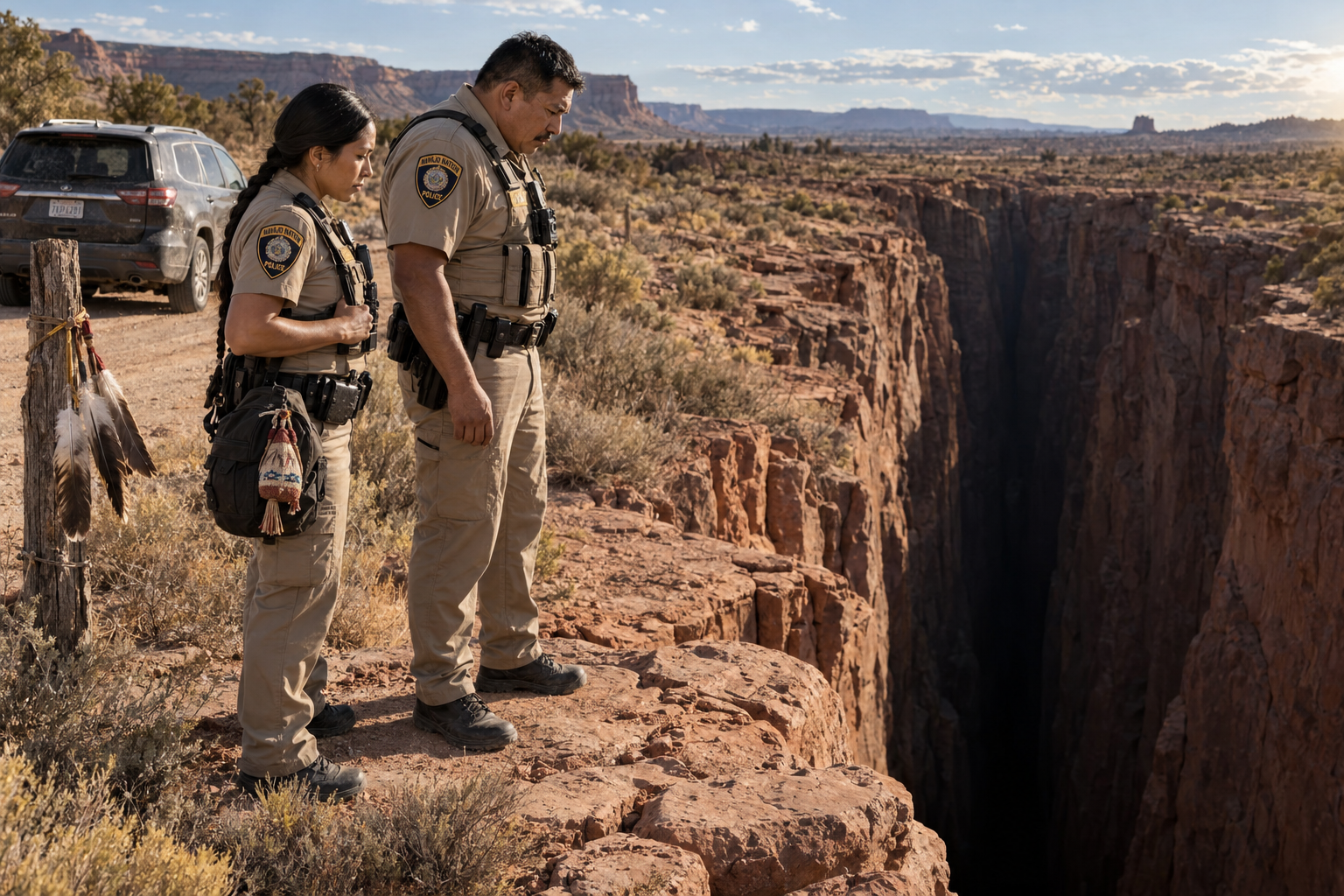
So when he saw the canyon, he stopped the cruiser.
It was September 15, 2024, just after four in the afternoon. The desert was still hot enough to press a dry hand against the windows, and the road behind him was nothing more than tire tracks threading through scrub.
But ahead, where Joseph remembered a low ridge of red stone, the earth dropped away.
A narrow canyon opened beneath the sun.
Patricia Beay got out beside him and said nothing.
She was a tribal police officer too, five years younger than Joseph, with dark hair pulled into a tight braid and the habit of touching the small medicine bundle in her duty bag whenever something felt wrong.
Joseph stared over the edge.
“That’s not on my map.”
“It shouldn’t be,” Patricia said.
Three miles back, an abandoned rental SUV sat beside the track. The doors were open. The battery had finally died. Dust covered the windshield.
Inside were three geology students’ backpacks, satellite printouts, water bottles, and a notebook belonging to David Chen.
Their professor had reported them missing the day before.
Joseph picked up the notebook and read the last line David had written:
The rocks here predate anything they should.
Patricia looked toward the canyon.
“Joey,” she said quietly, “we need to leave before we know why they’re gone.”
He almost laughed.
Instead, he took out his phone and started walking toward the rim.
Joseph had made it ten feet closer when the air changed.
The insects stopped.
The wind stopped.
Even Patricia’s boots seemed too loud.
Then Joseph noticed the footprints.
Three sets led from the SUV toward the canyon. At first they looked ordinary. Near the rim, the impressions became impossibly deep.
Patricia crouched beside one.
“People don’t make tracks like this.”
Carved into the sandstone nearby were strange figures, tall and thin, surrounding a spiral.
Below them were five words in English:
NATIONAL GEOGRAPHIC EXPEDITION, 1982.
And underneath:
God forgive us for what we’ve awakened.
Patricia stood so quickly she nearly stumbled.
“Joey.”
He lifted his phone.
The date on the screen read September 18.
Joseph stared at it.
“What?”
“We’ve been here ten minutes.”
Patricia looked at her own phone.
September 18.
Then they heard singing.
Three voices were coming from the canyon.
Joseph knew the voices.
“David?”
The singing stopped.
Three figures appeared across the gap.
David Chen. Rebecca Martinez. Kyle Thompson.
They looked exactly as they had in their missing-person photographs.
Except none of them moved correctly.
Rebecca’s feet hovered inches above the rock.
Kyle’s head tilted farther than a human neck should allow.
David smiled without moving his lips.
“We’ve been waiting for you.”
Patricia opened her medicine bundle.
“Don’t answer them.”
David’s smile widened.
“You already did.”
The world went silent.
Then Patricia scattered corn pollen in a circle around them.
Something screamed from below.
The sound wasn’t human.
For one terrible second, Joseph saw the canyon change. Stone became transparent. Beneath it was a sprawling city made of impossible angles, glowing structures folding through themselves, streets that seemed to return to where they began.
Then everything snapped back.
The missing hikers were gone.
In the dirt between Joseph and Patricia, black glass had appeared.
Words had been scratched into it.
WE ARE STILL HERE.
What the Elders Remembered
Six hours later, federal agents arrived.
They wore dark suits and no agency insignia.
One collected Joseph’s phone.
Another collected Patricia’s body camera.
A woman named Sarah Winters shook Joseph’s hand.
Her fingers were cold.
“Thank you for your cooperation,” she said.
When Joseph asked where the hikers were, she gave him a practiced smile.
“Federal custody.”
The report Joseph filed described a dangerous canyon, missing persons, environmental anomalies, and an apparent loss of time.
It did not mention the singing.
It did not mention the figures.
It did not mention the date on his phone.
Patricia had copied her body-camera footage before the equipment was seized. That night, she showed it to her grandmother, Maria Beay, who watched the recording without blinking.
When it ended, Maria sat quietly for a long time.
Then she said, “Your grandfather knew about this.”
Joseph felt his throat tighten.
“My grandfather?”
“He tried to warn the soldiers.”
Joseph had heard stories about his grandfather, a World War II code talker. Until that night, he’d never imagined those stories had anything to do with his police work.
Maria led them to an old hogan where elders had gathered.
In the center lay a weathered leather journal.
Thomas Benali, ninety-three years old and nearly deaf, opened it carefully.
“My father was there,” he said. “Before Trinity. Before the story they tell the public.”
He described a military experiment in July 1945, weeks before anyone outside the program knew what was happening.
The scientists had not been trying to make a larger bomb.
They had been trying to tear open space.
The place they selected already had a weak boundary, one the Diné had known for generations through stories and warnings.
The experiment had succeeded.
And then the scientists lost control.
Thomas turned a page.
“Your grandfather discovered the mistake,” he told Joseph. “He encoded a warning into songs because he knew ordinary reports could disappear.”
A map was unrolled across the floor.
Red lines spread from the canyon through Arizona, New Mexico, Colorado, and Utah.
Dates marked the lines.
“Each disturbance weakens the boundary,” Maria said.
Joseph looked at the map.
“What happens when all the lines connect?”
No one answered immediately.
Finally Thomas said, “Then the prison opens.”
Joseph’s radio crackled.
A voice came through.
“Officer Yazy.”
He froze.
It was David Chen.
“We need to talk.”
The Three Who Came Back
They met at one in the morning beneath a cluster of red rocks three miles from the vanished canyon.
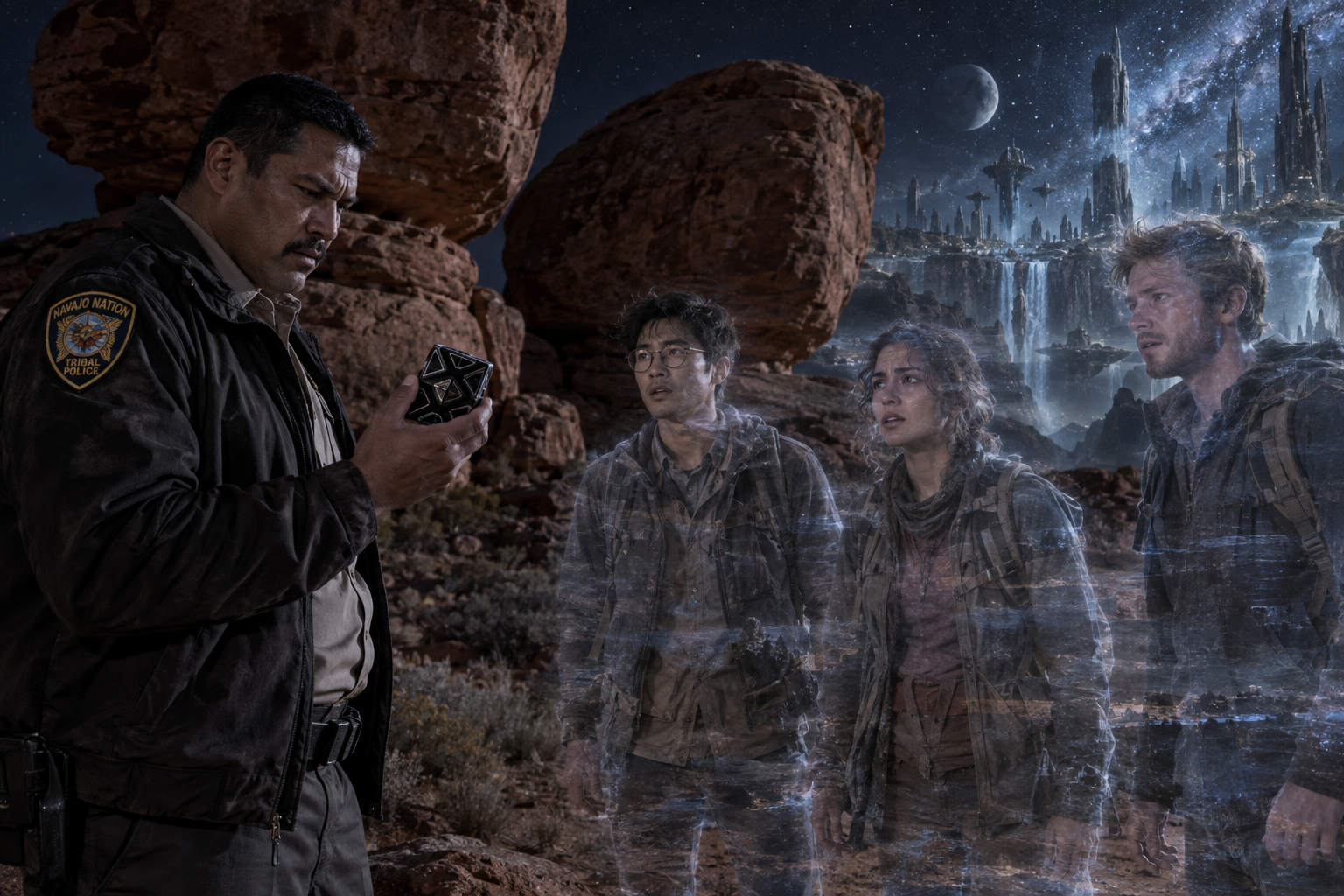
David, Rebecca, and Kyle stood in the darkness.
Sometimes they were solid.
Sometimes Joseph could see through them.
Behind their bodies was another world.
A city.
An ocean flowing upward.
A sky with unfamiliar stars.
“What are you?” Joseph asked.
Rebecca looked almost relieved to see him.
“Changed.”
David held out a device about the size of a portable radio. Its black surface was covered in shifting equations.
“You have three days.”
Joseph didn’t touch it.
“For what?”
“The convergence.”
Kyle’s laugh sounded like gravel.
“The government plans to destroy the rift.”
Rebecca shook her head.
“They think they can cauterize it.”
“Can they?”
“No.”
She told him what they had learned during the days they had been missing.
The beings beyond the canyon were not invading.
They were trapped too.
The original experiment had opened a passage between realities, and both sides had spent decades trying to close it.
Now the boundary was failing.
The device in Joseph’s hands, combined with his grandfather’s coded songs, could create a stable membrane between the worlds.
But someone would have to carry the signal into the center of the rupture.
Joseph understood before Rebecca finished.
“Someone has to go in.”
She nodded.
“And that person doesn’t come back the same.”
Before they disappeared, Rebecca pressed something into Joseph’s palm.
A frequency.
A sequence hidden inside his grandfather’s old songs.
Not a weapon.
A translation.
The Night They Tried to Burn the Door
By September 30, the desert had filled with military vehicles.
Roadblocks appeared.
Airspace was restricted.
Officials told nearby residents there had been a hazardous chemical incident.
Patricia learned the real name of the operation through a contact in Phoenix.
Project Cauterize.
At 3:00 a.m. on October 1, the government planned to detonate a device at the canyon’s coordinates.
Sarah Winters came to the tribal police station the night before.
Joseph almost didn’t recognize her.
In certain moments, her face appeared normal.
In others, it seemed composed of angles that didn’t belong to a human skull.
“We’ve been containing this for seventy-nine years,” she said.
Patricia stood beside Joseph.
“And you’re willing to destroy everyone connected to it?”
Winters didn’t look away.
“There are 2,847 changed people.”
“They’re alive.”
“Not entirely.”
Joseph thought of David’s face.
Rebecca hovering above the ground.
Kyle’s terrible laugh.
Winters lowered her voice.
“Somewhere along the way, we stopped asking whether they could be saved. We started asking whether saving them was worth risking everyone else.”
Joseph held his grandfather’s journal.
“What if there’s another way?”
Winters stared at him.
“There isn’t.”
After she left, Maria examined the journal one last time.
“Your grandfather didn’t write these songs to close the door,” she said.
“He wrote them so nobody would have to choose between the worlds.”
At midnight, Joseph left alone.
Patricia grabbed his sleeve.
“You’re not doing this alone.”
“I have to carry the device.”
“You still have two hands.”
For the first time that night, Joseph smiled.
They reached the canyon’s location at 2:30 a.m.
Nothing was there.
Then the ground disappeared.
Not physically.
Conceptually.
For a moment the desert became glass.
Below it, the other world pressed upward.
Military personnel shouted.
A black machine began to power up.
Sarah Winters appeared through the dust.
“Yazy!”
Joseph started singing.
The melody was one he remembered from childhood.
His grandfather had hummed it while repairing fence wire, washing dishes, or sitting alone on the porch.
Joseph had always thought it was simply an old song.
Now he understood the mathematics inside it.
The device in his hands began to vibrate.
3:00 a.m.
The military machine fired.
A pulse rolled across the desert.
Joseph’s signal answered.
For one second, the entire world disappeared.
He saw his grandfather.
He saw the soldiers from 1945.
He saw the missing hikers.
He saw people from every decade who had entered the canyon and never returned.
None were monsters.
They were holding a line.
Then he saw what stood behind them.
A vast presence pressed against reality.
Not angry.
Not merciful.
Simply waiting.
Joseph understood the danger.
The door couldn’t be destroyed.
The only choice was whether the two sides would tear each other apart trying to escape.
He kept singing.
Patricia’s voice joined his.
Then Maria’s.
Then Thomas.
Across the desert, the elders formed a circle and continued the song.
The military pulse hit the rift.
Joseph’s frequency met it.
And reality stopped.
The New Boundary
At 3:33 a.m., the canyon returned.
But it was no longer one place.
Its walls appeared solid from one angle and transparent from another. The desert existed beside the other world without becoming it.
The city beyond the rift remained visible.
So did the faces of the changed.
Sarah Winters collapsed to her knees.
For a moment she looked completely human.
Then she looked at Joseph.
“You found a third option.”
Joseph looked down at his hands.
They were still his.
Mostly.
His fingers flickered at the edges, like a reflection disturbed by water.
Patricia grabbed his wrist.
“Stay with me.”
Joseph tried to answer.
Instead, he heard voices in seventeen directions.
He saw overlapping versions of the desert.
He saw roads that had never been built.
He saw himself as an old man, a child, a stranger, a thousand different possibilities branching outward.
The pull was strong.
He could have let go.
He could have disappeared into something larger.
Then Patricia began singing the blessing she’d learned from her grandmother.
Maria joined her.
The elders followed.
Joseph closed his eyes.
He listened to the people who had known him before the canyon.
Before the badge.
Before the fear.
Before he had learned there were worlds beyond his own.
When he opened his eyes, the visions were still there.
But he was still Joseph.
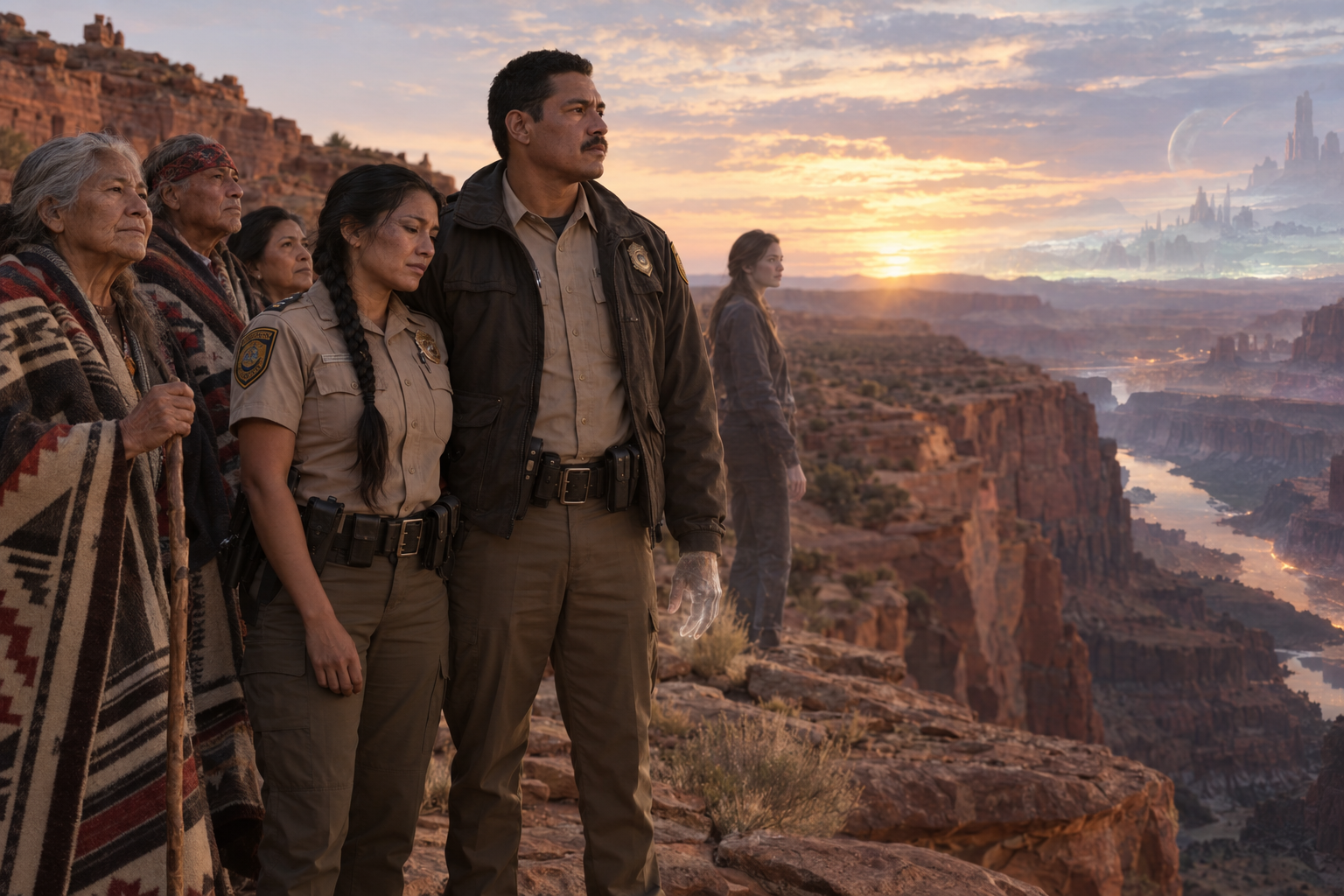
The government shut down the operation.
Officially, there had been no canyon.
Unofficially, a new federal program was created to study what the government now called the Membrane.
The Navajo Nation refused to hand over control.
For once, Washington had no easy answer.
David, Rebecca, and Kyle returned three months later.
They could walk.
They could talk.
They still sometimes appeared in two places at once.
Joseph became something new too.
He remained a tribal police officer, but his work changed.
He patrolled the boundary.
He investigated people who reported impossible dreams.
He met scientists who had stopped laughing when the measurements stopped making sense.
And when someone arrived at the desert road with questions, he watched carefully before deciding whether to let them see what was beyond it.
Most people couldn’t.
Their minds turned the canyon into empty desert.
A dry wash.
A ridge.
Anything ordinary.
But some people saw the truth.
One winter morning, Joseph stood beside the old fence post where the three eagle feathers still moved in the wind.
Patricia came up beside him.
“You ever miss when your biggest problem was speeding tickets?”
“All the time.”
She laughed.
Below them, somewhere beyond ordinary sight, two realities breathed against each other.
Not merging.
Not fighting.
Listening.
Joseph touched the feathers.
His grandfather’s voice came to him—not as a ghost, but as a memory shaped like wind.
You found the third option.
Joseph looked toward the desert.
The horizon was empty.
Then, very faintly, the rocks began to sing.
He smiled.
For the first time, he wasn’t afraid of the sound.
He was listening.
STORY IDEA:
Adapted from the supplied source story about Joseph Yazy, a Navajo Nation tribal police officer, an impossible canyon, three missing geology students, a 1945 experiment, and the struggle to contain a rupture between realities.