The Tape Measure
The tape measure was the first thing I noticed.
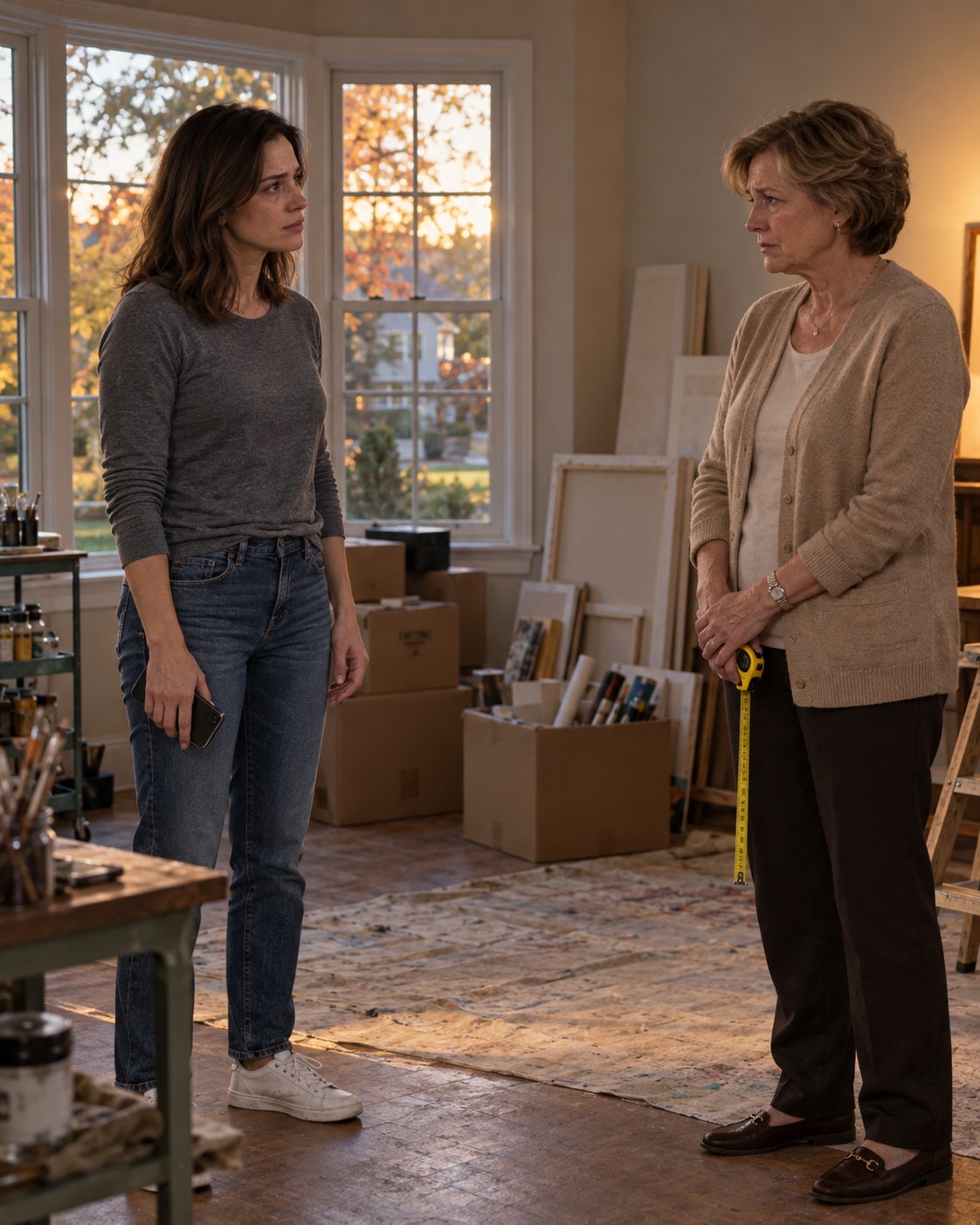
It was sticking out of my mother’s purse as she walked through the front door of our new house, bright yellow against the black leather, swinging from a little metal clip.
My mother, Sandra, had never carried a tape measure in her life.
I stood there holding two paper cups of coffee, still wearing the jeans I’d slept in because we’d spent most of the previous night unpacking boxes. Behind me, half the living room was stacked with books, dishes, and the remains of a moving-day pizza.
“You’re really going to love this place,” I told her.
She barely answered.
She ran her fingers along the staircase railing, opened the coat closet without asking, inspected the kitchen cabinets, and peered through the windows as if she were looking for flaws the realtor had missed.
Julian had gone upstairs to get our six-week-old daughter, Ren, after she started fussing in her bassinet. Our four-year-old son, Grayson, was somewhere in the backyard investigating the new fence.
I followed my mother through the house, still trying to enjoy the feeling I’d had when we first got the keys.
For the first time in my life, I had a room that was mine.
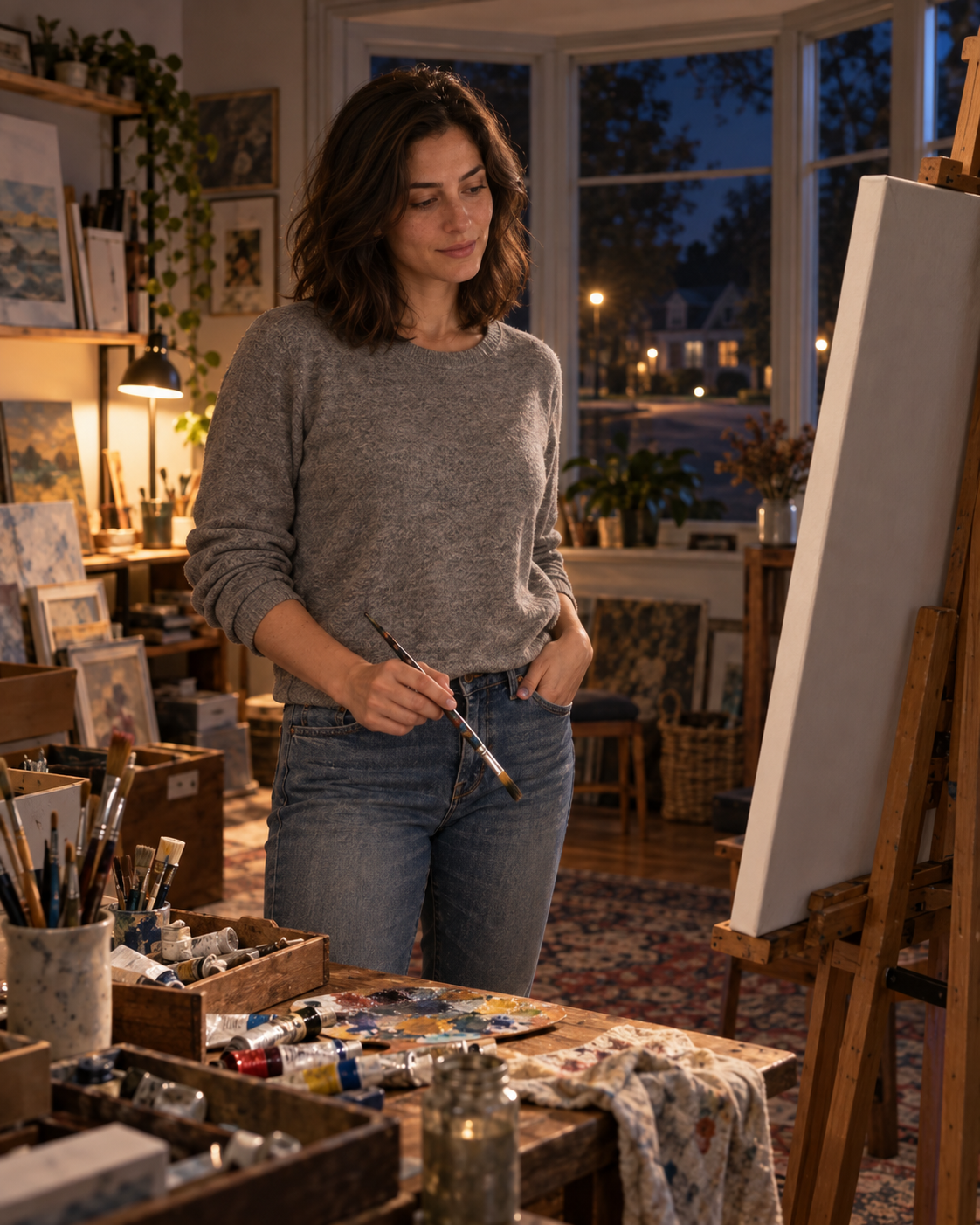
Not technically mine alone, of course. Julian and I had bought the house together after four years of saving. But the finished downstairs suite had a big bay window, pale walls, and enough space for an easel, shelves, canvases, and a proper worktable.
I’d spent more than ten years painting wherever there was room.
Kitchen counters. Bedroom corners. A folding table in our last apartment.
I’d stopped painting almost completely after Grayson was born. There was always something else that needed doing.
But three weeks earlier, I’d told Julian I wanted to start again.
He’d kissed my forehead and said, “Then we’re going to make you a studio.”
Now the room was still empty except for a few boxes of art supplies.
My mother pushed open the door.
She stopped.
“The downstairs suite,” she said.
Her voice had changed.
She stepped inside slowly, looking at the closet, the bathroom, the bay window.
“This is perfect.”
I smiled.
“That’s what I thought.”
She opened the closet.
Then she turned toward me with the expression I knew better than almost any expression on earth.
It was the look she wore when she’d already made a decision and was waiting for everyone else to catch up.
“Your brother and his wife will take this floor.”
I actually laughed.
“What?”
“I told Wesley they can move in Saturday.”
The laugh disappeared.
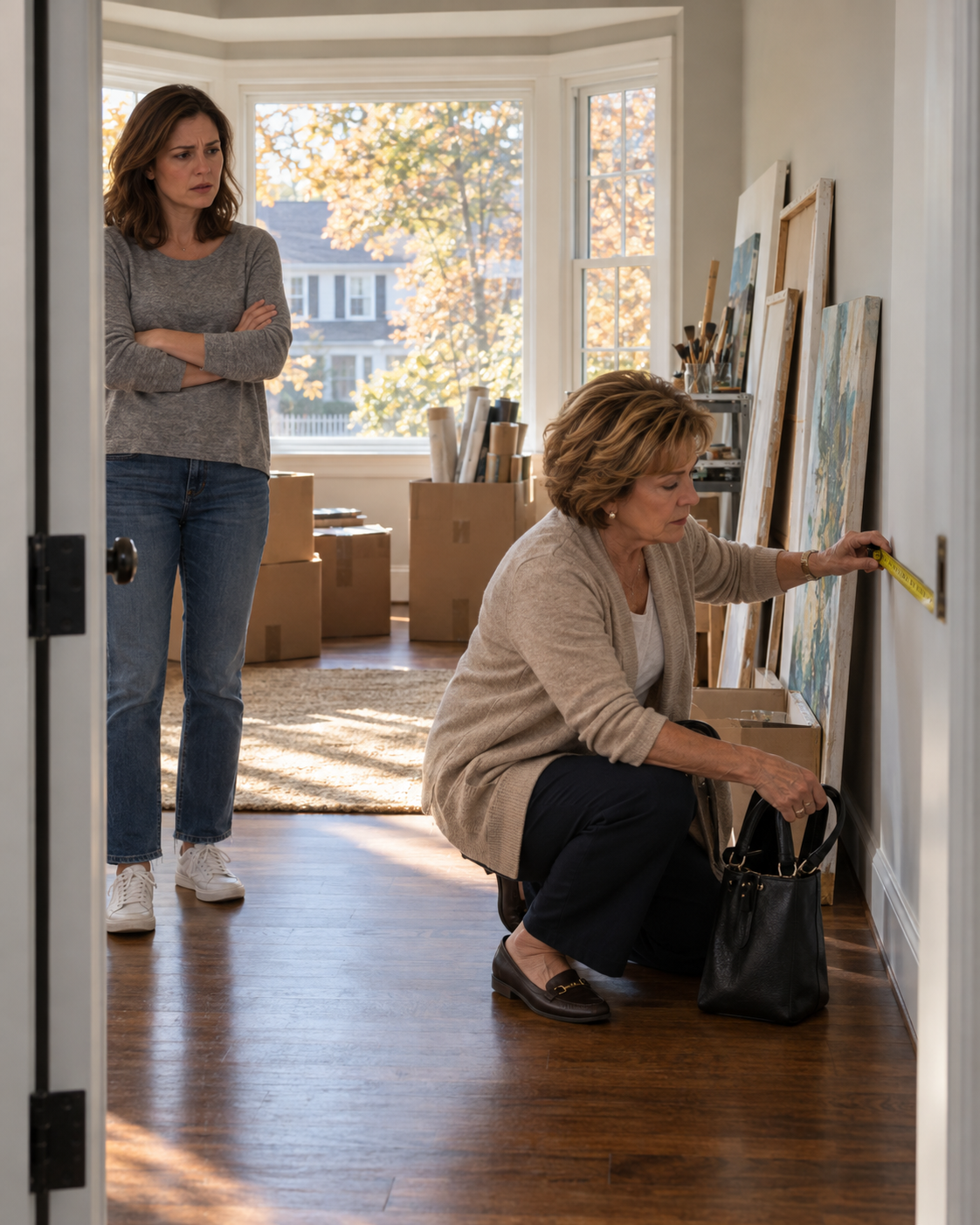
My mother pulled the tape measure from her purse.
“I told them this would be much better than staying at your father’s place. They’ve been cramped for almost a year. Wesley needs somewhere to get settled.”
She snapped the tape measure open.
I watched her measure the closet.
Then the wall.
Then the window.
“Mom.”
“His dresser should fit here,” she murmured. “Although they may need a different bed frame.”
She wasn’t looking at me anymore.
She was looking at my room as if I weren’t standing there.
I should have stopped her then.
Instead, I let her finish measuring.
Maybe because I was still hoping she’d laugh and say she was kidding.
Maybe because I’d spent my whole life waiting for my mother to realize she’d gone too far without me having to tell her.
She measured the baseboard.
“The television can go here,” she said.
“Mom.”
“And Wesley’s wife can use the bathroom upstairs if they need more space.”
“Mom.”
She finally looked at me.
“What?”
“Why are you measuring my studio?”
She frowned.
“Because I’m trying to figure out how they’ll arrange it.”
“They won’t.”
Her mouth tightened.
“Grace, they’ve been living with us for almost a year.”
“I know.”
“They need somewhere to go.”
“I know.”
“Then what’s the problem?”
I stared at her.
“The problem is that you gave them my room.”
She sighed, as though I’d misunderstood something very simple.
“You have the whole upstairs.”
“This is my studio.”
“You can paint upstairs.”
“I don’t want to paint upstairs.”
“You can use the dining room.”
“It’s not your house to decide.”
Her expression hardened.
“I’m trying to help your brother.”
“And you’re helping him by taking something that belongs to me.”
She shook her head.
“You’ve always been so sensitive about Wesley.”
There it was.
The old sentence.
The one that could turn any argument into a personality flaw.
Before I could answer, footsteps thundered down the hallway.
Grayson came flying around the corner.
“Mom!”
He wrapped both arms around my leg.
“Mom, Dad said the pizza’s here!”
Behind him came Julian, carrying Ren against his chest.
Our daughter was asleep, one tiny fist curled around his finger.
My mother’s face changed.
The tape measure slipped from her hand.
It hit the hardwood floor with a metallic snap.
She looked at Grayson.
Then Ren.
Then me.
“You… you have children,” she said.
For a second, I couldn’t speak.
Then something inside me became very still.
“Yes, Mom.”
She looked at Grayson again.
“I knew you had—”
“You’ve known about Grayson for four years.”
She swallowed.
“And you held Ren at the hospital six weeks ago.”
Julian looked at me.
He didn’t say anything.
He didn’t need to.
He had seen that look on my face before.
The Things She Always Forgot
My mother picked up the tape measure.
“I just thought the room was empty.”
“It isn’t empty.”
“I mean, it’s empty right now.”
“It’s my studio.”
“I didn’t know you were actually going to use it.”
I almost smiled.
“Then you weren’t listening.”
She looked away.
Three weeks earlier, I’d called her while sitting on the floor surrounded by paint samples.
I’d told her about the studio.
I’d told her I wanted to paint again.
She’d said, “That’s nice, honey.”
Then she’d spent ten minutes asking whether Wesley could store some boxes in our garage.
At the time, I’d thought nothing of it.
Now I realized she’d heard the words my studio and somehow translated them into available space.
I pulled my phone from my pocket.
“I have our messages.”
My mother stiffened.
“Grace, this doesn’t need to become a whole thing.”
“It already is a whole thing.”
I opened our family message thread.
Two weeks earlier, she’d written:
Wesley’s apartment fell through. Maybe they could stay with you guys for a little while.
I hadn’t answered.
Four days later, another message had appeared.
Talk to Grace. Downstairs is all set for you too. Move in Saturday. I’ll help you measure for furniture this weekend.
My mother watched my face.
“You never answered,” I said.
“I assumed—”
“You assumed I said yes?”
“I thought you would understand.”
“Understand what?”
“That Wesley needs help.”
I lowered the phone.
“I’ve spent my entire life understanding that Wesley needs help.”
She crossed her arms.
“That’s not fair.”
I almost laughed again.
Not because anything was funny.
Because the words were so familiar.
My brother needed help when we were teenagers, so I got the hand-me-down winter coat.
Wesley needed a car when I went to college, so my mother gave him mine because I “wasn’t using it enough.”
Wesley needed room, so when I moved out at twenty-two, my mother gave away my bedroom furniture.
She always called it helping.
And somehow I was always the person expected to understand.
Julian quietly carried Ren toward the kitchen.
“Come on, buddy,” he said to Grayson. “Let’s see what kind of pizza your dad ordered.”
Grayson grabbed his hand.
I watched them leave.
My mother looked at the empty doorway.
“You’ve changed.”
“No.”
I put my phone on the counter.
“I’ve just started paying attention.”
That silenced her.
For a moment, neither of us moved.
Then she said, more quietly, “I don’t know why you make everything about Wesley.”
“I don’t.”
“Yes, you do.”
“I make it about me when you take something from me.”
She looked at the floor.
“I was trying to make things easier.”
“For him.”
“For everyone.”
I shook my head.
“Not for everyone.”
She looked at me.
“You have a beautiful house. You have a husband. You have two healthy children. Wesley is struggling. I thought you’d be willing to give him a little space.”
“A little space?”
I pointed toward the room.
“You promised him an entire floor.”
She didn’t answer.
I took a breath.
“You know what hurts most?”
Her eyes lifted.
“I don’t think you even realized you’d done anything wrong.”
She opened her mouth.
Nothing came out.
What I Finally Said
My mother had always been very good at making decisions sound inevitable.
She didn’t ask.
She announced.
She didn’t request.
She assumed.
And when someone objected, she treated the objection as the problem.
Standing there in my unfinished studio, I realized I was tired of fighting her decisions after they had already been made.
So I stopped fighting.
I simply told her no.
“Wesley isn’t moving in.”
She stared at me.
“You can’t just—”
“I can.”
“He’s your brother.”
“I love him.”
“Then why wouldn’t you help him?”
“Because helping him isn’t your decision to make with my house.”
She looked toward the staircase.
“You and Julian have plenty of room.”
“We have two children.”
“You have the upstairs.”
“And this room is where I’m going to paint.”
She shook her head.
“You’ve become very selfish.”
The word landed harder than I expected.
Selfish.
I had heard it before.
Every time I wanted something that competed with what someone else wanted.
But this time, I didn’t defend myself.
I nodded.
“Maybe.”
My mother blinked.
I continued.
“Maybe I should have been selfish a long time ago.”
Her face softened for just a second.
Then she looked angry again.
“You’d really let your own brother struggle?”
“I’d help him find an apartment. I’d help him move. I’d bring dinner. I’d loan him money if we could afford it.”
I paused.
“But I won’t give him a room he doesn’t have permission to take.”
She looked toward the bay window.
There were three unopened boxes beneath it.
One was labeled oil paints.
Another said canvases.
The third simply said Grace’s art.
She stared at them.
Then she whispered, “I didn’t know.”
I looked at her.
“You did.”
She shook her head.
“I mean, I didn’t know it mattered this much.”
That sentence nearly broke me.
Because it wasn’t an apology.
But it was the closest thing to recognition she’d ever offered.
I sat on the edge of one of the boxes.
“It matters because I kept giving up pieces of myself.”
My mother was silent.
“When I was twenty-two, you gave away my bedroom furniture. When I was twenty-four, you told me Wesley needed my car. When I was pregnant with Grayson, you told me I should put painting aside because motherhood was more important.”
“I never said you couldn’t paint.”
“You said, ‘Maybe when things settle down.'”
She looked at me.
“And things never settled down.”
For the first time, my mother didn’t have an immediate response.
The Doorway
She left twenty minutes later.
The coffee she’d poured herself sat untouched on the kitchen counter.
At the front door, she turned around.
“Are you really not going to let them stay?”
“No.”
“Not even for a few weeks?”
“No.”
She nodded slowly.
“I suppose Wesley will be upset.”
“I imagine he will.”
“And me?”
I looked at her.
“What about you?”
“You won’t be upset with me?”
I thought about that.
“I don’t know.”
Her eyebrows lifted.
It was probably the most honest answer I’d ever given her.
“I might be,” I said. “But I’m not changing my answer because you’re upset.”
She stood there for another moment.
Then she opened the door.
“Your father will say you’re being difficult.”
“I know.”
She gave me a tired look.
“You always were.”
I smiled faintly.
“Maybe.”
Then she walked down the front steps.
I watched her get into her car.
For most of my life, I had felt guilty whenever my mother was disappointed in me.
That afternoon, I felt something different.
Not triumph.
Not relief exactly.
Just the strange sensation of setting down a heavy bag I’d forgotten I was carrying.
I closed the door.
Behind me, Grayson was laughing in the kitchen.
Julian was trying to keep Ren asleep while opening a pizza box one-handed.
The house smelled like cardboard, tomato sauce, and fresh paint.
It was messy.
It was ours.
And for once, nobody else had decided what it would become.
The Room That Stayed Mine
Wesley called that night.
I almost didn’t answer.
Then I did.
“Hey,” he said.
“Hey.”
There was a long pause.
“Mom told me.”
I closed my eyes.
“I’m sorry.”
“For what?”
“I know you needed somewhere to go.”
He exhaled.
“I did.”
Another pause.
“Did she really tell you that you could move in?”
“Yeah.”
“I never said yes.”
“I know.”
His voice sounded embarrassed.
“I told Mom I didn’t want to assume.”
That surprised me.
“Why didn’t you tell me?”
“I figured if you were okay with it, you’d say something.”
I sat on the floor of the studio.
“I wish you had.”
“Me too.”
Neither of us spoke for a few seconds.
Then Wesley said, “For what it’s worth, I don’t want your room.”
I laughed softly.
“Thanks.”
“I’m serious.”
“I know.”
He cleared his throat.
“Actually, I found a place today.”
“Already?”
“Small apartment. Nothing fancy.”
“Do you need help moving?”
He hesitated.
“Yeah.”
“I’ll help.”
“Thanks, Grace.”
When we hung up, I stayed on the floor for a while.
The house was quiet.
Upstairs, I could hear Julian walking softly with the baby.
Grayson was asleep in his new room.
I opened the first box.
Inside were my old brushes.
Some were stiff from years of neglect. Others still had traces of dried paint caught between the bristles.
I arranged them on the windowsill.
Then I carried my easel into the center of the room.
Julian appeared in the doorway.
“You okay?”
I nodded.
“Yeah.”
He looked around.
“Want help?”
I smiled.
“No.”
He raised an eyebrow.
“I’ve got it.”
He nodded.
“Okay.”
He started to leave.
“Julian?”
He turned.
“Thank you.”
He smiled.
“For what?”
I looked at the room.
“For never deciding what I should give away.”
He understood.
He always did.
That night, after everyone was asleep, I stood in front of the bay window with a blank canvas.
Outside, the streetlights made small pools of gold on the pavement.
A moving truck passed at the end of the block.
For a moment, I thought about my mother’s tape measure.
How quickly she’d measured the room.
How easily she’d filled it with someone else’s furniture.
For years, I’d believed that being a good daughter meant making room.
For other people’s emergencies.
Other people’s expectations.
Other people’s needs.
I used to think there would always be time to make something of my own later.
I dipped my brush into a jar of water.
Then I opened the first tube of paint.
The house was finally quiet.
The canvas was blank.
And this time, I didn’t wait for anyone to tell me what belonged there.