He told me I would walk away with almost nothing before I had even opened the envelope.
“You’ll be fine,” Ethan said, standing across from me in our kitchen with his car keys in one hand and the divorce papers in the other. “I’m not trying to be unfair, Naomi. But most of what we have, I built.”
He said it so calmly that, for a second, I almost smiled.
Not because it was funny.
Because he had no idea.
I had spent twenty years married to a man who believed he understood our finances because he understood his own. He knew the construction company he had inherited from his father. He knew the house. He knew the investments he had chosen.
What he had never known was me.
Not really.

The Money He Never Asked About
My name is Naomi Ward. I was forty-two years old, a lieutenant colonel in the U.S. Army, and after twenty years of marriage, I had learned that there are some forms of distance you don’t notice until they’re impossible to cross.
Ethan and I met when I was twenty-two.
I had just finished my MBA and was preparing to leave for my first military assignment. Ethan was already working for his father’s construction company, a mid-sized business that had been passed down to him with enough reputation to make him feel as though he had inherited more than a company.
He had inherited an identity.
He was charming. Quick with a joke. Good at remembering names. The kind of man who could walk into a room and make everyone believe he belonged there.
I loved him.
That part matters.
Because it would be easy to rewrite twenty years after the fact and pretend I had spent every day waiting for the marriage to collapse. I hadn’t. We had good years. We had vacations. Sunday breakfasts. Quiet evenings. We learned how to live with the grief of never having children.
We built a life.
We just built different parts of it.
Ethan handled our household finances.
Or, more precisely, he liked saying that he did.
“I handle the money, Naomi,” he’d tell me with a grin. “You handle the Army.”
So I let him.
Not because I couldn’t manage money. I could. I’d been managing my own accounts since college. I simply didn’t see the point in competing over something he seemed to need to feel important.
Meanwhile, without fanfare, I kept my own financial habits.
I contributed steadily to my military retirement.
I put as much as I could into my TSP year after year.
At twenty-six, I opened a Roth IRA and left it alone.
I bought index funds and reinvested the dividends.
When my aunt Carol died, she left me a small lakehouse several hours outside the city. Ethan called it “your little project.”
I never corrected him.
The lakehouse wasn’t flashy. It had peeling paint on one side and an old wooden dock that needed replacing.
But it was mine.
So was most of the financial life I had built.
None of it was secret.
That distinction would become important later.
Ethan hadn’t been locked out of my accounts. He hadn’t been deceived.
He simply hadn’t asked.
Then, about six months before he filed for divorce, his behavior changed.
Small things.
His phone started living face down on tables.
He changed his passcode.
He began coming home late.
Supplier meetings.
Traffic.
A job site problem.
Then there was the way he smiled at his phone.
One night, around eleven, I came downstairs for water and heard him on the back porch.
“Just wait another couple weeks,” he said quietly.
Then he laughed.
It was a warm laugh.
An affectionate laugh.
I hadn’t heard him laugh like that with me in a long time.
I stood in the dark hallway for a moment.
Then I went back upstairs.
I didn’t search his phone.
I didn’t follow his truck.
I didn’t call anyone.
The Army had taught me something better than suspicion.
Gather facts first.
So I sat at the kitchen table and opened our financial statements.
What Twenty Years of Patience Had Built
At first, I expected to find nothing.
Instead, I found patterns.
Charges I didn’t recognize.
Business expenses that didn’t match the projects Ethan described.
Hotels.
Restaurants.
Large purchases he had never mentioned.
Nothing dramatic enough to prove an affair.
Everything ordinary enough to make me uncomfortable.
I called Diane Foster, a CPA I had met years earlier through a military financial-planning program.
“I think my marriage is ending,” I told her.
She didn’t gasp.
She didn’t ask whether Ethan was cheating.
She simply said, “Bring me everything.”
Two days later, I sat across from her with folders covering a conference table.
Diane walked through every account.
My TSP.
My Roth.
My investments.
My military pension.
The lakehouse.
Years of statements and tax records.
She looked up at me.
“Naomi, you’ve been doing this for a long time.”
“I know.”
“No,” she said. “I mean you’ve been doing this very consistently.”
That was when I understood how invisible discipline can become.
One contribution doesn’t look like much.
One dividend doesn’t look like much.
One year of saving can look almost pointless.
But twenty years can change the shape of a life.
I wasn’t wealthy in the way Ethan imagined wealth.
I didn’t drive expensive cars.
I didn’t collect watches.
I didn’t spend weekends at luxury resorts.
I had simply kept showing up.
Again and again.
Quietly.
The same way I’d done everything else.
My attorney, Patricia Reyes, said the same thing after reviewing the records.
“Do not hide anything,” she told me. “Disclose everything. Completely.”
“I will.”
She studied me.
“What are you hoping for?”
I thought about that.
“I’m not trying to punish him,” I said. “I just want him to finally see what he never bothered to look at.”
Patricia nodded.
“Then let the paperwork speak.”
For the next few weeks, I prepared.
I had the lakehouse appraised.
I collected every contribution statement.
Every tax return.
Every investment record.
Every document showing how long the accounts had existed and how consistently I had managed them.
At night, Ethan would come home and barely notice the folders on the dining table.
Once, he kissed the top of my head and went to the refrigerator.
He didn’t ask what I was doing.
That was the strange part.
Even when he was preparing to end our marriage, he still didn’t think there was anything about me worth investigating.
Two weeks later, he handed me the envelope.
“You’ll walk away with almost nothing,” he said.
I looked at him.
“You really believe that?”
He laughed.
“I know how this works.”
I picked up the papers.
“No,” I said quietly. “You think you do.”
The Day He Finally Looked
Three days later, I met Patricia at her office and signed the preliminary documents.
We moved forward without shouting.
No screaming match.
No broken dishes.
No dramatic confrontation.
Just signatures, disclosures, spreadsheets and the increasingly uncomfortable realization that the man who thought he had built our entire financial life had never actually examined mine.
The court hearing came a few weeks later.
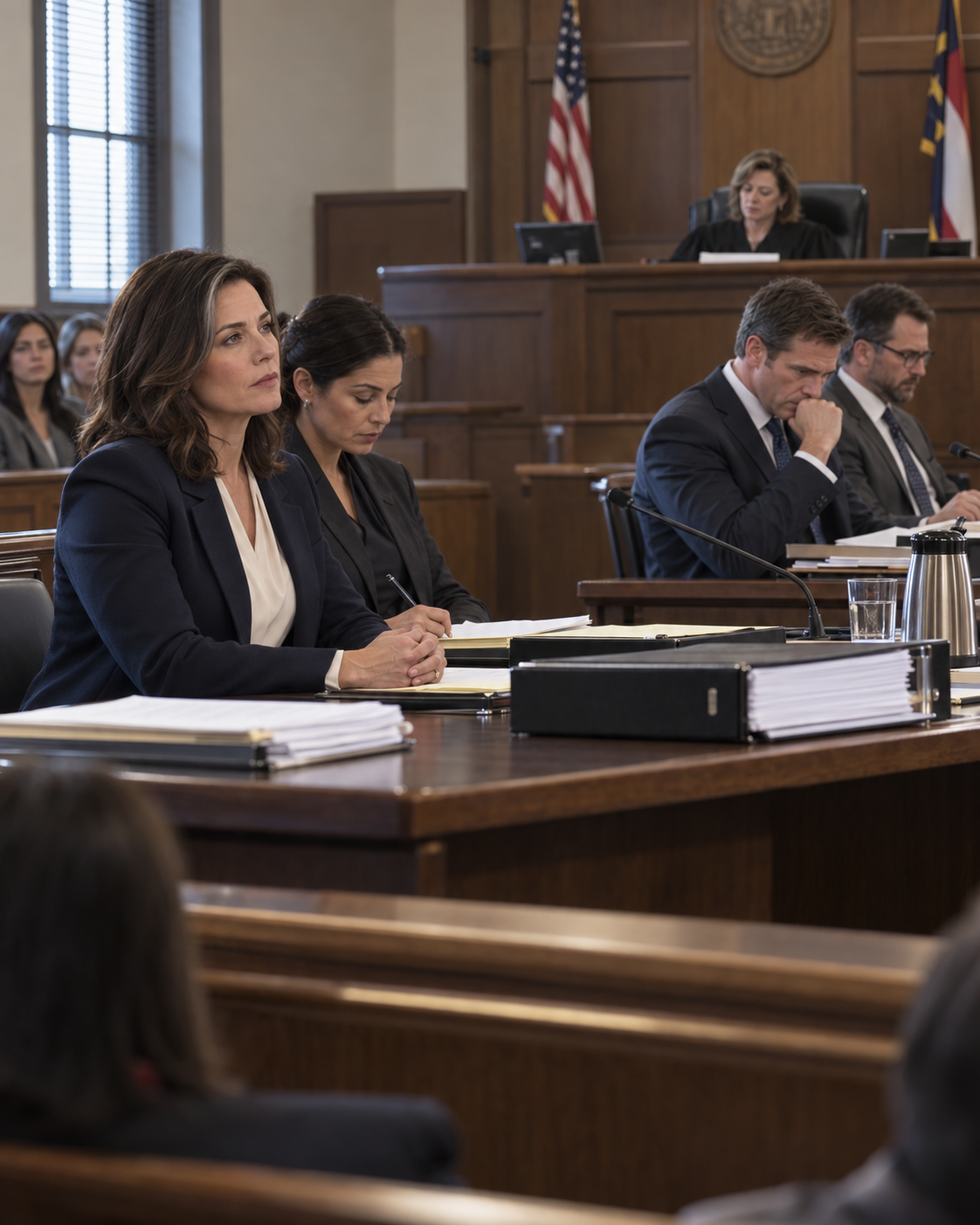
The room was smaller than I expected.
Judge Alvarez sat at the bench with reading glasses low on her nose.
Ethan sat beside his attorney, Gregory Holston.
His mother was behind him.
His confidence was almost reassuringly intact.
Gregory began by presenting Ethan as the primary builder of our shared financial life.
Years of business ownership.
High earnings.
Property.
Assets.
It was a convincing story.
The problem was that it wasn’t the whole story.
When Diane took the stand, she started with my military pension.
Then my TSP.
Then my Roth IRA.
Then the investment portfolio.
She explained the contribution history.
The reinvested dividends.
The fact that I had never made large withdrawals.
Every document supported the same thing.
Twenty years of consistency.
Then she reached the lakehouse.
Inherited separately.
Documented.
Maintained in my name.
Appreciating steadily.
Ethan’s posture changed.
Only slightly.
But I saw it.
His shoulders moved back.
His eyes narrowed.
He glanced at Gregory.
Gregory looked down at his notes.
Diane continued.
She showed the court account histories that traced my financial activity year after year.
No unexplained gaps.
No hidden transfers.
No secret withdrawals.
Nothing theatrical.
Just records.
At one point, Judge Alvarez looked directly at Ethan.
“Mr. Ward, did you review your wife’s financial statements during the marriage?”
Ethan hesitated.
“No, Your Honor.”
“Why not?”
He swallowed.
“I assumed I understood our finances.”
Judge Alvarez looked at him for a long second.
“You assumed.”
It wasn’t an accusation.
Somehow that made it worse.
Ethan’s attorney tried to challenge the separate nature of some of my assets.
Diane answered every question with another document.
Patricia didn’t raise her voice.
She didn’t need to.
The paper trail was already in the room.
Then Diane began discussing Ethan’s financial activity.
A boat.
An RV.
Restaurant charges from locations that didn’t correspond to documented client meetings.
Hotel expenses.
Repeated patterns.
Gregory objected.
The judge sustained some objections.
None of it required an accusation about an affair.
The numbers were enough to show that Ethan’s picture of our financial life wasn’t nearly as complete as he had believed.
By the afternoon session, the man who had walked into the courtroom convinced I would leave with almost nothing was sitting silently with his hands folded in front of him.
I didn’t enjoy watching it.
That surprised me.
I had imagined relief.
Maybe even satisfaction.
Instead, I felt sad.
There is something painful about watching someone you loved realize how little they knew you.
At the end of the second day, Ethan looked across the courtroom.
He wasn’t angry.
He looked lost.
As if he were mentally walking backward through twenty years, trying to figure out where he had been standing while all of this happened.
The Question That Changed Everything
The final hearing came under a gray sky.
Gregory made a more careful argument this time.
He talked about the marriage as a partnership.
About shared expectations.
About the life Ethan believed they had built together.
Patricia answered without attacking him.
“Mr. Ward did not discover hidden assets,” she said. “He discovered assets he never asked to see.”
The courtroom became very quiet.
She continued.
“My client disclosed everything fully. The fact that her husband didn’t know the extent of those assets is not evidence that she concealed them. It is evidence that he never looked.”
Judge Alvarez recessed.
We waited.
Ethan sat across the hallway from me.
For a long time, neither of us moved.
Then he looked at me.
There was no anger in his face anymore.
Just disbelief.
Later that afternoon, Judge Alvarez delivered the ruling.
My military pension was protected under the applicable federal rules.
My TSP and Roth IRA were recognized according to their documented histories.
The investment portfolio remained separate.
The lakehouse, inherited from my aunt, remained mine.
The marital home was to be sold and divided according to the court’s determination.
The undisclosed expenditures from Ethan’s side were taken into account.
It wasn’t the dramatic courtroom victory a television writer might have imagined.
No one slammed a folder shut.
No one shouted.
The judge simply read the numbers.
Facts.
Law.
Documentation.
That was all.
And somehow, it was enough.
When we left the courthouse, we ended up beside the same bank of elevators.
For a moment, it was just the two of us.
Ethan looked at the floor.
“I really didn’t know,” he said.
“I know.”
“About the accounts. The property. Any of it.”
I nodded.
He looked at me.
“I thought I knew what you were worth.”
I let that sit between us.
Then I said, “You were wrong about that too.”
The elevator doors opened.
I stepped inside.
He didn’t follow.
It was the last real conversation we ever had.
The Lakehouse
The divorce took time to settle.
There were forms.
Transfers.
Meetings.
More signatures.
Eventually, the house was sold.
I took leave from the Army and drove to the lakehouse.
I stayed there for a month.
Not to celebrate.
Not to post pictures.
Not to prove anything.
I repainted the porch railing.
I fixed one of the windows.
I learned which birds came to the feeder every morning.
Some evenings, I sat on the dock until the sun disappeared.
The lake didn’t care about the divorce.
The birds didn’t know what the judge had ruled.
The trees had no opinion about Ethan or Patricia or Gregory.
They just stood there.
One afternoon, I found an old mug in a cabinet.
It was one Ethan and I had bought during our first year of marriage.
The design was faded.
I held it for a moment.
Then I put it back.
For the first time in years, I wasn’t trying to preserve something just because it had once mattered.
I was learning the difference between remembering a life and remaining trapped inside it.
I still thought about Ethan sometimes.
I didn’t hate him.
That was easier than I expected.
He wasn’t a monster.
He had simply confused familiarity with understanding.
He had assumed that because he knew where the money in one account went, he knew the financial life of the woman sleeping beside him.
He had assumed because I was quiet, I had nothing to say.
Because I was disciplined, I needed nothing.
Because I could handle difficult things, difficult things couldn’t hurt me.
He had been wrong.
And eventually, the law had made him look at the evidence.
But the deeper realization came later.
It came one evening at the lake.
I was sitting on the dock with my shoes off, listening to the water move against the wood.
For twenty years, I had built a life without asking anyone to applaud it.
I had saved.
Contributed.
Waited.
Worked.
Served.
Learned.
Started over.
Again and again.
I had never needed Ethan to announce my worth.
But I had spent years allowing his assumptions to make me question it.
That was the part I finally let go.

The thing Ethan had thought was my weakness had actually been the foundation of my life.
It just didn’t make noise.
I used to think being underestimated was something I needed to correct.
Now I understand that sometimes the most important thing isn’t proving someone wrong.
It’s realizing you no longer need them to know your value at all.
The lake was almost completely still by then.
I watched the last line of sunlight disappear across the water.
For twenty years, someone else had thought they knew exactly what my life was worth.
For the first time, I was sitting somewhere quiet enough to answer for myself.