The Plane at the Edge of the Trees
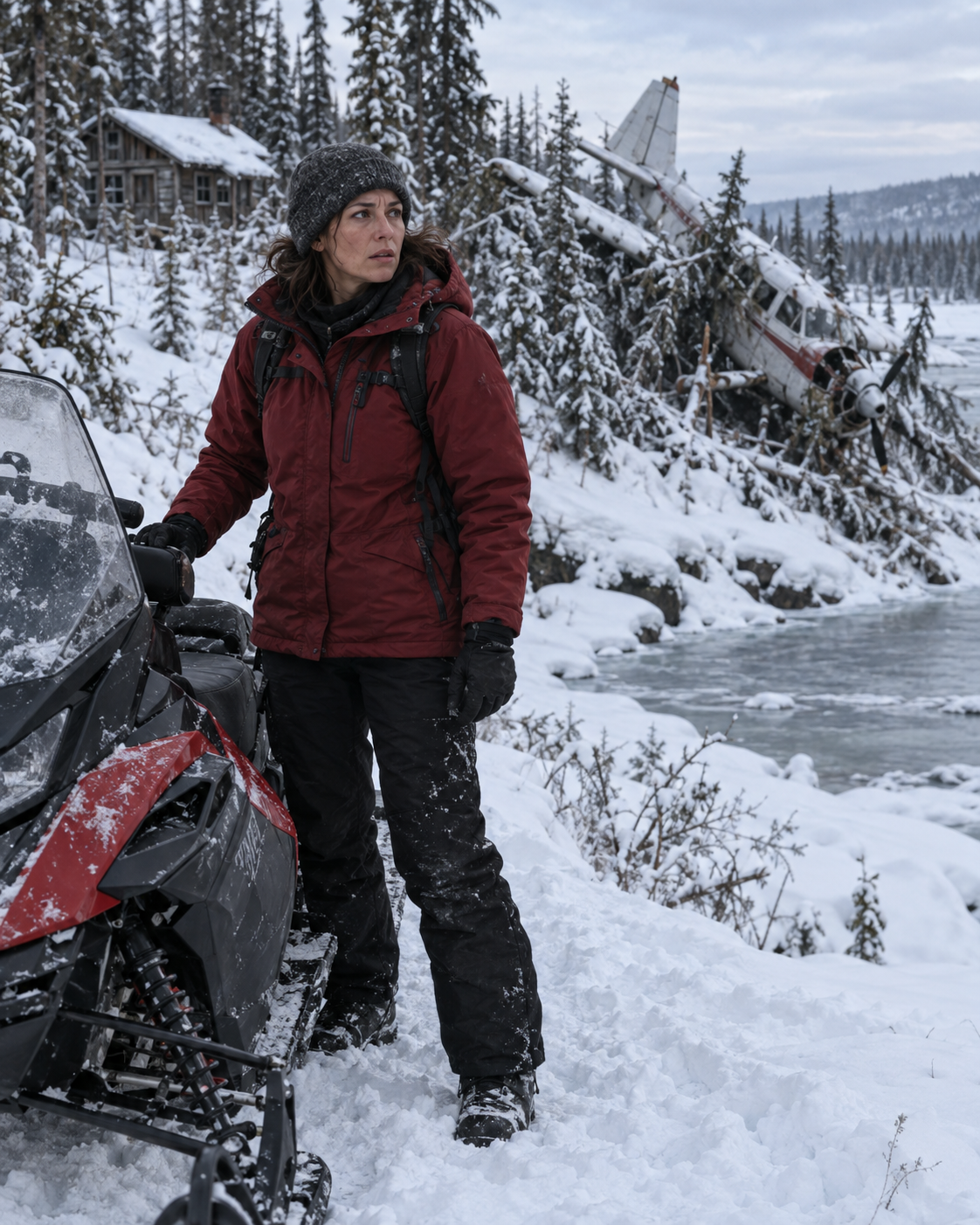
Mara Bennett first saw the airplane upside down.
It lay twenty feet above the frozen riverbank, caught in the branches of a spruce tree like a child’s toy someone had thrown too hard. One wing was buried in snow. The aluminum skin flashed pale in the February light.
Mara killed the engine of her snowmobile and stared at it.
For a moment, she forgot to breathe.
Her brother Evan had disappeared six weeks earlier.
The official story was an accident. His small bush plane had gone down somewhere in the northern wilderness, and because the weather had turned bad, the search had been suspended after twelve days.
But Mara had never believed the search was over.
She knew her brother. Evan was forty-one, stubborn, careful with fuel, careful with weather, careful enough to label the jars in his kitchen. He was the kind of man who checked a door twice after locking it.
He would not simply vanish.
Mara stepped off the snowmobile and walked toward the wreck.
The forest was silent except for the faint ticking of cooling metal.
She wore a red parka, black insulated pants, and a wool cap pulled low over her dark brown hair. Her face had already started to sting from the cold. Behind her, the river stretched white and empty beneath a pale gray sky.
She climbed over a fallen log.
That was when she noticed the cabin.
It stood perhaps sixty yards from the wreckage, nearly swallowed by spruce and snow.
Its roof sagged. One shutter hung loose.
Smoke was not rising from the chimney.
Mara stopped.
Evan had told her about the cabin once.
Not because he had been there.
Because he’d been obsessed with finding it.
He called it the Mercer Cabin, an old emergency shelter built decades ago by trappers and rarely marked on modern maps. There were stories about men disappearing around it. Stories about abandoned camps, strange footprints, and people who walked into the woods carrying everything they owned and never came back.
Evan used to laugh at those stories.
Then, after one winter trip, he stopped laughing.
The Notebook in the Cabin
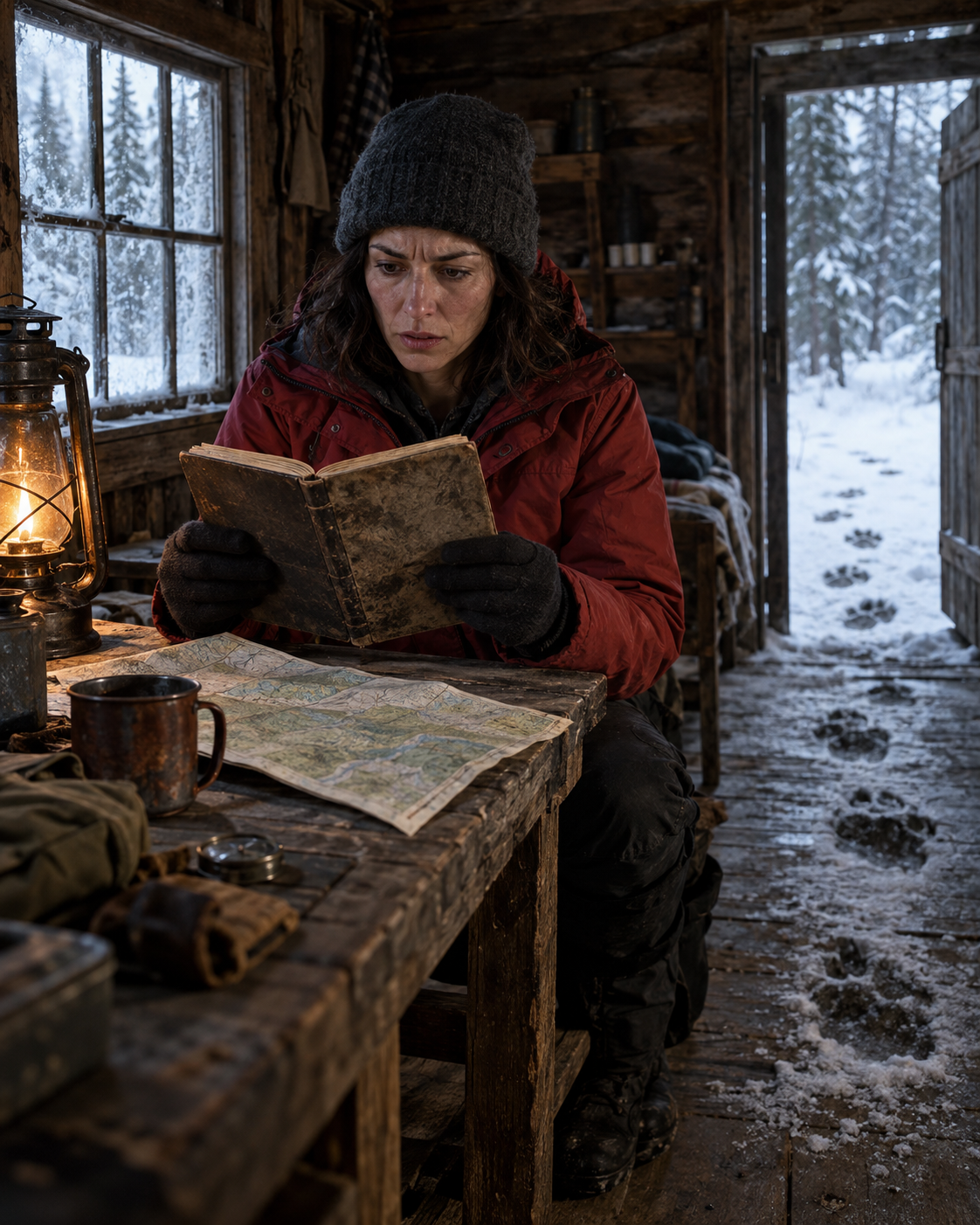
The cabin door was unlocked.
Mara pushed it open with one gloved hand.
Inside, the air smelled of old wood, kerosene, and something faintly metallic.
There was a cast-iron stove in the corner. A narrow cot. Two wooden chairs. Shelves lined with empty cans and rusted tools.
And on the table sat a notebook.
Mara knew Evan’s handwriting immediately.
Her hands began to shake.
She opened it.
Most of the pages were filled with weather observations, coordinates, notes about fuel consumption, and sketches of the surrounding mountains.
Then she reached the final page.
Jan. 18.
Saw the lights again.
Mara frowned.
She turned the page.
Nothing.
She went back.
They aren’t aircraft.
The next line had been scratched out so hard the paper was nearly torn.
Underneath it, Evan had written:
I know how this sounds.
Another page.
If Mara comes looking for me, tell her to stop at the river.
Mara read that sentence three times.
Then she heard something outside.
Three slow knocks.
Not on the cabin door.
On the wall.
Mara froze.
The sound came again.
Knock.
Knock.
Knock.
She reached into her coat pocket for the flare gun she had brought from the snowmobile.
Then the cabin fell silent.
Mara stood there for nearly a minute before forcing herself to move.
She went to the window.
There was nothing outside but snow.
She opened the door.
Cold air rushed in.
Her own footprints led from the snowmobile to the cabin.
There were no others.
Not human ones, anyway.
Along the far wall, half buried under powder, she saw a line of prints disappearing toward the trees.
They were enormous.
Mara crouched beside them.
She had enough experience in the woods to know what bear tracks looked like. These were not bear tracks.
They looked almost human.
Five long impressions.
A heel.
A broad foot.
And then another.
She followed them for perhaps twenty yards before common sense finally stopped her.
Evan had taught her that lesson when they were children.
Never follow something into the trees just because you don’t understand it.
She returned to the cabin.
On the table, beneath Evan’s notebook, she found a folded map.
A circle had been drawn around a narrow canyon west of the river.
Beside it, Evan had written two words.
Not alone.
The Lights Across the River
That night, Mara made camp beside the wreck.
She couldn’t bring herself to sleep inside the cabin.
At 2:17 a.m., she woke to light.
Three bright points hovered on the other side of the river.
They moved slowly through the trees.
Mara sat up inside her sleeping bag.
The lights disappeared.
Then came back.
Closer.
She grabbed the flare gun.
“Evan?”
Her voice sounded embarrassingly small.
One of the lights shifted.
A second followed.
Then all three went out at once.
Mara stayed awake until dawn.
The next morning, she found fresh tracks around her camp.
This time they stopped beside her sleeping bag.
A half-burned piece of firewood lay on top of the snow.
Someone had placed it there.
She packed immediately.
She should have flown out.
Instead, she looked at Evan’s map again.
Not alone.
There was one place marked beyond the canyon.
An old mining tunnel.
Mara knew exactly what she was going to do.
She followed the river west.
By late afternoon, the terrain narrowed between steep rock walls. Snow came down harder. The wind funneled through the canyon with a low moaning sound.
Then she saw the tunnel.
It was partly collapsed, but a narrow opening remained.
Beside it stood a wooden post.
Three cuts had been carved into the wood.
Mara touched them.
They looked fresh.
She entered.
Inside, the air smelled of damp stone.
After twenty yards, she found a camp.
Not old.
Recent.
There was a sleeping bag.
A metal cup.
A battery-powered radio.
And beside the radio sat Evan’s watch.
Mara snatched it up.
The face was cracked.
But the second hand was still moving.
A sound came from deeper in the tunnel.
Someone coughing.
Mara ran.
“Evan!”
Another cough.
Then a voice.
“Mara?”
She nearly collapsed.
He was sitting against the rock wall, thinner than she’d ever seen him.
His beard had grown in unevenly. His left shoulder was wrapped in torn cloth. His lips were cracked from dehydration.
For several seconds, neither of them moved.
Then Mara threw herself down beside him.
“You idiot,” she whispered.
Evan laughed weakly.
“You came.”
“Of course I came.”
He looked past her.
His smile disappeared.
“You shouldn’t have.”
What Evan Saw in the Snow
Evan had not crashed where the search teams believed.
His plane had struck a tree during a storm and lost a wing.
He survived.
For days he lived beside the wreck, eating the food from the aircraft and calling repeatedly on the radio.
Someone had answered.
At first, he thought it was rescue.
Then the voice spoke his name.
Not over the radio.
Outside his shelter.
He never saw a person.
Only the lights.
He believed someone was watching him from the tree line.
On the seventh night, he followed them.
“I thought somebody was trying to lead me somewhere,” Evan said.
Mara sat beside him on the cold stone floor.
“Who?”
“I don’t know.”
“You saw someone?”
“No.”
“Then what did you see?”
Evan looked at her.
“I saw what they left behind.”
He pointed toward the tunnel wall.
Carved into the stone were dozens of small marks.
Names.
Dates.
Initials.
Some went back decades.
Some were barely legible.
Mara stepped closer.
At the bottom, there was a name she recognized.
John Mercer.
The man the cabin had been named after.
Beside his name was a date.
Then another.
And another.
People had been coming here for years.
Some had died.
Some had disappeared.
But at least some had survived long enough to leave messages.
Evan reached into his jacket and handed Mara a small metal box.
Inside was a stack of photographs.
The first showed an old man standing beside the cabin.
The second showed three men beside a river.
The third was almost completely blurred.
But in the background, between two trees, there was a shape.
Tall.
Broad-shouldered.
Watching them.
Mara stared at it.
“That’s what you saw?”
“No.”
Evan looked toward the tunnel entrance.
“The thing in the picture was just the first time I realized it wasn’t a person.”
A long silence followed.
Then they heard a branch snap outside.
Mara stood.
Evan grabbed her wrist.
“Don’t.”
Another crack.
Closer.
Mara turned off the lantern.
They waited in darkness.
Something moved beyond the tunnel entrance.
Not rushing.
Not hiding.
Just walking.
Slowly.
Evan’s breathing became shallow.
Mara held his hand.
They heard three steps.
Then nothing.
Ten minutes passed.
Neither of them moved.
Finally, Evan whispered, “There’s another way out.”
They crawled through a narrow passage at the back of the tunnel and emerged on the other side of the mountain.
The storm had cleared.
Morning light spilled across the river.
Far in the distance, they heard the unmistakable thump of helicopter blades.
Mara laughed once, almost angrily.
Then she began to cry.
Not loudly.
Just tears running down her face while she helped her brother into the snow.
The River Keeps Its Secrets
The helicopter landed on a flat stretch of ice two hundred yards away.
The rescue crew found two exhausted people stumbling toward them.
Nobody asked Mara about the lights.
Not then.
Evan spent nine days in a hospital recovering from frostbite, dehydration, and a fractured collarbone.
When the investigators questioned him, he told them everything.
The cabin.
The tunnel.
The markings.
The photographs.
The strange tracks.
They searched the area again.
They found the cabin.
They found the crashed plane.
They found the tunnel.
They found the names carved into the stone.
But they found no person who could have made the tracks.
No hidden camp.
No radio operator.
No explanation for the lights.
The photographs were inconclusive.
Evan refused to discuss the subject after that.
Mara almost did the same.
For months, the whole experience sat between them like an unfinished sentence.
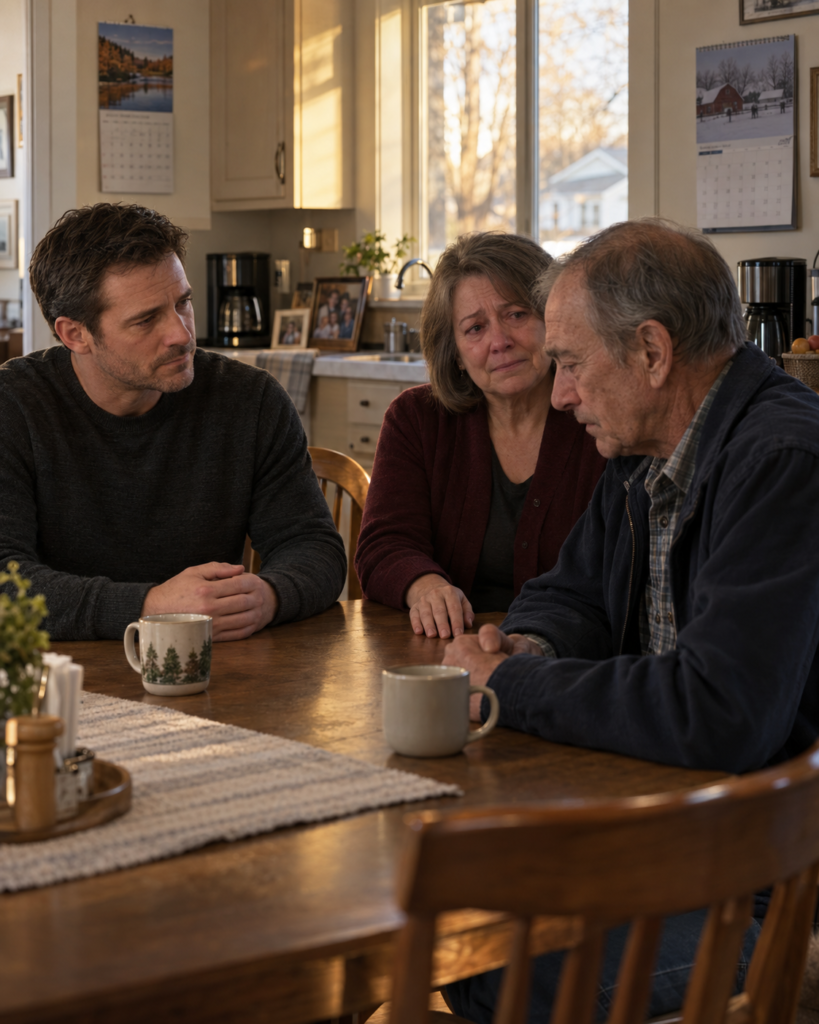
Then, one Saturday in early spring, Evan came to Mara’s house carrying a wooden box.
He set it on the kitchen table.
“You keeping these?”
Inside were the photographs.
Mara looked at him.
“You want me to get rid of them?”
He shook his head.
“No.”
She picked up the last photograph.
The blurred shape between the trees was almost impossible to see.
Almost.
Mara turned it toward the window.
Sunlight crossed the image.
For the first time, she noticed something she had missed before.
The figure was not standing in the trees.
It was standing on the other side of the river.
And behind it, barely visible through the haze, was a second figure.
Smaller.
Human-sized.
Holding what looked like a lantern.
Mara lowered the photograph.
Evan was already watching her.
“You see it?”
“Yes.”
Neither said anything for a while.
Outside, children were riding bicycles down the street. A neighbor was dragging a trash bin to the curb. Somewhere nearby, somebody was mowing a lawn.
Ordinary sounds.
Safe sounds.
Mara put the photograph back in the box.
Then she closed the lid.
“You’re never going back there,” she said.
Evan gave a tired smile.
“I know.”
But that evening, after he left, Mara stood at her kitchen window and watched the last light disappear beyond the rooftops.
She thought about the frozen river.
The cabin.
The tunnel full of names.
And the strange certainty she had felt in those dark woods that something had been watching her all along.
She pulled the curtains shut.
Then she checked the lock on the back door twice.
Some places don’t follow you home.
They simply teach you how to listen for them.