Before the City Woke
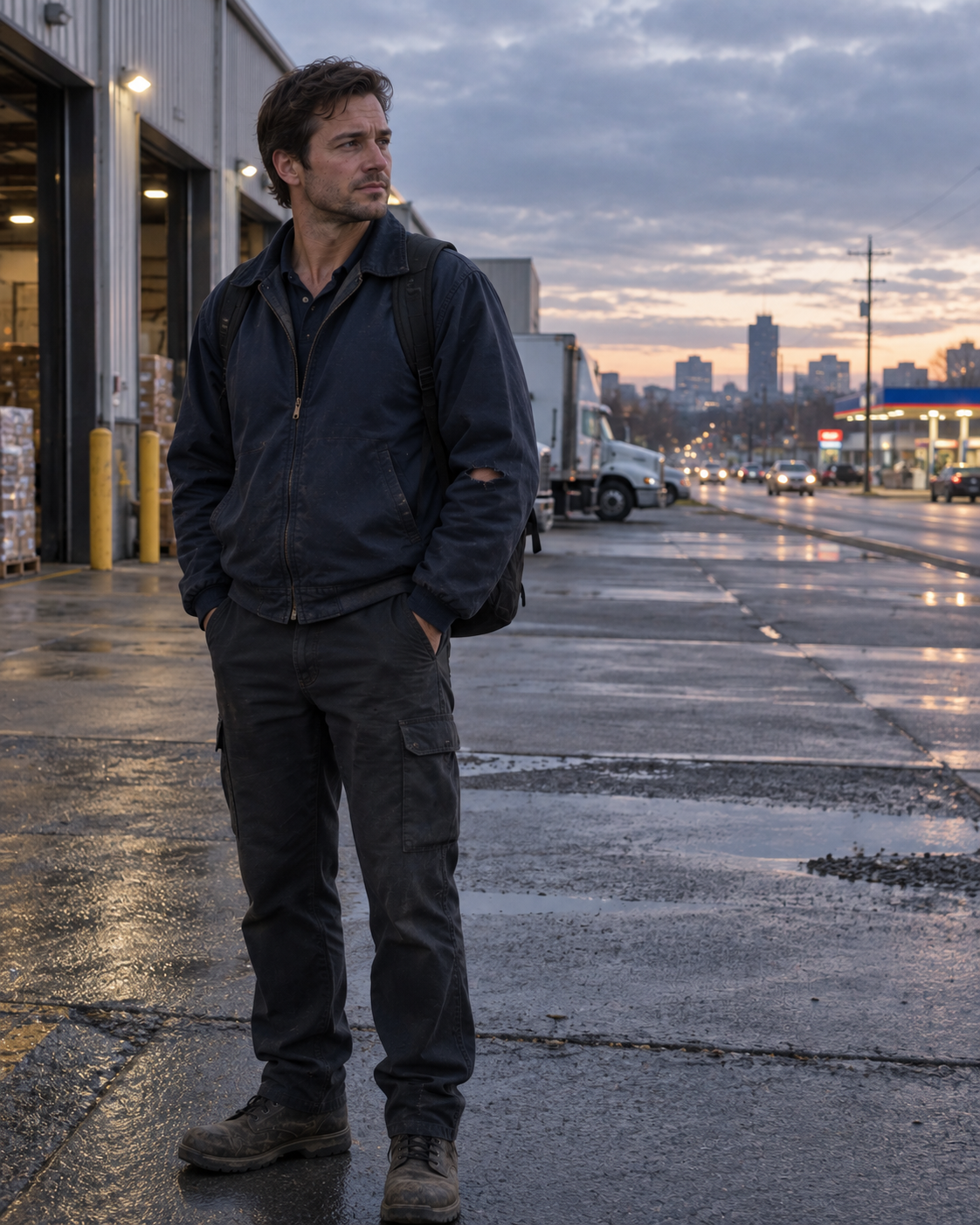
At 6:07 every morning, Daniel Mercer walked out of the warehouse through the employee entrance and watched the sky change color over the highway.
He had begun to hate that part of the morning.
Not because the sunrise was ugly. It was beautiful, actually. The problem was that everybody else seemed to be starting their day while his was already over.
A delivery driver would pull into the gas station across the street carrying a cup of coffee. Parents in school-drop-off lines would lean forward in their cars, talking to children in the back seats. Office workers hurried toward the commuter train with backpacks and pressed shirts.
Daniel walked in the other direction.
His shoes were worn at the heels. His security jacket had a tear near one sleeve that he had repaired twice. At thirty-four, he lived alone in a one-bedroom apartment above a laundromat in Dayton, Ohio, where the pipes rattled whenever somebody on the first floor ran a washing machine.
He worked from 8 p.m. to 6 a.m. at a regional distribution warehouse.
The pay covered rent, groceries, gas, and not much else.
Daniel had no wife, no kids, no college degree, and no savings worth mentioning. What he did have was a stubborn habit of showing up.
He had worked nights for six years.
He had applied for better jobs.
He had been told, politely and sometimes not so politely, that other applicants had more experience, more education, more certifications.
Eventually, he stopped telling people he was trying to move up.
His mother still asked.
Every Sunday afternoon, while Daniel sat at his kitchen table eating whatever dinner he had cooked too early, his phone would ring.
“You sleep yet?” his mother, Rose, would ask.
“Yes.”
“Did you?”
Daniel smiled even though she couldn’t see him. “Some.”
Rose lived three hours away in the small town where Daniel had grown up. She had raised him alone after his father left when Daniel was eleven. She still kept a vegetable garden behind the house, even though her knees had started bothering her.
One Sunday she said, “You sound tired.”
“I work nights, Mom.”
“That isn’t what I mean.”
Daniel rubbed a hand over his face.
She was quiet for a moment.
“Daniel, when are you going to start believing you’re allowed to have a different life?”
He stared at the kitchen wall.
“I don’t know.”
“You’ve always been good at enduring things,” she said. “But enduring isn’t the same as living.”
That night, Daniel almost wrote down the sentence.
He didn’t.
Two days later, at 5:18 on a cold November morning, his sister called.
“Dan, you need to come home.”
Something in her voice made him sit down.
“What happened?”
“Mom collapsed.”
The apartment suddenly felt too small.
“She’s awake,” his sister added quickly. “They took her to the clinic. The doctor says she’s stable. But you should come.”
Daniel was on the first bus before sunrise.
The Promise
Rose was sitting up when Daniel arrived.
She looked smaller than he remembered.
Her gray hair was pulled into a loose bun, and there was an IV taped to the back of her hand. A paper cup of water sat on the bedside table.
“You came all this way for me,” she said.
“Of course I did.”
“You look terrible.”
Daniel laughed.
“Nice to see you too.”
Her smile faded.
The doctor told them Rose had fainted from exhaustion and dehydration. She needed to take her medication regularly, eat better, and stop pushing herself so hard.
Daniel listened while staring at the number written on the discharge paperwork.
He knew exactly how much he had in his checking account.
Not enough.
Not nearly enough.
That evening, after his mother fell asleep, Daniel sat beside her bed.
Her hands rested on top of the blanket.
He remembered those hands when he was eight, tying his shoes before school. At seventeen, washing his work uniform in the kitchen sink because the washer had broken. At twenty-three, slipping twenty dollars into his pocket when he was between jobs and too proud to ask.
She had spent her whole life making impossible things look ordinary.
Around 4:50 the next morning, Daniel stepped outside the clinic.
The town was dark and quiet.
A farmer drove slowly past in an old pickup. Somewhere behind the buildings, a train horn sounded.
Daniel checked his phone.
5:00 a.m.
He thought about the years he had spent telling himself there would be time later.
Later, when he had more money.
Later, when he had more energy.
Later, when somebody finally gave him a chance.
He leaned against the cold brick wall.
“I need to stop waiting,” he whispered.
It was not a grand decision. There was no sudden certainty.
Just a quiet recognition that if nothing changed, nothing was going to change.
On the bus back to Dayton, Daniel noticed an older man across the aisle reading a paperback with a notebook balanced on his knee.
Daniel recognized him after a minute.
Frank Delaney owned three neighborhood hardware stores and had lived in town for years. His stores were the kind where customers knew employees by name.
Daniel hesitated before speaking.
“Mr. Delaney?”
The man lowered his book.
“Do I know you?”
“I work security at the Mercer warehouse.”
Frank nodded. “Night shift.”
“Yeah.”
Frank looked at the dark circles under Daniel’s eyes.
“Heading home?”
“Yes.”
“Then you should be asleep.”
Daniel gave a tired laugh.
“I know.”
Frank closed the book.
“What do you want to be doing instead?”
The question caught Daniel off guard.
“I don’t know.”
Frank studied him for a moment.
“That’s not true.”
Daniel looked out the window.
After a long silence, he said, “I want a job where I can build something. Learn something. I just don’t know how to get there.”
Frank opened his notebook.
“Then stop trying to solve your whole life at once.”
He wrote something down.
“Two hours.”
Daniel frowned.
“What?”
“Two hours a day. That’s enough to start.”
“To do what?”
“To become somebody who can qualify for the next job.”
Frank gave the notebook back.
“Pick one useful skill. Learn it every day. And protect your sleep while you do it. Don’t confuse exhaustion with discipline.”
Daniel read the words Frank had written.
Excel. Bookkeeping. Inventory systems.
“Why those?”
“Because you already understand warehouses,” Frank said. “You just need to understand what happens on the other side of the loading dock.”
The bus rolled through another red light.
Frank tore a page from the notebook and handed him his number.
“Call me in three months.”
Daniel looked at the paper.
“What happens in three months?”
Frank smiled.
“That depends on what you do before then.”
The Hours No One Saw
Daniel did not become disciplined overnight.
The first two weeks were miserable.
He changed his sleep schedule carefully instead of cutting it in half. After work, he came home, showered, ate something small, and went to bed. He woke in the afternoon, worked his night shift, and on his days off kept his sleep schedule as consistent as possible.
His sacred hours were not five in the morning.
They were the hours he could reliably protect without destroying his health.
For Daniel, that meant a quiet block after waking.
At first, he could barely concentrate for thirty minutes.
He opened free Excel lessons on his aging laptop and spent twenty minutes figuring out how to make a simple formula work.
He swore.
Deleted the file.
Started again.
The next day, he learned something slightly harder.
Then something harder than that.
He created a spreadsheet to track imaginary shipments.
He read about purchase orders.
He learned why inventory discrepancies mattered.
He watched videos during his lunch break at work, wearing cheap earbuds beneath his security jacket.
He carried a notebook everywhere.
His coworkers teased him.
“Planning to become CEO, Danny?”
Daniel smiled.
“Something like that.”
But he didn’t feel ambitious.
Not yet.
He felt embarrassed.
For years, he had hidden the fact that he didn’t know how computers worked beyond email, passwords, and basic forms.
Now he was learning from the beginning.
One night, a box truck arrived three hours late.
The receiving clerk was furious because the system showed eighty-seven cases, while the driver had counted eighty-nine.
Daniel watched them argue.
He looked at the handwritten receiving sheet.
Then at his notebook.
He began asking questions.
The next week, he built a simple inventory tracker for himself.
It wasn’t official.
Nobody asked him to do it.
He just wanted to understand what was going wrong.
By the end of the month, he could see patterns other people were missing.
By the second month, his supervisor noticed.
“You’re different lately,” he said.
Daniel shrugged.
“Trying to learn.”
“Learn what?”
“Anything useful.”
The supervisor nodded toward the computer room.
“You ever thought about transferring?”
Daniel laughed.
“To where?”
“Day shift. Inventory support. Maybe operations.”
Daniel looked at him.
“You think they’d hire me?”
“I think they’d at least talk to you.”
For the first time, Daniel allowed himself to imagine it.
Not a dream.
A possibility.
The Spreadsheet
On a Thursday morning in February, Daniel found a mistake worth almost $18,000.
The warehouse had been ordering replacement parts based on an inventory number that had not been updated properly in the system. It had happened gradually, one missed adjustment after another.
Daniel found it because a small spreadsheet he had built for his own notes showed that the physical count didn’t match the software.
He checked it three times.
Then he walked into his supervisor’s office.
“I think something’s off.”
His supervisor looked at the screen.
“What am I looking at?”
Daniel explained.
Ten minutes later, they were standing in the warehouse with a clipboard.
By noon, the operations manager was there.
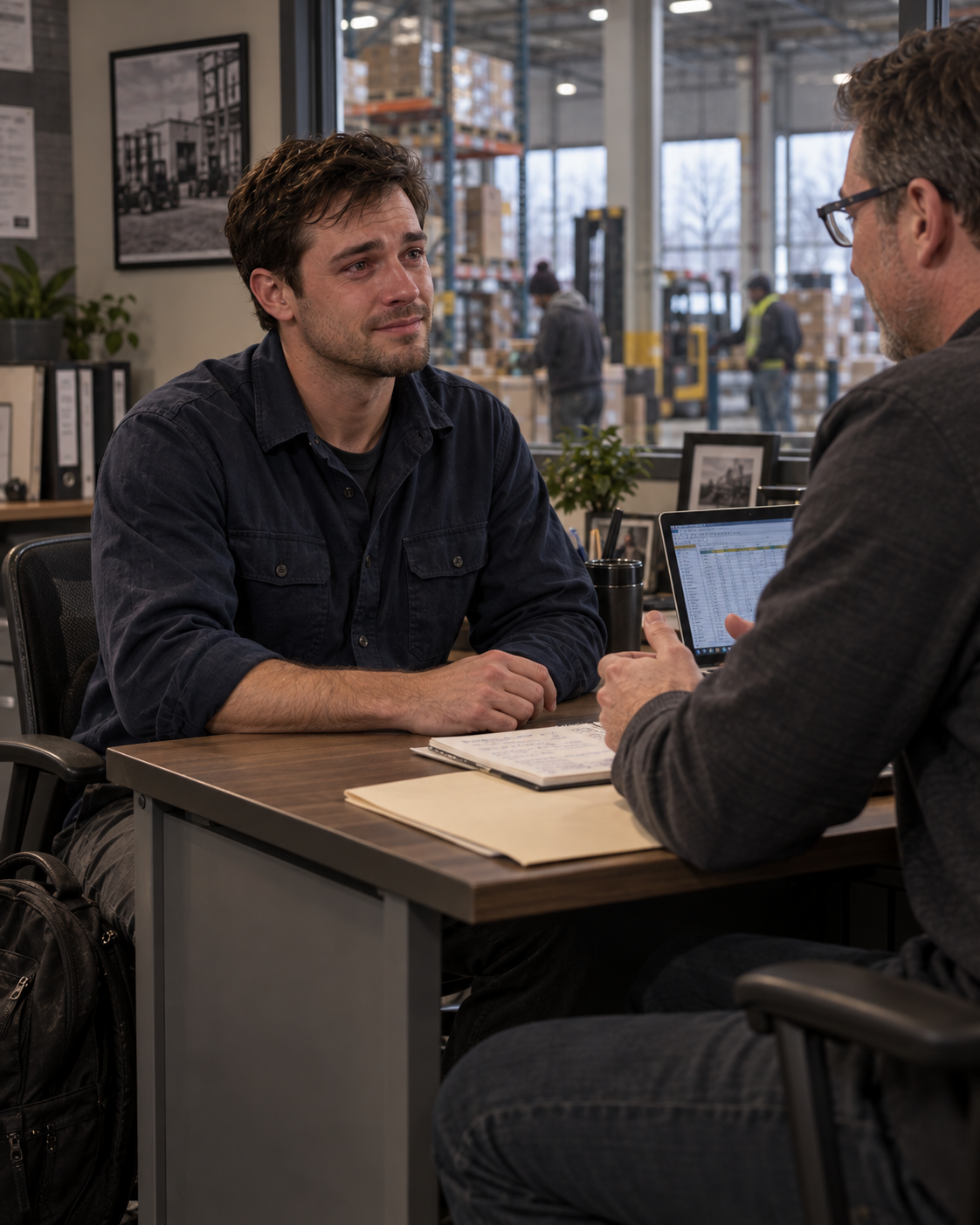
By three, Daniel was sitting in a meeting room with two people from accounting.
He expected to be asked to leave.
Instead, a woman named Melissa Chen slid a chair toward him.
“Walk me through how you found this.”
Daniel did.
She asked another question.
He answered.
Then another.
He admitted when he didn’t know.
He explained what he had learned.
He told her he had been teaching himself because he didn’t want to stay where he was forever.
Nobody laughed.
A week later, his supervisor called him into the office.
Daniel thought he was in trouble.
Instead, the supervisor closed the door.
“The company is creating an inventory coordinator position.”
Daniel waited.
“They want you to take it.”
He stared at him.
“Me?”
“You already know this place. You know the receiving crew. You know the shipping side. And apparently, you know more about spreadsheets than I do.”
Daniel smiled nervously.
“What about the degree requirement?”
“We’re waiving it.”
His throat tightened.
“How much?”
The supervisor told him.
Daniel sat very still.
It was more money than he had ever made.
Not enough to make him rich.
Enough to breathe.
What Changed at Home
Daniel’s first call was to his mother.
She answered on the third ring.
“Hello?”
“Mom.”
“What’s wrong?”
“Nothing.”
There was a pause.
“You never call this early.”
“I got a new job.”
Rose was silent.
“What kind?”
Daniel told her.
“Day shift?”
“Day shift.”
“Daniel.”
Her voice broke slightly.
“You did it.”
He sat on the edge of his bed.
“I had help.”
“Still counts.”
He laughed.
She cried.
He did too.
A year later, Daniel was no longer the new guy in inventory.
He had become the person newer employees went to when they couldn’t figure something out.
He had taken two community college classes at night.
He had paid off the credit card he used to call his emergency fund.
He had moved into a small two-bedroom apartment with a kitchen that actually got sunlight.
Most importantly, Rose no longer lived three hours away alone.
Daniel helped her move closer to him.
She complained about the smaller garden.
He built her three raised planting beds behind the apartment.
She called them “ridiculous.”
Then she spent four hours planting tomatoes.
Some mornings, Daniel still woke before sunrise.
Not because he was afraid of losing his progress.
Not because somebody had promised him that waking early would magically fix his life.
He woke because he had learned what it felt like to choose where his hours went.
One Saturday, months after his promotion, Daniel drove to the old warehouse parking lot before dawn.
He sat in his car with the heater running.
The buildings looked the same.
The loading docks.
The security booth.
The highway.
A truck moved through the intersection, headlights cutting across the dark.
Daniel remembered the man he had been when he walked out of that warehouse every morning.
He had thought his problem was that no one had opened a door for him.
Now he understood that the first door had been quieter.
It had been a decision made in a hospital hallway.
A notebook on a bus.
A spreadsheet nobody asked him to create.
An hour spent learning when quitting would have been easier.
And a second hour spent becoming less afraid of what he didn’t know.
Daniel started the car.
At the first light, the sky began turning pale.
He drove toward the apartment where his mother would probably already be awake, checking on her tomato plants.
For once, he wasn’t watching the city wake up without him.
He was heading somewhere inside it.