The Days He Kept Letting Slip Away
By the time Daniel Hart turned twenty-two, his father had stopped asking what he planned to do with his life.
That silence worried Daniel more than any lecture ever had.
He lived with his father, Martin, in a small weathered house outside a quiet town in Pennsylvania. Martin had spent thirty years repairing engines at a local auto shop, and he believed in getting up early, doing honest work, and leaving a place better than you found it.
Daniel believed in sleeping late.
Most mornings, Martin was already gone when Daniel rolled out of bed. By ten, Daniel would wander downtown, sit on the bench outside the diner, scroll through his phone, joke with whoever happened to pass, and eventually find his way home after dark.
He always had a reason.
He was waiting for the right job.
He was thinking about starting something.
He needed a break.
The problem was that every day seemed to be a break from the day before.
One Thursday in early October, Martin came home before dinner. He placed his keys on the kitchen counter and stood quietly in the doorway.
Daniel was sprawled on the couch, one shoe hanging from his foot, a video playing on his phone.
“Dad?”
Martin nodded toward the hallway.
“Come with me.”
Daniel sat up.
“What for?”
“Just come on.”
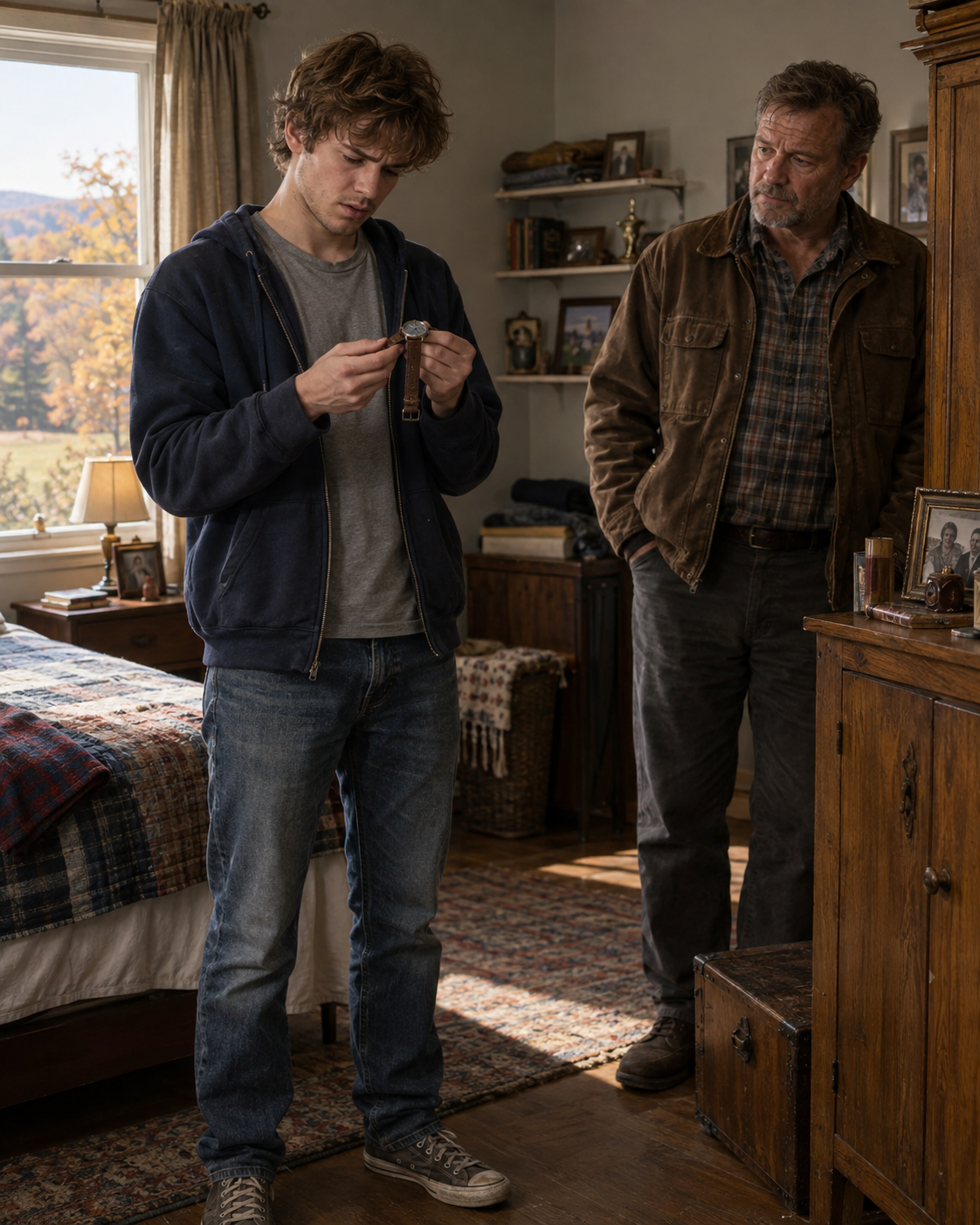
Martin led him into the spare bedroom, where an old wooden cabinet stood against the wall. It had belonged to Daniel’s grandfather. The brass handle was worn smooth from decades of use.
Martin opened the top drawer and reached inside.
He took out a silver wristwatch.
It was old-fashioned, with a scratched leather band and a round face that had yellowed slightly around the edges.
“Take this,” Martin said.
Daniel turned it over in his hand.
“What is it?”
“An old watch.”
“I can see that.”
Martin almost smiled.
“I want you to take it to the market tomorrow.”
Daniel frowned.
“And do what?”
“Ask people what they think it’s worth.”
Daniel looked at the watch again.
“That’s it?”
“That’s it.”
Daniel shrugged.
“Okay.”
Martin closed the cabinet.
Before leaving the room, he paused.
“Bring it back to me.”
That was all he said.
The Watch at the Market
The next morning, Daniel walked downtown with the watch in his pocket.
The market occupied a broad brick building near Main Street. Inside were booths selling produce, antiques, old records, handmade furniture, and things people had cleaned out of their attics.
Daniel stopped first at a table covered with vintage kitchenware.
A gray-haired woman picked up the watch, turned it over, and squinted.
“Swiss?” she asked.
“I don’t know.”
She examined the back.
“Maybe. Fifty dollars.”
Daniel blinked.
“That’s it?”
She shrugged.
“You asked what I think it’s worth.”
At another booth, a man who sold old tools offered seventy-five.
A young collector laughed and said he’d pay forty.
A dealer behind a glass case named a hundred and twenty, then lowered it to ninety after looking more closely.
Daniel kept walking.
By lunchtime, he had heard nearly every number between forty and one hundred and twenty dollars.
He also noticed something else.
Nobody seemed especially interested in the watch itself.
They were interested in what they thought someone else might pay for it.
When Daniel returned home that afternoon, Martin was sitting at the kitchen table with a cup of coffee.
“Well?”
Daniel put the watch on the table.
“Forty dollars. Seventy-five. Ninety. One guy said a hundred and twenty.”
Martin nodded.
“So what’s it worth?”
Daniel rubbed his chin.
“I guess… somewhere around a hundred bucks.”
“Maybe.”
Martin picked up the watch.
Then he put it back in Daniel’s hand.
“Put it in the cabinet.”
Daniel stared at him.
“That’s all?”
“For today.”
Daniel walked away, puzzled.
He had expected an explanation.
He got none.
The Question Nobody Wanted to Answer
The following morning, Martin woke him before sunrise.
Daniel stumbled into the kitchen in sweatpants, hair sticking up on one side.
“Seriously?”
Martin poured coffee into his own mug.
“Bring me the watch.”
Daniel sighed but went upstairs.
When he returned, Martin was already putting on his work boots.
“Take it back to the market.”
Daniel raised an eyebrow.
“Same thing?”
“Not exactly.”
“What do I ask?”
Martin looked at him.
“This time, don’t ask how much the watch is worth.”
Daniel waited.
“Ask them how much the time inside the watch is worth.”
Daniel laughed.
“What?”
“You heard me.”
“That doesn’t even make sense.”
Martin opened the front door.
“Ask anyway.”
The market was busier that day.
Daniel approached a man arranging secondhand books.
“How much is the time inside this watch worth?”
The man looked up.
“What?”
Daniel repeated himself.
The man laughed.
“You serious?”
At another stall, a woman shook her head.
“Kid, I don’t know what you’re talking about.”
One person told him to stop wasting his time.
Another laughed so hard he nearly dropped the coffee he was holding.
Daniel’s ears burned.
By noon, he had stopped asking.
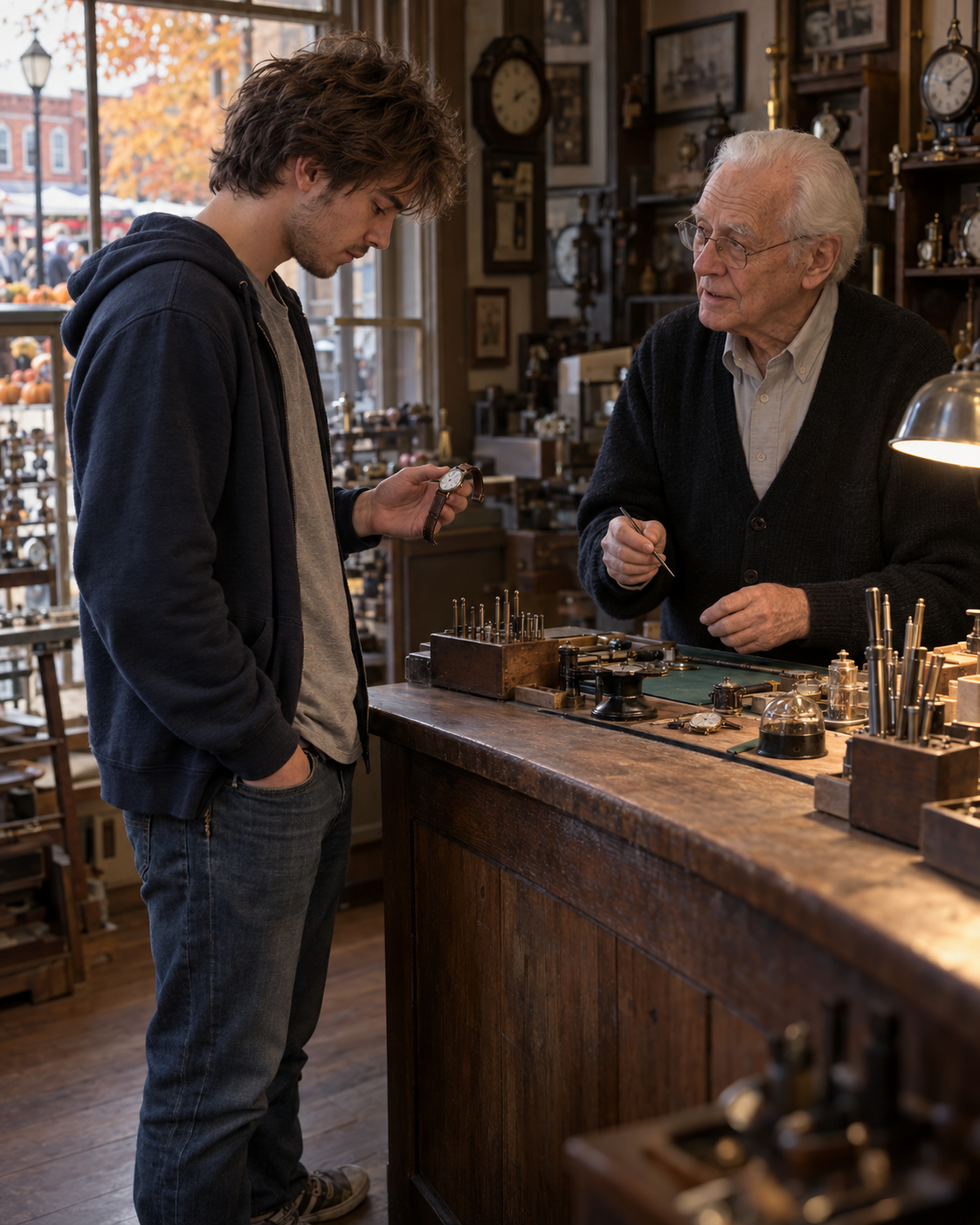
He stood outside a small repair shop at the edge of the market and looked through the window.
An old man sat behind a wooden counter beneath a bright desk lamp. Tiny tools were arranged in neat rows. Several watches lay open in front of him, their backs removed, their tiny gears exposed.
Daniel stepped inside.
A bell chimed above the door.
The old man looked up.
“What can I do for you?”
Daniel reached into his pocket.
“My dad gave me this watch.”
The man held out his hand.
Daniel gave it to him.
The old man examined the case, then the face.
“Old piece,” he said.
“My father told me to ask people what it’s worth.”
“Reasonable question.”
“Then he told me to ask how much the time inside it is worth.”
The old man’s hands stopped moving.
He looked up.
“And what did people say?”
“Mostly that I was an idiot.”
The old man smiled.
“Some people are uncomfortable when a question asks more of them than a number.”
Daniel glanced at the watches on the counter.
“What would you say?”
The old man picked up a tiny screwdriver.
“I’d say you’re asking the wrong way.”
“How?”
He held up the watch.
“This doesn’t contain time.”
Daniel frowned.
“It doesn’t?”
“No. It measures time. That’s different.”
He turned the watch over in his palm.
“You can replace the crystal. Replace the strap. Clean the gears. Maybe repair the hands.”
He looked directly at Daniel.
“But no watchmaker in the world can put yesterday back inside the case.”
Daniel went quiet.
The old man set the watch gently on the counter.
“You can spend twenty dollars and buy another watch. You can spend two thousand. Maybe twenty thousand.”
He tapped the glass with one finger.
“But nobody has ever bought another hour.”
Daniel looked down.
The old man continued, his voice calm.
“That’s the strange part about time. People act like they have plenty of it because they can’t see it leaving.”
Daniel swallowed.
“So what am I supposed to do?”
The old man shrugged.
“You don’t have to become a different person by Monday.”
A faint smile crossed his face.
“Just stop giving your hours away without noticing.”
Daniel stared at the watch.
For some reason, that sentence hurt more than being called lazy ever had.
The First Morning
Daniel walked home instead of taking the bus.
It took nearly an hour.
For once, he didn’t mind.
He thought about all the mornings he had slept through. Jobs he’d ignored because the starting pay wasn’t exciting. Messages he’d left unanswered. Things he’d said he’d do later.
Later had always sounded like a place he could visit whenever he wanted.
Now he wasn’t sure it was a place at all.
When he reached the house, Martin was repairing a cabinet hinge at the kitchen table.
Daniel placed the watch in front of him.
“I met an old watchmaker.”
Martin nodded.
“What did he say?”
Daniel hesitated.
“He said a watch doesn’t hold time.”
Martin waited.
“It only measures it.”
A small smile appeared on Martin’s face.
Daniel pulled out the chair across from him.
“Dad?”
“Yeah?”
“Why didn’t you just tell me?”
Martin set down the screwdriver.
“Tell you what?”
“That I’m wasting my life.”
Martin leaned back.
“I’ve told you.”
“No. You’ve told me I’m lazy.”
Martin looked toward the window.
“You were twenty-two. You heard ‘lazy’ because it was easier than hearing ‘I’m worried about you.’”
Daniel looked away.
The kitchen fell quiet except for the refrigerator humming.
After a while, Martin said, “I don’t care whether you become rich.”
Daniel looked at him.
“I care whether you wake up one day and realize you spent years waiting to become somebody else.”
Daniel ran his thumb across the scratched watch crystal.
“I don’t know what I want.”
“That’s okay.”
“I thought you’d tell me to figure it out.”
“I am.”
Martin smiled.
“But figuring it out doesn’t require sitting still.”
The next Monday, Daniel got up at six-thirty.
He put on clean clothes.
He drove to a landscaping company that had posted an opening weeks earlier.
The work was hard, and he hated it by the second day.
He went back on the third.
He also started taking night classes at the community college because he had always been interested in small-engine repair. He didn’t suddenly become disciplined. He still slept through an alarm once. He still wasted entire evenings scrolling through his phone.
But now, when he caught himself doing it, he noticed.
That was new.
Months passed.
Daniel kept the old watch on his desk.
It no longer worked properly. It lost a few minutes every day.
He could have had it repaired.
Instead, he liked the imperfect movement.
It reminded him that time didn’t need to be perfect to matter.
What the Old Watch Became
By spring, Daniel had earned enough money to buy a used toolbox.
By summer, he was doing small engine repairs for neighbors on weekends.
He wasn’t successful in the dramatic way people write about in stories. He didn’t wake up one morning with a thriving business and a stack of cash.
He simply became dependable.
When someone called, he answered.
When he said he’d show up at nine, he showed up at nine.
When a job went badly, he came back the next day and tried again.
Martin noticed, but he rarely commented.
One Saturday evening, Daniel found him sitting on the porch.
The old watch was on Martin’s wrist.
Daniel stopped at the steps.
“I thought that thing was broken.”
“It is.”
“Then why are you wearing it?”
Martin looked at the face.
“It still keeps me aware.”
Daniel sat beside him.
The town was quiet. Across the road, a kid was riding a bicycle in slow circles while his mother called him in for dinner.
A breeze moved through the trees.
Martin pulled the watch from his wrist and handed it over.
“You should keep it.”
Daniel turned it in his fingers.
“I thought it was Dad’s.”
“It was.”
He paused.
“Now it’s yours.”
Daniel looked at the old scratched face.
“Why?”
Martin leaned back against the porch chair.
“Because you finally know what it costs.”
Daniel smiled.
“No. I don’t.”
Martin raised an eyebrow.
Daniel looked down at the watch.
“You can’t really know what time costs.”
His father nodded once.
“That’s probably true.”
Daniel slipped the watch onto his wrist.
The band was loose, and the face sat crooked against his skin.
The hands were several minutes behind.
He didn’t fix them.
He sat there beside his father as the evening light faded over the street, listening to the ordinary sounds of home—the screen door closing, a car passing, someone laughing two houses down.
For the first time, Daniel didn’t feel the need to be somewhere else.
He watched the second hand move.
Then he stayed long enough to see it move again.