The Boy With the Torn Backpack
By the time the last school bus disappeared around the bend, Kabir had already decided he was done telling people what he wanted to become.
He stood beside the cracked sidewalk outside the only convenience store in Bell Creek, a small rural town surrounded by soybean fields and low wooded hills. His backpack hung from one shoulder, its zipper held together with a safety pin. One of his sneakers had a hole near the toe.
Across the street, two boys from his class were laughing.
“Still planning to be some big businessman?” one called.
Kabir kept walking.
“What are you going to sell?” the other shouted. “Your empty pockets?”
They laughed again.
Kabir slipped his hand into his pocket.
Nothing.
Not even enough for a soda.
He walked past the storefronts toward the river, where the town became quieter. His father had told him not to come home until after dark because there was little food in the kitchen and Kabir’s mother needed to rest.
Their house sat at the edge of a small farm his father had rented for years. The roof leaked in two places. Their old pickup started only when it felt like cooperating. Some months, the electricity bill sat on the kitchen counter for days before anyone dared open it.
Kabir knew exactly how poor they were.
What he couldn’t understand was why everyone believed that meant he had to stay poor forever.
At the river, he sat on a flat stone and watched the water move around the weeds.
“You look like someone who just lost an argument.”
Kabir turned.
Mr. Rao stood a few feet away, holding an old canvas fishing bag.
People in town called him Guruji, a nickname he’d carried since his years teaching elementary school. He had retired before Kabir was born, but he still tutored children at the library and repaired old clocks in his garage.
“I didn’t lose,” Kabir said.
Mr. Rao smiled. “Then why do you look defeated?”
Kabir stared at the river.
“They say I’m stupid for thinking about the future.”
“Who says that?”
“Everybody.”
“Everybody is a very large group.”
Kabir finally looked at him.
Mr. Rao reached into his bag and pulled out a small rectangular mirror with a scratched wooden frame.
“Look.”
Kabir frowned. “Why?”
“Because I’m asking.”
Kabir held it up.
His own face stared back at him. Thin cheeks. Messy black hair. A faint bruise beneath one eye from a fall at the farm.
“What do you see?”
“Myself.”
“What else?”
Kabir shrugged.
Mr. Rao sat beside him.
“Look longer.”
Kabir did.
The longer he stared, the less he noticed the hole in his shoe or the dirt beneath his fingernails.
He noticed his eyes.
They looked tired.
But they weren’t empty.
“There,” Mr. Rao said quietly. “You see it?”
Kabir shook his head.
“Something in you is still fighting.”
Kabir lowered the mirror.
“Fighting what?”
“Everything that tells you to give up.”
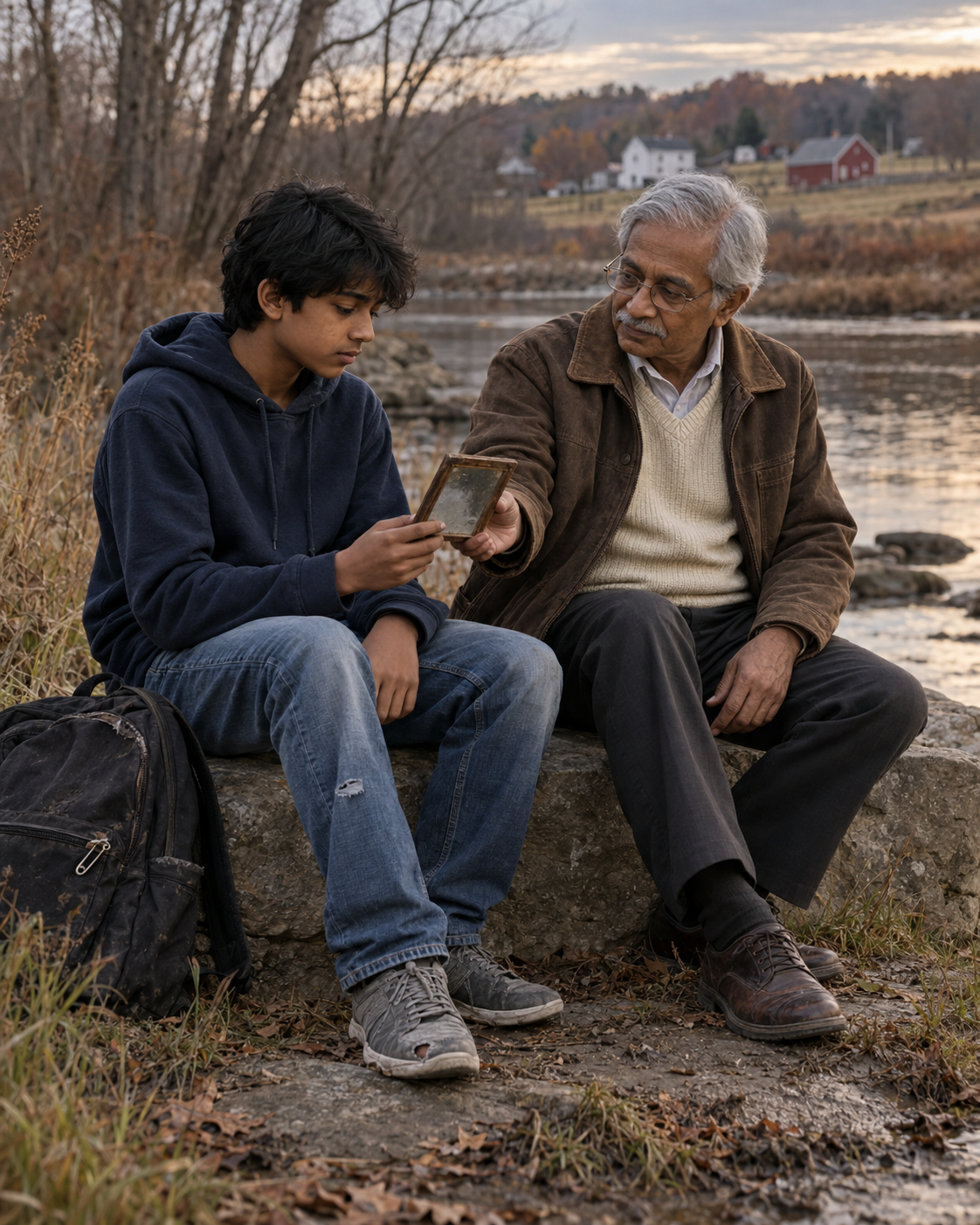
Mr. Rao tapped the mirror.
“People can tell you what they see when they look at you. They cannot decide what you see when you look at yourself.”
Kabir said nothing.
“Your family has very little money,” Mr. Rao continued. “That’s a fact. But facts are not always permanent.”
Kabir looked at the mirror again.
“What if they’re right?”
“Then prove them wrong slowly.”
“How?”
“With work.”
Mr. Rao stood and brushed dirt from his jacket.
“Dreaming is easy. Keeping a promise to yourself every day is harder.”
He handed Kabir the mirror.
“Take it.”
Kabir stared at him.
“For what?”
“So you remember that your circumstances are something you are living through, not something you are.”
That evening, Kabir placed the mirror beside the lamp on his desk.
Then he opened his math book.
The Hours Nobody Saw
Kabir’s dream changed shape many times.
At first, he wanted to be rich.
Then he wanted to own a business.
Later, after watching his father struggle to keep a failing tractor running, he decided he wanted to understand machines and technology.
He didn’t have the money for expensive equipment or private lessons, so he learned whatever was available.
He read old computer manuals at the library.
He watched free repair tutorials on a borrowed laptop.
He took apart broken radios and cheap phones people were about to throw away.
Sometimes he put them back together.
Sometimes he made them worse.
He kept a notebook of every mistake.
At sixteen, he started working evenings at Miller’s Diner, wiping tables and washing dishes. His first paycheck disappeared almost immediately.
His mother needed a prescription.
His father needed new work gloves.
There was a utility bill.
Kabir kept twenty dollars for himself.
He put it inside an envelope labeled TOOLS.
His mother found it that night.
“You need clothes,” she said.
“I’ll manage.”
“You’ve been saying that since you were twelve.”
Kabir smiled.
His mother, Leena, was sitting at the kitchen table with a blanket around her shoulders. Her illness had made her thinner over the past few years, and some mornings she struggled to get out of bed.
She pushed the envelope toward him.
“Keep some money for yourself.”
“I am.”
“You call twenty dollars keeping money?”
Kabir laughed.
She smiled, but her eyes remained worried.
“You don’t have to save everyone, Kabir.”
He looked toward his father, asleep in a chair after another twelve-hour day in the fields.
“I know.”
But he wasn’t sure he believed her.
After graduation, Kabir enrolled at the nearby community college, choosing an electronics and technology program. He couldn’t afford to stop working, so his days became a careful puzzle.
Classes in the morning.
Diner in the afternoon.
Repair work at night.
Sleep whenever there was time.
He nearly quit during his second semester.
His grades dropped. His mother had another serious episode. His father injured his back and couldn’t work for several weeks.
One night Kabir sat at the kitchen table with three overdue bills in front of him.
His textbooks were stacked beside them.
He stared at the numbers until they blurred.
Then he heard the faint rattle of the mirror on his desk.
He picked it up.
For a moment, he saw exactly what everyone else had seen for years: a poor kid with too many problems and not enough money.
Then he remembered Mr. Rao.
Prove them wrong slowly.
Kabir closed the bills.
He opened his textbook.
And kept going.
The First Shop
The repair business started with a folding table in the back room of a laundromat.
Kabir fixed cracked phone screens, replaced batteries, repaired charging ports, and cleaned water-damaged electronics. He charged less than the stores in the nearest city because he knew what it felt like to count every dollar.
His first customer was an elderly woman named Mrs. Jenkins whose phone had stopped charging.
Kabir repaired it for thirty-five dollars.
She tried to give him fifty.
“No,” he said. “Thirty-five is enough.”
She looked at the tiny handwritten receipt.
“You sure?”
“Yes.”
She smiled.
“Then I’ll tell people.”
She did.
Word traveled through Bell Creek.
Within six months, Kabir had more work than he could handle.
He rented a narrow storefront beside a laundromat. The sign above the door simply said KABIR TECH REPAIR.
The paint was uneven.
The counter was secondhand.
The shelves came from a closing hardware store.
But it was his.
He kept the little mirror in the top drawer of his desk.
Not because he needed inspiration every morning.
Because some days he needed reminding.
Business grew.
Kabir hired a part-time assistant from his old high school. Then another.
He started selling chargers, cases, cables, and refurbished phones.
Instead of spending his profits on a nicer car or a bigger house, he put the money back into inventory and equipment.
People who had once laughed at him began stopping by to ask for advice.
One afternoon, a local contractor offered him a partnership.
Kabir said no.
He had a different idea.
He wanted to build affordable charging accessories for people who couldn’t afford premium brands.
It took two years of failed prototypes, returned shipments, and sleepless nights.
Then one distributor placed an order.
The number on the purchase agreement was larger than any amount Kabir had ever seen attached to his own name.
He read it three times.
His hands shook.
He called his mother.
“Mom?”
“What’s wrong?”
“Nothing.”
“Then why are you crying?”
Kabir laughed through the tears.
“I think we’re going to be okay.”
What He Carried Home
Success did not arrive like a movie.
There was no single morning when everything changed.
It came in invoices, phone calls, long drives, tax forms, rejected products, repaired equipment, and hundreds of ordinary decisions.
By the time Kabir was thirty, his company employed twenty-seven people.
His parents no longer worried about medical bills.
His father stopped farming full-time and spent most mornings tending a small vegetable garden behind their house.
His mother kept a row of herbs beside the kitchen window.
Kabir bought them a newer home on a quiet street outside town.
But he refused to move far away.
Bell Creek had been hard on him.
It had also taught him how to work.
One rainy Saturday, Kabir drove his old pickup to the library.
Mr. Rao was there, sitting near the window with a book open on his lap.
He looked older.
Smaller.
His hands trembled slightly when he turned a page.
Kabir stood in the doorway.
“Guruji.”
Mr. Rao looked up.
His face brightened.
“You came.”
“I said I would.”
Kabir sat across from him.
For a while, neither spoke.
Then Kabir placed something on the table.
The old mirror.
Mr. Rao picked it up.
“I wondered where this went.”
“You gave it to me.”
“I remember.”
“It stayed with me.”
Mr. Rao turned the mirror over in his hands.
“You kept it all these years?”
“Almost every day.”
Mr. Rao smiled.
“And did it work?”
Kabir looked toward the rain-covered window.
“Not exactly.”
“No?”
“It didn’t make me successful.”
Mr. Rao waited.
“It just reminded me to get back to work.”
The old teacher nodded.
“That’s what I hoped it would do.”
Kabir swallowed.
“I thought you were going to tell me I could become anything.”
“I could have.”
“Why didn’t you?”
Mr. Rao smiled.
“Because that’s not always true.”
Kabir looked at him.
Mr. Rao continued.
“Sometimes people work hard and still lose. Sometimes they do everything right and life remains unfair. I didn’t want to give you a pretty sentence.”
He placed the mirror back on the table.
“I wanted you to understand that your life was worth building anyway.”
Kabir stared at the scratched glass.
For years, he’d remembered the conversation as a promise about success.
Now he understood it differently.
The Light in the Window
A few months later, Mr. Rao died quietly in his sleep.
Kabir attended the funeral with his parents.
There were former students, neighbors, librarians, mechanics, teachers, and people Mr. Rao had helped without ever telling anyone.
Afterward, Kabir drove to the river.
The town looked almost exactly as it had sixteen years earlier.
The same bend in the road.
The same trees.
The same muddy bank.
He sat on the flat stone where he had once believed his life was already decided.
From his coat pocket, he took the mirror.
The glass was more scratched now.
His reflection looked different too.
There were faint lines around his eyes. His hair was shorter. His shoulders were broader.
But the eyes were familiar.
Kabir smiled.
Then he noticed a boy standing near the river with a backpack hanging from one shoulder.
The boy couldn’t have been more than thirteen.
Kabir watched him for a moment before asking, “You okay?”
The boy shrugged.
“They keep telling me I won’t amount to anything.”
Kabir looked down at the mirror in his hand.
Then he held it out.
The boy hesitated.
“What is it?”
“Something an old teacher gave me.”
“Why?”
“Because I needed to see something.”
The boy took it.
Kabir watched him look at his reflection.
He didn’t explain what he was supposed to find.
He didn’t tell him that dreams always come true.
He didn’t promise that hard work would make life fair.
Instead, he sat beside him and waited.
The river moved quietly past them.
For the first time, Kabir understood that the thing Mr. Rao had given him was never really the mirror.
It was the decision to keep looking at himself honestly—and then to keep moving forward.
When the boy finally looked up, Kabir smiled.
“Come on,” he said. “Tell me what you’re working toward.”
And for a while, beside the river, they talked about a future that neither of them could see yet.
::