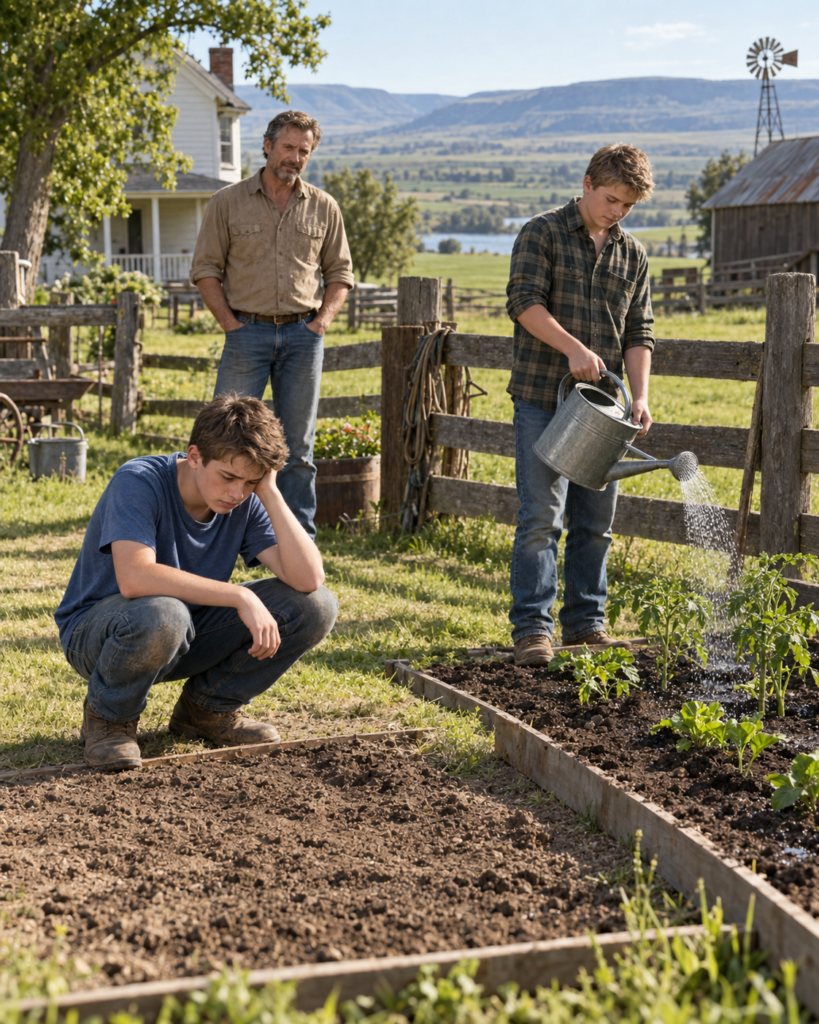
The Boy Who Couldn’t Sit Still
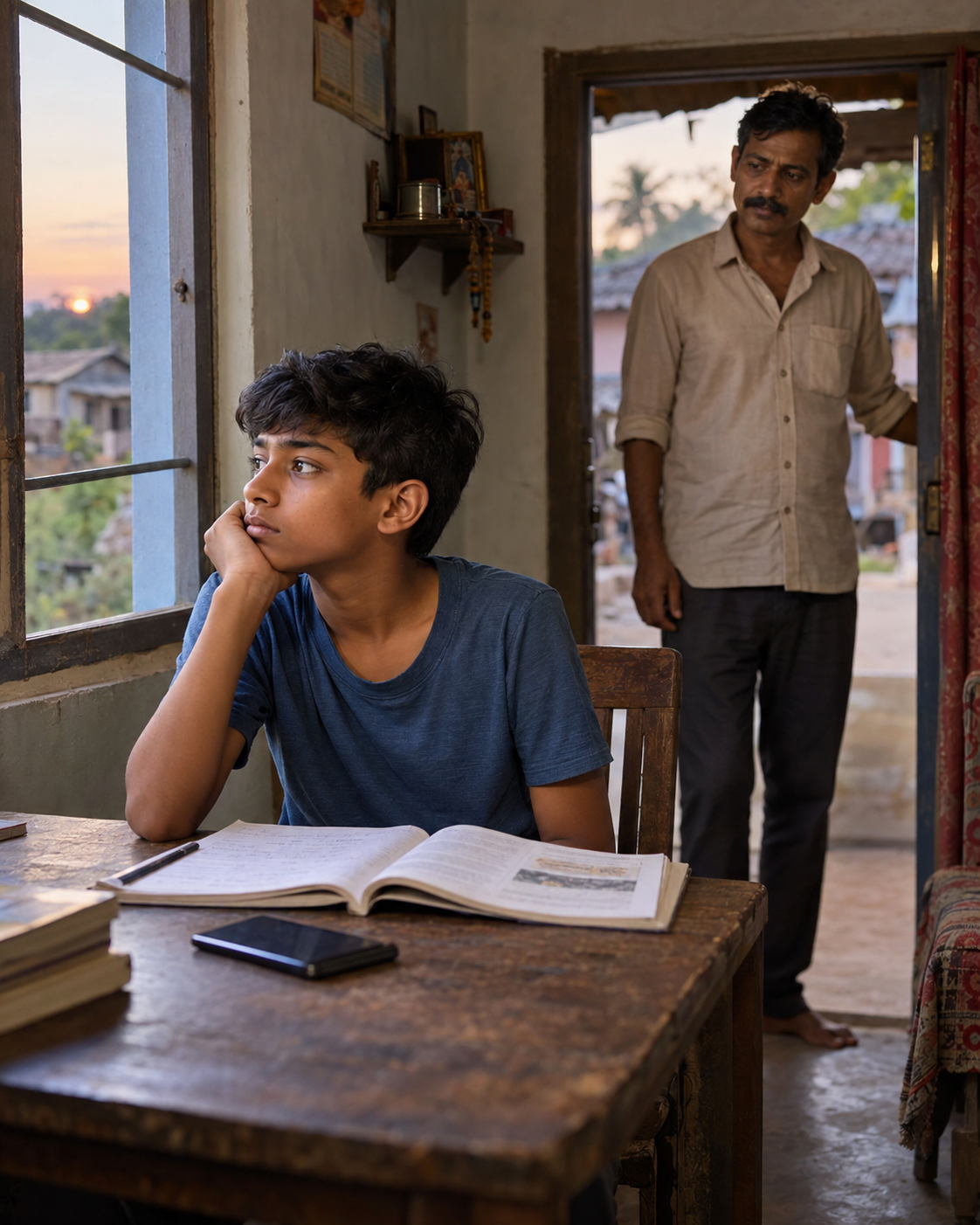
The first time Kabir realized he had failed again, he was staring at the same paragraph for nearly ten minutes.
He had read the first sentence three times. He understood every word, but somehow none of them had stayed in his head.
Outside the open window, two boys were arguing over a soccer ball. A motorcycle rattled down the road. Somewhere in the kitchen, his mother dropped a spoon, then laughed at herself.
Kabir looked at his phone.
Just for a second, he told himself.
Twenty minutes later, his book was still open to the same page.
“Kabir.”
His father’s voice came from the doorway.
Kabir quickly turned the phone facedown.
His father, Ramesh, stood there with his arms folded. He was a quiet man who repaired farm equipment for a living and rarely raised his voice. Somehow, that made his disappointment harder to ignore.
“You have been studying for an hour?”
Kabir looked at the clock.
“Almost.”
“Tell me what you just read.”
Kabir opened his mouth.
Nothing came out.
His father sighed and pulled up the other chair.
“You’re smart,” he said. “That’s never been the problem.”
Kabir stared at the table.
“You know what your problem is?”
“My phone?”
His father almost smiled.
“Your mind.”
Kabir looked up.
“It jumps wherever it wants,” Ramesh continued. “Like a horse that has never learned the reins. If you learn to guide it, it can take you somewhere. If you don’t, it will take you anywhere.”
Kabir had heard versions of this speech before.
He nodded because he knew that was what his father wanted.
But inside, he was already thinking about whether his friends were playing soccer that evening.
The Glass of Water
A week later, Ramesh took Kabir to meet someone.
Guruji lived in a small house at the edge of the village, surrounded by a garden that looked almost too carefully tended for the dusty road outside it.
He was an older teacher named Dev Sharma, though everyone called him Guruji. For decades, he had taught mathematics and science to local students. People remembered him less for his lessons than for his ability to make difficult things seem simple.
Kabir expected a lecture.
Instead, Guruji asked him, “Do you like solving problems?”
“Sometimes.”
“Do you like winning?”
Kabir smiled.
“Yeah.”
“Good. Then we don’t need to talk about failure yet.”
Guruji walked into the garden and returned carrying a small glass of water.
He handed it to Kabir.
“Walk around the garden.”
Kabir looked at the glass.
“And?”
“Don’t spill a single drop.”
“That’s it?”
“That’s it.”
Kabir shrugged.
He started walking.
At first, it was easy.
He kept his eyes on the water and moved carefully along the narrow stone path.
Then he heard birds in a tree above him.
He glanced up.
A few drops splashed over the rim.
He frowned and continued.
Near the far side of the garden, three younger children were playing with a ball. One of them kicked it badly, and it rolled directly across Kabir’s path.
“Hey! Kick it back!”
Kabir laughed and nudged the ball away with his foot.
More water spilled.
When he reached the other side, he heard a bicycle bell behind him. He turned.
Another splash.
By the time he returned to Guruji, almost half the water was gone.
Guruji looked into the glass.
Then he looked at Kabir.
“Why?”
Kabir shrugged.
“I got distracted.”
Guruji nodded.
“Exactly.”
Kabir waited for the lesson.
“The garden wasn’t the problem,” Guruji said. “The birds weren’t the problem. The children weren’t the problem. None of those things forced you to look away.”
Kabir lowered his eyes.
“The glass was your goal,” Guruji continued. “The water was your attention. The world will always give you reasons to look somewhere else.”
Kabir glanced at the half-empty glass.
“So I just have to ignore everything?”
“No.”
Guruji took the glass from him.
“You have to decide what deserves your attention.”
The sentence stayed with Kabir.
Not because it sounded profound.
Because it sounded practical.
Five Minutes at a Time
Kabir did not become disciplined overnight.
The first morning he tried meditation, he lasted four minutes.
He spent most of those four minutes thinking about breakfast.
The next day, he tried again.
He woke at the same time, sat on the edge of his bed, closed his eyes, and counted his breaths.
One.
Two.
Three.
By ten, he was thinking about a message from his friend Arjun.
He opened his eyes.
His first instinct was to reach for his phone.
Instead, he put both hands under his legs and waited.
Then he started again.
His father noticed the changes before Kabir did.
The phone stayed in a drawer while Kabir studied. He began breaking his schoolwork into smaller pieces instead of sitting for hours and accomplishing almost nothing.
Twenty minutes of mathematics.
A short break.
Twenty minutes of reading.
Then another break.
When his mind wandered, he stopped treating it like an emergency.
He simply brought it back.
Sometimes he failed five times in five minutes.
Sometimes twenty.
But he kept returning.
A month later, he could finish a chapter without checking his phone.
Three months later, his teacher returned a test with a score Kabir hadn’t seen in a long time.
He stared at the number.
His friend Arjun leaned over.
“Since when are you good at this?”
Kabir laughed.
“I’ve always been good at it.”
Arjun raised an eyebrow.
“No, you haven’t.”
Kabir smiled.
Maybe that was the point.
He hadn’t suddenly become smarter.
He had simply started staying in the room with his own thoughts.
One Question at a Time
Almost a year after his visit to Guruji, Kabir’s school announced a national academic competition.
The contest would test students on mathematics, logic, and problem-solving. There would be hundreds of competitors, all working under strict time limits.
Kabir almost didn’t enter.
The thought of competing against students from better schools made his stomach tighten.
His father found the registration form on the kitchen table.
“You’re not submitting it?”
“I don’t know if I’m ready.”
Ramesh sat across from him.
“Are you afraid you’ll lose?”
Kabir hesitated.
“Yes.”
His father nodded.
“Then enter.”
Kabir laughed.
“That doesn’t make sense.”
“It does to me.”
The night before the competition, Kabir barely slept.
He kept imagining difficult questions.
He imagined looking at the clock and realizing he had wasted ten minutes.
He imagined other students finishing before him.
At six the next morning, he almost reached for his phone.
Instead, he sat quietly beside the window.
Five minutes.
He listened to the sound of the village waking.
A gate opened.
A truck passed in the distance.
Someone called to a neighbor.
His thoughts came and went.
He let them.
Then he packed his bag.
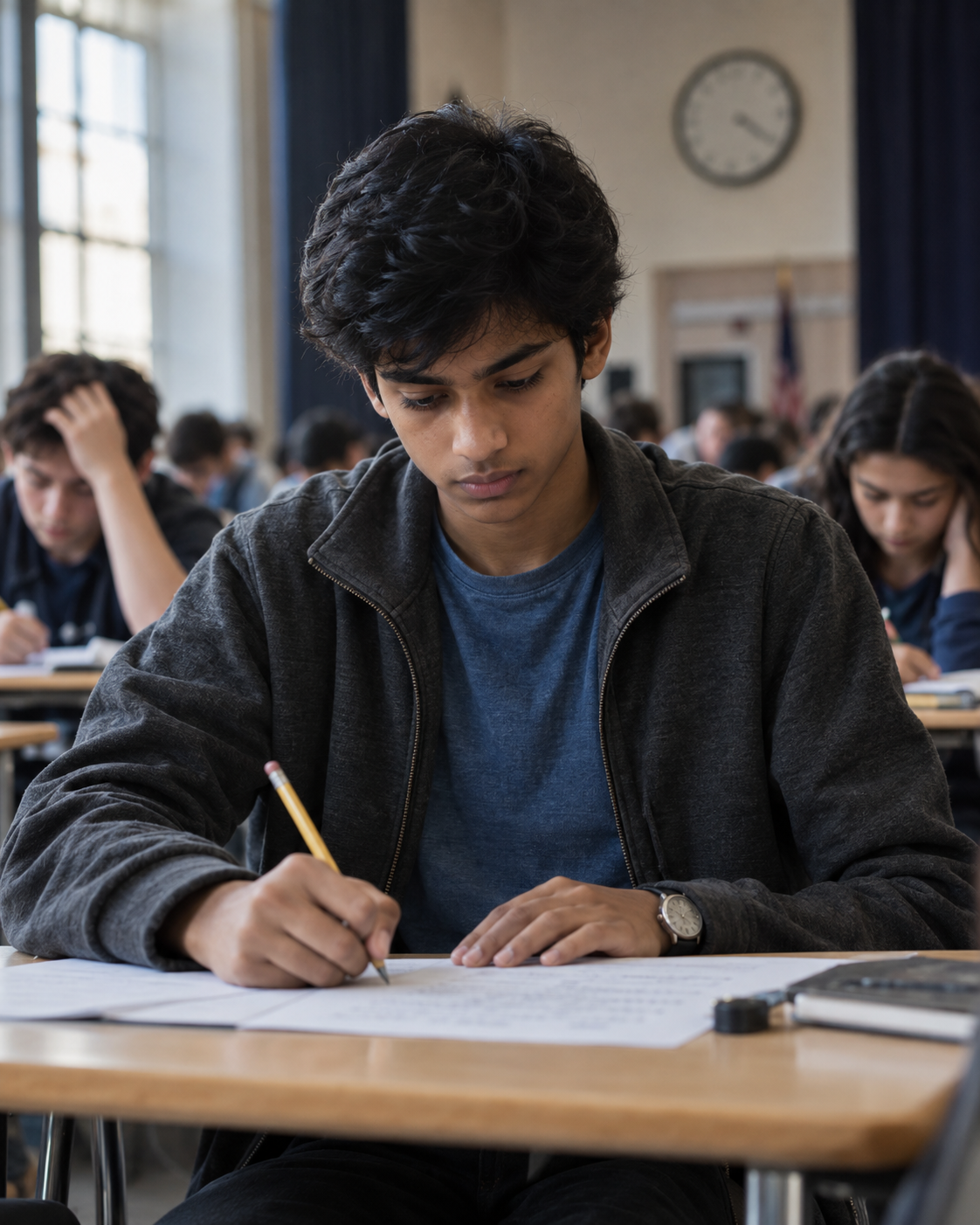
At the competition hall, the room was larger than anything Kabir had expected.
Rows of desks stretched across the floor.
Students whispered nervously.
Teachers moved between them.
A digital clock on the wall counted down the minutes until the test began.
When the papers were placed facedown, Kabir felt his heartbeat in his throat.
“Begin.”
He turned over the paper.
The first question was difficult.
He tried it once.
Twice.
Nothing.
For a moment, panic started climbing through him.
Then he remembered a glass half full of water.
He remembered the garden.
He put his pencil down.
One breath.
Then another.
He moved to the next question.
That one was difficult too.
He kept going.
He didn’t try to solve the entire competition.
He solved the question in front of him.
Then the next.
Then the next.
The Result
Three weeks later, Kabir was sitting beside his father in the school auditorium.
Students filled the rows.
Parents whispered.
Teachers stood near the stage with envelopes in their hands.
Kabir had already convinced himself that he hadn’t won.
That was easier than hoping.
When the final results were announced, his name came third.
The room applauded.
Kabir clapped too, smiling politely.
Then the teacher paused.
“There is one more recognition.”
Kabir looked up.
“For the highest overall score in the problem-solving section…”
The teacher read his name.
“First place: Kabir Ramesh.”
For a second, Kabir didn’t move.
Arjun grabbed his shoulder.
“That’s you!”
Kabir stood.
The applause seemed to come from very far away.
He walked to the stage, accepted the certificate, and looked into the crowd.
His father was standing.
He wasn’t cheering loudly.
He simply had one hand over his mouth, trying unsuccessfully to hide his smile.
After the ceremony, Kabir found Guruji outside near the school gate.
He had come quietly, without telling anyone.
Kabir held up the certificate.
“I won.”
Guruji smiled.
“I know.”
Kabir laughed.
“You knew?”
“I was there.”
They stood together for a moment.
Kabir looked at the certificate, then back at him.
“You were right about the glass.”
Guruji shook his head.
“No. I was right about the practice.”
Kabir frowned.
“What do you mean?”
“Your mind will wander again tomorrow.”
Kabir smiled.
“I know.”
“You’ll get distracted.”
“I know.”
“You’ll lose focus sometimes.”
Kabir nodded.
Guruji pointed at him.
“And what will you do?”
Kabir thought about it.
Then he answered.
“I’ll come back.”
Guruji smiled.
“That is discipline.”
The Garden at Dusk
A few days later, Kabir returned to Guruji’s garden.
The old teacher was trimming a row of jasmine bushes.
Kabir asked, “Can I try the glass again?”
Guruji handed it to him.
This time, Kabir walked slowly around the garden.
The same birds were in the trees.
Children laughed beyond the wall.
A bicycle passed on the road.
Leaves moved in the afternoon breeze.
Kabir noticed all of it.
He simply didn’t follow every sound.
When he returned, the glass was still full.
Guruji took it and inspected the rim.
“Not bad.”
Kabir grinned.
“I didn’t look at the birds.”
Guruji handed the glass back.
“You did.”
Kabir looked surprised.
“I did?”
“Yes.”
He nodded toward the trees.
“You noticed them. You just didn’t have to chase them.”
Kabir stood quietly.
The garden suddenly seemed different.
Or maybe he was.
He looked down at the water in his hands. It trembled slightly as the evening breeze passed over him.
For the first time, Kabir understood that controlling his attention didn’t mean building a wall around himself.
It meant choosing where to stand while the world kept moving.
He carried the glass back toward the house.
This time, he didn’t rush.
And not a single drop spilled.