The Door I Thought Would Prove Everything
The morning Cole left, I kept filming because I was afraid that if I stopped, I would have to admit I did not know what happened next.
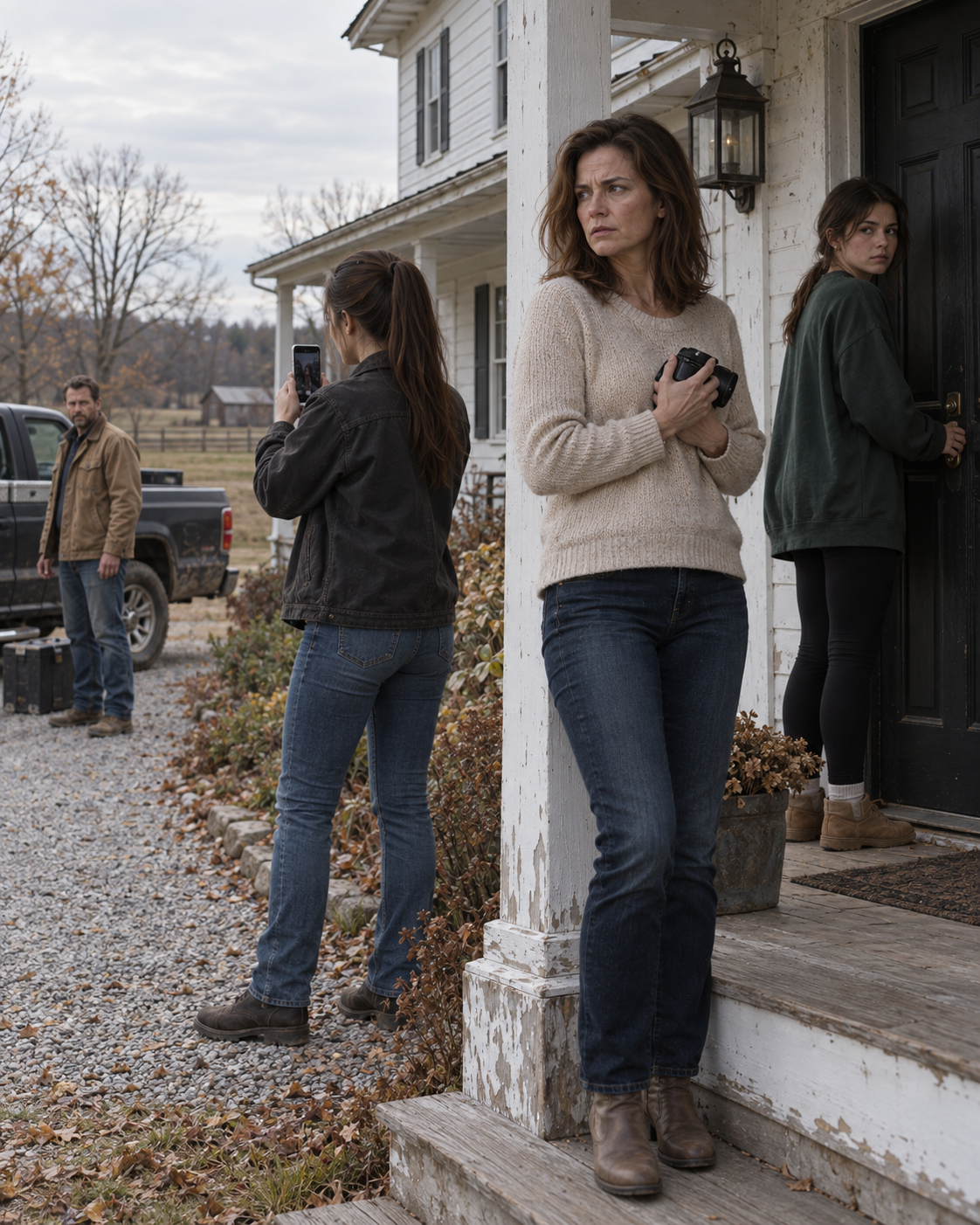
Haley stood on the porch with her phone raised, recording from a better angle than mine. Sophie, sixteen and furious in the quiet way she had developed over the past year, slid the deadbolt into place.
Cole was beside his pickup with one metal toolbox on the ground.
For twenty-one years, I had watched that man repair everything.
Broken sinks. Sagging porch steps. The old refrigerator that hummed through three summers. The girls’ bicycles. Cabinet doors. My mistakes, at least the ones I could convince him were his.
Now the farmhouse we had rebuilt together belonged to me.
So did the company.
So did the cameras, the sponsorship deals, the furniture, and the social media accounts that had turned our renovation project into a business called Reed House Revival.
The divorce papers had been signed three days earlier.
I had spent months making sure the story was simple.
Cole hated being filmed.
Cole hated our channel.
Cole was bitter about the attention.
Cole resented the girls for being part of it.
There were clips to prove it.
At least, there were clips I had chosen.
Haley looked at her father over the phone in her hand.
“Don’t make content out of leaving, Dad.”
Cole’s expression barely moved.
“That was never what I wanted.”
“It doesn’t matter what you want now.”
Sophie slid the lock into place.
Click.
The sound seemed enormous.
Cole lifted the toolbox into the truck bed.
Then he looked at both girls.
“You can call me whenever you want.”
Haley didn’t answer.
Sophie stared at the porch boards.
Cole looked at me last.
He did not look angry.
That bothered me more than anger would have.
“One day,” he said, “they’re going to ask what you cut out.”
My fingers tightened around the camera.
“Get out of my frame,” I said.
He nodded as if I had just confirmed something.
Then he drove away.
I stood there until the truck disappeared beyond the cottonwoods.
Haley lowered her phone.
“Good,” she said.
I didn’t ask whether she meant he was gone or whether she thought we had won.
That afternoon, I filmed the farmhouse at sunrise, then at noon, then again after cleaning the kitchen island until it looked untouched.
I made a video called A Fresh Start at Reed House.
I left Cole out.
Not literally. His shadow appeared in an old shot. His hands were visible in another.
I removed what I could.
The internet loved the result.
Messages poured in.
You and the girls deserve peace.
Finally, the house can breathe.
A women-led rebuild. This is what strength looks like.
Before midnight, a cabinet company emailed about a sponsorship.
I stared at the offer while sitting at the same island where Cole had once helped me calculate lumber costs on the backs of grocery receipts.
I told myself I had not lied.
I had edited toward the truth.
That was the phrase I used.
I would spend a long time hating it.
The Tape Over the Camera
Cole’s lawyer sent the notice the next morning.
It was painfully ordinary.
I was not to use Cole’s name, face, voice, likeness, or identifiable work in monetized material without permission.
Old footage showing him was not to be used in sponsor packets or licensing discussions.
At the bottom was a scanned note in Cole’s handwriting.
The girls can call or visit whenever they want. They do not need to report it to either parent.
I hated that sentence.
It made him sound reasonable.
Haley read it twice.
“So he’s punishing the channel.”
“He’s protecting himself,” I said.
She gave me a look.
“You know what I mean.”
I did.
A week later, a producer named Naen walked through the farmhouse in white sneakers that somehow stayed clean.
She admired the porch.
The pantry.
The unfinished east wing.
The fact that Haley and Sophie had grown up on camera.
“A mother-daughter renovation series has a built-in audience,” she said.
I smiled.
Through the kitchen window, I could see the empty patch beside the barn where Cole’s truck had sat for years.
For the first time, I thought of the space as something useful.
Three weeks later, I saw him at the old library on Mercer Street.
The building was being converted into a community arts center, and local creators had been invited to document the restoration.
I expected Cole to be carrying lumber alone.
Instead, he had two employees, a clipboard, and a line of people waiting for answers about the trim work.
His beard was shorter.
His canvas jacket looked almost new.
“Boss,” one of the workers called.
Cole turned.
“Yeah?”
“You want the scribing done before lunch?”
“Please.”
There was no hesitation in his voice.
No bitterness.
No defeat.
Just work.
Haley stood beside me, holding her phone.
Cole noticed us.
“Hi, Hails.”
Her shoulders tightened.
“Don’t call me that if you’re going to keep attacking Mom’s work.”
“I haven’t attacked your mom’s work.”
“You refused releases.”
“I refused to be in it.”
“To everyone watching, that’s the same thing.”
Cole looked at me.
Then back at Haley.
“I’m not having this conversation on camera.”
I almost smiled.
See?
I wanted to say.
There he was again.
The man who wouldn’t cooperate.
But Cole only rubbed a pencil between his fingers.
“You can be angry,” he told Haley. “You can call me when you need something. Those two things can exist at the same time.”
Haley’s face changed for half a second.
Then she looked away.
That night, I posted a video about women learning to rebuild what had been neglected.
The comments supplied the villain for me.
The pilot offer arrived the next morning.
Six episodes.
A real production company.
Real distribution.
Real money.
Enough to fix the roof.
Enough to finish the east wing.
Enough to make the divorce settlement stop feeling like a weight chained to my ankle.
Then I read the conditions.
Haley had to sign her own release.
Sophie, because she was sixteen, needed permission from both parents.
And any episodes based on the history of Reed House Revival required access to the raw family archive.
I read that paragraph four times.
Raw family archive.
The same archive Cole had spent years labeling.
PRIVATE.
DO NOT UPLOAD.
FAMILY RAW.
I had always called those labels dramatic.
Now they were an obstacle between me and enough money to save the house.
At dinner, I sold the opportunity to my daughters.
“This could pay for your last two years of school,” I told Haley.
Sophie picked at her cereal.
“Would Dad have to agree?”
“Technically.”
Haley laughed.
“He’ll love that.”
I opened my laptop.
There was a clip I had used during mediation.
Cole stepping between the camera and Sophie.
His hand covering the lens.
His voice saying, “Enough. She doesn’t owe them this.”
I paused the frame.
“That’s what I’m talking about.”
Sophie stared at the screen.
“I don’t remember that day.”
“You were upset.”
“About what?”
“There were so many days.”
I heard myself say it.
So many days.
That should have stopped me.
Instead, I pressed play again.
What the Camera Wasn’t Showing
The pilot crew arrived on a Tuesday.
Two cameras.
One sound technician.
An assistant carrying a tablet.
Naen called the mudroom “perfect.”
“It has history,” she said.
I had begun to hate that word.
History meant material.
History meant an old bench, a cracked tile, a backpack hook.
History meant something painful that could be turned into a storyline.
Sophie stood by the washing machine in paint-stained overalls.
Her arms were crossed tightly.
I picked up a strip of blue painter’s tape.
“Your dad used to put this over the camera light,” I said.
Sophie looked at it.
“Remember?”
The camera operator stepped closer.
I smiled.
“Maybe we could reclaim it. Turn something controlling into something creative.”
Sophie looked directly into the lens.
Then she walked over to the softbox, unplugged it, and carried the cord away.
The room went dim.
Naen looked at me.
“We can pause.”
Haley was already reaching for her phone.
“I’ll find the original clip.”
Something inside me whispered, Stop.
But the crew was there.
The pilot depended on a clear conflict.
I told myself I was not hurting anyone.
I was only showing context.
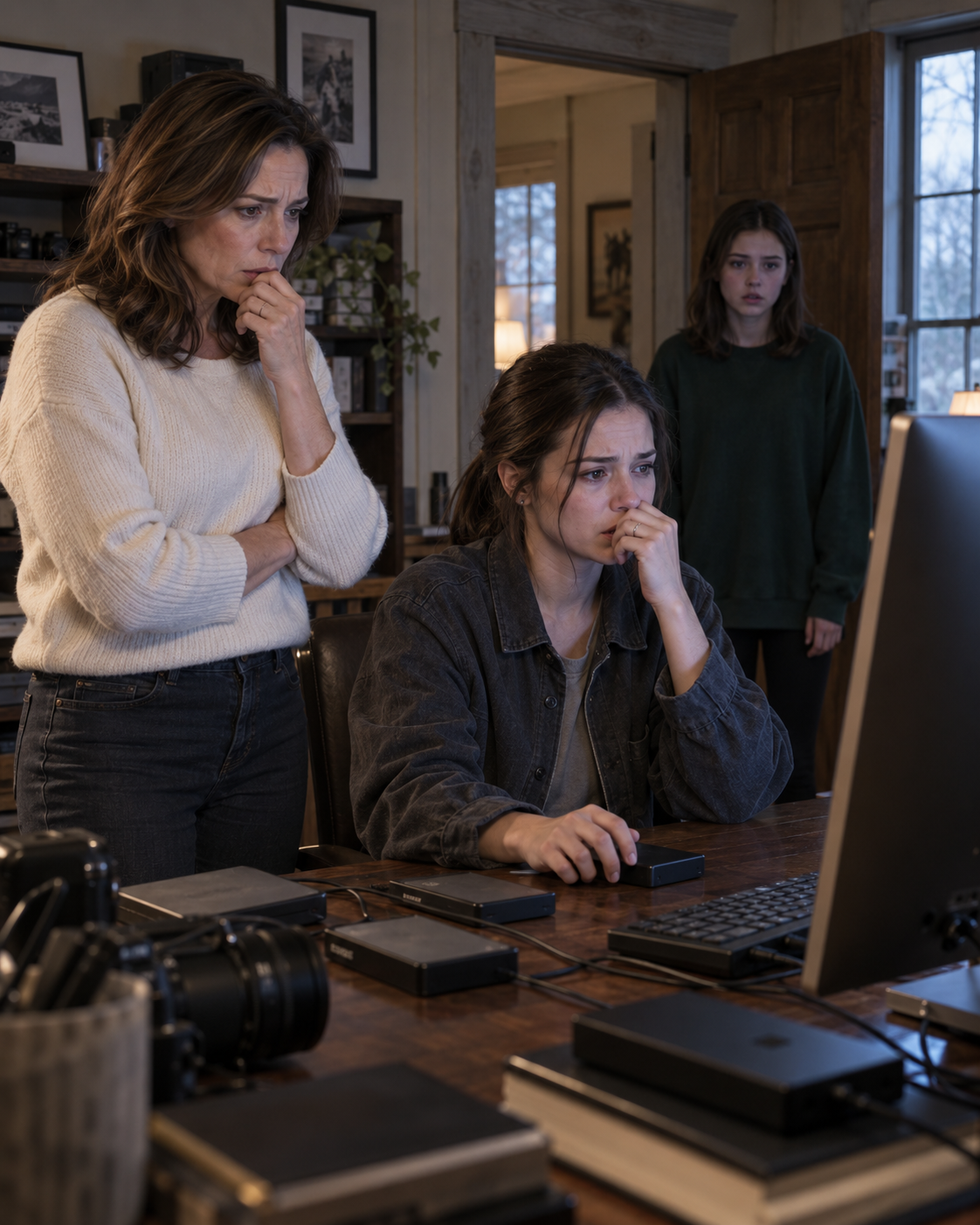
Haley found the drive in the office closet.
The labels were still there.
HR SCHOOL.
SR PRIVATE.
FAMILY RAW 2018.
She connected one to the monitor.
The first video showed Haley at seventeen.
She was sitting halfway up the stairs in a gray sweatshirt, her face swollen from crying.
“Dad, please,” the younger Haley said.
Cole’s voice came from behind the camera.
“I won’t.”
She wiped her face.
“She keeps saying people relate to heartbreak. I don’t want it up.”
“You don’t have to be on camera.”
Then my voice came from the kitchen.
“Haley, honey, just one sentence.”
“No.”
I heard my younger voice laugh softly.
“You’re emotional right now. You don’t understand the opportunity.”
Haley froze the clip.
Nobody moved.
Then she pressed play.
Cole stepped into frame.
“Enough, Denise.”
The camera shook.
His hand covered the lens.
The screen went black.
For years, that was the beginning of the clip I showed people.
But the audio continued.
“She’s asking you to stop,” Cole said.
A pause.
Then my voice.
“She’ll understand later.”
Haley stopped breathing for a second.
Naen looked down.
I could barely hear myself.
“It’s one little clip.”
Cole answered quietly.
“No. It’s her life.”
Haley turned toward me.
“You said he hated the channel.”
“He hated what it did sometimes.”
“You said he hated us being seen.”
I opened my mouth.
Nothing came.
She loaded another file.
Sophie, fourteen, in the downstairs bathroom.
A swimsuit video had gone live.
Someone at school had left cruel comments about her body.
Sophie was crying.
“Dad, make her take it down.”
Cole wrapped a towel around the camera on the counter.
“I’ll handle it.”
Another clip.
Haley after a college rejection.
“Please don’t upload this.”
“I won’t,” Cole said.
Another.
Sophie after a panic attack.
Another.
Haley asking for a video to stay private.
Another.
Another.
The dates were all there.
The blue tape.
The folders.
The same man I had edited into a villain kept stepping between my daughters and the lens.
Not because he hated the channel.
Because they had asked him to.
My stomach turned.
Haley pulled the drive from the computer.
“You knew.”
“I remembered differently.”
“No.”
Her voice was calm.
“You knew.”
Sophie had come downstairs without any of us noticing.
She looked at the monitor.
At the frozen image of herself.
Then at me.
“He didn’t leave that day,” she said.
I looked at her.
“He stopped you.”
The room went silent.
The House Became Too Quiet
Haley moved out that evening.
She took her camera.
Her laptop.
A ring light she had bought herself.
Nothing else.
Sophie called Cole.
I heard only her side of the conversation.
“Can I come now?”
A pause.
“No, I don’t want to talk about Mom.”
Another pause.
“Just this week.”
Cole came in his truck.
He did not come to the porch.
Sophie carried her backpack down the steps.
Before getting into the truck, she looked at me.
“I’m not filming anymore.”
Haley started her car.
“Neither am I.”
Then they left.
That was the first night in eight years the farmhouse made sounds nobody was watching.
Pipes ticking.
Wind moving the siding.
The refrigerator clicking on.
A floorboard settling in the hallway.
I walked from room to room and realized how much noise we had mistaken for life.
The sponsors pulled back.
One froze payments.
Another requested “clarification.”
A third stopped shipping product.
Naen called on Sunday.
“We can’t move forward without the girls.”
I sat on the kitchen floor.
“Can you wait?”
“No.”
She paused.
“There is another possibility.”
I knew before she said it that I would hate it.
“A solo special.”
She explained the concept.
A woman rebuilding after divorce.
A mother whose daughters had been pulled away from her.
A story about manipulation and control.
“We’d need the archive,” she said.
I stared at the canvas bag in my office closet.
“Raw?”
“Yes.”
“How much?”
She gave me the number.
It was enough to save the farmhouse.
The roof deposit.
The missed payments.
Part of the debt.
Enough to make my worst decision feel financially responsible.
That night, I put the drives in a canvas bag.
I carried them downstairs.
Then I stopped in the kitchen doorway.
The growth chart was still there.
Cole had built the frame around it years earlier.
The girls’ heights climbed the wood in pencil marks.
Haley at five.
Haley at seventeen.
Sophie at three.
Sophie at fourteen.
The dates lined up with the private videos.
I stood there for a long time.
The marks were not content.
They were proof of a life that had existed whether anyone watched or not.
I put the bag beside my bed.
The next morning, the realtor scheduled the final showing.
Naen’s crew would come afterward.
I could still sign.
The house could still be saved.
At eleven, Cole’s truck pulled into the driveway.
What I Finally Refused to Sell
He was carrying a pry bar and a utility knife.
“What are you doing here?”
“Sophie asked me to get the growth chart.”
He waited until I moved.
Then he walked inside.
The growth chart was attached to the kitchen doorframe.
He knelt and began cutting through the old caulk.
“Naen’s outside,” I said.
“I know.”
“She offered enough to stop the sale.”
His hand paused.
“For the archive?”
I nodded.
Cole looked at the canvas bag on the island.
“You can’t sell that.”
“I can legally use some of it.”
“That’s not what I said.”
I looked away.
“Why didn’t you ever post the full footage?”
He set the pry bar against the floor.
“The girls didn’t ask me to.”
“You could have cleared your name.”
He gave a tired laugh.
“You think I wanted to prove I was right by exposing them?”
The casing loosened.
He caught it before it fell.
“You knew,” he said.
I swallowed.
“I know now.”
“No. You knew then. You just didn’t count it if it got in the way.”
I wanted anger.
Anger would have given me something to push against.
Instead, he held the growth chart carefully in both hands.
My phone buzzed.
Naen.
Need release by noon.
I picked up the bag.
Cole watched me.
“Denise.”
I stopped.
“If you hand those over, that’s a decision too.”
I walked toward the porch.
Naen was crossing the gravel.
She had her tablet open.
The realtor’s car was behind her.
“I can’t license the archive,” I said.
She stared at me.
“You understand what that means financially?”
“Yes.”
“You could still blur their faces.”
“No.”
“You could narrate around it.”
“No.”
The word sounded different this time.
Not powerful.
Not strategic.
Just final.
Naen nodded slowly.
“All right.”
She left.
I went back inside.
Haley arrived first.
Sophie came ten minutes later.
I placed every hard drive on the kitchen island.
“These are yours.”
Haley stared at the labels.
“You kept copies?”
“No.”
“How do we know?”
“You don’t.”
That was the first honest answer I had given them in a long time.
Sophie picked up the drive with her initials.
I looked at both girls.
“I am sorry.”
Neither moved.
“I used what hurt you to make you choose me over your father.”
Still nothing.
Then Sophie hugged the drive against her chest.
It was not forgiveness.
It was not reconciliation.
It was simply something she needed to hold.
Cole carried the growth chart out to the truck.
Before closing the tailgate, he turned toward me.
“This stops one more betrayal.”
I nodded.
“It doesn’t undo the first.”
“I know.”
He glanced toward the kitchen.
“Sunday supper. At my place.”
I almost laughed.
“What?”
“You come. No phone.”
“That sounds romantic.”
“It isn’t.”
Despite everything, I smiled.
He didn’t.
“I’m not moving you back in,” he said. “I’m not promising anything except dinner.”
“Then what is this?”
He looked at me for a long moment.
“Divorced.”
The word did not hurt the way I expected.
It sounded like a boundary.
A fact.
Something solid enough to stand on.
“Once a month,” he added. “After they leave, you and I talk alone.”
“About what?”
“Whatever we should have talked about before we started turning everything into footage.”
The Things No One Needed to Record
The farmhouse sold three months later.
Reed House Revival ended without a farewell video.
I moved into a second-floor apartment above a dentist’s office.
I found work with a home-services company that did not care whether my kitchen looked good on camera.
Cole’s shop stayed booked.
Haley saw him on Thursdays when she wanted.
Sophie split her weeks between his duplex and my apartment.
In both places, there was one rule.
No filming.
In the spring, Cole mounted the growth chart in his hallway.
I held the level while he drove the screws.
Sophie stood against the wall in her socks.
Cole marked her height.
Then he wrote the date beside the line.
No camera.
No microphone.
No sponsor.
No comments waiting somewhere beyond the room.
Just a pencil moving softly across wood.
I had missed one Sunday dinner the month before.
Cole did not ask why.
He did not cancel the next one.
Sometimes the girls answer my texts right away.
Sometimes they don’t.
When they come to my apartment, my phone stays in a drawer.
I still catch myself reaching for it.
That part has not disappeared.
The habit is stubborn.
But I am learning that not every beautiful moment is asking to be saved.
Not every hurt needs an audience.
Not every memory becomes more true because strangers saw it.
A few weeks ago, I drove past the farmhouse.
The new owners had painted the kitchen doorway.
The growth chart was gone, of course.
For just a second, with the evening light coming through the side windows, I could see the pale strip of wood where it had been.
A blank space surrounded by newer paint.
I kept driving.
I did not take out my phone.
And for once, letting the moment disappear did not feel like losing it.