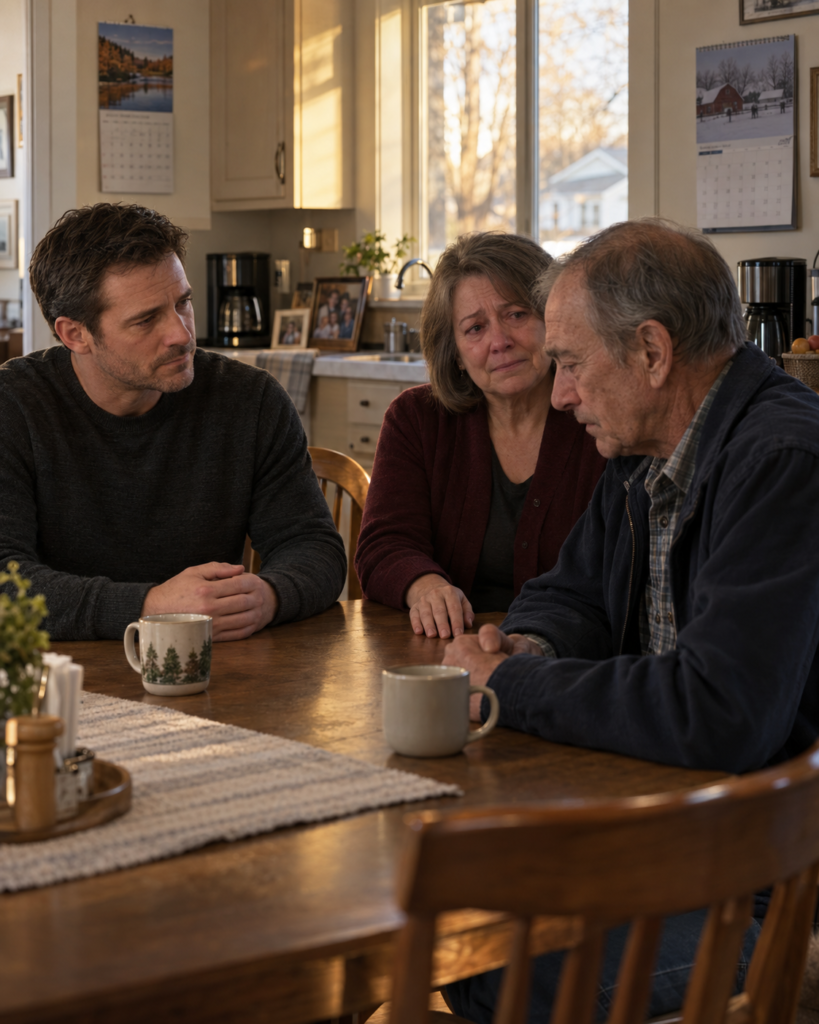
The Call After Midnight
At 12:14 a.m., my son called and said, “Dad, turn off every light and get downstairs. And whatever you do, don’t tell Claire or Mark that I called.”
I sat upright in bed, staring at the blue-white glow of my phone.
“Evan, what happened?”
“Dad, please. Just trust me.”
Then he hung up.
For several seconds, I listened to the old house settling around me. Pipes clicked in the walls. The refrigerator hummed downstairs. Somewhere near the kitchen, the clock my wife had bought at an estate sale kept tapping out the seconds.
My name is Howard Mercer. I was sixty-eight, retired after thirty-seven years as a city building inspector, and I had spent most of my working life looking at structures and asking one basic question:
What doesn’t belong here?
That question had been bothering me for months.
My daughter Claire and her husband, Mark, had moved into my house the previous spring after telling me they needed a temporary place while they got back on their feet. Claire had always been my soft spot. When she was eight, she used to sit beside me at the dining-room table while I repaired watches and ask a hundred questions before I finished the first sentence.
But after her marriage to Mark, she became harder to reach.
She stopped dropping by just to talk. She stopped calling unless she needed something. Then she and Mark moved in.
At first, I was grateful for the company.
Then Mark changed the locks.
“Security,” he said.
Then he installed cameras.
“For your protection.”
Then he started handling my mail.
“You miss things, Howard. Let me organize it.”
I laughed it off at first.
But you notice patterns when you spend decades inspecting cracked foundations and unsafe buildings.
The cameras faced the doors, the hallway, and the stairs.
None faced their bedroom.
None faced the basement.
That bothered me.
I followed my son’s instructions anyway.
I locked the windows. Shut off the lights. Pulled on a sweater and went downstairs to the workshop where I repaired old clocks, radios, and anything else that had gears.
From the little ground-level window, I could see the driveway.
I waited.
At 12:41, I heard footsteps overhead.
Mark.
Then his voice, low and careful.
“Yeah. He’s asleep. You can come now.”
A pause.
“No, use the side entrance. Nobody’s going to see you.”
My mouth went dry.
I moved closer to the window.
Five minutes later, a dark SUV rolled to the curb.
Then another.
Three men stepped out.
And Mark opened my front door for them.
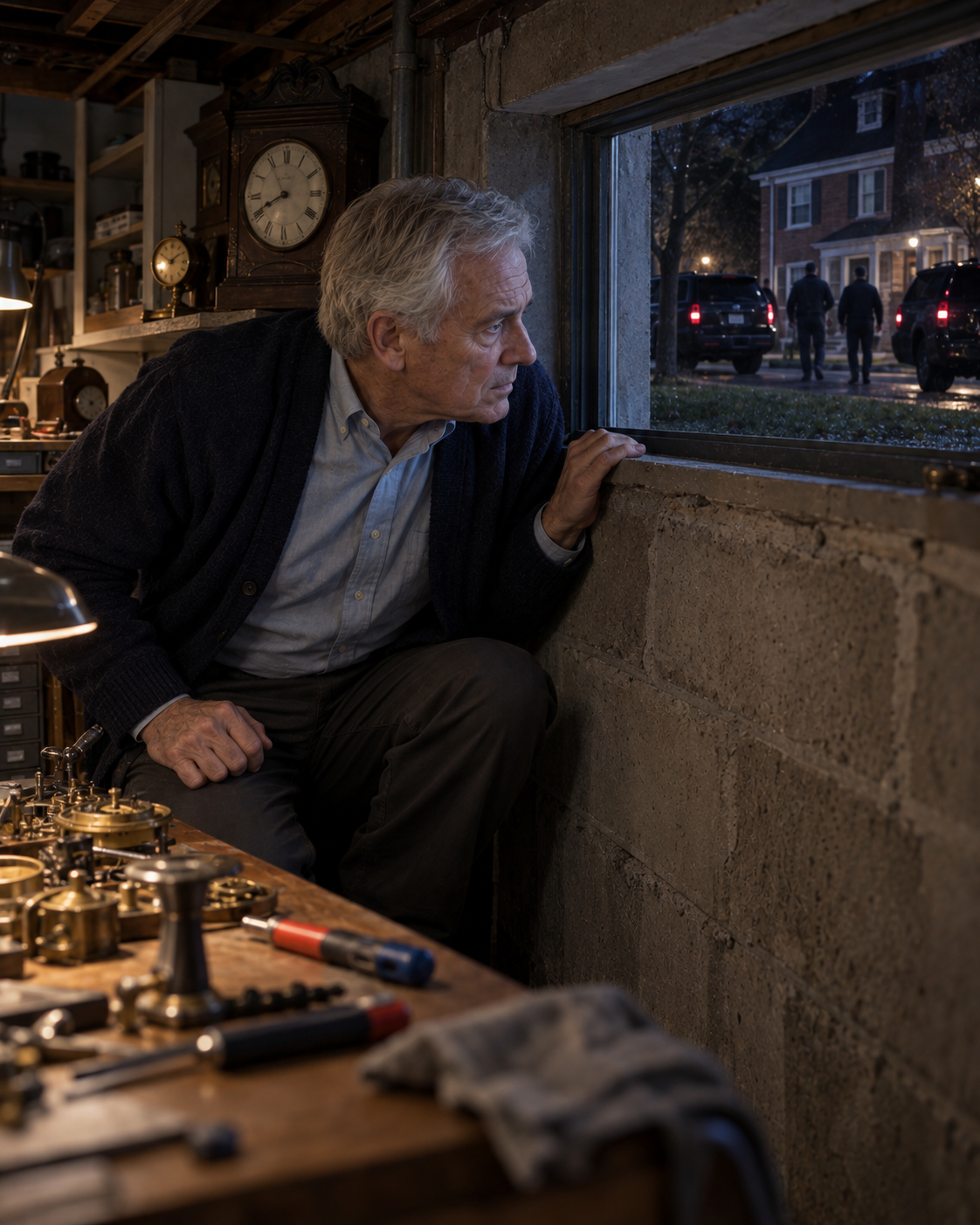
The men disappeared into the house.
I watched their shadows move across the curtains.
Toward my office.
Toward the safe.
That was the moment fear gave way to certainty.
This wasn’t about helping an old man.
It was about taking something from me.
The Safe in the Study
I stayed downstairs until dawn.
At 6:20, I heard the ordinary sounds of morning begin above me.
Coffee maker.
Cabinet doors.
Running water.
The strange normalcy almost made me doubt what I had seen.
Then I checked the safe.
My hands shook as I spun the combination.
Inside, several folders were gone.
The original deed.
Copies of my financial statements.
An old power-of-attorney document.
My wife’s life insurance papers.
Claire had once asked for the combination.
“Just in case something happens,” she had said.
I had given it to her because she was my daughter.
That memory hurt more than the missing papers.
When I walked into the kitchen, Claire was standing at the counter in a robe, holding two mugs of coffee.
“You’re up early, Dad.”
I looked at her.
“Couldn’t sleep.”
Mark smiled from the stove.
“Rough night?”
His voice was almost cheerful.
I poured myself coffee.
“Yes,” I said. “Very.”
Neither of them seemed concerned.
Over breakfast, they talked about errands, bills, and Claire’s work.
I said very little.
That morning, I called Evan.
He worked for a federal financial-crimes task force. When he answered, I said only, “Tell me the truth.”
There was silence.
Then he said, “Dad, Mark is under investigation.”
“For what?”
“Real-estate fraud. Forged documents. Identity theft.”
I sat at the kitchen table.
Evan told me his team had been tracking a group that used stolen property documents to create fraudulent transfers. Mark’s name had surfaced repeatedly.
They had suspected he was using my home as a source of original records.
“I couldn’t officially intervene,” Evan said. “But I knew something might happen tonight. I needed you safe.”
“You think Claire knows?”
“I don’t know.”
That was the part that stayed with me.
I didn’t know.
So I stopped assuming.
I started watching.
Mark kept his office door closed.
He took the trash out himself.
He never let anyone else handle the mail.
He made frequent trips to meet “clients” and became visibly irritated whenever I asked harmless questions.
Then, one Friday morning, I found something in the trash.
A legal document.
My name was at the top.
Petition for Appointment of Guardian.
The document claimed I had become mentally incapable of managing my finances.
The proposed guardians?
Claire Mercer and Mark Dalton.
I read the page twice.
Then a third time.
I had never felt old until that moment.
Not because of my age.
Because someone had decided it was enough to make me helpless.
I photographed every page before putting it back exactly where I found it.
Then I called a lawyer.
Her name was Renee Foster.
She specialized in elder financial abuse, and after I explained what was happening, she didn’t tell me to calm down.
She said, “Mr. Mercer, you have a narrow window here. Let’s use it.”
What I Found in Their Room
Renee arranged for an independent medical evaluation.
The doctor spent nearly two hours with me, testing memory, reasoning, attention, and judgment.
At the end, he smiled.
“There is nothing in these results suggesting incapacity.”
“Good.”
He looked at me over his glasses.
“More than good. Your scores are unusually strong.”
I laughed for the first time in weeks.
“Can I put that in writing?”
“You already have.”
The next step was harder.
Renee helped me revoke old powers of attorney, secure my accounts, change the locks, and place safeguards around my property.
Everything was done quietly.
I pretended nothing had changed.
Mark noticed the banking restrictions first.
Claire noticed the new locks.
They both began to panic.
I kept my face blank.
Then I found the evidence that connected Mark to the larger scheme.
He had left a box in the back of his closet.
Inside were copies of property records belonging to strangers.
Dozens of them.
Some were for homes owned by widows and retirees.
People who, like me, had accumulated something valuable over forty or fifty years.
People who could be persuaded that they were simply getting old.
I photographed everything.
Then I saw Claire’s name on one page.
Not as a beneficiary.
As a witness.
My stomach dropped.
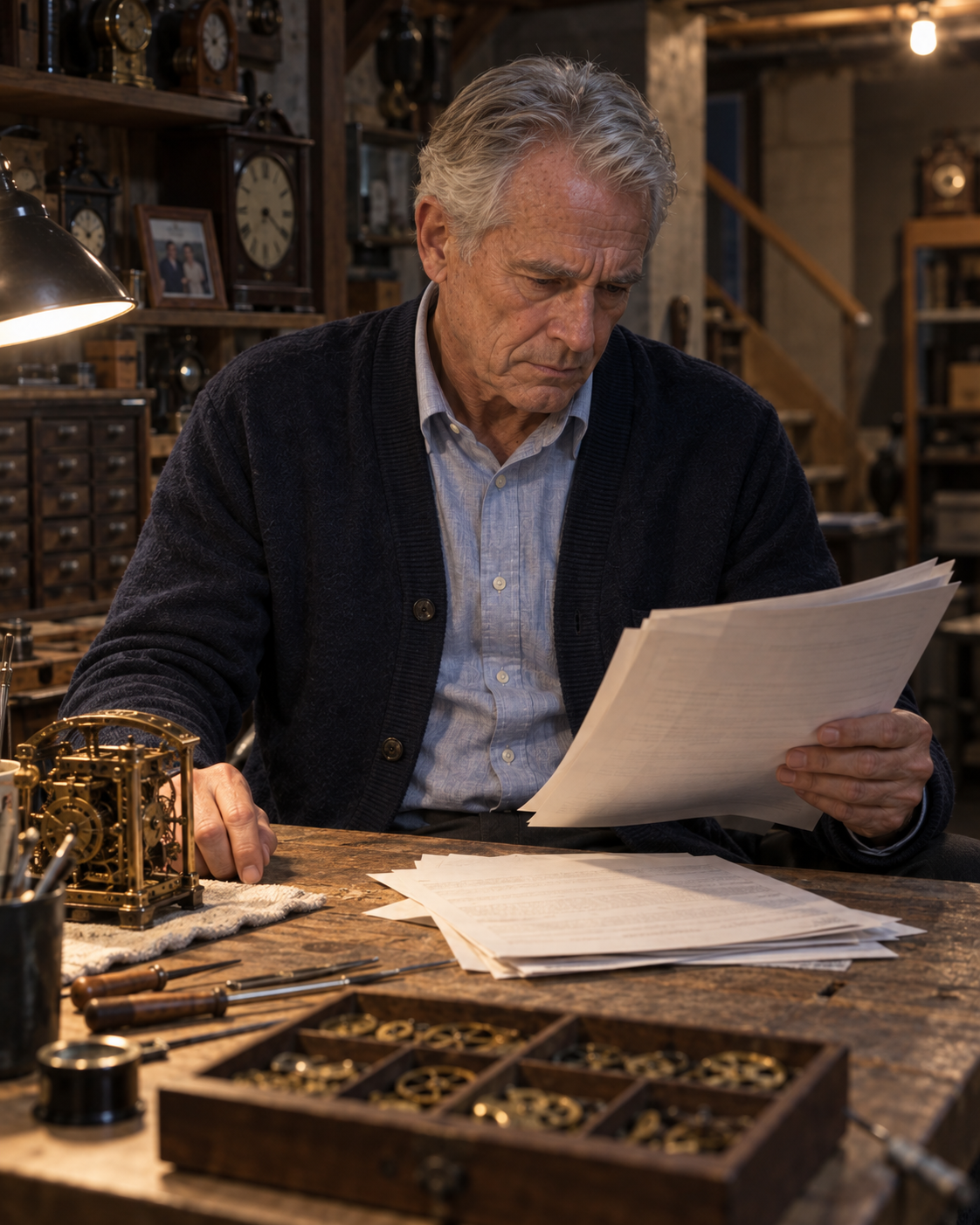
That night, I sat in my workshop staring at a brass clock I had restored when Claire was twelve.
She had handed me tiny screws while I worked.
“Daddy,” she had asked, “how do you know what goes where?”
“Pay attention to the pattern,” I told her.
I remembered her little hands.
Her pink sweater.
The way she smiled when the clock started ticking again.
I wondered whether I had spent twenty years remembering a daughter who no longer existed.
A week later, Renee helped me document everything.
The isolated phone calls.
The financial pressure.
The guardianship petition.
The stolen documents.
And, most importantly, the conversation I accidentally overheard from the hallway.
Mark had said, “Once the court approves it, everything becomes easier.”
Claire had whispered, “I know.”
“What about your dad?”
“He’ll be taken care of.”
I closed my eyes.
They weren’t talking about helping me.
They were talking about controlling me.
I wanted to confront them that night.
Renee told me not to.
“Don’t give them a chance to destroy evidence,” she said.
So I waited.
The Door Finally Closed Behind Them
Three weeks after Evan’s midnight call, I sat at the kitchen table while Claire and Mark ate breakfast.
Mark buttered toast.
Claire looked at her phone.
I folded the newspaper.
Then I said, “I know about the petition.”
Claire froze.
Mark slowly lowered his coffee cup.
“What petition?” he asked.
“The one declaring me incompetent.”
Nobody moved.
I looked at Claire.
“Did you really think I wouldn’t notice?”
Her eyes filled immediately.
“Dad—”
“No.”
The word stopped her.
“I also know about the property records.”
Mark stood.
“You’ve been spying on us.”
“This is my house.”
He stared at me.
Then his tone changed.
“You have no idea what you’re doing.”
“I know exactly what I’m doing.”
I slid a folder onto the table.
Medical evaluation.
Bank records.
Photographs.
Legal filings.
Everything.
Mark’s face went pale.
Claire picked up the first page and started shaking.
“You changed the locks,” she whispered.
“Yes.”
“You froze the accounts.”
“Yes.”
“Dad, why?”
I looked directly at her.
“Because you stopped treating me like your father.”
She began to cry.
I expected relief when I said what came next.
Instead, I felt tired.
“Claire, you have thirty days to move out.”
Mark slammed his hand on the table.
“You can’t just throw us out.”
“I own the house.”
“We have rights.”
“You do.”
I nodded toward the folder.
“And so do I.”
Then I told them Evan knew about Mark’s business.
That finally broke the room open.
Claire turned toward her husband.
“What did you do?”
Mark said nothing.
“Mark?”
Still nothing.
The truth arrived in her face before he ever admitted it.
She had married a man who had been using people.
Now she understood she had helped him.
Within days, federal agents arrested Mark.
The case was larger than anyone expected.
There were victims in multiple states.
Forged property records.
Fraudulent transfers.
People who had nearly lost homes they had spent decades paying for.
Claire was not charged in the federal case, but she could not escape what she had done to me.
The guardianship petition was dismissed.
My accounts were restored.
And the house became quiet again.
But quiet wasn’t the same as peaceful.
What Remained After the Apologies
Claire came to my door one rainy afternoon.
I almost didn’t answer.
When I opened it, she looked exhausted.
Her hair was pulled back.
She wore an old gray coat.
“I’m working now,” she said.
I stepped aside.
She sat at the kitchen table where she had once eaten pancakes with me on Sunday mornings.
“I’m sorry.”
I said nothing.
She twisted her hands together.
“I kept telling myself the guardianship was for your own good.”
“You knew it wasn’t.”
She looked down.
“Yes.”
That honesty mattered.
Not enough to repair anything.
But enough to matter.
“I don’t expect you to forgive me,” she said.
“Good.”
She nodded.
“I just wanted you to know I finally understand.”
I looked toward the hallway.
The family photographs were still there, but I had stopped seeing them as proof that everything had always been fine.
Sometimes photographs only prove that a moment existed.
They don’t prove it lasted.
Claire stood.
At the door, she paused.
“I love you, Dad.”
I believed her.
That was the hardest part.
“I love you too,” I said.
She looked surprised.
Then I added, “But loving someone doesn’t mean giving them access to hurt you.”
She nodded slowly.
Then she left.
I changed the locks one more time.
Not because I expected trouble.
Because I liked knowing exactly who could open my door.
Months later, I sold the old house.
A young couple bought it.
They had two little boys who raced through the rooms during the inspection, laughing loudly enough to echo.
The husband shook my hand.
“We’re going to make good memories here.”
I smiled.
“I hope you do.”
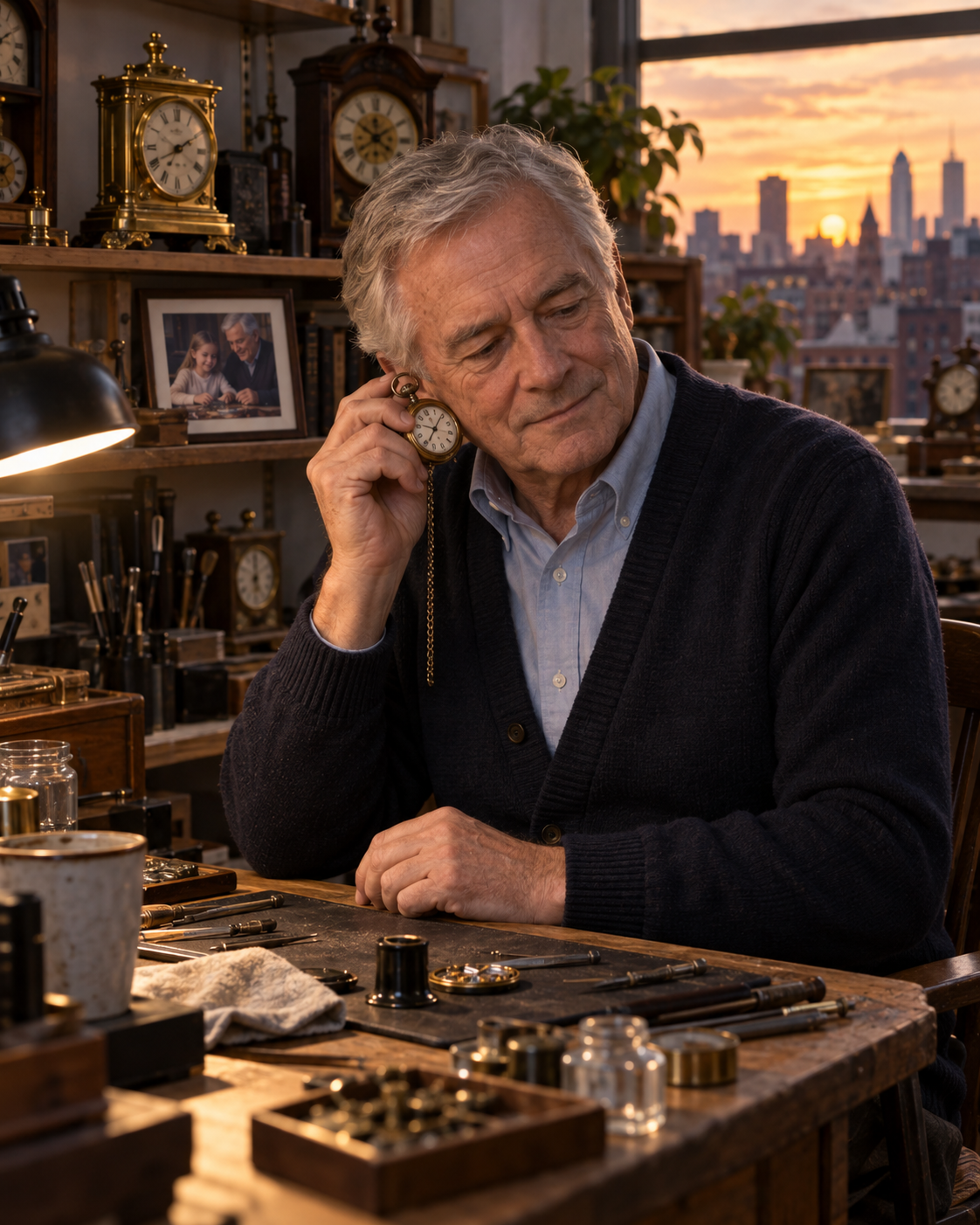
I kept my clocks.
All twenty-three of them.
I kept the workshop tools.
I kept the pocket watch Claire had once helped me fix.
And I kept one postcard she eventually mailed from a small apartment across town.
She was working.
Paying what she owed.
Going to counseling.
Trying, according to the postcard, to become someone she could live with.
I didn’t write back.
Not yet.
Maybe one day.
For now, my workshop was quiet except for the clocks.
Tick.
Tick.
Tick.
I used to think repairing an old clock meant making it work exactly as it had before.
I know better now.
Sometimes you can’t return something to the way it was.
Sometimes a spring is too worn.
Sometimes a gear is too damaged.
Sometimes the whole thing has to be taken apart.
Cleaned.
Rebuilt.
Made into something different.
That evening, I wound the old brass clock and set it on the mantel.
The same clock that had once sat above a conversation that nearly destroyed my family.
Now it simply kept time.
I stood there listening.
Then I turned off the light and went to make dinner.
The clock kept ticking behind me.
And for the first time in a long time, I wasn’t afraid of what the next hour might bring.