The Man Who Made the Quiet Town Feel Different
The first thing Daniela noticed about Michael was that he actually listened.
It was a small thing, almost too small to remember, except that Daniela had spent most of her adult life surrounded by people who seemed to be waiting for their turn to talk.
She was twenty-nine and worked the front desk at a small hotel in Brighton Bay, a quiet coastal town a couple of hours from New York City. Her life wasn’t exciting. She rented a modest apartment, knew which café served the strongest coffee, and could tell from the sound of the waves whether the weather was about to change.
She liked it that way.
After a few relationships that had ended badly, Daniela had stopped looking for anything serious. She had friends, books, long walks by the water, and a routine she trusted.
Then Michael checked into the hotel.
He was in town for business, carrying a dark suitcase and looking more tired than most guests who walked through the lobby. He spoke softly, thanked her twice during check-in, and smiled when she handed him his room key.
The next morning, he came downstairs and asked for a good place to get coffee.
Daniela gave him three options.
He listened to all three.
“You’re clearly the person I should have asked,” he said.
She laughed. “Only if you want the local answer.”
After that, he started coming down to the lobby in the evenings.
At first they talked for a few minutes. Then half an hour. Then longer.
During the two weeks he stayed in Brighton Bay, they walked along the beach, sat near the lighthouse, and talked about books, music, work, family, and the lives they imagined they might have someday.
One night, with the ocean dark behind them and the lighthouse turning slowly across the water, Michael looked at her.
“Being with you feels like peace,” he said.
Daniela carried those words home with her.
She didn’t know then how much they would cost her.

The Secret He Should Have Told Her First
When Michael’s business trip ended, he left Brighton Bay.
They stayed in touch.
Every morning there was a message from him. Every night they talked on the phone. Daniela found herself smiling at her screen in ways she hadn’t smiled in years.
A month later, Michael returned.
This time, he rented a small house near the harbor.
Daniela visited after work. They cooked pasta together, opened a bottle of wine, and danced badly in the kitchen while music played from his phone.
It felt easy.
That was why what happened next hurt so much.
They were sitting on the couch drinking tea when Michael put his cup down.
“Daniela, I need to tell you something.”
She looked at him.
His face had changed.
“I’m married,” he said.
For a second, she thought she had misunderstood him.
“I have two children.”
The room seemed to become strangely quiet.
Daniela stared at the cup in her hands. Her fingers had gone cold.
“Why didn’t you tell me?”
“I was going to.”
“When?”
He looked toward the floor.
“I didn’t know how.”
She stood up.
“That’s not an answer.”
He followed her when she walked outside. The night air was cold, and the ocean sounded louder than usual.
“My marriage hasn’t been good for a long time,” he said. “We live in the same house, but there’s no love anymore. I stay because of the kids.”
Daniela didn’t turn around.
“You should have told me before I fell for you.”
“I know.”
She wanted him to argue. She wanted him to give her something she could hate.
Instead, he stood several feet away, saying nothing.
Finally, he said, “I understand if you never want to see me again.”
Daniela walked home alone.
She didn’t sleep that night.
For days afterward, she kept reaching for her phone whenever it buzzed.
Then his message appeared.
I’m sorry. I miss you.
She didn’t answer.
But a week later, she met him near the beach.
He told her he cared about her.
She told herself that meant there was still something worth saving.
That was how the secret began.
The Life That Happened Only After Dark
Michael came to Brighton Bay once or twice a month.
He stayed at the little house near the harbor.
Daniela went there after work.
They cooked. Watched old movies. Talked until midnight. Sometimes they simply sat together without speaking.
Those evenings felt real.
Everything outside them felt unreal.
They never went out together.
They didn’t hold hands on the sidewalk.
There were no photographs of them, no shared holidays, no plans for a home.
Michael never left a shirt in the closet or a toothbrush in the bathroom. When he drove away, the house looked exactly as though he’d never been there.
Daniela noticed.
She just tried not to think about what it meant.
He remembered little things about her. He brought books she’d mentioned once. He knew how she took her coffee. He could make her laugh when she was tired.
That made leaving harder.
She told herself she wasn’t asking for much.
She would wait.
Eventually, he would make a decision.
Eventually, there would be a place for her in his real life.
But waiting changed her.
She began turning down invitations from friends because Michael might call.
She checked her phone during meals.
She arranged her weekends around his visits.
She stopped reading by the sea.
She stopped taking long walks.
Her world became smaller without her noticing.
One rainy night, after Michael had driven back to his family, Daniela sat beside her apartment window and watched water slide down the glass.
There were no photographs of him in her apartment.
No belongings.
No evidence.
She had given him so much space in her life, and he had left almost nothing behind.
“What’s wrong with me?” she whispered.
The question frightened her.
Not because she didn’t know the answer.
Because she was beginning to.
The Question He Couldn’t Answer
Daniela told only one friend the truth.
Nenah knew enough to see what Daniela could not yet admit.
They were sitting in a small café one Saturday morning when Daniela finally said, “I’m tired.”
Nenah stirred her coffee.
“Then stop.”
Daniela looked down.
“It’s not that simple.”
“It is. It’s just painful.”
Daniela didn’t answer.
Nenah leaned forward.
“You deserve someone who’s proud to love you. Someone who walks beside you in daylight, not someone who only has a few hours for you in private.”
The words stayed with Daniela.
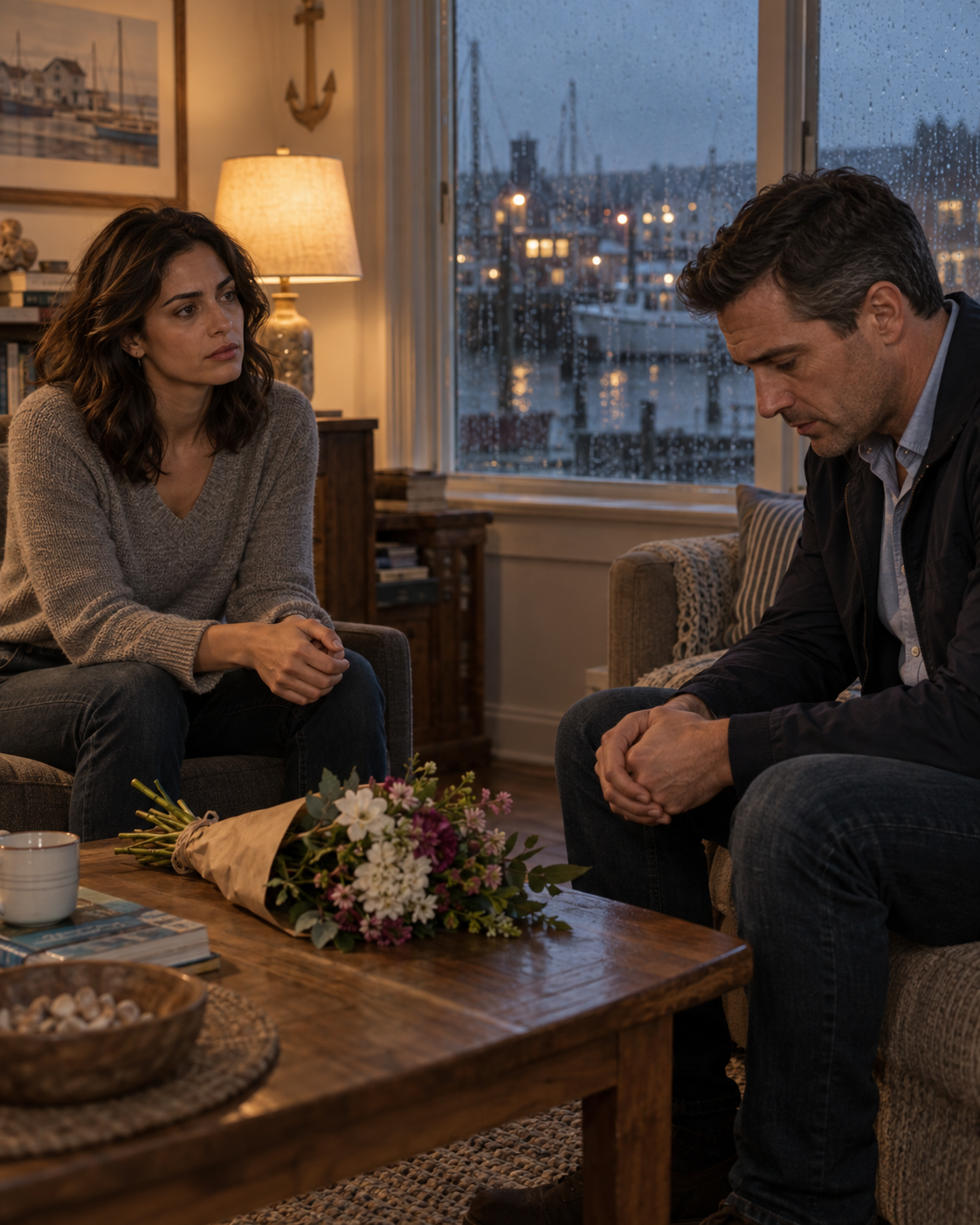
A few days later, Michael came to the harbor house with flowers.
He kissed her forehead as if everything were normal.
Daniela didn’t smile.
“What’s wrong?”
She looked at the flowers in his hand.
“I don’t know if I can keep doing this.”
His expression tightened.
“Why now?”
“Because I’m not living my own life anymore.”
He sat down.
Daniela remained standing.
“I’m always waiting,” she said. “Waiting for your messages. Waiting for your visits. Waiting for you to decide what I mean to you.”
“I love you.”
“Then why don’t you choose me?”
Michael looked away.
“It’s not that easy.”
“Because of your children?”
He nodded.
“Because I have a family.”
Daniela swallowed.
“And what am I?”
He said nothing.
She waited.
The silence answered for him.
She sat down across from him.
“I’m your secret.”
Michael closed his eyes.
That night, Daniela cried after he left.
But something was different.
She wasn’t crying because she didn’t understand anymore.
She was crying because she did.
The Morning She Stopped Waiting
After Michael left, Daniela didn’t call him.
She didn’t send an angry message.
She simply stopped.
At first, it was harder than she expected.
She missed him.
She missed his voice and his hands and the small things he remembered about her. Some mornings she opened her phone automatically, expecting his name to be there.
Instead, she began walking to the beach before work.
She carried a notebook.
She wrote down whatever came to mind.
Some days it was only a sentence.
I want my life back.
Other days she filled several pages.
Slowly, she remembered who she’d been before Michael.
She met Nenah for coffee.
She started reading again.
She went back to the park.
She took a small writing class at the community center, partly because she’d always wanted to write and partly because she needed somewhere to go that had nothing to do with waiting for someone.
Michael continued sending messages.
I miss you.
Can we talk?
Please answer me.
Daniela read them.
She didn’t respond.
A week later, he appeared at her apartment.
When she opened the door, he looked tired.
“I needed to see you.”
Daniela stepped aside.
They sat in the living room where the afternoon light fell across the floor.
“I’ve been thinking,” she said.
“So have I.”
“I love you.”
He looked at her.
“But I can’t keep living like this.”
He nodded slowly.
“I want a real life,” she continued. “I want someone who can give me all of himself, not just the parts he can fit between other responsibilities.”
Michael rubbed his hands together.
“I can’t leave my children.”
Daniela closed her eyes for a moment.
She believed him.
And strangely, that made letting go easier.
“I know.”
“I’m sorry.”
“I know.”
He stood.
For a moment they simply looked at each other.
Then he hugged her.
“I’m going to miss you,” he whispered.
Daniela held him briefly.
“So am I.”
When he walked out the door, she didn’t follow him.
She stood by the window until his car disappeared down the street.
Then she sat down at her kitchen table and cried.
The grief came hard.
But underneath it was something else.
Relief.
For the first time in months, she wasn’t waiting for anyone to choose her.
She had chosen herself.
Someone Who Walked Beside Her
Healing didn’t happen quickly.
There were nights Daniela still missed Michael.
There were mornings when she wondered whether she’d made a mistake.
But her life began filling in again.
Nenah invited her for coffee every weekend.
Daniela returned to the beach.
She kept writing.
At the community center, she met a man named David.
They first spoke in a bookstore near the corner after class. He was looking through travel books when he recognized her.
“You’re in the writing class, right?”
Daniela smiled.
“Yes.”
They talked for a few minutes.
Nothing remarkable happened.
That was what Daniela liked about it.
David didn’t overwhelm her.
He didn’t make promises.
He didn’t ask questions she wasn’t ready to answer.
He listened.
After class, they began getting coffee together.
Sometimes they walked through the park.
Sometimes they talked about books.
Sometimes they sat quietly.
One evening, they were on a wooden bench near the beach when Daniela told him about Michael.
She didn’t soften the story.
“I loved him,” she said. “But he was married. I waited for him for a long time. I don’t want to be someone’s secret again.”
David looked out at the water.
After a moment, he said, “Thank you for trusting me enough to tell me.”
Daniela glanced at him.
“You don’t think I’m foolish?”
“No.”
He paused.
“I think you stayed somewhere too long. That’s different.”
She smiled.
Their relationship grew slowly.
There were no dramatic declarations.
No promises made too early.
Just consistency.
David called when he said he would.
He showed up.
He introduced her to his friends.
He walked beside her in public without hesitation.
And little by little, Daniela stopped expecting love to disappear.
Months later, she stood in front of her apartment mirror while getting ready for dinner.
She caught her own reflection.
For a moment, she saw the woman she’d been before Michael—the woman who had laughed easily, read books by the sea, and made plans without checking someone else’s schedule first.
Then she realized something.
She wasn’t that woman anymore.
She was someone who had learned what it felt like to lose herself.
And someone who had found her way back.

One evening, David asked her, “Do you ever think about the future?”
Daniela looked at the ocean.
“Sometimes.”
“What do you see?”
She smiled.
“A home. Maybe a family someday.”
David nodded.
“Me too.”
Neither of them said anything more.
They didn’t need to.
The waves moved steadily toward shore, breaking and pulling back, breaking and pulling back.
Daniela thought about all the time she’d spent waiting for someone to give her a place in his life.
She had thought love meant holding on.
Now she understood that sometimes love meant knowing when to let go.
She reached for David’s hand.
This time, there was nothing secret about it.
They walked toward the lights of town together, and Daniela realized that peace didn’t arrive when someone finally chose her.
It had begun much earlier, on the morning she stopped waiting for them to.