The Woman on the Station Bench
By midnight, the Cheyenne train station had gone quiet.
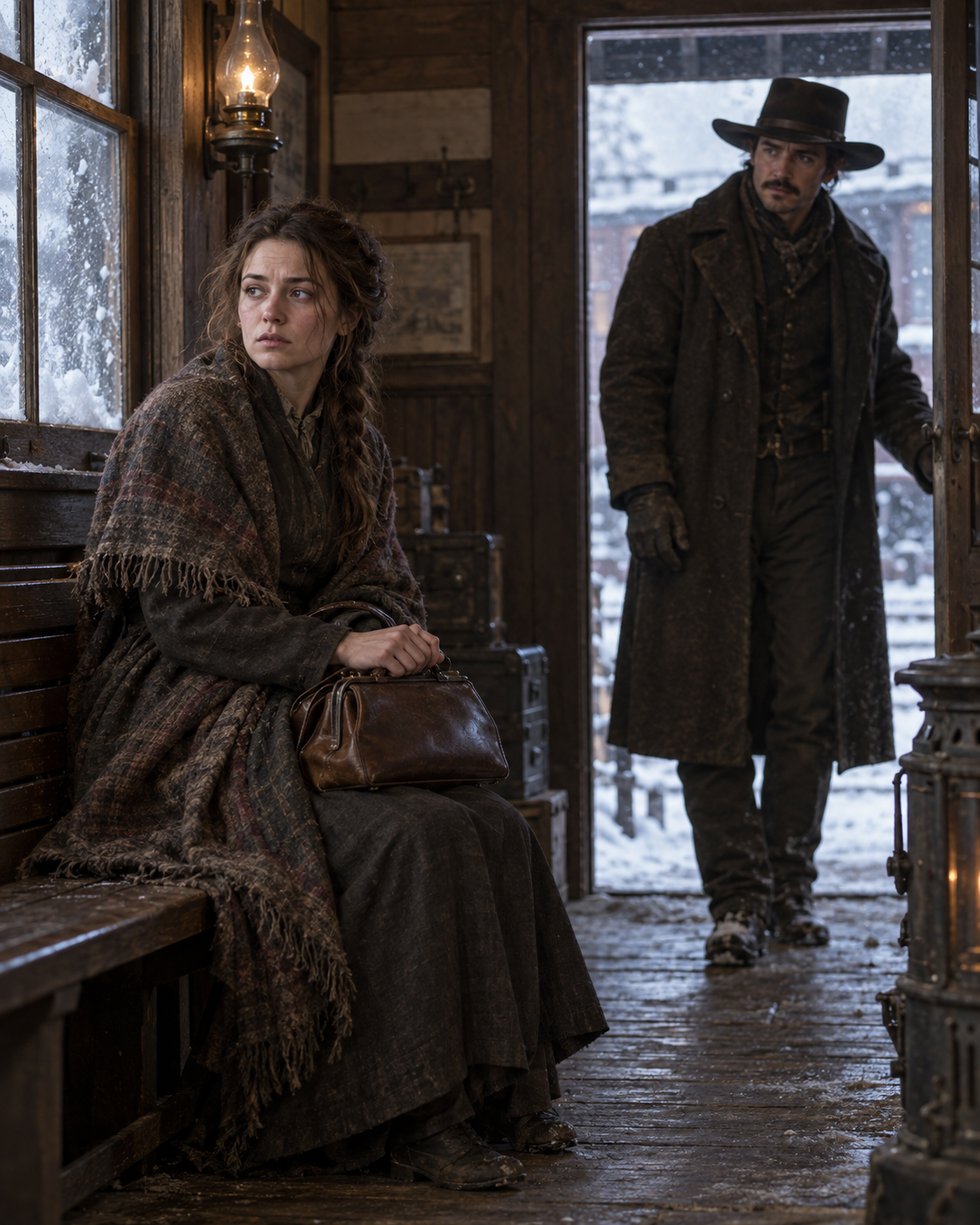
Elizabeth “Libby” Montgomery sat alone on a wooden bench beneath a weak gas lamp, both hands wrapped around a tin cup of water that had gone cold an hour ago. Snow pressed against the windows in thick white waves, and every time the wind found a crack in the old building, she pulled her shawl tighter.
Beside her rested a small leather medical bag.
Inside were a few instruments, bottles of medicine, folded certificates from Philadelphia, and nearly everything she had left in the world.
Three dollars were tucked inside her coat pocket.
That was all.
Two months earlier, Libby had been working as a nurse at a charity hospital in Philadelphia. She had spent years learning how to dress wounds, assist with surgeries, deliver babies, and keep frightened patients calm when doctors could not.
Then Dr. Harrison cornered her one evening.
When he tried to force himself on her, Libby fought back with the nearest thing she could grab.
A metal bedpan.
The hospital dismissed her.
Harrison told his version of the story first, and because he was a physician and she was a nurse, people believed him.
So Libby left.
She headed west because she had heard that the mining camps and ranches were desperate for anyone who knew how to care for the sick and injured.
Instead, Cheyenne had taken the last of her money.
The boardinghouse owner had refused her another night.
And now the storm had canceled the evening train.
Libby stared through the window at the snow and tried not to think about morning.
A set of hoofbeats emerged from the wind.
She straightened.
A dark horse stopped outside the station, and a broad-shouldered man climbed down. He wore a heavy wool coat and a wide-brimmed hat dusted white with snow.
He tied his horse, opened the station door, and brought half the storm inside with him.
“Evening, miss.”
His voice was low and calm.
Libby looked up.
He was around thirty, with dark hair, a weathered face, and tired brown eyes. His clothes were expensive enough to suggest money, but there was nothing polished about the way he carried himself.
His gaze fell to her medical bag.
“You waiting on that train east?”
“It already left.”
He glanced toward the windows.
“Doesn’t look like the next one is coming tonight.”
“No.”
She tried to stand.
Her legs shook.
The man caught her elbow before she fell.
“You’re freezing.”
“I’m fine.”
He looked at her blue fingers.
“No, ma’am. You’re not.”
She should have been frightened.
Instead, for reasons she couldn’t explain, she felt something she hadn’t felt since leaving Philadelphia.
Relief.
“My name’s Jack Thornton,” he said. “I own the Double T Ranch about twenty miles north of here.”
Libby nodded politely.
“I’m Elizabeth Montgomery.”
“Are you a nurse?”
“Yes.”
The surprise in his face was immediate.
“Then you’re exactly where you shouldn’t be.”
She almost laughed.
“I was beginning to suspect as much.”
His mouth lifted.
“Come with me. I know a hotel that still has a room. You can get warm, eat something, and decide what to do in the morning.”
“I can’t pay for it.”
“You don’t have to.”
She studied him.
Men had taught her to be suspicious of generosity.
But Jack simply removed his heavy coat and held it out.
“Miss Montgomery,” he said, “you can distrust me tomorrow. Tonight, you need to get warm.”
For the first time that night, Libby smiled.
The Offer She Didn’t Expect
By morning, the storm had passed.
Cheyenne glittered beneath fresh snow, and sunlight poured through the hotel window.
When Libby opened her door, Jack stood outside holding a breakfast tray.
“You’re becoming a habit,” she said.
He smiled.
“I’ve been accused of worse.”
Over eggs, biscuits, bacon, and strong coffee, Jack asked about her plans.
Libby told him about Philadelphia. She told him about the hospital. She told him only what she was ready to tell him.
When she reached the part about Harrison, Jack’s expression hardened.
“He tried to assault you?”
“He tried.”
“And you stopped him.”
“With a bedpan.”
Jack stared at her.
Then, to her surprise, he laughed.
Libby did too.
It was the first honest laugh she’d had in months.
“You know,” Jack said, “I think I just found the toughest nurse in Wyoming.”
She shook her head.
“I wasn’t trying to be tough.”
“No?”
“I was trying to survive.”
That answer quieted him.
Jack told her the Double T employed dozens of ranch hands. Men got kicked by horses, thrown from saddles, caught in machinery, burned around campfires, and injured during storms. The nearest reliable physician was far away.
“I’ve been trying to hire someone for months,” he said. “I need a medical professional.”
“You’re offering me a job?”
“A real one. Salary. Your own cabin. Medical supplies. Privacy. No favors expected.”
Libby narrowed her eyes.
“What’s the catch?”
“That you’re going to discover ranching is harder than it looks.”
“And if I don’t like it?”
“You leave.”
“And if you don’t like me?”
“You still leave.”
That answer mattered more to her than the salary.
She accepted.
The ride to the Double T took most of the day.
As they crossed the snowy valley, Jack pointed out streams, cottonwood groves, cattle pens, and distant mountain ridges.
When the ranch finally appeared below them, Libby stopped her horse.
The place spread across the valley like a small frontier town.
The main house stood near the center, surrounded by stables, corrals, bunkhouses, sheds, and barns.
“This is yours?”
“Part of it.”
She looked at him.
“How much land is ‘part of it’?”
He shrugged.
“Enough to keep me busy.”
The ranch hands greeted them with curiosity.
Jack introduced her simply.
“This is Miss Montgomery. She’s our new nurse.”
A gray-bearded foreman named Tom Bradley shook her hand.
“We’ve needed you longer than you know.”
Within hours, Libby had treated a badly bruised foot and cleaned a deep cut on a ranch hand’s palm.
The men watched her carefully.
Then they watched her work.
By dinner, the teasing stopped.
By the end of the week, respect had replaced curiosity.
Jack kept his distance during working hours.
At night, however, they sometimes sat on the porch outside her cabin with mugs of coffee and talked until the fire burned low.
He told her about losing his wife, Rebecca, to illness years earlier.
Libby told him she had spent so much time trying to become respectable that she had forgotten how to simply be herself.
“You don’t seem like someone who forgot,” Jack said.
“No?”
“No. You seem like someone who finally got tired of asking permission.”
She looked at him for a long moment.
That was the night she realized she was falling in love with him.
She didn’t tell him.
Neither did he tell her.
The Night They Had No Time to Wait
In late April, a storm rolled across the ranch with almost no warning.
Lightning cracked over the pasture.
The horses panicked.
Then a rider came shouting across the yard.
“Jack!”
Both Jack and Libby ran outside.
A young ranch hand named Danny had been thrown when his horse bolted.
By the time they reached him, he was barely conscious.
Libby dropped to her knees.
His breathing was shallow.
“Get him to the medical room.”
Jack looked toward the road.
“I’ll ride for the doctor.”
“You won’t make it back in time.”
He knew she was right.
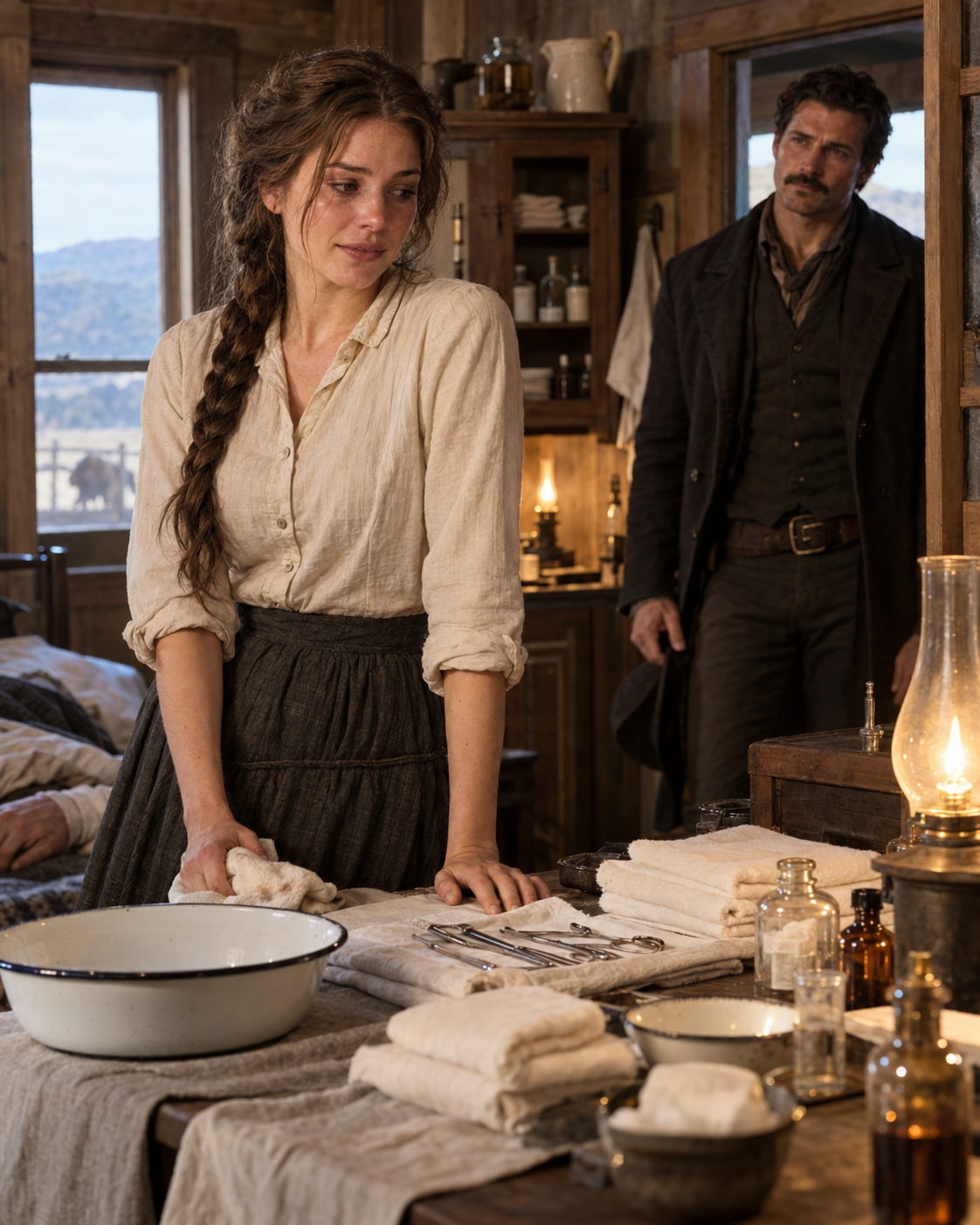
The men carried Danny inside.
Libby washed her hands, rolled up her sleeves, and opened her medical bag.
Her hands were steady.
Her heart wasn’t.
For three hours, the room smelled of soap, blood, medicine, and wood smoke.
Tom assisted.
Jack waited outside because there was nothing else he could do.
Libby worked the way she had learned to work in Philadelphia: carefully, efficiently, without panic.
When it was finally over, Danny’s breathing eased.
“He has a chance,” she said.
Jack closed his eyes for a moment.
Then he leaned against the doorway.
Pride and exhaustion were written across his face.
“You saved him.”
“He wasn’t ready to die.”
“Neither were you.”
Libby looked up.
Jack crossed the room slowly.
That was the first time neither of them cared about what was proper.
That night, sitting on her porch beneath a sky crowded with stars, Jack took her hand.
“I love you,” he said.
Libby looked down at their joined hands.
Then back at him.
“I love you too.”
He kissed her gently.
Not like a man claiming something.
Like a man asking.
When he pulled away, he whispered, “Marry me.”
She smiled through tears.
“You’re asking after one kiss?”
“I’m asking after watching you save a boy’s life.”
She laughed softly.
“I think you should give me at least a little more time to be sensible.”
“I can do that.”
But they both knew she had already made up her mind.
The Past Came Looking for Her
They married six weeks later.
The wedding took place on the porch of the main house.
Tom walked Libby down the aisle.
Martha, the ranch cook, tucked wildflowers into Libby’s hair.
The cowboys stood in their cleanest shirts and tried not to look emotional.
Jack looked more nervous than Libby had ever seen him.
When they exchanged vows, she felt something settle inside her.
Not certainty about the future.
Something better.
Trust.
For the next year, the Double T changed.
Libby expanded the medical room. She taught the ranch hands first aid. She helped neighbors miles away. She treated children, farmers, riders, pregnant women, and anyone else who arrived at her door needing help.
Jack never introduced her as “my nurse.”
He introduced her as “my wife, Libby Thornton.”
Then one spring morning, a stranger arrived.
Dr. Harrison.
He claimed he had come to investigate Libby’s medical practice.
Libby recognized him instantly.
He smiled as though the past belonged to him.
“You don’t have the authority to practice medicine here,” he said.
Jack stepped forward.
“She has credentials.”
“Credentials don’t erase what happened in Philadelphia.”
Libby’s stomach tightened.
Harrison had brought official-looking papers and a territorial marshal.
He expected fear.
Instead, Libby looked him directly in the eye.
“You already had your chance to tell your story.”
Harrison smiled.
“This time, people will listen.”
For the first time, Jack reached for her hand.
Not to speak for her.
To remind her she wasn’t standing alone.
What She Chose to Keep
The hearing in Cheyenne drew more people than anyone expected.
Former patients spoke.
Ranch workers testified.
The doctor who had eventually examined Danny’s recovery praised Libby’s work.
Then Harrison’s own past began to surface.
His record was not nearly as respectable as he had claimed.
Libby’s was not nearly as questionable.
When the judge finally ruled, the decision was clear.
Harrison’s accusations were dismissed.
Libby’s qualifications were formally recognized.
Outside the courthouse, the crowd spilled into the cold afternoon.
Jack found her near the steps.
For a moment, neither spoke.
Then Libby exhaled.
“It’s over.”
Jack nodded.
“You don’t have to prove anything to him anymore.”
She looked at him.
“I never wanted to prove anything to him.”
She squeezed his hand.
“I wanted to prove it to myself.”
They returned to the Double T that evening.
Years passed.
The ranch grew.
Libby helped establish a proper hospital in Cheyenne and trained young women who wanted to work in medicine.
Jack expanded the ranch and invested in the surrounding community.
They had children.
They fought over money, exhausted themselves over work, worried over sick family members, and learned that love was much less glamorous in ordinary life than it had seemed on that snowy night at the station.
It was also stronger.
Decades later, the old leather medical bag still sat in a glass case in Cheyenne.
Visitors saw it and heard the story of the nurse who arrived with three dollars and no reason to believe her life would get better.
But Libby never thought of that night as the beginning of a perfect love story.
She remembered the cold.
The hunger.
The fear.
And a stranger taking off his coat without asking for anything in return.
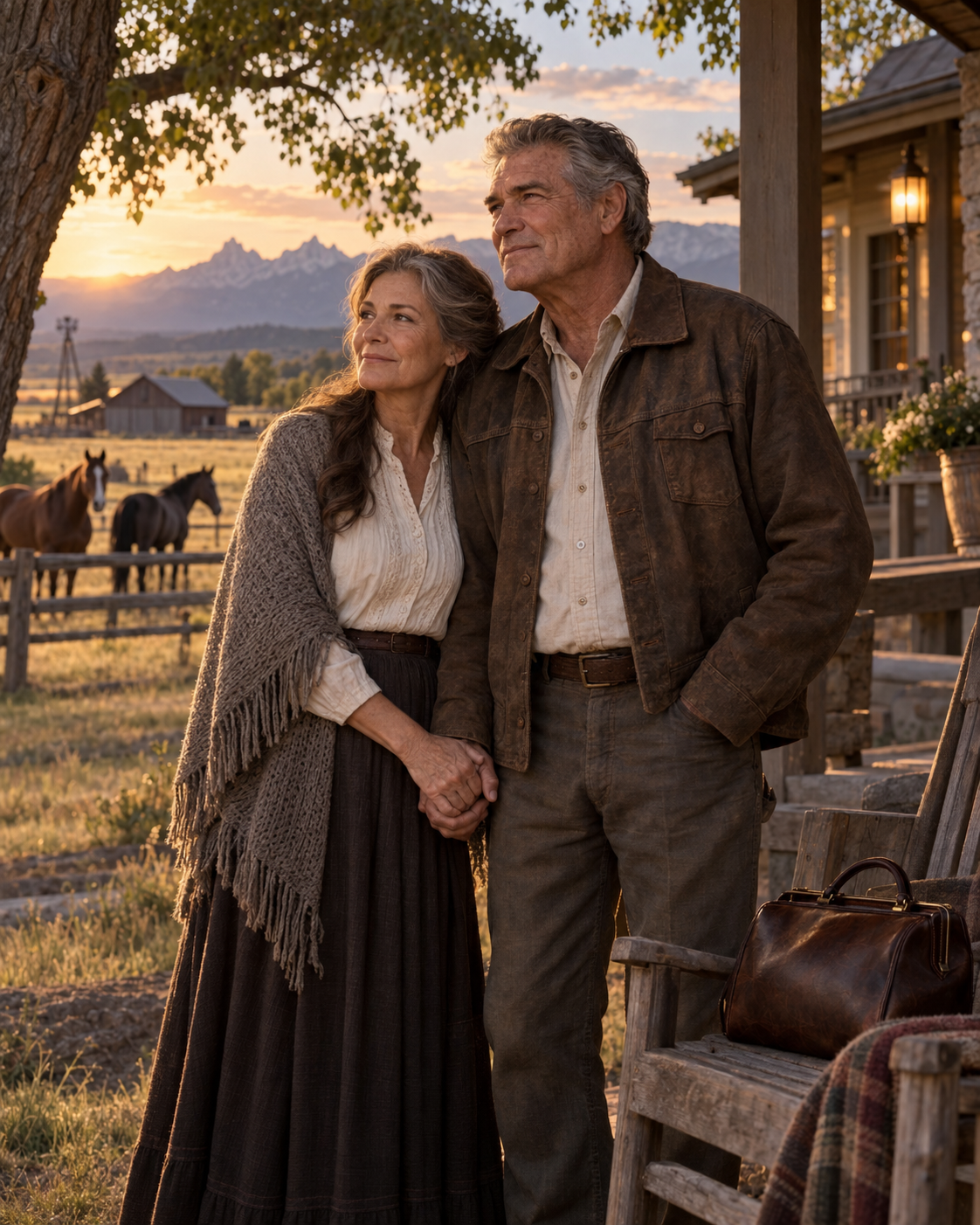
Years after their wedding, on a quiet evening at the ranch, Libby found Jack standing outside beneath the cottonwood trees.
She slipped her hand into his.
“Do you ever think about that station?” he asked.
“All the time.”
“You nearly froze to death.”
“I know.”
“And you still decided to come home with me.”
She smiled.
“I didn’t know it was home yet.”
Jack looked at her.
“You do now?”
Libby glanced toward the house, where their children were laughing inside.
She looked across the fields, where the last light rested on the grass.
Then she tightened her fingers around his.
“Yes,” she said.
And this time, the word needed no explanation.