Emily Carter knew something was wrong the moment her husband lied without blinking.
They were having dinner at a steakhouse outside Columbus, Ohio, the kind of place with dark wood booths, heavy glasses, and waiters who never seemed rushed. Mark was halfway through cutting his steak when his phone rang.
He glanced at the screen.
“Jenna,” he said.
He answered.
“Yeah,” he said calmly. “Caleb’s still with the client. Meeting ran long.”
Emily stopped moving.
Forty-five minutes earlier, she had watched that client leave their office building. Ten minutes after that, Mark had stood beside the elevators, pulled on his coat, and told the three of them, “Tell Jenna I’m heading home.”
Now he was telling Jenna that her husband was still at the office.
Mark noticed her staring.
For just a fraction of a second, something flickered across his face.
Then he smiled.
“Everything okay?” he asked after ending the call.
“Jenna can’t find Caleb?”
“She gets worried.”
“You told her he was still with the client.”
“He probably is.”
“The client left.”
Mark lowered his knife.
“Emily, I was trying to keep her from panicking.”
“You knew he wasn’t with that client.”
“I assumed he had another meeting.”
The explanation was smooth enough that, for several minutes, Emily wondered if she were the one being unreasonable.
Seventeen years of marriage teaches you the difference between a strange moment and a real problem.
At least, that’s what she had always believed.

The Numbers That Wouldn’t Stay Quiet
Emily was 43 and had been married to Mark for seventeen years.
From the outside, theirs was a comfortable Midwestern marriage. They had a house, adult careers, family dinners, holiday traditions, and the kind of shared history that made other people call a marriage “solid.”
Mark was an executive at Carter Home Systems, the publicly traded company his father, Frank, had built from a regional distributor into a large Midwestern business.
Emily worked there, too.
She had earned a finance degree, spent years building her own career, and eventually joined the company in a senior finance position. Her job was rarely dramatic. She reviewed budgets, expenses, forecasts, controls, and the thousands of ordinary transactions that kept a large business accountable.
That was why the dinner bothered her.
Not because Mark had lied to Jenna.
Because he had lied about something she had personally witnessed.
The next morning, Emily saw Caleb at the office.
He smiled.
“Morning.”
“Morning.”
She almost asked where he’d been the night before.
Instead, she kept walking.
Then she began noticing small inconsistencies.
A hotel stay extended one night beyond a conference.
A mileage claim for a meeting that had supposedly become a video call.
A client dinner on a date when Emily remembered the client had already left town.
None of it was enough to prove anything.
In a company that size, calendars changed. Flights were delayed. Expenses were corrected. Meetings moved.
Emily knew that better than anyone.
So she made herself a promise.
She would not turn one uncomfortable lie into a conspiracy.
Then an expense report crossed her desk.
Caleb’s.
Frank had approved it.
Mark had verified part of the schedule.
Emily leaned back.
A few days later, another expense came through involving Frank.
Mark had verified that one, too.
Emily opened a yellow legal pad and wrote three names.
Mark.
Caleb.
Frank.
Under Caleb, she wrote: Frank approved. Mark confirmed.
Under Mark: Caleb confirmed.
Under Frank: Mark confirmed.
She stared at the page.
It wasn’t proof of fraud.
But it was a pattern.
And for the first time, Emily wondered what would happen if the three men ever needed each other to confirm the same story.
Three Versions of the Same Night
For the next week, Emily stopped asking questions.
She didn’t search Mark’s phone.
She didn’t follow Caleb.
She didn’t rummage through Frank’s office.
She simply paid attention to information already crossing her desk.
One Thursday, Frank’s schedule showed an overnight trip to Cleveland.
At Sunday dinner, Susan, his wife, casually mentioned it.
“Frank hates traveling now,” she said, laughing. “But put a business dinner in front of him and suddenly he’s twenty-five again.”
Emily smiled.
She said nothing.
Then she noticed the original calendar.
Frank’s meeting had been scheduled for Friday morning.
The updated schedule showed him leaving Wednesday afternoon.
Mark had been copied on the change.
Later that week, Frank appeared at Emily’s office.
“I hear finance has been giving the boys some extra work.”
“Finance gives everyone extra work.”
He smiled.
“You know what I mean.”
“I’ve asked for documentation on a few expenses.”
“Emily, this company was built on relationships. Not every dinner comes with a perfect paper trail.”
“I understand.”
“Sometimes numbers tell you what happened,” Frank said, resting a hand on the back of a chair. “They don’t always tell you why.”
After he left, Emily sat very still.
That evening, Mark brought home Thai food from her favorite restaurant.
He opened wine.
He asked about her day.
For nearly an hour, everything felt normal.
Then he said, “Dad mentioned you’re holding up reimbursements.”
“I’m not holding anything up.”
“He thinks you’re being aggressive.”
Emily looked at him.
“Your father doesn’t usually monitor routine accounting questions.”
Mark’s expression changed.
“It’s his company.”
“No,” she said quietly. “It’s a public company.”
He didn’t answer.
Two days later, they had Sunday dinner with the whole family.
Jenna, Caleb, Frank, and Susan were there.
After dessert, Jenna put down her coffee.
“So,” she said, “are we going to talk about this?”
Emily knew immediately what she meant.
“Talk about what?”
“You’ve been questioning everyone’s schedules.”
“I’ve been doing my job.”
“It doesn’t sound like that.”
Frank leaned back.
“The real issue is trust.”
Emily looked at him.
“At a public company, internal controls aren’t a question of trust.”
Jenna laughed.
“You always do that.”
“Do what?”
“Talk to us like we’re employees.”
Mark shifted in his chair.
“Emily, maybe you should just apologize.”
She looked at him.
“For asking people to explain expenses?”
“That’s not what this is about.”
“Then what is it about?”
No one answered.
Jenna crossed her arms.
“Dad built this company before you ever became part of the family.”
There it was.
Not numbers.
Not policies.
Blood.
Emily kept her voice level.
“And thousands of shareholders own part of it now. That’s why the rules matter.”
Mark’s jaw tightened.
“Just apologize.”
“No.”
His head snapped toward her.
“Emily.”
“No.”
His voice rose.
“Apologize to my sister or get out of my house.”
The room went silent.
Their house.
The house they had bought together eleven years earlier.
Emily slowly stood.
She looked first at Jenna, then Caleb, then Frank.
Finally, she looked at Mark.
“Fine,” she said.
Everyone waited.
Instead, Emily said, “Jenna, ask Caleb why he, Mark, and your father keep covering for one another.”
Caleb laughed.
“That is ridiculous.”
Emily named two dates.
Mark immediately supplied an explanation.
Caleb supplied another.
Frank offered a third.
Every discrepancy had an answer.
Every answer sounded reasonable.
Emily left the dinner knowing she had made a mistake.
She had shown them exactly what she had seen.
Now they knew what to clean up.
That night, Mark didn’t follow her upstairs.
He didn’t apologize.
He simply said, “You embarrassed yourself.”
Emily closed the guest-room door.
For the first time in seventeen years, she slept alone.
The Women Start Comparing Notes
Two weeks later, Jenna called.
Her voice sounded different.
“Emily?”
“Yeah?”
“Do you remember that Dayton trip you mentioned?”
“Yes.”
“Caleb says he was with Mark most of that night.”
Emily sat down.
“Mark says the same thing.”
There was a pause.
“That’s impossible,” Jenna said.
“Why?”
“Because Mark was at Mom and Dad’s anniversary dinner.”
Emily remembered.
She had arrived late that night after working through a quarter-end deadline.
Mark had been there before her.
There were pictures.
Time stamps.
A private dining room.
Jenna spoke more quietly.
“I found the photos.”
Emily closed her eyes.
Three days later, Susan came to her office.
She carried her handbag with both hands.
“That Cleveland trip,” Susan said. “When was it?”
Emily told her.
Susan shook her head.
“Frank left Wednesday.”
“The company records say Thursday.”
“I know.”
“How do you know?”
“I packed his suitcase.”
Susan gave a nervous little laugh.
“After forty-three years, I know when my husband walks out the door.”
Emily leaned forward.
“What did he say?”
“That it was business.”
“And was it?”
Susan looked down.
“I don’t know.”
That was the moment something changed.
Not because Susan believed Emily.
Because Susan admitted she didn’t believe Frank anymore.
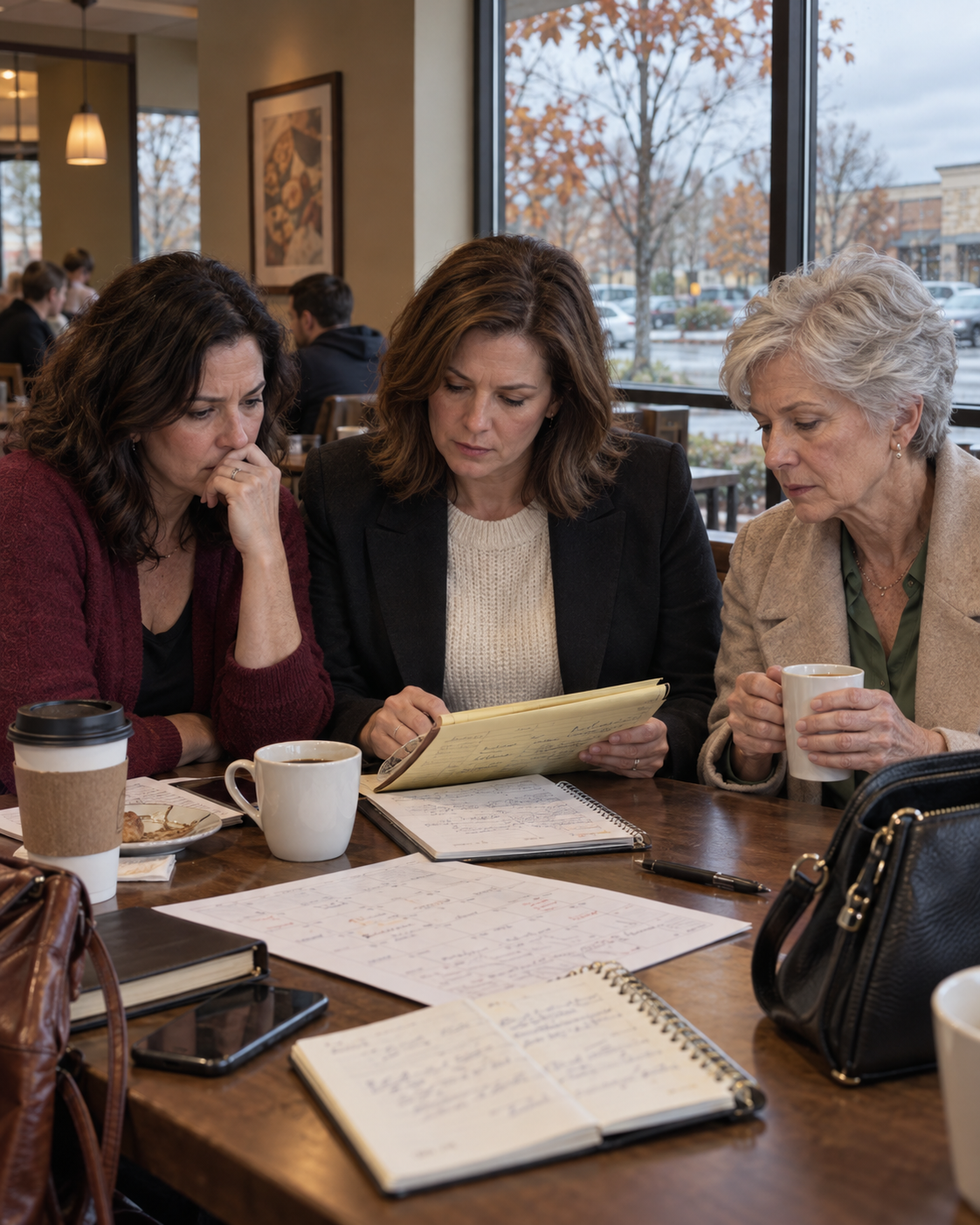
A few days later, Emily, Jenna, and Susan met at a Panera on the far side of town.
They did not look like investigators.
They looked like three women in their forties and sixties drinking coffee on a weekday afternoon.
For half an hour, they compared only things they personally knew.
No phone hacking.
No secret recordings.
No breaking into offices.
Just dates.
Places.
Things their husbands had told them.
One by one, the explanations stopped lining up.
Six dates remained.
Then four.
Then three.
Jenna stared at the list.
“They think we don’t talk.”
Susan stirred her tea.
“We don’t.”
“Not anymore,” Emily said.
Susan looked at both women.
“What if they still think we don’t?”
Emily understood.
Their weakness was not a hotel receipt.
It was the women.
Three wives.
Three households.
Three separate versions of reality.
The men had relied on those worlds never touching.
Susan smiled faintly.
“Then let’s not tell them they touched.”
The Test They Never Saw Coming
For the next month, the women appeared divided.
Jenna complained about Emily in front of Caleb.
Susan told Frank she thought the entire situation had become ridiculous.
Emily became quiet at home.
When Mark asked where she was looking for documents, she simply said, “I’m tired of fighting.”
He relaxed.
He thought she had surrendered.
She had not.
Susan suggested one final test.
They wouldn’t fabricate records.
They wouldn’t impersonate anyone.
They wouldn’t do anything illegal.
They would simply tell each husband a different version of a harmless upcoming review.
Emily told Mark finance might examine older travel documentation.
Jenna mentioned vendor dinners.
Susan mentioned archived calendar changes.
Three different subjects.
Then they waited.
Two business days later, accounting received a request from Mark’s office asking for old travel files.
Frank’s assistant was asked to locate archived calendars.
And Caleb casually asked Jenna whether she remembered the name of a restaurant from an old vendor dinner.
The women met that evening.
“They’re comparing notes,” Jenna said.
Emily nodded.
“They still are.”
Then Mark made the mistake they had been waiting for.
One night, while sorting mail, he asked casually, “Did finance decide how far back they’re reviewing those vendor dinners?”
Emily looked up.
“I never said they were reviewing vendor dinners.”
Silence.
Mark froze.
Only for a second.
But it was enough.
“Caleb mentioned something,” he said.
Emily said nothing.
The next morning, she called Jenna.
“He heard your version and passed it to Mark.”
Jenna was quiet.
Then she said, “Good.”
Not triumphantly.
Not happily.
Just with certainty.
At that point, an independent internal controls review was already underway.
The company had noticed the unusual rush to reconstruct older documentation.
Once people outside the Carter family started reviewing the records, the men could no longer control every explanation.
The first major issue involved a hotel stay tied to one of Caleb’s business trips.
The meeting had been real.
The hotel had been real.
But the timing did not match the story Caleb had given Jenna.
Another file raised questions about Frank’s travel.
Another involved Mark.
One discrepancy could be explained.
Two could be coincidence.
But a pattern across three executives was different.
And then personal evidence began connecting the business records to private lives.
Jenna found a woman repeatedly appearing in reservation confirmations connected to Caleb’s travel.
Susan found old receipts at home that contradicted Frank’s explanations.
Emily discovered emails showing Mark had repeatedly helped smooth inconsistencies in Caleb’s and Frank’s schedules before those discrepancies reached finance.
He hadn’t just lied to her.
He had been coordinating the lies.
Emily read the old messages twice.
Then she closed her laptop.
She didn’t cry.
Not yet.
She simply understood.
The marriage she thought she was defending had been built around information she was never allowed to see.
The Room Where the Stories Finally Met
The meeting happened on a Monday morning in a conference room Emily had used hundreds of times.
This time, outside counsel was there.
So were the audit committee chair, the head of internal audit, and two independent directors.
Mark arrived first.
Then Caleb.
Then Frank.
The three men sat together.
For years, that arrangement had protected them.
They could look at each other and know which version of the story had to survive.
Then the door opened.
Jenna walked in.
Caleb went pale.
A few seconds later, Susan entered.
Frank stood.
“Susan?”
She set her purse down and sat beside Jenna.
Mark looked at Emily.
“What is this?”
Emily took her chair.
“You’ll see.”
The corporate findings came first.
No one exaggerated them.
That was important.
Not every expense was fraudulent.
Not every trip was fake.
The problem was that legitimate business activity had repeatedly been mixed with private activity, company resources had been used improperly, and the three executives had repeatedly helped verify one another’s explanations.
Mark protested.
“Schedules change.”
“Of course,” the audit chair said.
Frank added, “Executives meet people outside normal business hours.”
Again, no one disagreed.
Then Jenna spoke.
“Mark wasn’t with Caleb that night.”
She slid a photograph across the table.
Mark was visible in the background of an anniversary dinner.
The time stamp placed him there when he claimed to be elsewhere.
Mark looked at Caleb.
Caleb looked at Frank.
Susan spoke next.
“Frank, you told me the extra night in Cleveland was business.”
Frank didn’t answer.
“You left Wednesday,” she said. “The company meeting started Thursday.”
Caleb tried to recover.
“The Indianapolis dinner was real.”
Emily looked at him.
“The client left at 6:12.”
The dinner charge came later.
Jenna placed the reservation record on the table.
The woman’s name appeared again.
And again.
Caleb leaned back.
“This has nothing to do with company controls.”
Outside counsel answered quietly.
“It does when personal activity is represented as business.”
Frank turned toward Mark.
“You told me all of this had been cleaned up.”
Mark stared at him.
Caleb looked from one man to the other.
“Cleaned up?”
Frank realized too late what he had said.
Then the alliance that had held together for three years began to collapse.
“You were changing the schedules,” Mark said.
“You were covering them,” Caleb shot back.
“You said you had handled the documentation,” Frank snapped.
The voices rose.
Not dramatically.
Not like a television courtroom.
Like three frightened men realizing the person sitting beside them was no longer an ally.
Emily watched silently.
That was the moment she knew it was over.
Not the marriages.
Those had been damaged long before.
The system was over.
The belief that three men could keep three women separated forever was over.
What Remained After the Truth
The company survived.
The people inside it still had to show up for work.
Warehouses still shipped orders.
Customers still bought products.
But Mark and Caleb lost their executive positions.
Frank stepped away from active leadership.
Independent management took control.
The investigation widened, and the personal betrayals became impossible to hide.
Caleb had been involved with the woman Jenna had identified.
Frank had concealed another long-running relationship from Susan.
And Mark had betrayed Emily while spending years helping the other two men hide what they were doing.
None of the divorces were clean.
None were cheap.
There was no satisfying courtroom moment where everyone lost exactly what they deserved.
There were lawyers, spreadsheets, property valuations, retirement accounts, stock negotiations, and long evenings spent signing documents.
The company stock fell sharply before beginning a slow recovery.
Mark eventually moved into a smaller condo.
Caleb found another job outside the Carter orbit.
Frank remained in the house he had shared with Susan for decades.
Susan left.
Jenna did, too.
Emily stayed in Ohio for several months after the divorce before accepting a finance position in North Carolina.
Starting over was less dramatic than she had imagined.
She bought a new coffee maker.
Found a grocery store she liked.
Learned new roads.
Ate alone more often than she expected.
The first apartment felt painfully quiet.
Eventually, the quiet became peaceful.
A year later, Emily drove back through Columbus.
She passed the Carter Home Systems headquarters.
Frank’s reserved parking space was gone.
Mark’s name was gone from the leadership page.
Caleb’s was gone, too.
The company had recovered from its worst quarter.
Not perfectly.
But steadily.
Emily had once been offered a larger role there.
She declined.
She didn’t want Mark’s office.
She didn’t want Frank’s influence.
She didn’t want to spend another chapter of her life proving she belonged in a company that had once told her she should be grateful to belong to the family.
She kept driving.
That evening, she went to Susan and Jenna’s new house.
It was smaller than the Carter home but warm and comfortable.
Susan had already started a flower bed.
Jenna was cooking.
They ate roast chicken around a round oak table.
Halfway through dinner, Jenna became quiet.
“You know what I was thinking about?”
Emily already knew.
“That night?”
Jenna smiled awkwardly.
“I really thought I’d won.”
Emily remembered.
Jenna had been so certain then.
Certain that Emily was paranoid.
Certain that Mark had chosen her.
Certain that family loyalty meant believing the right person.
“I was wrong,” Jenna said.
Susan reached across the table and touched her daughter’s hand.
Jenna looked at Emily.
“I’m sorry.”
Emily nodded.
“I know.”
That was enough.
Nobody pretended the past had disappeared.
Nobody said the word forgiveness as if it erased anything.
Three women had simply learned to trust one another after spending years being encouraged not to.
Later, when Emily stepped outside, the evening air was cold.
Behind her, she could hear Jenna laughing in the kitchen.
Susan called after her to come look at the flower bed.
Emily turned.
The porch light spilled across the yard.
For years, she had thought the truth would arrive like a verdict—loud, undeniable, impossible to escape.
Instead, it had arrived as a series of small things.
A phone call.
A changed itinerary.
A photograph.
A woman remembering when her husband left the house.
A question asked by someone who had finally decided to compare notes.
Emily stood there for a moment, then walked back toward the light.