At 2:17 in the morning, Marco was standing at the kitchen sink, counting the drops of water sliding down the glass.
He had no reason to be awake.
His alarm was set for 6:30. His work boots were by the back door. His phone was charging on the counter, face down, though he had already checked it six times.
Still, sleep would not come.
He turned off the faucet and stared out the window at the dark outline of the mountains beyond town.
Tomorrow, he thought.
Then, without meaning to, another thought followed.
What if I can’t keep this job?
Then another.
What if Mom was right about me?
Then another.
What if I already messed up the best years of my life?
Marco rubbed both hands over his face.
He was twenty-four, but lately he felt much older. Every mistake he had made seemed to follow him around, while every possible future seemed to wait somewhere ahead with its arms crossed.
Six months earlier, he’d quit community college halfway through the semester. Before that, he’d broken up with his girlfriend after months of telling himself he needed to “figure things out.” His father had stopped asking when Marco planned to leave town because the question always turned into an argument.
Even good news made him nervous.
When his boss had offered him more hours at the hardware store, Marco had gone home and spent three nights worrying about whether he could handle them.
He wasn’t unhappy all the time.
That almost made it worse.
He had moments when he laughed with coworkers or watched his younger sister dance around the living room while cooking dinner. But his mind always returned to the same two places: behind him and ahead of him.
The past.
The future.
Almost never the hour he was actually living.
That morning, his sister Elena found him sitting on the front steps before sunrise.
“You sleep?” she asked.
“Not really.”
She dropped her backpack beside him. “You look terrible.”
“Thanks.”
“I’m serious.”
“I know.”
Elena studied him for a moment. She was seventeen and had mastered the particular expression younger siblings used when they were deciding whether to tease you or tell you the truth.
“You’re doing it again,” she said.
“Doing what?”
“Thinking about everything at once.”
Marco smiled without much humor. “Apparently that’s my specialty.”
She nudged his shoulder.
“Mom told me about the old guy.”
“What old guy?”
“The one up in Bell’s Ridge. The retired psychologist.”
Marco glanced at her.
Elena shrugged. “She said Dad’s friend went to see him after his divorce. Said the guy helped him get his head straight.”
“That’s not exactly a medical credential.”
“No. But you’re the one who’s desperate.”
Marco looked toward the mountains.
Bell’s Ridge was nearly two hours away, up narrow roads that twisted through wooded hills.
He had nowhere he needed to be that weekend.
By Saturday morning, he’d decided to go.
The Road Into the Hills
The trip took longer than Marco expected.
Rain had washed gravel across one of the county roads, forcing him to take a detour through a tiny town with one gas station, a feed store, and a diner with a hand-painted sign in the window.
He almost turned around twice.
Not because he was lost.
Because he kept telling himself this was ridiculous.
At twenty-four, he thought, you’re driving into the mountains to get advice from a retired therapist you’ve never met.
But every time he considered going home, the same heavy feeling settled in his chest.
So he kept driving.
By late afternoon, the road narrowed.
The houses became farther apart. Cell service disappeared. Trees crowded the shoulders until Marco felt as though he were passing through a green tunnel.
Then he saw a faded wooden sign for Bell’s Ridge.
The village consisted of perhaps forty houses scattered along a slope, a small church, a general store, and a volunteer fire station.
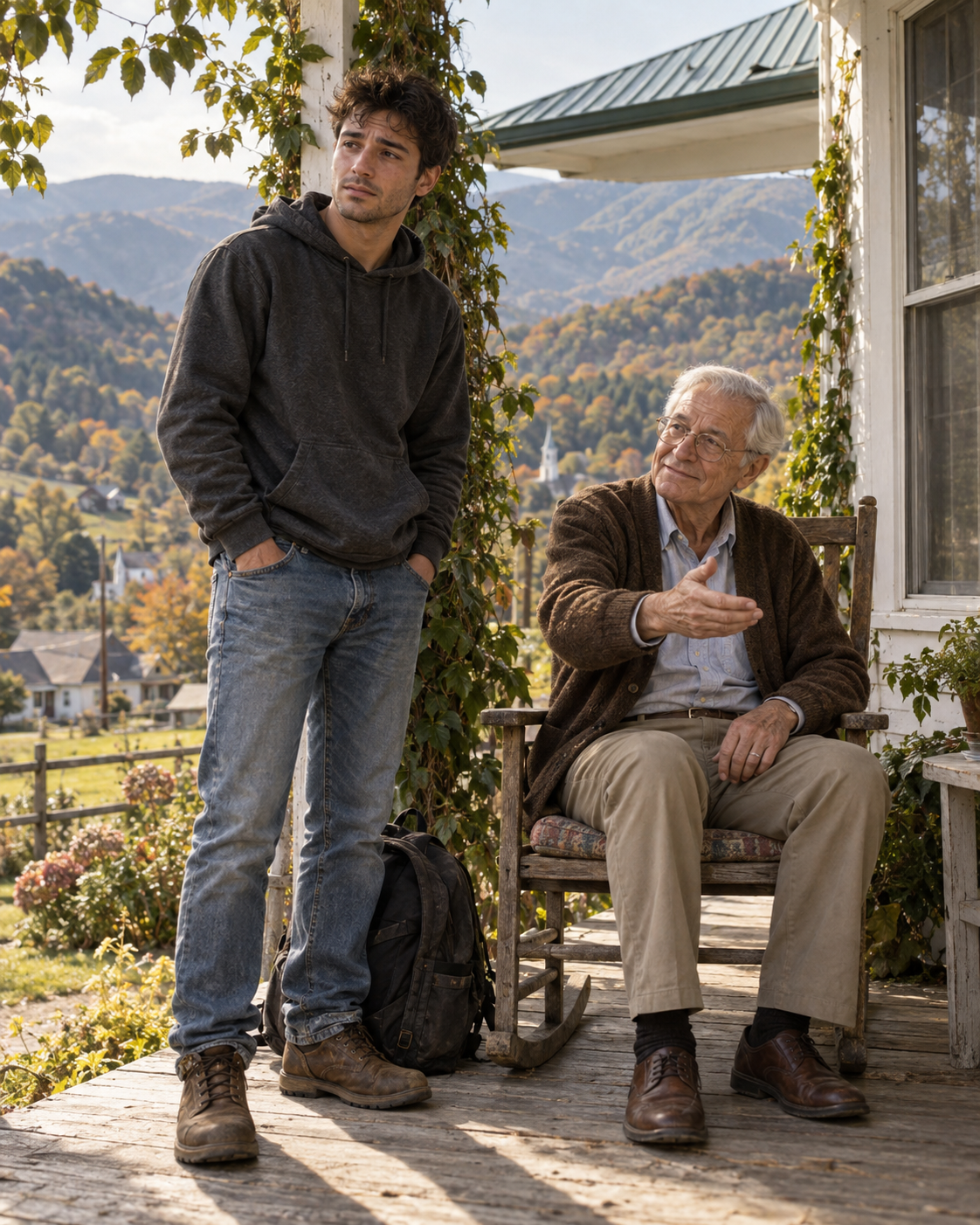
Near the top of the hill stood a white cottage with a green metal roof.
A porch wrapped around the front.
Vines climbed the railing.
An older man sat in a wooden chair beneath a ceiling fan.
He looked to be in his seventies, with silver hair combed neatly to one side and a thin face lined more by years of smiling than frowning.
Marco parked at the bottom of the steps.
The old man opened his eyes.
“You took your time,” he said.
Marco stopped.
“I’ve never been here before.”
“I know.”
Marco looked around.
The man smiled.
“People drive slowly when they finally have somewhere important to go.”
Marco wasn’t sure whether that was wisdom or just something old men said.
Either way, he sat down.
“Are you Mr. Harris?”
“That depends who’s asking.”
“My name’s Marco.”
“I figured.”
Marco laughed for the first time that day.
Mr. Harris gestured toward the chair beside him.
“Tell me what’s bothering you.”
Marco did.
Not all at once.
He talked about work, his father, school, his breakup, the constant worry that he was falling behind everyone his age.
He told the story in messy pieces, circling back, correcting himself.
Mr. Harris didn’t interrupt.
When Marco finished, the old man sat quietly for several seconds.
Then he stood.
“Come on.”
“Where?”
“I’m going to give you a job.”
Marco followed him into the yard.
The Glass
Inside the kitchen, Mr. Harris picked up a clear drinking glass.
He filled it to the very rim.
Then he handed it to Marco.
“Walk to the mailbox at the end of the road.”
Marco looked at the glass.
“That’s it?”
“Then walk back.”
“What am I supposed to do?”
“Carry it.”
Marco waited.
Mr. Harris raised an eyebrow.
“Without spilling any.”
Marco almost smiled.
“This is your big advice?”
“It’s not advice. It’s a task.”
The mailbox was less than a quarter mile away.
Marco stepped onto the road.
At first, he was embarrassed.
He held the glass in both hands, keeping his arms close to his body.
A pickup truck passed.
A dog barked behind a fence.
Two kids rode bicycles down a driveway.
Marco carefully adjusted his grip.
By the time he reached the mailbox, the surface of the water was still.
He turned around.
A woman waved from her front porch. Marco barely noticed.
He stepped around a pothole.
A gust of wind pushed at his hoodie.
He tightened his fingers around the glass.
When he returned to the cottage, Mr. Harris was waiting on the porch.
Marco held out the glass.
“Not one drop.”
Mr. Harris looked at the water.
Then he looked at Marco.
“What did you see?”
Marco frowned.
“What?”
“On your walk.”
“I don’t know.”
“Think.”
Marco looked toward the road.
“There were kids on bikes.”
“Anything else?”
“A dog.”
“Anything else?”
“Someone was outside washing a truck.”
Mr. Harris nodded.
“Did you hear the church bell?”
Marco shook his head.
“The church bell rang twice while you were gone.”
“I didn’t hear it.”
“Did you notice the hawk circling over the ridge?”
“No.”
Mr. Harris smiled.
“Of course you didn’t.”
Marco felt a flicker of irritation.
“So what’s the point?”
“The point is that for ten minutes, you had one job.”
Mr. Harris gently tapped the glass with one finger.
“Don’t spill this.”
Marco said nothing.
“You weren’t thinking about school. You weren’t thinking about your father. You weren’t replaying your breakup. You weren’t trying to solve next year.”
Mr. Harris paused.
“You were carrying water.”
Marco looked down.
It sounded almost embarrassingly simple.
Yet he couldn’t deny it.
Those ten minutes were the quietest his mind had felt in months.
Not because his problems had disappeared.
Because, for once, he had not been chasing them.
What He Couldn’t Carry
That evening, Marco stayed for dinner.
Mr. Harris made vegetable soup, toasted sourdough in a cast-iron pan, and set two bowls on the small kitchen table.
“You used to work in New York?” Marco asked.
“Chicago first. Then Boston. Mostly hospitals and private practice after that.”
“You liked it?”
“I liked helping people.”
“Then why leave?”
Mr. Harris broke a piece of bread.
“Because I got very good at telling other people to slow down.”
Marco smiled.
“And?”
“And I was terrible at taking my own advice.”
He looked through the kitchen window at the darkening hills.
“My wife died fifteen years ago. After that, I stayed busy. Too busy. I thought if I kept enough appointments, gave enough talks, answered enough calls, I wouldn’t have to sit quietly with myself.”
Marco listened.
“Did it work?”
“For a while.”
“And then?”
“I realized I’d spent years preparing myself for a future that never arrived.”
The words stayed with Marco.
That night, he slept in a spare room at the back of the cottage.
For the first time in weeks, he didn’t check his phone before bed.
In the morning, he woke to birds outside the window.
On the drive home, his thoughts returned.
Of course they did.
He remembered his failed classes.
He worried about work.
He wondered whether he’d made a mistake leaving his girlfriend.
Nothing had been magically erased.
But now, when his mind raced ahead, he could feel the movement.
He knew what it was doing.
He didn’t have to follow every thought just because it appeared.
For the next few weeks, Marco tried something different.
When worry started, he focused on one physical thing.
The sound of his boots against concrete.
The smell of sawdust at work.
The steam rising from his coffee.
The feel of his sister’s dog’s ears beneath his palm.
Sometimes it worked.
Sometimes it didn’t.
On the bad mornings, he still woke at three.
But instead of lying in bed building disasters in his head, he got up and washed the dishes.
One plate.
Then another.
Then another.
He came home less irritated.
He listened longer.
He even called his father.
Their conversation lasted eleven minutes.
They argued for three.
It wasn’t perfect.
But neither of them hung up.
The Day He Nearly Broke It
Three months later, the hardware store announced it was cutting staff hours.
Marco’s supervisor called him into the office.
“We’re keeping you,” she said. “But everyone’s getting fewer shifts.”
Marco nodded.
“Okay.”
He walked back onto the sales floor.
Immediately, his mind began its familiar work.
What if I can’t pay my bills?
What if I have to move?
What if this proves Dad was right?
What if I’m wasting time again?
He reached the paint aisle and stopped.
For a moment, he felt the old storm gathering.
His hands tightened around the clipboard.
Then he remembered the glass.
Not the lesson.
The glass itself.
Clear.
Full.
Steady only if he kept his hands steady.
He took one slow breath.
Then another.
A customer approached.
“Excuse me,” she said. “Do you know where the exterior primer is?”
Marco looked at the shelf.
“Yeah. I’ll show you.”
He walked her down the aisle.
The future could wait.
For the next five minutes, there was only primer.
That evening, he drove back to Bell’s Ridge.
Mr. Harris was on the porch again.
“You came back,” he said.
“Yeah.”
“Why?”
“I think I messed up your lesson.”
Mr. Harris smiled.
“You were supposed to.”
Marco sat beside him.
“I got bad news at work.”
“I imagined.”
“How?”
“You look less peaceful.”
Marco laughed.
They sat in silence for a while.
Then Marco said, “I thought learning to stay present meant I’d stop worrying.”
Mr. Harris shook his head.
“No.”
“Then what does it mean?”
“It means worry doesn’t get to drive.”
Marco stared at the mountains.
Mr. Harris continued.
“You don’t have to become a different person. You don’t have to empty your mind. You just have to notice where you’ve gone.”
He pointed toward the glass resting on the porch table.
Then he handed it to Marco.
The Walk Home
The sun was low when Marco finally left.
He hadn’t planned to stay long.
But before he drove away, Mr. Harris filled the glass again.
“One more time,” he said.
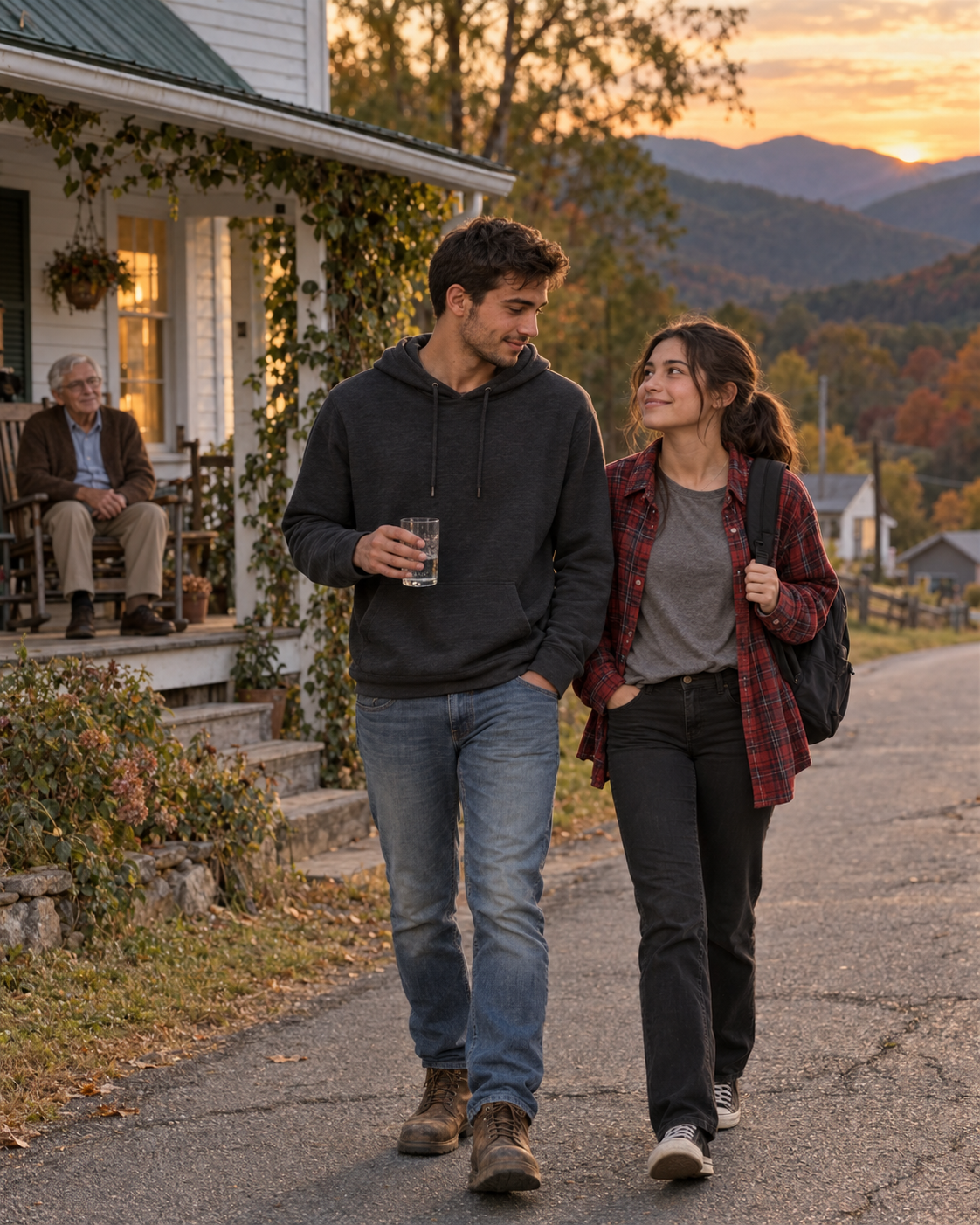
Marco took it.
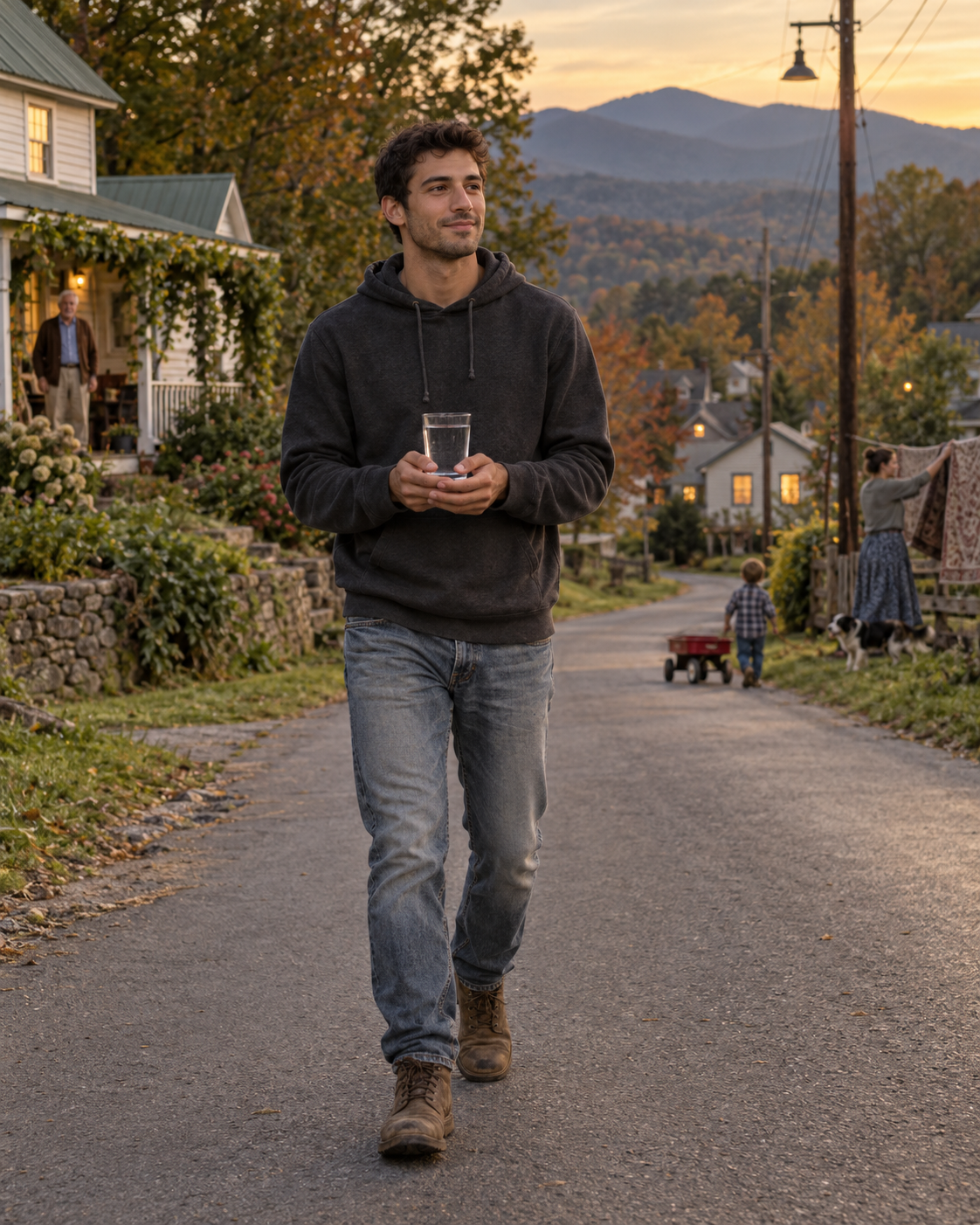
He walked down the road.
This time, he noticed everything.
A little boy dragging a red wagon behind him.
The smell of someone grilling dinner.
A woman shaking out a rug over her porch rail.
A blue jay landing on a telephone wire.
Somewhere far off, a lawn mower sputtered and stopped.
At the bend in the road, Marco paused.
The glass was still full.
He looked at it and smiled.
Not because everything was fixed.
His job was still uncertain.
His relationship was still over.
His father was still complicated.
The future was still unknown.
But the road beneath his boots was real.
The evening air was cold against his face.
The water was in his hands.
For once, that was enough.
He made it to the mailbox and turned around.
Halfway back, he heard footsteps behind him.
Elena.
She came running up the road, breathless, wearing a red flannel shirt over a gray T-shirt and carrying her backpack.
“Mom said you disappeared again.”
Marco laughed.
“I told her where I was going.”
“She still worries.”
“Yeah.”
Elena looked at the glass.
“What’s that?”
“My homework.”
She rolled her eyes.
“You’re weird.”
“I know.”
She walked beside him.
After a few steps, she said, “You seem different.”
Marco looked ahead.
“I think I’m getting better at noticing where I am.”
“That sounds like something Mr. Harris would say.”
“It probably is.”
They walked in silence for a while.
At the porch, Elena reached for the glass.
“You want me to carry it?”
Marco handed it over.
She took two careful steps.
Then she deliberately tilted it until a little water spilled onto the road.
Marco stared at her.
She grinned.
“Now it’s less stressful.”
He laughed so hard he had to sit down on the bottom porch step.
It was the kind of laugh that surprised him because it felt like it had come from somewhere he hadn’t visited in a long time.
Mr. Harris watched from his chair.
He didn’t say anything.
He didn’t need to.
The mountains were turning dark against the evening sky.
Elena handed Marco back the glass.
A few drops of water clung to the outside.
Marco wiped them away with his sleeve.
Then he looked down the road toward home.
For once, he wasn’t wondering how fast he could get there.
He simply started walking.
That night, Marco slept through until morning.
And when tomorrow came, he let it come on its own.