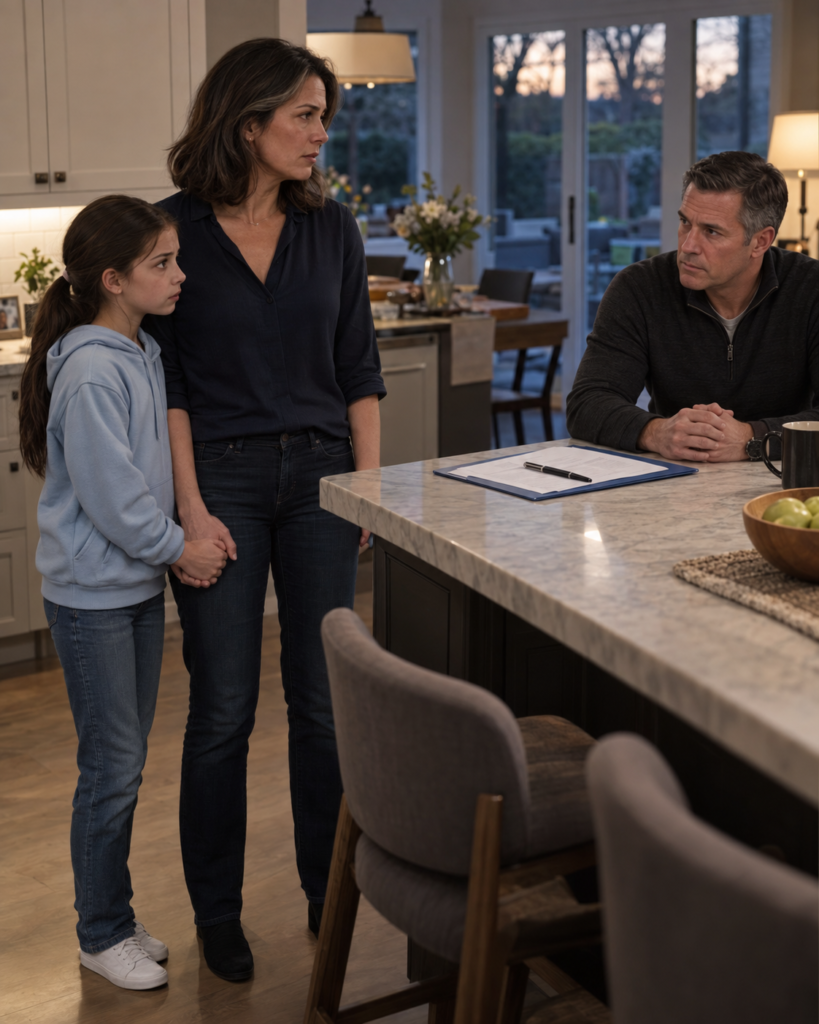
The Night He Left
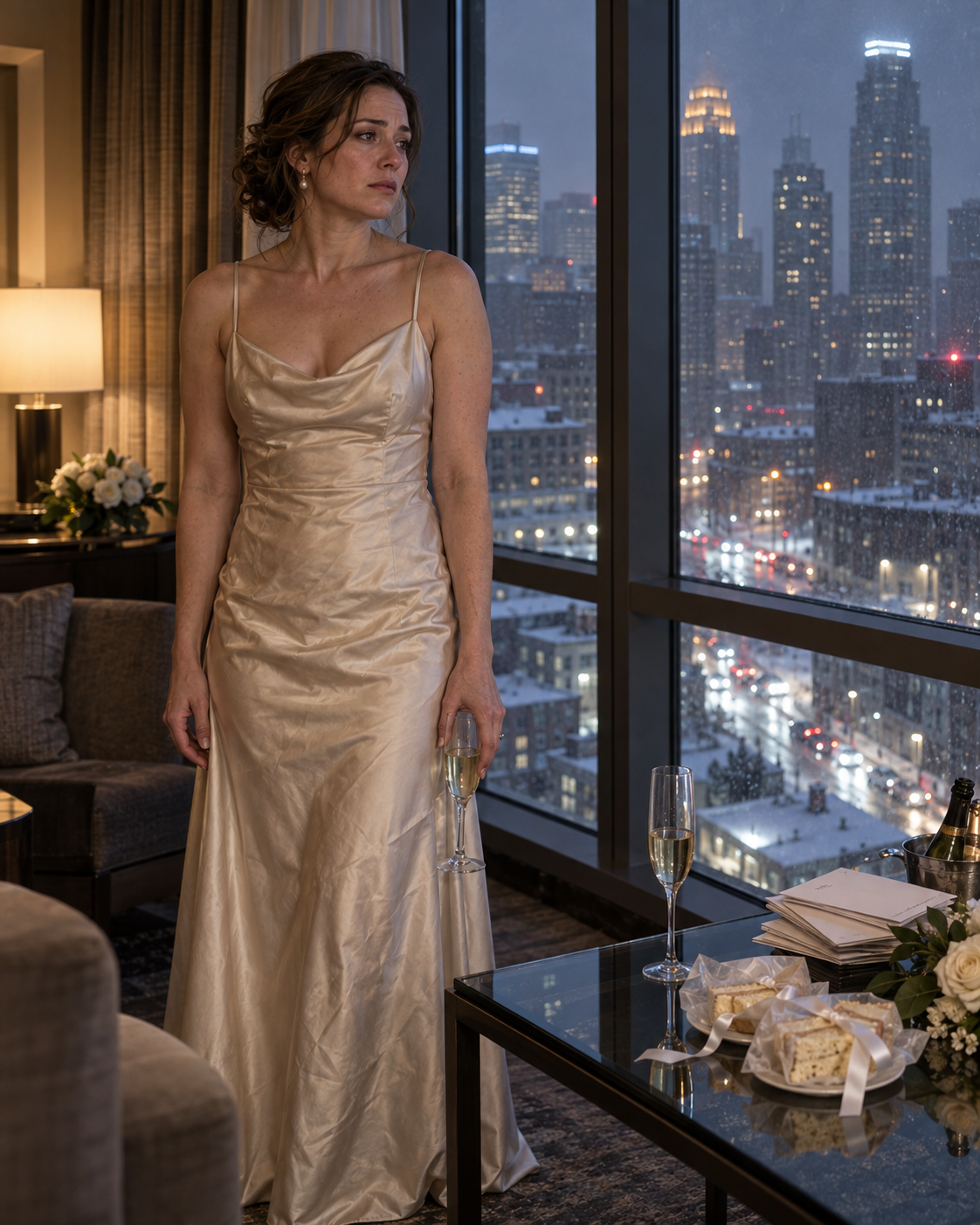
Susanna Merrill was still wearing the champagne-colored dress from her wedding reception when her new husband told her he had to leave.
The hotel suite was twenty-two floors above downtown Minneapolis. Ice pellets ticked against the floor-to-ceiling windows, and an emergency alert on Theren’s phone had been glowing for nearly twenty minutes.
Black ice on 35W. Reduced visibility north of the city. Travel not recommended.
Theren read it again and slid the phone into his pocket.
“My ex got diverted,” he said. “She landed at the wrong terminal.”
Susanna stood beside the window with a glass of champagne she had been holding since the elevator ride upstairs. Four hours and seventeen minutes after saying their vows, she was watching her husband pull on the gray wool overcoat she had helped him choose the previous January.
“She doesn’t know the city,” he continued. “The car apps are surging. She’s panicking.”
Susanna stared at him.
“She has a phone.”
“She called me.”
There was no anger in his voice. That was almost worse.
On the coffee table sat the remains of their wedding: two untouched cake slices wrapped in wax paper and tied with a ribbon Susanna had cut that morning, two full champagne flutes, and a small stack of gift envelopes.
“Theren.”
He finally looked at her.
She said his name slowly, the way you say a word when you need the other person to hear everything inside it.
“Please don’t go.”
His expression tightened.
“I’ll be two hours. Three at most.”
“That’s not what I said.”
He looked toward the door.
“You shouldn’t drive in this.”
“No.”
He swallowed.
“That’s why I’m going.”
Susanna understood then that the decision had already been made.
Roselene Varga had been the defining relationship of Theren’s late twenties. She had moved to Copenhagen for a design residency and returned four years later with a lifestyle brand, a following, and the quiet confidence of someone who believed the world had been waiting for her.
Theren had told Susanna that story on their second date.
He had told it honestly enough that Susanna believed it was finished.
She had wanted it to be finished.
She watched him pick up his keys.
“If you walk out of this room,” she said, “don’t call it an errand.”
For a moment, neither moved.
Then Theren opened the door.
It closed behind him with a soft, expensive click.
Susanna remained by the window.
Ice traced white lines across the glass. Below, headlights crawled through the storm.
At 1:08 in the morning, she opened Roselene’s public account.
There was a photograph of a hotel room.
A paper cup of tea. A pale cashmere sleeve.
And a familiar hand wearing a brushed-steel watch.
The same watch Susanna had fastened around Theren’s wrist eight hours earlier, just before they walked down the aisle.
She had teased him because the clasp kept catching.
He had smiled and said, “You always get the details right.”
In the photograph, his wedding ring was visible beneath the watchband.
Susanna zoomed in.
Then she saved the image.
At 1:30, she called her closest friend, Odal Varga.
Odal answered on the second ring.
“Tell me it’s not the dress.”
Susanna closed her eyes.
“Tell me you just spilled something on the dress.”
“Theren left.”
A pause.
“He’s with Roselene.”
Odal’s voice changed completely.
“I’m putting on shoes.”
“Don’t.”
“I’m already in the hallway.”
“Odal.”
“Which hotel?”
“I don’t need you to come.”
“What do you need?”
Susanna looked around the room.
“I need you to bring the van in the morning.”
Odal was quiet for a beat.
“Okay.”
“I need to think first.”
“Okay.”
“And don’t let him know where I am.”
“That part is easy.”
Susanna sat on the edge of the bed after they hung up.
She stayed there for nearly an hour.
Then she changed out of her wedding dress.
She folded it carefully into her suitcase.
She photographed the room.
The cake.
The gifts.
The two untouched glasses.
She did not smash anything. She did not call Roselene. She did not post the photograph of the watch.
She understood that the next hour could be made louder.
Louder would only make the next year worse.
At three fifteen, she placed her wedding ring in the center of a piece of hotel stationery.
Her note contained seven words.
I will reach you through an attorney.
Then she packed her tools.
What Was Already Broken
Odal arrived at four in the morning in her delivery van, wearing rubber boots and carrying a thermos of coffee.
She hugged Susanna once, hard.
Neither woman mentioned the photograph again.
By dawn, they were at the apartment Susanna and Theren had shared for two years.
Susanna moved through the rooms with quiet efficiency.
She took her grandmother’s ceramic tools.
Her wire loops.
Wooden ribs and paddles that still smelled faintly of clay.
Two large binders of glaze formulas in her own handwriting.
Her firing notebooks, every one dated.
Her turntable.
She left the kitchen equipment.
She left the wedding gifts stacked in the dining room.
She took nothing that wasn’t hers without a receipt or some other proof.
At 9:15 that morning, Theren came home.
His shoes were damp at the toes.
He had spent most of the drive rehearsing explanations.
Roselene had experienced a panic attack.
The hotel check-in system had failed.
The roads north had been nearly impassable.
Every individual fact was defensible.
He opened the apartment door and stopped.
The ceramic shelves along the studio wall were empty.
The turntable was gone.
The binders were missing.
On the dining table sat his wife’s ring on a white plate.
Centered.
Deliberate.
He called Susanna.
Voicemail.
He called Odal.
She answered.
“No,” she said before he finished.
“Is she safe?”
“She’s with me.”
“Can I—”
“She’s safe. That’s the full menu.”
The line went dead.
That afternoon, Susanna’s mother called.
Dorothia Merrill had raised Susanna alone after her father left, and the abandonment had turned her into a woman who believed almost any crisis could be controlled with the right calendar, enough information, and a detailed plan.
“Theren says there was an emergency,” Dorothia said.
“His ex-girlfriend was stranded at the airport on your wedding night?”
“Yes.”
Silence.
Then, very softly:
“Come home.”
“I’m at Odal’s.”
“I’m not asking about Odal.”
Susanna waited.
“We spent thirty-four thousand dollars.”
She understood immediately.
Her mother wasn’t being cruel.
She was frightened.
And when Dorothia was frightened, she converted fear into accounting.
“I know,” Susanna said.
“The money—”
“I know.”
“Susanna, people are going to ask questions.”
“I know.”
Another pause.
“I didn’t marry the centerpieces, Mom.”
Dorothia said nothing.
Susanna ended the call before worry could become instruction.
Three days later, the professional part of the betrayal arrived.
Susanna had been the creative director behind Pace Studio’s ceramic collection: matte-glazed vessels, architectural tiles, carved wall panels. The work had earned the firm national design features and several major commissions.
Theren had the client relationships.
He had the showroom.
He had the introductions.
Susanna had the work.
More importantly, she had developed the glaze formulas herself.
For eighteen months, she had tested them in a rented kiln space on the city’s northeast side, documenting every adjustment.
She contacted the studio office manager, Randall, and asked for copies of any documents that contained her name, her photographs, or references to her formulations.
Twenty minutes later, one arrived.
A press package dated six weeks before the wedding.
Pace Studio announces its new creative partnership with design consultant and tastemaker Roselene Varga.
Below the announcement was a photograph of carved slab vessels from Susanna’s winter collection.
The caption described them as Roselene’s interpretation of Nordic craft traditions.
Susanna opened one of her binders.
There it was.
The corresponding formula page.
Dated eleven months earlier.
Her initials beside every test tile.
Theren’s handwriting in the margin:
This is the one. This sells the whole line.
Susanna stared at the page for a long time.
Odal came into the kitchen.
“What did he say?”
Susanna closed the binder.
“Don’t post anything.”
Odal looked at her.
“Not yet.”
Susanna called an attorney.
Her name was Hester Albi.
She had an office above a dry cleaner and no visible sentimentality about marriage.
“Do you want to dissolve the marriage?” Hester asked.
“Yes.”
“Any interest in reconciliation?”
Susanna thought about the photograph.
The press package.
The dated notebook.
“No.”
Theren came to Odal’s house after he was served.
He stood on the porch in the cold.
Susanna opened the door but did not unlatch the screen.
“You filed,” he said.
“Yes.”
“Because of one night?”
“Because of the press package dated six weeks before the wedding.”
He stared at her.
“And because of eleven months of documented work with someone else’s name on it.”
The wind moved a dead leaf across the porch.
“The wedding night was the last evidence,” Susanna said. “Not the first.”
His face tightened.
“I was trying to get the collection attention.”
“You were trying to get it attention without me.”
“I needed someone with Roselene’s reach.”
“You never asked me.”
“You hate being photographed.”
“I hate being erased.”
He gripped the porch railing.
“Susanna, open the door.”
“No.”
“I love you.”
She had waited a long time to hear those words without a request attached.
They arrived now carrying a list of things he needed her to overlook.
“Drive carefully,” she said.
She closed the door.
Her hands were steady.
Her knees were not.
The Work Still Had Her Name
The difficult part was not leaving Theren.
It was figuring out what came after him.
Susanna no longer had a studio.
The kiln space she had once rented was gone. She had given it up when she began working primarily at Pace.
She had her turntable.
Her tools.
Her formulas.
Her hands.
But nowhere to fire the work.
Odal knew a place.
Ironside Collective occupied a converted machine shop in the North Loop, two blocks from the river. A printmaker worked there. So did a furniture restorer, a glassblower, a textile artist, and three ceramicists sharing two kilns.
The building owner, Ezra Cole, met Susanna at seven the next morning.
He was forty-one, broad-shouldered, with dark hair cut short and a permanent habit of wearing canvas work trousers and a canvas jacket.
He did not ask why a ceramicist associated with one of Minneapolis’s better-known design firms suddenly needed emergency kiln access.
He asked for her liability coverage, production schedule, materials list, and firing requirements.
“Cone ten reduction,” Susanna said.
“The large kiln runs neutral.”
“I know.”
“You’ll have to adjust.”
“I’ve been adjusting recipes since I started.”
He studied her.
Then he named a rate and deposit.
Susanna signed.
Her first Monday, she produced seventeen pieces.
The second week, twenty-three.
She named the independent line Salt Marsh, after a strip of lakeshore where her grandmother had once taught her how to recognize usable clay by touch.
The first eight pieces sold through a small interior design firm across town.
The payment landed in her account that afternoon.
She stared at the number on her phone.
It wasn’t enormous.
It wasn’t life-changing.
But it was hers.
A month later, Theren’s attorney sent a letter questioning ownership of Susanna’s glaze formulas.
Hester answered with copies of dated notebooks and receipts from the kiln space.
The photographs disappeared from Pace Studio’s website the next morning.
Susanna kept working.
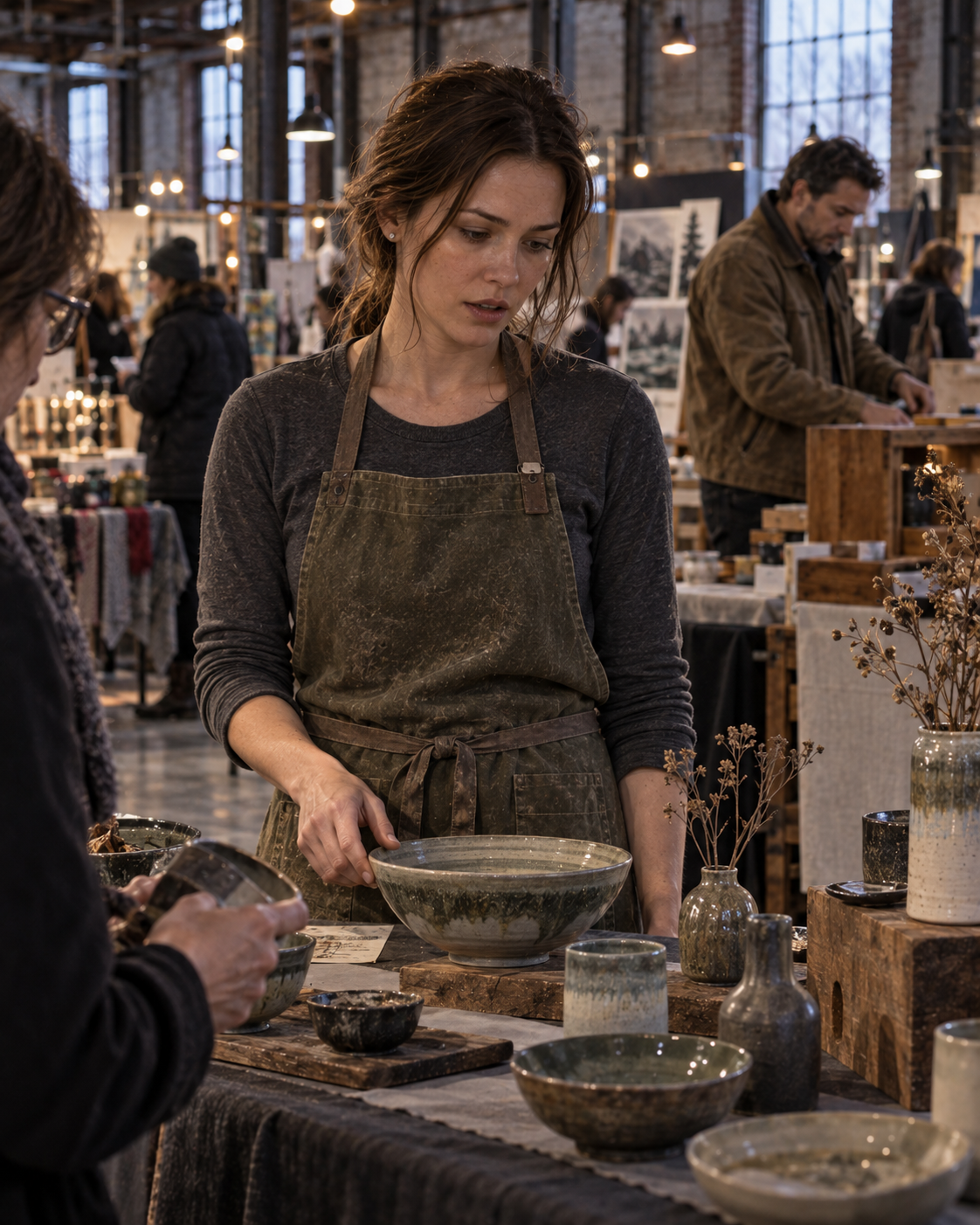
She began selling at a Saturday craft market in Ironside’s freight bay.
Ezra charged twelve percent of sales.
“Ten,” she said.
“Twelve.”
“I’ll teach a wheel workshop once a month.”
“That’s not equivalent value.”
“Your occupancy is eighty percent.”
He raised an eyebrow.
“My workshop will increase it.”
He considered that.
“Ten.”
“Done.”
The workshops filled every month.
Susanna realized something strange had happened.
She had spent years thinking of herself as the quiet half of a partnership.
Now she was becoming visible without anyone handing her permission.
In March, the Minnesota Craft Guild announced its annual juried exhibition.
The theme was Endurance.
Susanna submitted the full winter Salt Marsh series.
She was accepted.
So was Roselene, representing a new ceramic line through Pace Studio.
Two weeks before the exhibition, Roselene posted a photograph of a vessel glazed in deep oxidized crimson.
The caption called it a personal colorway she had developed after a year of material study.
Susanna knew the color immediately.
She had developed that glaze eleven months earlier.
She had fifty-three dated test tiles to prove it.
Her first instinct was anger.
Her second was exhaustion.
Her third was to close the binder and walk away.
Instead, she took it to the guild.
The review happened during the exhibition’s lunch break.
Susanna sat across from the curator and two board members.
She placed a reference tile on the table.
Then the notebook.
“This isn’t about whether somebody can use a certain color,” she said. “I’m showing dated development records for this specific formula and this specific application.”
Roselene entered the room.
She looked at the tile.
Then at Susanna.
Something changed in her face.
Not guilt exactly.
Calculation.
“Theren told me the studio owned the development,” Roselene said.
Susanna uncapped her pen.
“Did he show you the document?”
Roselene said nothing.
Susanna turned back to the board.
“The press materials crediting her with this work were prepared before she had produced a single piece in the studio.”
The curator looked at Roselene.
“Do you have dated development documentation?”
“I developed it collaboratively.”
“Dated documentation?”
Silence.
This time, nobody rescued it.
The board removed Roselene’s crimson vessel from award consideration and added a catalog note crediting the glaze development to Susanna Merrill, independent ceramicist.
They did not remove Roselene’s other pieces.
They did not make a spectacle of the private betrayal.
They corrected the professional record.
That was all.
It was enough.
Susanna won the Endurance Prize.
The award came with a year-long retail partnership, a paid residency, and more work than she could accept alone.
The consequences traveled through the design community quietly.
A regional publication postponed a profile of Roselene.
Several Pace Studio clients requested revised creative attribution before signing contracts.
Randall left the firm.
Roselene’s consulting agreement ended without renewal.
None of it felt as dramatic as Susanna had once imagined justice would feel.
Mostly, she was tired.
A Different Kind of Safe
In August, Theren sent a message through Hester.
Three sentences.
He acknowledged that the glaze formulas were Susanna’s.
He admitted he should have documented the arrangement years earlier.
He did not ask for anything.
Susanna read the message once.
Then she closed it.
An apology could be genuine and still arrive after its usefulness had ended.
The divorce was finalized in September.
On the courthouse steps, the maple trees were just beginning to turn.
Susanna had expected triumph.
Instead she felt physically tired, the deep exhaustion that comes after holding a door closed with both hands for a long time and finally stepping away.
She bought a coffee from a cart on the corner.
Then she went back to the studio.
That winter, she leased her own production space.
Not Ironside.
Her own.
She negotiated the terms herself.
She hired two assistants.
For the first time, she paid herself what her work had been worth for years.
Her relationship with Ezra grew slowly.
There was no grand moment.
No rescue.
No promise that he would never hurt her.
It began with dinners after long workdays and conversations that had nothing to do with kilns.
He respected the difference between helping and taking over.
When Susanna needed different lease terms, they negotiated them professionally.
Afterward, they went to dinner.
Neither pretended the two conversations were the same.
One spring evening, Ezra arrived at her studio to fix a failing ventilation fan.
He repaired it in thirty minutes.
Then he looked at the row of new pieces drying on the shelf.
“You changed the lip.”
“The original caught glaze unevenly.”
“Which version is this?”
“Four.”
“How many versions did the first one take?”
“Eighteen.”
He nodded solemnly.
“Good.”
She laughed.
He leaned against the workbench.
“Tell me something that has nothing to do with this building.”
Susanna looked up.
“Is this you asking me to dinner?”
“It is.”
He paused.
“I wanted the question to sound less like a lease renewal.”
She smiled.
“Tuesday.”
The kilns weren’t running Tuesday.
They went to a Korean restaurant where nobody knew either of them professionally.
They talked badly at first.
About family.
Books.
Bad television.
The small humiliations of childhood.
Eventually Susanna told him about her grandmother teaching her to dig clay near the lake.
She told him about the first bowl she sold at seventeen because she needed money for a utility bill.
She told him about the marriage in the abbreviated version, leaving out the private details she no longer wanted to use as an entrance fee to intimacy.
Ezra listened.
He did not try to solve anything.
That mattered more than she expected.
They moved in together the following June.
Their apartment was halfway between Ironside and Susanna’s studio.
There were two desks in the second room.
A brass bowl by the front door.
And one rule:
Either person could close a door without it meaning the world was ending.
The rule failed sometimes.
They adjusted.
Neither called the other impossible.
When the Lights Went Out
That November, the first real storm of the season arrived on a Tuesday night.
Susanna was home reading when the power flickered.
Then the apartment went dark.
She lit a candle on the kitchen counter.
For a moment, the old fear arrived.
Not a fear of storms.
A fear of being alone inside one.
The old hotel room rose in her memory: ice against the windows, a closing door, the knowledge that she had not been chosen.
She sat at the kitchen table.
She did not call anyone.
She let the fear exist without letting it make a decision.
At nine o’clock, her phone buzzed.
Leaving now. Roads are fine.
Susanna typed:
Power went out. It’s back. Drive carefully.
Ezra came home at 9:40 with damp shoulders and a paper bag from the diner two blocks away.
“You didn’t need to stop,” she said.
“The food was there.”
He set the bag on the counter.
Then he looked at her.
“Were you afraid?”
She nodded.
“A little.”
“You did fine.”
He sat across from her.
She pushed one of the containers toward him.
Outside, the storm moved east.
Across the street, lights blinked back on in apartment windows one by one.
Susanna watched them.
“Theren left during a storm,” she said.
It wasn’t an accusation.
It wasn’t a comparison.
Just a fact that had once shaped the room.
Ezra reached across the table.
She put her hand in his.
The candle was still burning.
She had lit it because she thought she needed something to keep the dark from swallowing her.
Now the lights were back.
She left the candle burning anyway.
Not because she was afraid.
Because sometimes a thing could begin as a necessity and become, later, simply part of the room.
Outside, the city settled into the quiet that comes after bad weather.
Neither of them was in a hurry to leave the table.