Seat 14B
At 2:14 in the morning, Hazel Jennings felt the airplane dip before anyone else noticed.
It was barely anything. A soft drop of the nose, a brief shudder through the floor, then a correction that felt too abrupt for ordinary turbulence.
The man sleeping beside Hazel never opened his eyes.
Two rows ahead, a flight attendant steadied a stack of plastic cups with one hand.
Hazel took off her headphones.
She had learned, over eleven years, not to ignore what an aircraft was telling her.
Outside the window, the Pacific was an unbroken black sheet. Inside, Trans Global Flight 771 was quiet with the strange, suspended silence of a long overnight flight. Most passengers were asleep. A few seatback screens glowed in the darkness.
Hazel glanced at the clock on her phone.
Seattle was still three hours away.
Her father had been in a Seattle hospital for two days after a severe stroke. Hazel had been on emergency leave, moving through airports with one goal: get home before he woke up and wondered why she wasn’t there.
She wore a faded gray sweater two sizes too large, black leggings, old running shoes, and her blonde hair twisted into a careless knot.
Nothing about her suggested the United States Air Force.
That was how she preferred it.
Eight months earlier, Major Hazel Jennings had walked away from the most demanding flying career most people never knew existed. She had flown missions she could not discuss, trained for situations ordinary pilots hoped never to encounter, and spent years learning how to make decisions while every instinct in her body screamed.
Now she wanted a hospital room.
She wanted her father’s voice.
She wanted, for once, to be nobody.
Then she heard the sound behind the curtain.
A dull impact.
Not luggage.
Not a service cart.
A body.
Hazel sat up.
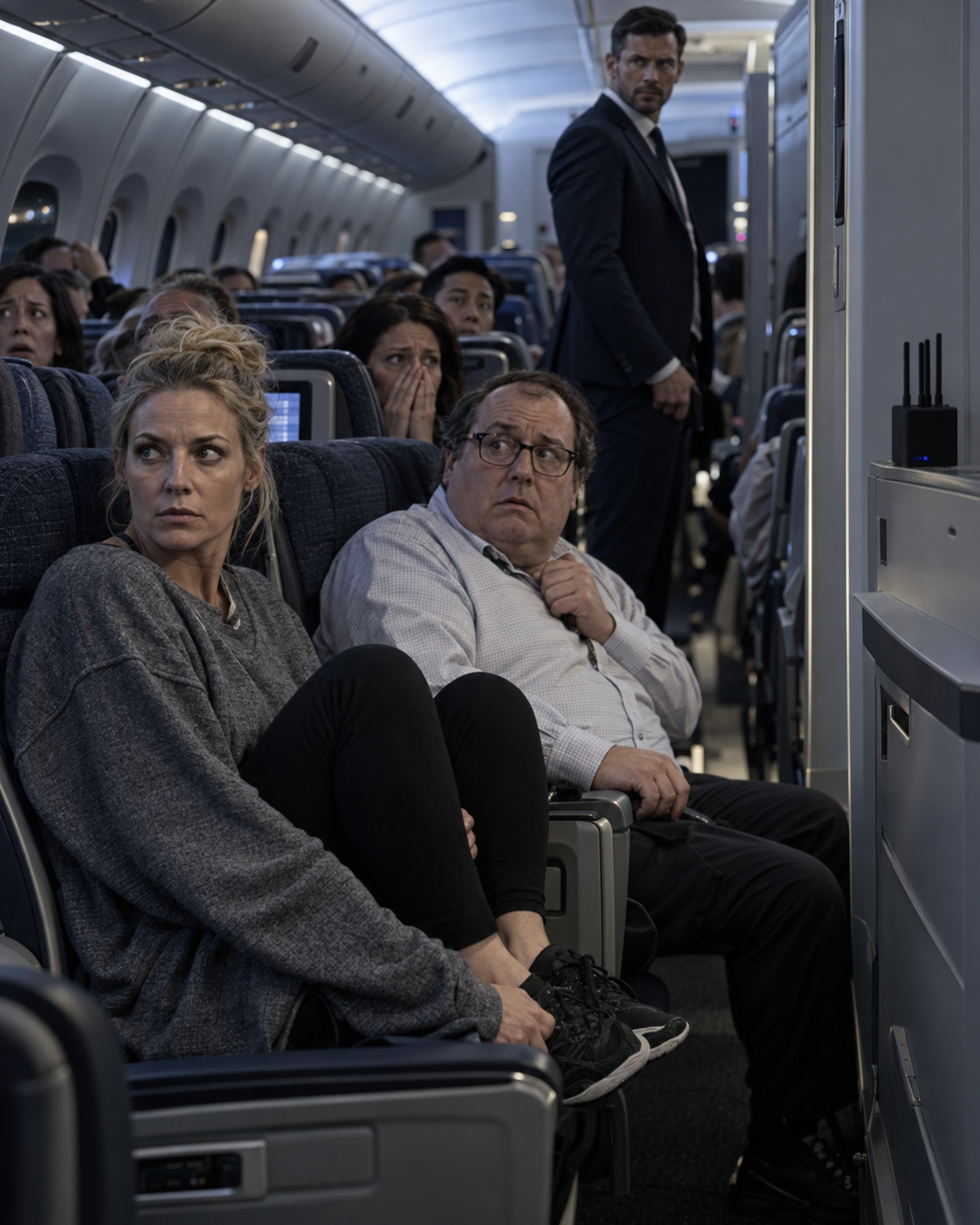
The curtain dividing first class from economy moved slightly. A tall man in a navy suit stepped through it backward.
His face was calm.
His eyes were not.
He kept one hand inside his jacket.
Behind him, another man rose from his seat near the rear of the cabin and began walking toward the galley without looking at anyone.
Hazel’s gaze moved between them.
Then she noticed the small black device resting on a shelf near the bulkhead.
A jammer.
Her stomach tightened.
The tall man looked down the aisle.
“Everyone stays seated.”
A flight attendant named Jessica approached with a puzzled expression.
“Sir, is there—”
The gunshot was muffled, but the scream was not.
Jessica collapsed.
The cabin exploded into panic.
Hazel did not move.
The man with the gun raised it toward the ceiling.
“Everybody stays in their seats!”
Beside Hazel, Robert Hayes woke with a strangled gasp.
“What is happening?”
Hazel put one hand over his.
“Keep your head down.”
Her voice was calm enough to make him stare at her.
“You’re going to be okay.”
She looked toward the cockpit.
The cockpit door was closed.
The plane had begun another turn.
And Hazel knew exactly what that meant.
Someone had control of the aircraft.
Hazel looked at the window again.
The stars had shifted.
The aircraft was turning southeast.
Not toward Seattle.
Toward the coast.
She knew enough about military geography to understand what lay ahead: ports, shipyards, naval facilities, thousands of civilians living beneath an air corridor that was never supposed to become a battlefield.
The hijackers had not simply stolen an airplane.
They had chosen a destination.
Hazel tightened her seat belt.
For eight months she had told herself she was done.
Done with radios clipped to her vest.
Done with classified briefings.
Done with the sensation of sitting in a cockpit while someone else’s life depended on whether she could remain calm.
But training had a cruel habit.
It stayed.
And somewhere in the dark part of her mind, the woman they used to call Eagle One woke up.
The Red Line
Two thousand miles away, inside an underground command center in Alaska, Colonel Roland Harris watched a red aircraft symbol crawl across a digital map.
“Transponder is still dark,” a technician said.
“How long since last response?”
“Sixteen minutes.”
Harris stared at the screen.
“Any contact at all?”
“Nothing.”
“Altitude?”
“Twenty-five thousand.”
“Speed?”
The technician swallowed.
“Point eight five.”
Harris leaned closer.
A commercial aircraft moving fast and silent toward the American coast was the kind of problem that turned every decision into a calculation of lives.
“Launch the alert fighters.”
The room changed instantly.
Orders moved through headsets. Doors opened. Personnel stood.
On a frozen runway, two F-22 Raptors came alive in the darkness.
Captain Louis Miller climbed into the lead cockpit and pulled on his helmet.
His wingman, Lieutenant Chris Henderson, checked his instruments.
“Brimstone, comm check.”
“Loud and clear.”
They launched.
Minutes later, the F-22s were racing over the Pacific toward the hijacked airliner.
Harris listened as the intercept unfolded.
“Visual in two.”
The fighters found Flight 771 exactly where the radar predicted.
They slid alongside the Boeing.
The cockpit windows were dark.
No lights.
No visible pilot.
Louis transmitted on the emergency frequency.
“Trans Global 771, this is United States Air Force. You are entering restricted airspace. Acknowledge by rocking your wings and turn west immediately.”
Nothing.
He tried again.
Nothing.
He looked through the canopy at the Boeing’s dark cockpit.
“Command, no response.”
Harris closed his eyes for a second.
The final authorization had already been prepared.
Three minutes.
If the aircraft did not turn, the order was clear.
The fighter pilots did not know there were passengers inside trying not to breathe loudly.
They did not know a woman in seat 14B had just started calculating how much time remained.
Hazel watched the shadow of an F-22 slide across her window.
The fighter was close enough for her to make out the pilot’s helmet.
“They’re here,” she whispered.
Robert looked at her.
“Who?”
“The Air Force.”
His face went white.
“Oh, God.”
Hazel glanced toward the aisle.
One hijacker guarded the front.
Another remained farther back.
The leader was inside the cockpit.
She checked the exits.
Counted the passengers.
Counted the seconds.
Then she made a decision.
She unbuckled her seat belt.
Robert grabbed her sleeve.
“What are you doing?”
Hazel looked at him.
“I’m going to the front.”
“You can’t.”
She gave him the smallest shake of her head.
“Watch me.”
The second she stepped into the aisle, the guard noticed.
“Sit down!”
Hazel kept walking.
He raised the pistol.
She moved first.
There was no dramatic pause, no speech, no warning.
Only trained movement.
She knocked his weapon off line, drove him backward into the seats, and trapped his arm against the seatback. The gun hit the floor.
The second hijacker turned.
Hazel seized the weapon and shouted, “Down!”
Passengers dropped beneath their seats.
A brief exchange followed.
Then silence.
Hazel grabbed the fallen pistol and ran toward the cockpit.
She could already hear the engines changing tone.
The fighter outside was moving into firing position.
She slammed her shoulder against the cockpit door.
Locked.
Hazel looked at the emergency equipment mounted beside the galley.
She grabbed the crash axe.
One strike.
Metal screamed.
Second strike.
The latch housing cracked.
Third strike.
The door gave way.
Inside, the leader turned.
For a fraction of a second, Hazel saw his face.
Then the world narrowed to movement, sound, and the violent logic of survival.
A moment later, he was down.
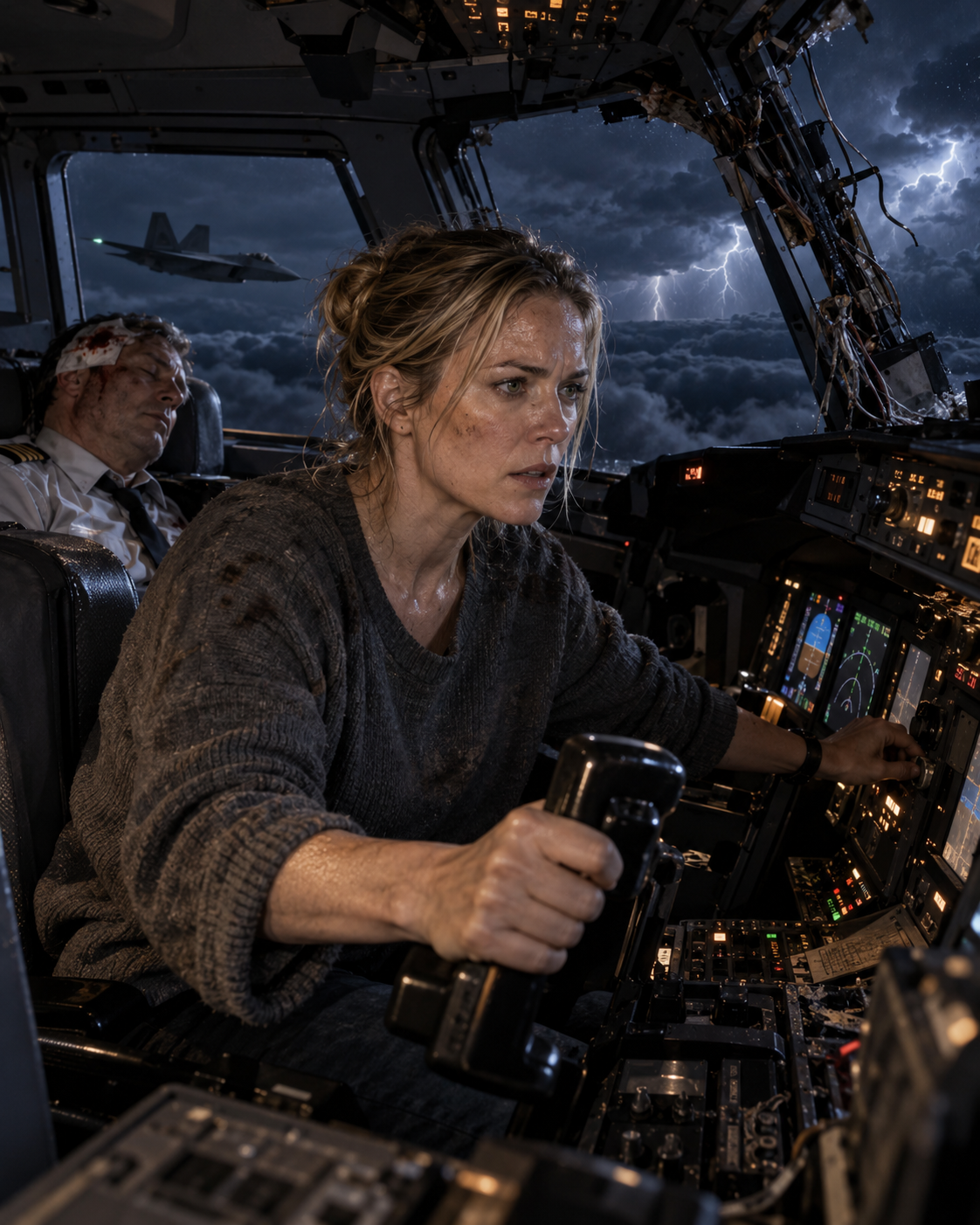
Hazel shoved the weapon away and looked at the flight crew.
The captain was unconscious.
The first officer was motionless.
The cockpit smelled of hot electronics, fuel, and adrenaline.
Hazel stared through the windshield.
The two F-22s were dropping behind the aircraft.
They were lining up.
She knew what came next.
Hazel sat in the captain’s seat.
She grabbed the headset.
Eagle One
“Brimstone, this is Flight 771.”
The fighter pilot heard a woman’s voice.
Not frantic.
Not confused.
Professional.
He frowned.
“Identify yourself.”
Hazel keyed the microphone.
“Hold your fire.”
Silence.
Then the pilot answered.
“Unknown aircraft, authenticate immediately.”
Hazel looked at the instruments.
She had flown fighters with far more advanced systems, but a Boeing cockpit was another language. Different controls. Different weight. Different limits.
Still, an airplane was an airplane.
It told you what it needed.
“Flight deck is secure,” Hazel said. “Hijackers are down. I have injured flight crew. I am taking control.”
“Authenticate.”
Hazel stared at the storm clouds building ahead.
Then she said three words.
“Eagle One.”
The response from the fighter was immediate.
“Say again?”
Hazel repeated it.
“Eagle One.”
In Alaska, Colonel Harris went completely still.
He knew that call sign.
Five years earlier, during a classified extraction in Syria, a young major had pulled Harris’s damaged aircraft out of a situation that should have killed everyone involved.
She had disappeared from active operations months later.
He had assumed she was gone for good.
“Colonel?” the technician asked.
Harris reached for the microphone.
“Eagle One, this is Command.”
Hazel exhaled when she heard his voice.
“Hello, Roland.”
Harris sat back.
“You’ve got to be kidding me.”
“Wish I were.”
“What is your status?”
“One dead crew member. One unconscious. Hostile passengers secured. I’m flying this aircraft manually.”
A pause.
Then Harris said quietly, “Weapons are standing down.”
Outside, the F-22 pilots repositioned.
Louis looked over at the Boeing.
“Who is she?”
Harris answered through the command channel.
“Someone you should listen to.”
Hazel barely had time to smile.
The aircraft lurched.
A warning alarm began sounding.
Her eyes snapped to the instrument panel.
Hydraulic pressure.
Falling.
“No.”
She checked again.
The left system was dropping rapidly.
Harris heard the change in her voice.
“What?”
“I’ve lost primary hydraulic pressure.”
She looked toward the damaged panel behind the captain’s seat.
The bullet that had struck one of the hijackers had done more damage than anyone realized.
The aircraft was still flying.
But Hazel was losing control authority.
“Can you maintain altitude?” Harris asked.
“Not indefinitely.”
“What do you need?”
“A runway.”
“You’re being routed to McCord.”
Hazel looked ahead.
A wall of clouds had swallowed the horizon.
“What’s the weather?”
Harris hesitated.
“Bad.”
“How bad?”
“Thirty-knot winds. Gusts forty-five. Severe turbulence.”
Hazel gave a tired laugh.
“That’s not bad.”
“Hazel.”
“That’s terrible.”
The fighter pilot’s voice came over the radio.
“Eagle One, Brimstone. We’ll stay with you.”
Hazel looked out at his aircraft.
“You don’t have to.”
“Yes, we do.”
A beat.
Then Louis added, “We leave no wingman behind.”
Hazel’s mouth tightened.
She pushed the throttles forward.
“All right,” she said. “Let’s get this thing home.”
Through the Storm
The Boeing disappeared into the clouds.
Rain hammered the windshield.
The first impact of turbulence sent everyone in the cabin against their seat belts.
Hazel felt the aircraft buck beneath her.
A warning sounded.
She ignored it.
Another followed.
She adjusted the throttles.
The left wing dipped.
“Two degrees left,” Louis called.
“Can’t give you two.”
“Then one.”
Hazel fought the yoke.
The airplane felt enormous.
In the Raptor, she had once been able to change direction with a movement of her wrist.
The Boeing required her whole body.
Her shoulders strained.
Her hands began to ache.
She used differential engine thrust to help compensate for the failing controls, making small corrections before the aircraft could become unstable.
Lightning flashed.
For a moment, the cockpit was white.
Hazel saw the storm directly ahead.
Then darkness returned.
“Altitude twelve thousand,” Louis said.
“I know.”
“Crosswind increasing.”
“I know.”
She didn’t sound annoyed.
She sounded exhausted.
Behind the cockpit door, hundreds of people sat in silence.
Some prayed.
Some cried.
Some simply stared at the cabin floor.
Robert Hayes had stopped shaking.
He was listening to every word over the intercom.
When Hazel announced that they were approaching an emergency landing, he looked at seat 14B.
Empty.
He had spent the entire flight sitting beside a woman he thought was a tired traveler.
He wondered how many other people walked through airports carrying lives no one could see.
The runway lights appeared through the rain.
McCord Air Force Base.
Hazel’s breathing slowed.
One problem remained.
The landing gear.
She lowered the gear.
The nose gear locked.
The right main gear locked.
The left light stayed red.
She tried again.
Nothing.
“Command,” she said.
Harris answered.
“I’ve got no left main gear.”
There was silence.
“Can you circle?”
“Not safely.”
“We can clear the runway if—”
“I won’t have control authority for another approach.”
Harris understood.
“Eagle One, don’t take unnecessary chances.”
Hazel looked at the runway.
She thought of her father.
She thought of the phone call in the hospital.
She thought of how ridiculous it would be to survive everything she had survived, only to die while flying home to sit beside the man who had taught her how to throw a baseball.
“I’ve spent half my life taking unnecessary chances,” she said quietly.
Harris did not answer.
Hazel reached for the manual gear release.
She pulled.
Nothing.
She pulled harder.
Still nothing.
The left gear trembled beneath the fuselage but refused to lock.
“Come on,” Hazel whispered.
She looked at the runway.
“Wake up.”
She forced the jet lower.
Five hundred feet.
Rain streaked across the windshield.
The runway rushed toward her.
Hazel rolled the aircraft just enough to load the landing gear.
Then she kicked the controls back.
The Boeing shuddered.
For one terrible second, it leaned farther than she intended.
Then—
A metallic bang.
She glanced down.
Green.
The left gear was locked.
Hazel exhaled.
“Thank you.”
The Ground
The right main wheel struck first.
The aircraft bounced.
The left gear touched seconds later.
The jet yawed violently as one engine responded differently from the other.
Hazel fought it.
The brakes screamed.
The runway blurred beneath the rain.
She kept the nose straight.
A hundred knots.
Eighty.
Sixty.
The aircraft drifted toward the edge.
Hazel corrected.
Fifty.
Forty.
Then the Boeing finally stopped.
For several seconds, nobody moved.
Rain tapped against the windshield.
Hazel’s hands remained on the controls.
She listened to the engines wind down.
Behind her, emergency slides deployed.
Doors opened.
People stumbled into the cold night, many crying, many simply holding each other.
Fire crews surrounded the plane.
Military police rushed toward the cockpit.
Hazel stayed where she was.
The captain was still breathing.
She made sure his airway was clear and kept pressure on his injury until medics reached the flight deck.
Only then did she stand.
Her legs almost failed her.
When Hazel stepped onto the metal stairs, cold rain struck her face.
She closed her eyes.
It felt better than anything.
At the bottom waited Roland Harris beneath a black military umbrella.
His silver hair was soaked at the edges.
Hazel stopped.
“You look terrible,” he said.
She laughed once.
“So do you.”
He opened his arms.
She stepped into them.
For a few seconds, neither spoke.
Then Harris said, “I thought Eagle One was gone.”
Hazel looked over his shoulder at the passengers being wrapped in emergency blankets.
“So did I.”
A roar rolled across the airfield.
Hazel looked up.
Two F-22 Raptors emerged from the clouds.
They passed over the runway together, wings tilting in a precise, silent salute.
Hazel watched until they disappeared into the darkness.
Then her phone began ringing.
Seattle hospital.
She stared at the screen.
For a moment, she was no longer Eagle One.
She was a daughter who had missed a few hours she could never get back.
Hazel answered.
“Hello?”
A nurse’s voice came through.
Her father had opened his eyes.
He had asked for her.
Hazel’s face changed.
Not dramatically.
Just enough for Harris to see the years of discipline fall away.
She turned toward the hospital vehicles waiting beyond the runway.
“I’m coming,” she said.
Then she walked.
Still wearing the same oversized gray sweater from seat 14B.
Still carrying the weight of a life she had tried to leave behind.
Behind her, Flight 771 sat silent on the wet runway, its engines cooling beneath the Washington rain.
Hazel did not look back.
For the first time in eight months, she wasn’t running from who she had been.
She was simply going home.