The Ranch Everyone Had Given Up On
By the time Hannah Mercer saw the place in daylight, she had already spent most of what she had left.
Sixteen acres of neglected Montana land stretched beneath a pale November sky, fenced with leaning posts and rusted wire. A small farmhouse sat near the center, its white paint peeling in long strips. Behind it, an old livestock barn leaned slightly east, as if decades of wind had finally made it tired.
Hannah stood beside her dark green Ford pickup with the deed folded in her jacket pocket.
“Five thousand five hundred dollars,” she said quietly.
She looked at the barn.
“That’s either the smartest thing I’ve ever done or the dumbest.”
The truck gave no opinion.
Neither did the property.
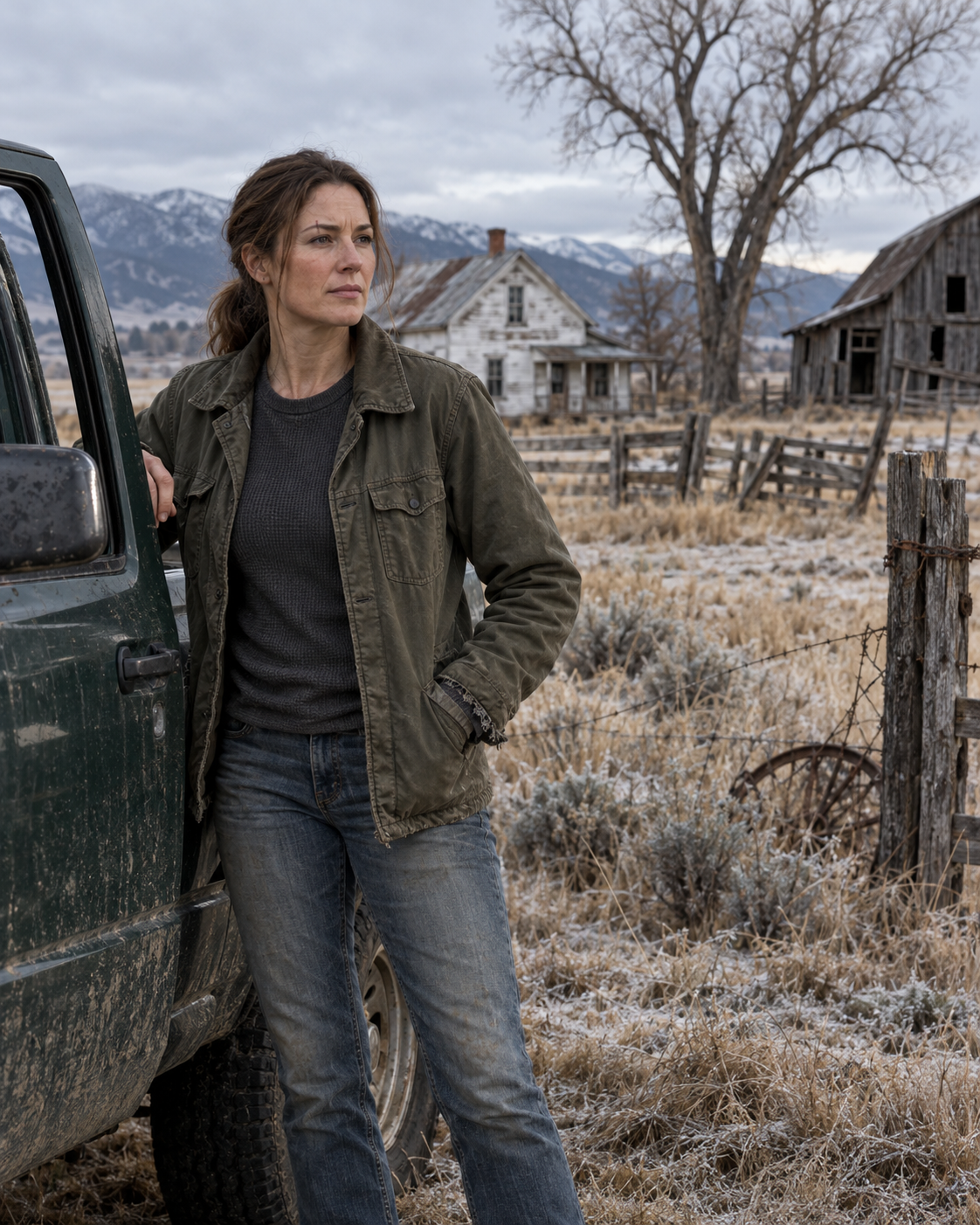
She had left the Army two years earlier after twelve years as a military canine handler. Civilian life had proved harder than she expected. Jobs came and went. She could follow procedures, fix equipment, train animals, and remain calm when everything around her wasn’t.
What she couldn’t seem to do was feel useful.
Her last working dog had died eight months earlier.
Hannah had promised herself she was done with dogs.
Then, three days after buying the ranch, she discovered three German shepherd puppies in the county shelter.
The first was a broad black-and-tan male with oversized paws. He stood perfectly still when she approached his run.
“Atlas,” Hannah murmured.
He watched her without jumping or barking.
The second dog was leaner, darker, and constantly investigating everything within reach.
“You inspect every room you enter, don’t you?”
He sniffed her boots, the gate latch, her coat pocket, and the concrete floor.
“Scout.”
The third was a smaller female with warm brown eyes and one ear that tilted sideways whenever she listened. She approached cautiously, stopped just short of Hannah’s hand, then leaned forward.
“Willow,” Hannah said.
The dog stayed there.
Hannah closed her eyes for a second.
“No,” she whispered.
Forty minutes later, she was driving three shelter dogs back to a broken ranch.
That evening, after feeding them, she sat on the porch with a cup of coffee gone cold.
Then Scout slipped outside.
“Scout.”
He ignored her.
His nose stayed low as he crossed the frosted grass and disappeared behind the barn.
Hannah followed.
He stopped beside an abandoned concrete livestock trough and began digging.
She shined her flashlight onto the hard ground.
There was nothing there.
Still, Scout kept digging.
The next morning, Hannah brought a shovel.
She expected a mouse nest.
Instead, she struck metal.
An old iron pipe ran beneath the dirt toward the barn. When she followed it uphill, she found a rusted valve and remnants of a buried water system.
Later that day, an older neighbor named Ruth Keller stopped by with cinnamon rolls and an old hand-drawn map.
“You found Earl Voss’s spring line,” Ruth said.
“Earl Voss?”
“The man who owned this place before the county got it.”
Ruth unfolded the map across Hannah’s kitchen table.
A blue line ran from a spring on the hill down toward the barn.
“He always said gravity was cheaper than electricity,” Ruth said. “He was right.”
The spring hadn’t dried up.
The system had simply been neglected.
For the first time, Hannah looked at the ranch and didn’t see something dead.
She saw something disconnected.
What the Dogs Were Becoming
Hannah repaired the water line one small section at a time.
She cleared roots from the pipe, replaced damaged connectors, and rebuilt part of the old intake. Weeks later, the trough filled with cold spring water.
It wasn’t impressive.
It ran at barely a trickle.
Hannah stood there watching it anyway.
Atlas drank first.
Willow followed.
Scout sniffed the water once and wandered away, apparently unimpressed by the accomplishment.
Hannah laughed.
“You’re impossible.”
The dogs became part of her daily life before she realized it had happened.
Atlas learned controlled obedience. He had the instincts of a natural guardian, but Hannah taught him that protection without judgment was dangerous.
Scout received scent work. Hannah hid gloves across the property and sent him looking.
Willow practiced obedience, socialization, and calm behavior around strangers.
Slowly, the three dogs changed.
So did Hannah.
The town noticed.
At the Red Creek Cafe, a rancher named Wade Turner still made a point of reminding her that she owned sixteen acres and “three dogs instead of cattle.”
Hannah stirred sugar into her coffee.
“I’m saving on payroll.”
Wade snorted.
“You’re not running a ranch.”
“Not yet.”
He shook his head.
But the laughter around the counter wasn’t as sharp as it had been.
Wade’s nine-year-old grandson, Caleb, became fascinated with Willow. He was a thin, freckled boy with sandy hair and a blue Denver Broncos cap that seemed permanently pulled too low over his forehead.
The first time Hannah caught him watching from outside the fence, she said, “You planning to stand there all afternoon?”
Caleb stepped back.
“Sorry.”
“I didn’t say leave.”
He looked surprised.
Willow walked over and sat beside the fence.
“Does she bite?” Caleb asked.
“She has teeth.”
His eyes widened.
Hannah almost smiled.
“She doesn’t bite people for entertainment.”
Caleb laughed.
After that, he came by often.
Hannah taught him how to approach a dog without startling it, how to recognize when an animal wanted space, and why being friendly didn’t mean ignoring boundaries.
Wade watched from a distance.
He didn’t like working dogs around his grandson.
But he didn’t stop coming.
Then one December morning, a county building inspector told Hannah something she had been trying not to think about.
The barn needed structural repairs.
“It’s not falling today,” the inspector said. “But another heavy snow could make that beam a problem.”
Hannah looked at her notebook that night.
Fuel.
Dog food.
Veterinary bills.
Pipe fittings.
Property taxes.
Insurance.
The numbers were getting too close together.
She had enough money for a short while.
Not enough to fix everything.
For the first time, she wondered if the people who laughed at her had been right.
She had mistaken stubbornness for a plan.
The next morning, she took Scout to a search-and-rescue training field.
Dana Brooks, a county volunteer coordinator, had heard about the young German shepherd.
“He’s eight months,” Hannah said.
“That’s young.”
“I know.”
Dana studied Scout.
“We’ll judge the dog we have, not the dog we hope he’ll become.”
Scout failed his first trail near a drainage ditch, circled twice, then found the scent again.
His second trail crossed other human tracks.
He stopped.
Waited.
Then turned toward a cluster of parked trucks and found the hidden volunteer.
Dana checked the stopwatch.
Martin Hayes, a retired firefighter and field coordinator, nodded.
“For his age,” he said, “he’s very good.”
Hannah looked down at Scout.
The dog seemed pleased with himself.
She scratched behind his ears.
“Don’t let it go to your head.”
But driving home that day, Hannah felt something she hadn’t felt in a long time.
Possibility.
The Night Caleb Disappeared
Spring arrived late in Red Creek.
By April, the grass around Hannah’s ranch had begun turning green. The spring line worked. The fence was mostly rebuilt. The barn still looked patched together, but it stood.
The dogs were nearing their first birthdays.
Caleb still came around.
He and Willow had become inseparable.
One Saturday afternoon, Caleb asked his grandfather if he could fish along Dry Creek.
Wade said no.
“You’re nine.”
“I’m almost ten.”
“That doesn’t make it better.”
“I know the safe part.”
“You know what Hannah showed you. That’s not the same thing.”
Caleb’s face tightened.
They argued.
Twenty minutes later, Wade found his bedroom empty.
Then he saw the bicycle was gone.
At 6:02 p.m., he began searching.
At 6:37, he found the bicycle lying beside the dirt road leading toward Dry Creek.
The fishing pole was missing.
Caleb wasn’t there.
Wade called the sheriff.
Then Hannah.
By the time he pulled into her ranch, the sky was darkening and rain had begun.
Hannah stepped outside.
Wade got out of the truck, breathing hard.
“Caleb is missing.”
Behind her, Scout stood.
Atlas rose.
Willow turned toward Wade.
Hannah’s face changed.
“When did you last see him?”
“About four-thirty.”
“Where was he going?”
“Dry Creek.”
Hannah looked toward the hills.
She remembered the unstable bank she had marked months earlier.
She called Dana.
She called the sheriff.
Within minutes, the search began.
The official rescue team was still some distance away.
Scout was not certified.
Hannah knew it.
Dana knew it.
Sheriff Mark Ellison knew it.
But Caleb was nine years old, temperatures were falling, and rain was turning the dry creek into fast-moving runoff.
Mark held out his hand for the blue Broncos cap Wade had brought from the house.
“Can he work from this?”
Hannah looked at Scout.
“He can try.”
The Creek
Scout took the scent.
His entire body changed.
The playful puppy disappeared.
His head lowered.
His tail leveled.
“Find.”
He moved through the wet grass, across the ranch, through a narrow gate and toward the road.
Hannah followed.
Rain intensified.
The scent trail eventually turned toward Dry Creek.
The water was no longer shallow.
It rushed through the cottonwoods, brown with snowmelt and mud.
Scout kept moving.
Then Willow stopped.
Hannah felt the lead tighten.
“Willow?”
The dog turned sharply toward the west.
Scout continued north.
Wade looked from one dog to the other.
“Which one is right?”
“That’s not how this works,” Hannah said.
Willow pulled again.
Hannah followed.
A tennis ball was caught in a wet bush.
Caleb’s tennis ball.
That was enough.
Hannah redirected Scout to the area.
He picked up the trail again and moved west.
The ground became unstable.
Hannah knew this place.
She had warned Caleb about it.
The old erosion channel.
The warning stake was still standing, but rain had carved fresh channels through the soil.
Then Atlas stopped.
He stared into the darkness.
A low bark came from his chest.
Hannah raised her flashlight.
Nothing.
Then she heard it.
“Hannah?”
She froze.
“Caleb?”
“I’m here.”
Wade moved forward.
Mark caught his arm.
“Stay back.”
Through the rain, Hannah could finally see him.
Caleb was trapped on a narrow shelf below the collapsing bank. Mud covered his jeans. One shoe was gone. A fallen cottonwood root had stopped him from sliding farther.
He was alive.
He was also frightened.
“Don’t move,” Hannah called.
“I’m scared.”
“I know. Stay where you are.”
The bank cracked.
Hannah stepped backward.
A section of soaked ground slid into the fissure.
Everyone moved away from the edge.
For a few seconds, nobody spoke.
Then Caleb called again.
“Can Willow hear me?”
Hannah looked at the dog.
Willow was straining toward his voice.
“She can hear you.”
“I want her here.”
Hannah knew what he really meant.
He didn’t need the dog to rescue him.
He needed something familiar.
She brought Willow to solid ground several yards from the edge and gave the down command.
Willow lowered herself.
Caleb’s breathing slowed.
Hannah stayed where he could hear her.
“Keep talking to me.”
“I’m cold.”
“I know.”
“I lost my fishing pole.”
Despite everything, Wade laughed once.
“I’ll buy you twenty.”
Caleb sniffed.
“Twenty?”
“Thirty.”
That kept him talking.
It also kept him still.
Dana and Mark established a safe anchor point away from the unstable bank.
The county rescue team was on its way.
Scout kept pulling west.
Hannah listened to him.
The western slope was steeper, but the ground beneath the trees was firmer.
She followed the dog’s attention until she found a narrow deer path that angled downward around the fissure.
A child’s sneaker was caught against a root.
Caleb’s.
They had a safer route.
No one jumped into the hole.
No one made a reckless move.
They set lines.
Checked anchors.
Communicated.
Then a trained rescuer descended from the western side.
Minutes later, a flashlight appeared below.
Caleb saw it.
“I see him.”
The rescuer reached him.
Then, slowly, carefully, they brought him up the safer slope.
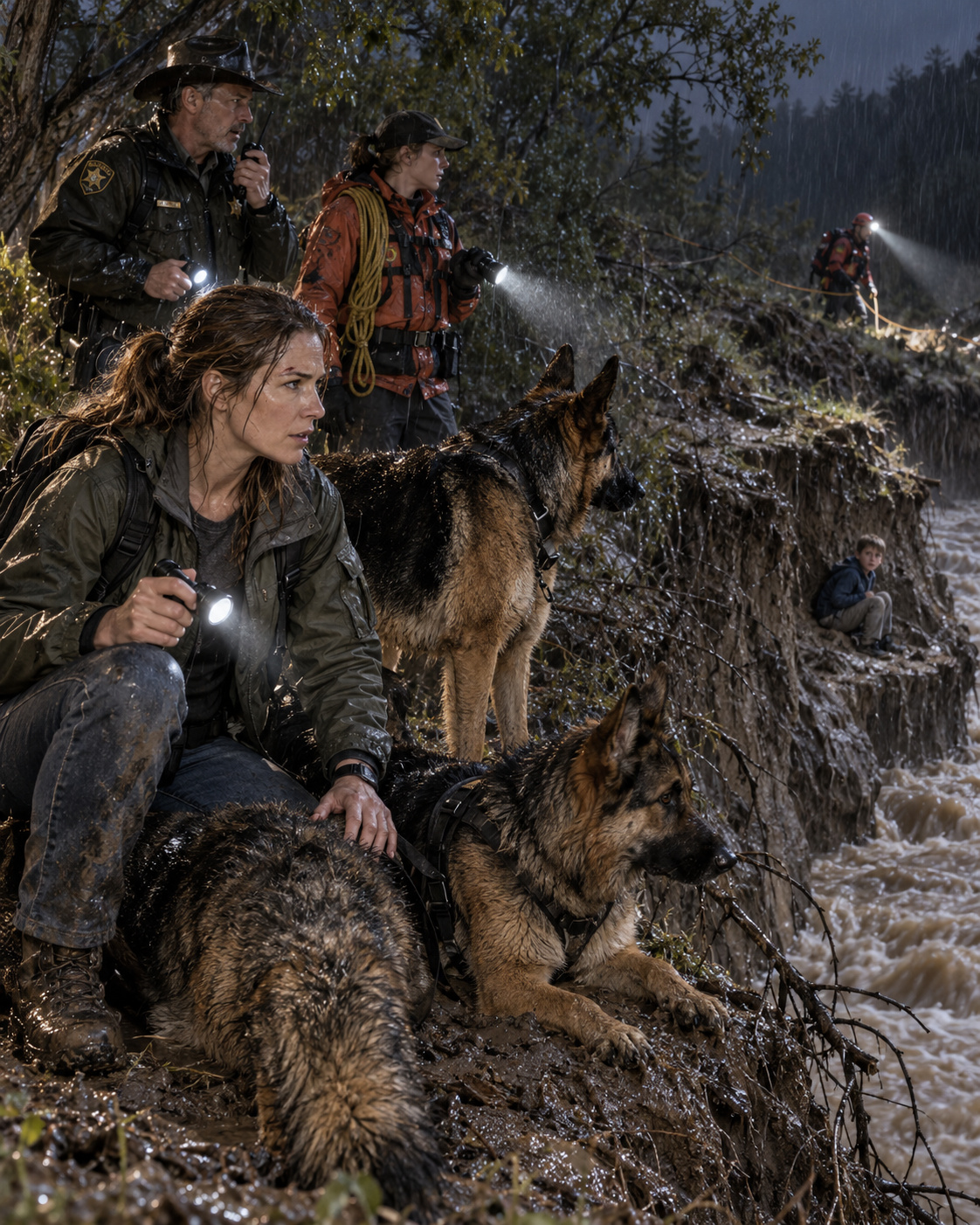
When Caleb finally reached the top, Wade dropped to his knees and pulled his grandson against his chest.
Caleb cried.
Wade cried too.
Nobody mentioned it.
Willow walked over and pressed her head against Caleb’s leg.
Caleb put one muddy hand on her face.
“You found me.”
Hannah looked at Scout.
Technically, he had found Caleb’s trail.
Willow had noticed the tennis ball.
Atlas had stopped the group before the unstable bank.
The rescuers had brought Caleb out.
Nobody dog deserved all the credit.
But Caleb didn’t need a technical answer.
What They Built Afterward
By sunrise, the storm had passed.
The next morning, Hannah heard engines outside.
One pickup.
Then another.
Then another.
Eleven trucks filled her yard.
Ranchers climbed out carrying lumber, roofing panels, tools, and bags of concrete.
Wade was first.
He walked toward the barn carrying a tape measure.
“What is this?” Hannah asked.
He looked at the damaged wall.
“Show us what needs fixing.”
She stared at him.
“Us?”
Wade shrugged.
“You’ve got enough work for a few people.”
No speech followed.
Nobody made one.
They simply started working.
They repaired the worst support posts. Reinforced the roof beam. Replaced sections of siding. Covered the weak part of the roof before the next storm could find it.
The hardware store donated usable lumber.
Someone brought extra hinges.
Another rancher supplied leftover roofing panels.
For three weekends, the neglected ranch sounded like a place people believed in.
Caleb came too.
He arrived on crutches, his ankle wrapped, and sat on the porch with Willow beside him.
“Did you see Scout?” he asked.
“That’s all he wants to talk about,” Hannah said.
Caleb smiled.
“Atlas helped too.”
From beneath the truck, Atlas opened one eye.
Hannah laughed.
Even Wade smiled.
By summer, the ranch had changed.
Not completely.
It still had crooked fences and mismatched barn doors.
The old porch still creaked.
The secondhand tractor needed two tries to start on cold mornings and a third when it was feeling stubborn.
But two acres of pasture had come back.
The spring still flowed.
The barn was safe.
Hannah started a small dog-training business out of one section.
Basic obedience for local families.
Recall.
Leash work.
Impulse control.
How not to repeat a command fifteen times and teach your dog that the first fourteen don’t matter.
Scout continued search-and-rescue training with Dana.
Atlas became the calm, dependable dog Hannah had hoped he would become.
Willow continued working with people who were nervous around animals.
None of the dogs were marketed as miracles.
Hannah knew better.
They were simply good dogs, given structure, patience, and a chance.
So was she.
One evening in late June, Hannah stood outside the barn as the sun dropped behind the hills.
Atlas rested against her boots.
Scout lay nearby, nose working whenever the wind shifted.
At the western fence, Caleb and Wade were replacing a damaged rail.
The board was crooked.
Wade pointed at it.
“You’re holding it wrong.”
Caleb looked at the board.
“It has character.”
Hannah laughed.
Wade looked over and shook his head.
For a moment, she simply watched them.
She remembered the first morning she had stood there.
Sixteen acres of dead grass.
A failing barn.
An empty trough.
Five thousand five hundred dollars she could barely afford.
And three dogs nobody wanted.
She had thought she was restoring an abandoned ranch.
She hadn’t expected the ranch to restore anything in her.
People had arrived one at a time.
Ruth with an old map.
Dana with an opportunity.
Mark with trust when every minute mattered.
Wade with lumber and an apology he never quite called an apology.
Caleb with three battered tennis balls and the kind of uncomplicated affection that doesn’t ask whether something is impressive.
And the dogs.
Especially the dogs.
Hannah rested her hand on Atlas’s head.
The old concrete trough caught the last light of day.
Clear spring water moved steadily into it.
For months, she had believed she was the one keeping the ranch alive.
Standing there, listening to the water and watching three dogs move through the evening grass, she understood it differently.
Some places don’t need to be rescued all at once.
Sometimes they only need one person to stop calling them finished.
And sometimes, without realizing it, that person is standing in the same broken place for long enough to discover that she was never the only thing being rebuilt.