The House at the Edge of Bellweather
By the time Mara Ellis was seventy-eight, people in Bellweather had started measuring their days by the thin ribbon of smoke above her chimney.
On cold mornings, it meant the soup was already on.
On rainy afternoons, it meant someone could knock on her door and stay awhile.
Her house stood alone near the edge of the mountain village, a small stone cottage with a sagging porch and blue-painted shutters that had faded nearly gray. There was a garden behind it, no bigger than a parking space, where she grew potatoes, onions, beans, tomatoes, and a few stubborn herbs that survived the mountain winters.
Mara had never married. She had no children.
She had spent most of her adult life working at the village post office, saving carefully, fixing what she could herself, and learning how to make one chicken last three dinners. She had been poor enough to notice every unexpected expense, but never poor enough to believe she had nothing.
People came to her house carrying their troubles.
A teenager waiting for college news.
A widower whose evenings had suddenly become too quiet.
A young mother exhausted by a baby who would not sleep.
Mara never pretended she had the right answer. She simply put another bowl on the table.
That evening, in late October, the mountains were already dark by five.
Mara stood over a dented blue pot, stirring cabbage soup with the handle of a wooden spoon. Her radio had stopped working months ago, so she hummed instead, an old melody her mother used to sing while hanging clothes on the line.
She had just settled into her chair beside the fireplace when someone knocked.
Three slow knocks.
Not the quick tapping of a neighbor.
Mara looked toward the door.
Outside, the wind moved through the bare trees with a dry, whispering sound.
She waited, then crossed the room and opened the door only a few inches.
A man stood on the porch.
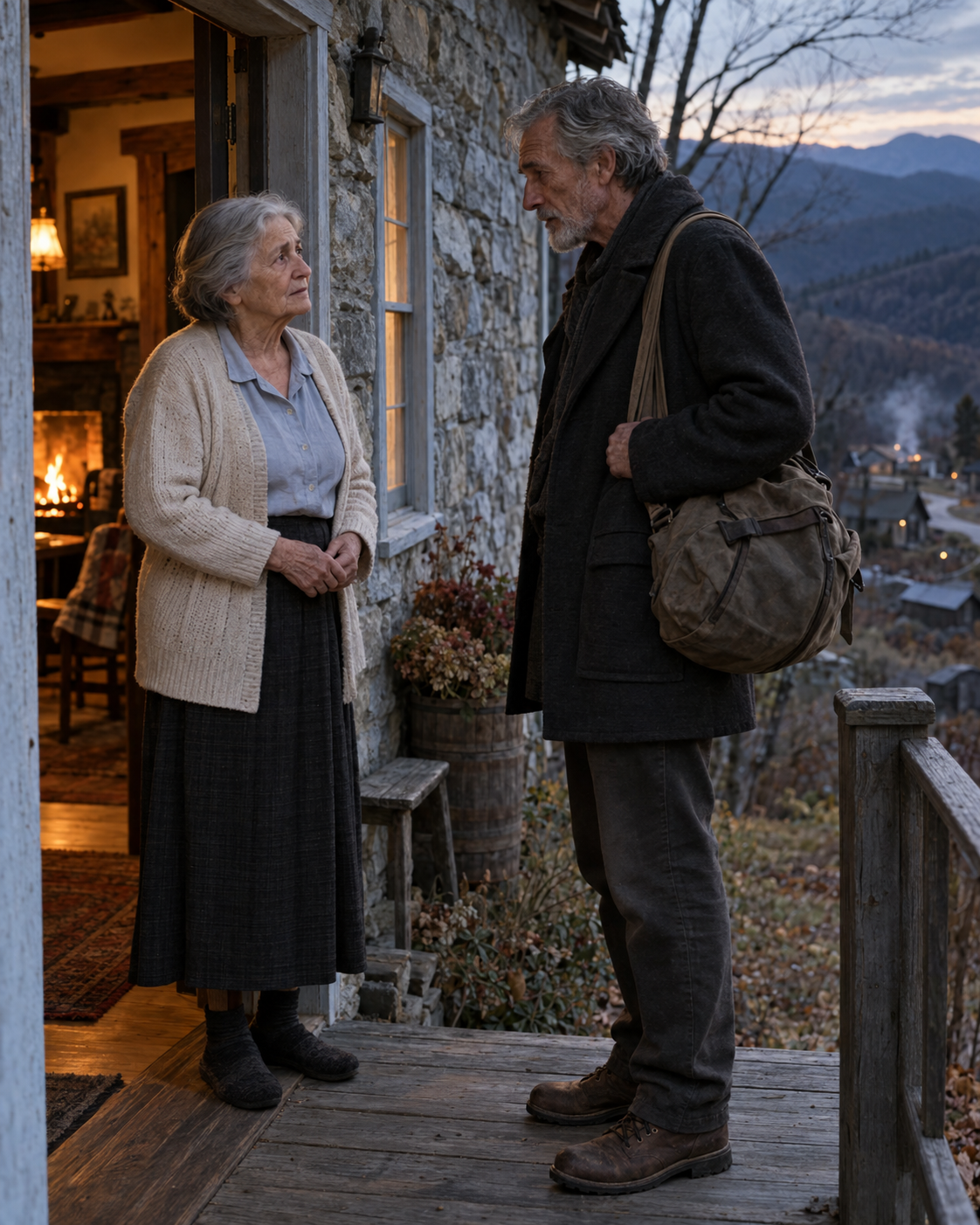
He appeared to be in his late fifties, perhaps early sixties, wearing a dark wool coat, weathered boots, and a canvas travel bag over one shoulder. His hair was mostly gray. His face was lined, though not in a way she disliked. He looked tired.
“Sorry to bother you,” he said.
Mara kept one hand on the door.
“It’s late.”
“I know.”
“Are you lost?”
The man smiled faintly.
“Maybe.”
She studied him for another moment, then opened the door wider.
“Come inside before you freeze.”
The stranger stepped into the warmth.
Mara pointed toward the chair beside the fire.
“Sit.”
He did.
She ladled soup into a bowl and set it in front of him without asking whether he wanted any.
He looked at it, then at her.
“You always feed strangers?”
“Only the ones who look like they need it.”
That made him laugh.
They ate in silence for a while.
Then the man placed his spoon beside the bowl.
“My name is Daniel.”
“Mara.”
“I know.”
Her eyes narrowed.
“How?”
“I’ve heard about you.”
Mara leaned back.
“From whom?”
Daniel glanced toward the fire.
“People.”
“People say a lot.”
“They say you’ve lived a good life.”
Mara gave a soft snort.
“That’s generous.”
Daniel reached into his coat pocket.
“What if I told you I could give you something you’ve wanted for a very long time?”
Mara smiled.
“Then I’d ask how much it costs.”
“Nothing.”
She looked at him.
Daniel held her gaze.
“Nothing at all.”
Three Doors in the Meadow
“What I want,” Mara said, “is for you to stop talking like you’re selling me something.”
Daniel smiled again.
“Fair enough.”
He stood and picked up his bag.
“Come outside.”
Mara glanced at the clock.
“I’m seventy-eight.”
“I noticed.”
“I don’t go wandering around in the dark with strange men.”
“You won’t be wandering.”
“I also don’t own a flashlight.”
Daniel reached into his pocket and held one up.
Mara stared at it.
“You really came prepared.”
“I had a feeling you might say yes.”
She sighed, wrapped an old wool coat around her shoulders, and followed him.
They walked only a few minutes from the house, down a narrow trail Mara knew well. At the bottom of the slope was a meadow she had visited since childhood. The moon had risen behind the ridge, washing the grass in pale silver.
And there, in the middle of the meadow, stood three doors.
They were not attached to anything.
One was tall and golden, polished so brightly it seemed to hold its own light.
The second was a plain wooden door, made from dark oak, with a brass handle.
The third was narrow, rusted, and crooked. Its paint had peeled away in strips.
Mara stopped.
For several seconds, she said nothing.
Daniel walked to the three doors and stood beside them.
“Behind one is your deepest desire.”
Mara looked at him.
“And behind the other two?”
“Disappointment.”
She gave a quiet laugh.
“That sounds fair.”
“Choose.”
Mara looked at the golden door first.
It was beautiful.
Then the wooden one.
It looked solid.
Finally, she studied the rusted door.
She walked toward it.
Daniel frowned.
“Why that one?”
Mara ran her fingertips lightly over the rust.
“Because I’ve noticed something.”
“What?”
“The best things I ever received looked ordinary at first.”
She glanced back at him.
“My house. My garden. The neighbors who became family. That old soup pot.”
“You call that a reason to choose a ruined door?”
“I call it a reason to be suspicious of shiny things.”
Daniel laughed softly.
Mara placed her hand on the rusted handle.
“You never told me what happens if I choose wrong.”
“I thought the disappointment would be enough.”
Mara smiled.
“Let’s see.”
She pulled the door open.
Inside was nothing.
No room.
No treasure.
No hidden path.
Only dust and darkness.
For a moment, Mara stared into the empty space.
Then she laughed.
Not loudly.
Just one warm, surprised laugh that disappeared into the night.
Daniel looked at her.
“You’re not disappointed?”
Mara closed the door.
“I’ve opened plenty of empty doors in my life.”
He waited.
She looked toward the mountain where her cottage sat, tiny and dark among the trees.
“Some led to places I thought would make me happy.”
“And?”
“They didn’t.”
Daniel’s expression changed.
For the first time, he looked less like a stranger and more like an old man carrying something heavy.
He nodded toward the golden door.
“You should see what was behind that one.”
Mara shrugged.
“I already know.”
What the Other Doors Held
Daniel opened the golden door.
On the other side was a room piled high with money.
Stacks of bills filled wooden crates and sat in neat columns on the floor. Gold coins spilled from open boxes. Jewelry glittered beneath warm lights.
Mara stood at the threshold.
She did not step inside.
Daniel opened the wooden door next.
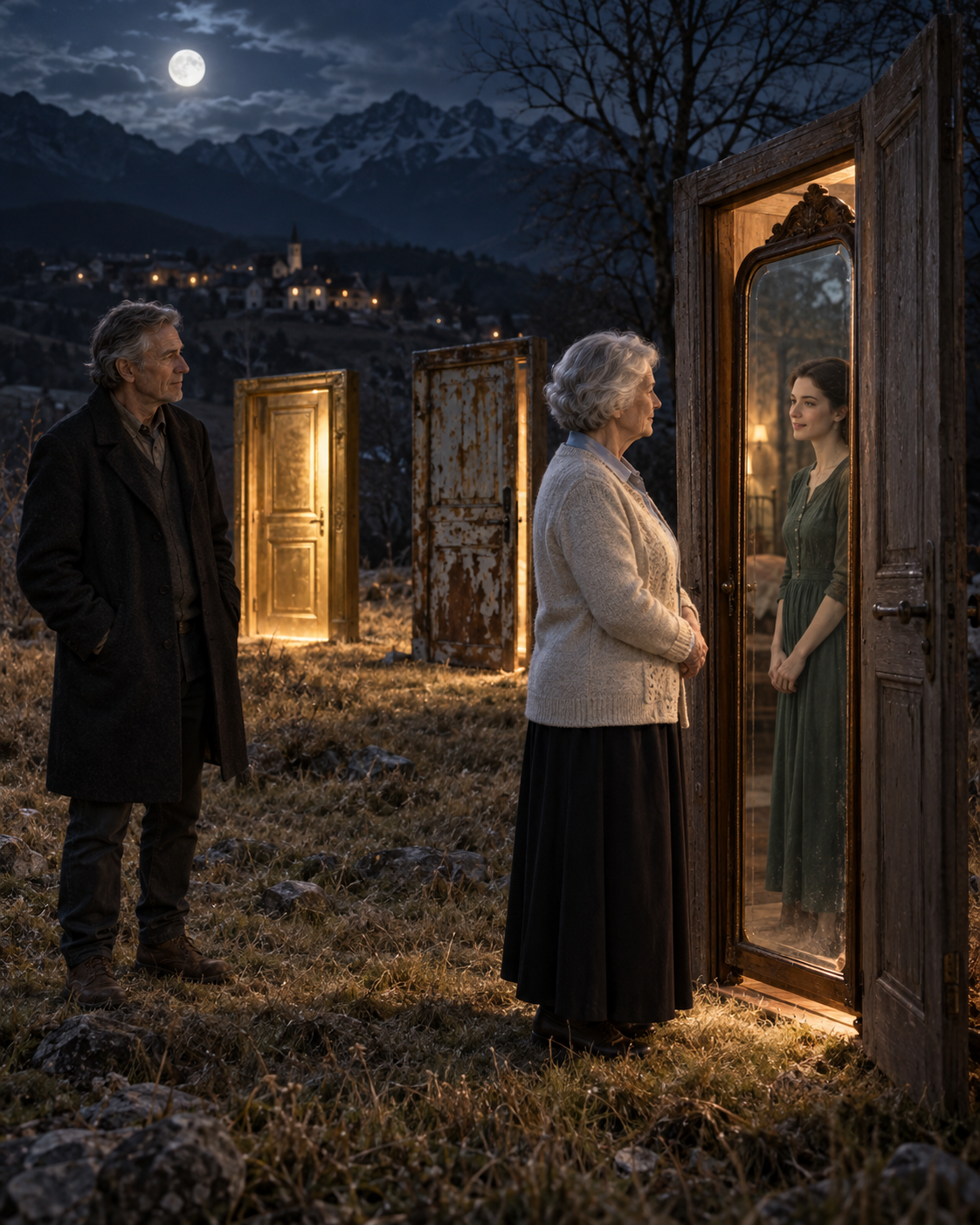
This time, there was a mirror.
But it was not an ordinary mirror.
Mara looked into it and saw herself as she had been at thirty.
Her hair was dark brown. Her back was straight. Her skin was smooth. She wore a green dress she had once owned and remembered perfectly.
Behind that younger Mara stood a large house with white columns.
A new car sat in the driveway.
There were flowers everywhere.
Daniel watched her carefully.
“You could have had this.”
Mara looked at the young woman in the mirror.
For a moment, she did not speak.
Then she smiled.
“I remember her.”
“Do you want to be her again?”
Mara studied the reflection.
The younger version of herself looked confident. Beautiful, perhaps. Unburdened.
But there was something in her eyes Mara recognized.
Hunger.
Not for money.
For something she had spent years believing would arrive later.
Marriage.
Children.
A life that looked fuller from the outside.
“You know,” Mara said, “when I was thirty, I thought forty would fix everything.”
Daniel said nothing.
“At forty, I thought fifty.”
She touched the edge of the mirror.
“At fifty, I finally got tired of waiting for my life to begin.”
Daniel lowered his eyes.
Mara turned away.
“That’s when I started noticing it.”
“What?”
“How much of my life was already happening.”
The fire in the room reflected softly in the glass behind her.
“I’d come home from work and hear Mrs. Bennett’s porch swing creaking next door. Mr. Ruiz would leave tomatoes at my door because he always planted too many. Kids from the school would race to the post office when their letters came.”
She smiled.
“Little things.”
“Little things don’t sound like enough.”
“They weren’t little to me.”
The Question She Asked
Daniel closed the mirror door.
“You could have had wealth,” he said.
“Yes.”
“Your youth.”
“Yes.”
“A different life.”
Mara slipped her hands into her coat pockets.
“Maybe.”
“You don’t regret anything?”
She looked at him.
“Of course I do.”
Daniel seemed surprised.
Mara smiled.
“I regret things all the time. I regret the words I didn’t say to my sister before she died. I regret that I was too proud to let my father help me when I was struggling. I regret a man I loved when I was young and never told.”
Daniel’s face went still.
“But regret isn’t the same as wanting to trade your whole life away.”
He looked back toward the doors.
“So you’re satisfied?”
Mara considered the question.
“No.”
He waited.
She gave a small shrug.
“I’m at peace.”
Daniel’s eyes lifted.
“There is a difference.”
For a moment, the meadow was completely quiet.
Then he asked, almost reluctantly, “What if the golden door didn’t just give you money?”
Mara glanced at him.
“What else?”
“A bigger house. Better health. People who never leave. Enough time to repair every mistake.”
Mara smiled sadly.
“That last part sounds dangerous.”
“Why?”
“Because some mistakes become part of who you are.”
Daniel looked away.
Mara studied him.
“Why did you come here?”
He didn’t answer.
“Daniel.”
He rubbed his thumb over a loose thread on the strap of his bag.
“My mother lived in a town not far from here.”
Mara said nothing.
“She died when I was twenty-three. We weren’t close.”
A long pause.
“I spent the next thirty years making sure I never had to feel poor, helpless, or dependent on anyone again.”
He gave a tired laugh.
“I succeeded.”
Mara waited.
“I made money. A lot of it. I bought the house. The cars. Everything I thought she’d wanted for me.”
He looked at the golden door.
“Then, a few years ago, I realized I couldn’t remember what she sounded like.”
Mara’s expression softened.
“I’m sorry.”
“I came back looking for the place where she used to live.”
“Did you find it?”
“An empty lot.”
He smiled without humor.
“That’s when I started wondering whether I’d spent my whole life building doors into rooms I didn’t actually want.”
Mara reached out and touched his sleeve.
“You didn’t come here to test me.”
Daniel looked at her.
“No.”
“You came because you needed someone to choose.”
He swallowed.
“Maybe.”
Mara nodded toward the mountain.
“Then let’s go home.”
The Fire That Was Still Waiting
They walked back to the cottage without speaking much.
Halfway there, Mara stopped.
Daniel turned.
“I forgot something.”
“What?”
“My soup.”
He laughed for the first time without sadness.
By the time they reached the house, the fire had burned low.
Mara stirred the pot again, added a little salt, and set two bowls on the table.
Daniel sat down.
“You do this every night?”
“Mostly.”
“Don’t you ever get tired of it?”
“Of soup?”
“Of the same life.”
Mara thought about that.
“The same life can look different when you pay attention.”
Outside, wind pushed against the windows.
Inside, the room was warm.
Daniel ate slowly.
Mara hummed the same old song she had been humming before he knocked.
After a while, Daniel said, “I think I know what the right door was.”
Mara smiled.
“Which one?”
He looked around the little kitchen.
“None of them.”
She nodded.
“Exactly.”
The next morning, Daniel left before sunrise.
He placed an envelope on the kitchen table.
Mara found it when she was pouring coffee.
Inside was a stack of cash.
She stared at it for a moment, then tucked it back into the envelope.
On the porch, she heard footsteps.
“Daniel.”
He turned from the path.
“You forgot this.”
“You can keep it.”
“I don’t want it.”
He smiled.
“I figured you’d say that.”
Mara held out the envelope.
Daniel took it.
Then he reached into his pocket and pulled out a small brass key.
“What is that?”
“My mother’s house key.”
Mara looked at it.
“I found it in an old box yesterday.”
“You going to use it?”
“No.”
He closed her fingers around it.
“But I think I finally know why I kept it.”
Mara looked down at the key resting in her palm.
Then she looked back at him.
Daniel walked away down the mountain road.
She stood on the porch until he disappeared behind the trees.
Weeks later, the first snow came.
Mara went about her ordinary routines.
She swept the porch.
She checked on Mrs. Bennett.
She mailed a birthday package for a boy who had forgotten to put a return address on his letter.
She cooked soup.
And one evening, when the sky turned purple behind the mountains, someone knocked on her door.
Mara opened it.
A young couple stood outside with a little girl between them. The father looked embarrassed. The mother looked exhausted.
“Sorry to bother you,” the woman said. “Mrs. Bennett told us that if we were having a hard week, we should come here.”
Mara smiled.
“Well, she’s usually right.”
The little girl peeked past Mara into the warm room.
“Does it smell good in there?”
Mara opened the door wider.
“It does now.”
They stepped inside.
Later that night, after the dishes were washed and the house was quiet, Mara sat beside the fire with her hands folded in her lap.
On the shelf above her was an old tin box.
Inside it was Daniel’s brass key.
She had never asked what it opened.
She didn’t need to.
The fire crackled.
Outside, snow settled over the roof, softening the edges of everything it touched.
Mara closed her eyes and listened to the house breathing around her.
She had no golden room waiting behind some hidden door.
No promise that the years ahead would be easy.
Just a small stone house, a garden asleep beneath the snow, soup for tomorrow, and another morning she had not yet seen.
For the first time in a long while, Mara found herself smiling at the thought.
She had spent enough of her life wondering what might have been behind another door.
She was content to be where she was when the right one opened.