Jonathan Mercer had spent years making sure his parents never had to worry about money again.
That was why the sight of his father carrying a grocery bag through the side door of their house at 9:17 on a Friday night made his stomach tighten.
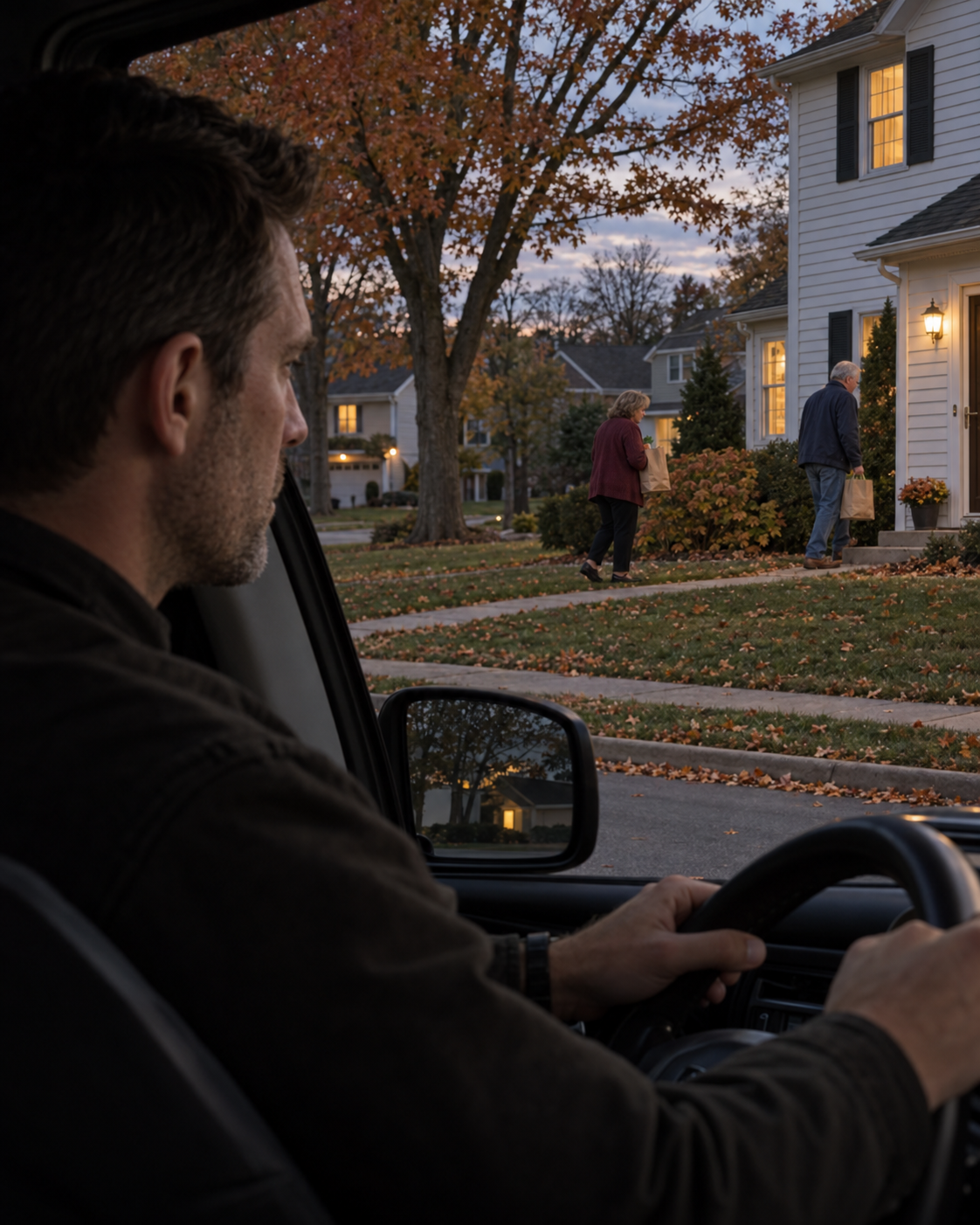
Jonathan sat behind the wheel of a black SUV parked half a block away, the engine off and the windows cracked open to the cool Ohio air. He had told no one he was coming. He had canceled a dinner in Chicago, caught a late flight to Columbus, rented a different car, and driven straight to the neighborhood where he had bought his parents a house six years earlier.
The house looked exactly as he remembered it.
Two stories. White siding. Wide front porch. A maple tree in the front yard. Warm light behind the curtains.
His father, Robert, looked different.
He was sixty-eight, but from that distance Jonathan thought he looked older. His shoulders had rounded. His gray hair was untidy. He carried the grocery bag in one hand and moved slowly toward the side entrance.
A minute later, his mother appeared.
Margaret carried another bag.
She didn’t wave to Robert.
Robert didn’t wait for her.
They entered through the same door several seconds apart.
Jonathan stared at the house.
Then the porch light went off.
The House She Left Behind
Jonathan had grown up only twenty minutes from that neighborhood, in a smaller house where the basement flooded every spring and the furnace made a metallic knocking sound whenever it started.
His father had repaired heating and cooling systems for most of his working life. His mother had spent decades in an elementary school cafeteria.
They weren’t wealthy.
But Jonathan had never gone to bed wondering whether there would be dinner.
His father taught him how to change a tire before he was old enough to drive. His mother slipped handwritten notes into his lunch bag when he was in high school, usually with the same message in different words: Be kind. Call when you get there.
At twenty-four, Jonathan started a software company with a secondhand laptop and an idea most people thought was ridiculous.
For years, it nearly killed him.
He rented a tiny room. Ate cheap food. Worked until two or three in the morning. There were months when his checking account made him afraid to open the banking app.
His parents couldn’t give him much money.
They gave him everything else.
Robert drove three hours one winter to help him fix a broken radiator.
Margaret mailed grocery-store gift cards inside old birthday cards without mentioning them.
When Jonathan’s company was finally acquired, everything changed.
Money arrived faster than he knew how to spend it.
He bought a beautiful house. Hired employees. Traveled constantly. Appeared in business magazines. People who once ignored his emails suddenly wanted to meet him.
And he bought his parents their new home.
“You’re never moving again,” he’d told them, standing in the empty living room on closing day.
Margaret had cried.
Robert had walked into the backyard, pretending to inspect the fence.
Jonathan had believed he was giving them security.
He didn’t understand then that security wasn’t the same thing as being present.
At first, he called every night.
Then every few days.
Then once a week.
When his father mentioned feeling tired, Jonathan arranged for a doctor to visit the house. When their furnace failed, he bought a new one. When the roof needed repairs, he paid the bill before Robert could even get an estimate.
It was how Jonathan said I love you.
He just didn’t realize his parents were hearing something else.
I’m busy.
I’ll handle it.
You don’t have to ask me.
I don’t have time to come home.
Six months earlier, Margaret had started missing his calls.
Then Robert began answering with short texts.
We’re fine.
Everything’s okay.
Busy today. Talk later.
Jonathan had asked what was wrong.
His mother always gave the same answer.
“Nothing.”
But something was wrong.
His assistant mentioned that Margaret had asked her not to come inside the house anymore.
Then Jonathan noticed that his parents had stopped using the household account he’d created for them.
They began withdrawing small amounts of their own money.
They canceled services.
They stopped accepting deliveries.
Jonathan had initially respected their privacy.
Then he saw his father that Friday night.
And the next morning, he came back.
Two Lives Under One Roof
From across the street, Jonathan watched his father leave the house just after sunrise.
Robert drove an old pickup to a small neighborhood repair shop.
Jonathan followed.
For nearly five hours, Robert repaired heating units, washing machines, and an old refrigerator.
When he finished, the shop owner handed him a small envelope.
Jonathan sat in his car and stared at it.
His father was working.
For money.
At sixty-eight.
The man who had a fully paid house, enough savings, and a wealthy son was spending his day repairing appliances for cash.
Jonathan couldn’t understand it.
So that afternoon, he followed Margaret.
She drove to a grocery store and filled her cart with inexpensive canned food, pasta, rice, and cereal.
Then she drove to a church.
Jonathan parked down the street.
He watched his mother carry the groceries inside.
She wasn’t asking for help.
She was giving it.
That night, Jonathan sat at a hotel desk and opened the financial statements he still had access to.
The pattern emerged slowly.
His parents had been donating money to people in their community.
Rent payments.
Medical bills.
Groceries.
Utility bills.
Not enormous amounts. Just one family here, another person there.
Jonathan leaned back.
“Why?” he whispered.
The answer came the following morning at the church pantry.
An elderly pastor named Samuel Whitaker recognized him immediately.
“You’re Robert and Margaret’s boy.”
Jonathan smiled faintly.
“Apparently I’m still somebody’s boy.”
Samuel smiled, but it faded when Jonathan asked about his parents.
“I need to know what’s happening.”
The pastor was quiet.
“That isn’t really my story to tell.”
“I know.”
Jonathan looked down at his hands.
“But I’m worried.”
Samuel studied him for a long moment.
Finally, he sighed.
“Your father found out your mother had been using some of their savings to help families around here.”
Jonathan frowned.
“She could’ve asked me.”
“She didn’t want to.”
“Why?”
Samuel looked toward the empty pantry shelves.
“Because your mother doesn’t want to spend her son’s money every time someone needs help.”
Jonathan swallowed.
“And my father?”
“He has his own secret.”
Samuel told him about a disabled former coworker of Robert’s whose medical expenses had become overwhelming.
Robert had been taking repair jobs and quietly sending the money to him.
Margaret had discovered it.
Robert had discovered what Margaret was doing.
Neither had liked what they found.
Robert believed Margaret was giving away too much of their retirement savings because she no longer trusted him to provide for them.
Margaret believed Robert was taking work because he was ashamed that retirement had made him dependent on their son.
They fought.
Then they stopped fighting.
Samuel’s voice softened.
“They both thought the other one was disappointed in them.”
Jonathan looked away.
“Did they ever use the money I gave them?”
“Not much.”
“Why?”
Samuel hesitated.
“They don’t want to become wealthy people’s parents, Jonathan.”
The sentence landed harder than he expected.
“They want to be your parents.”
What Jonathan Had Failed to See
Jonathan drove back to the house and sat in the driveway for several minutes.
He thought about every expensive thing he’d bought.
The new roof.
The furnace.
The landscaping.
The house itself.
He remembered how proud he’d been when the keys were handed over.
He had called it a gift.
Now he wondered whether he’d been using gifts to avoid conversations.
He had asked his father whether the furnace worked.
He hadn’t asked whether retirement frightened him.
He had asked his mother whether she needed anything from the store.
He hadn’t asked whether she felt lonely.
He had paid for their future without noticing they were already living in it.
Jonathan finally walked to the front door.
He knocked.
Margaret opened it.
For a moment, she simply stared.
“You didn’t tell me you were coming.”
“I know.”
Her eyes moved toward the driveway.
“How long have you been here?”
“Long enough.”
Her expression changed.
“Jonathan.”
“I know.”
He stepped inside.
The house looked beautiful.
And strangely divided.
Two coffee makers sat on opposite ends of the kitchen.
Two calendars hung on different walls.
Two laundry baskets sat in the hallway.
At the dining table, two place settings had been arranged at opposite ends.
Jonathan walked past a row of family photographs.
There was Robert holding him on his shoulders at a county fair.
Margaret standing beside him on his first day of school.
Jonathan at graduation.
Jonathan with his parents beside a Christmas tree.
But almost nothing recent.
He touched the edge of one frame.
“Where are all the new pictures?”
Margaret’s face tightened.
“You’re never here.”
Jonathan closed his eyes.
His father appeared at the end of the hallway.
Robert stopped when he saw him.
Nobody spoke.
Finally, Jonathan said, “I’m sorry.”
Robert looked away.
“For what?”
“For thinking money was the same thing as being your son.”
Robert’s jaw tightened.
Margaret sat down.
Jonathan pulled out a chair.
“I don’t want to fix this,” he said. “Not with money.”
His father looked at him.
“I just want to understand.”
Nobody spoke for a while.
Then Robert sat down.
Margaret remained quiet.
Jonathan waited.
And this time, he didn’t check his phone.

Robert spoke first.
“I don’t know what I’m supposed to be now.”
Jonathan frowned.
“What do you mean?”
“I worked forty years. I fixed things. I paid bills. I took care of you and your mother.”
He rubbed his thumb against the edge of the table.
“Then you got successful. Suddenly everything was handled. I know that’s a good thing. I know it is. But some mornings I wake up and wonder what I’m useful for.”
Jonathan didn’t interrupt.
Margaret wiped her cheek.
“I was afraid of something different,” she said.
Jonathan turned toward her.
“I kept thinking about what happens when people get old. Friends get sick. Husbands get sick. Children get busy.”
She gave him a tired smile.
“I didn’t want to become someone who called her son every time she was scared.”
Jonathan looked down.
“You could call me.”
“I know.”
She paused.
“But sometimes I wanted you to call me first.”
The room went quiet.
Robert reached across the table.
Margaret looked at his hand.
Then she took it.
Jonathan watched them.
It was a small gesture.
But it was the first time he’d seen them touch in months.
The First Sunday Dinner
Nothing changed overnight.
Robert didn’t suddenly become cheerful.
Margaret didn’t stop worrying.
They still argued about money.
They still misunderstood each other sometimes.
But they started talking again.
Jonathan made one promise.
He would come home one weekend every month.
Not for a dinner between meetings.
Not for a few hours between flights.
A whole weekend.
When he arrived the following month, Robert asked him to help clean out the garage.
Jonathan expected a contractor to be hired.
Robert handed him a broom.
“You know how to use that?”
Jonathan laughed.
“I think so.”
“Good.”
They worked for three hours.
At the end, Robert showed him a corner he’d cleared for a workbench.
“I want to keep fixing things.”
Jonathan nodded.
“What do you need?”
Robert looked at him.
“Nothing fancy.”
So Jonathan helped him convert the old garage into a modest workshop.
He bought tools, but Robert chose where everything went.
For Margaret, Jonathan helped the church organize a larger food program.
But he didn’t run it.
He didn’t put his name on it.
He simply asked what she needed.
And slowly, the house began to sound different.
Robert started making coffee in the morning.
Margaret came downstairs before breakfast.
They began eating dinner at the same table.
Jonathan joined them every Sunday.
Sometimes there was laughter.
Sometimes an argument.
Sometimes nobody had much to say.
But there was no longer a wall of silence between them.
One evening, Jonathan arrived home from a difficult business trip and opened the front door.
He heard laughter from the kitchen.
His father was complaining about someone leaving an empty bread bag on the counter.
His mother shouted back that Robert was the one who had eaten the last two slices.
Jonathan stood in the hallway, smiling.
The house was exactly the same.
The furniture hadn’t changed.
The walls hadn’t changed.
The backyard hadn’t changed.
But it no longer felt empty.
The Toolbox
Months later, Robert called Jonathan into the workshop.
“Come here.”
Jonathan sat beside him.
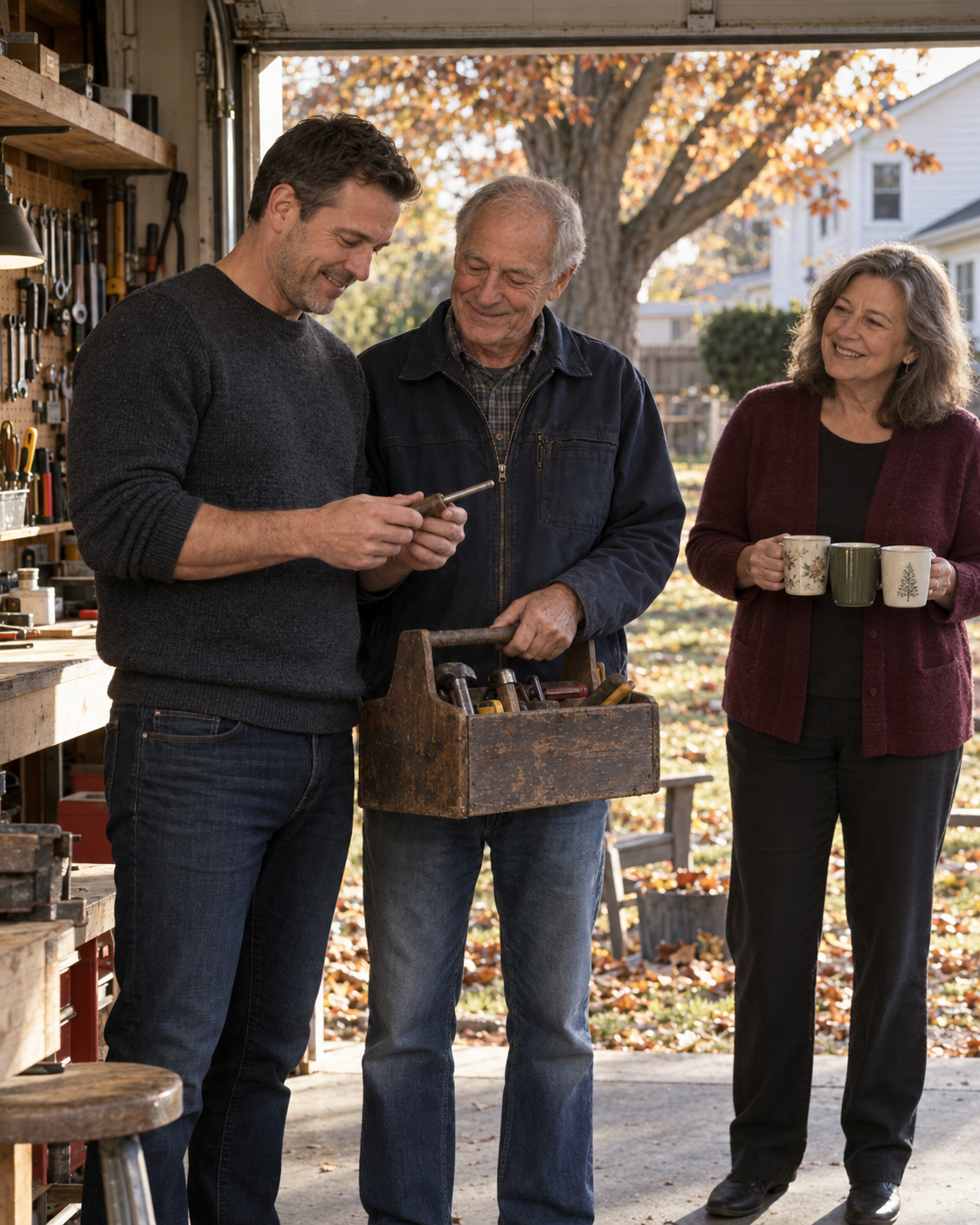
Robert opened an old wooden toolbox.
The wood was scratched and darkened with age. The metal hinges were worn smooth.
“I’ve had this since before you were born,” Robert said.
Inside were screwdrivers, pliers, wrenches, and a small adjustable wrench Jonathan remembered from childhood.
He picked it up.
“I remember this.”
“You should.”
Robert smiled.
“You used to steal it every time I wasn’t looking.”
Jonathan laughed.
“I was helping.”
“You were five.”
“I was helping.”
Robert shook his head.
Then his expression softened.
“You know what I remember?”
“What?”
“You sitting on the garage floor watching me fix your bicycle.”
Jonathan nodded.
“I thought you could fix anything.”
Robert looked at the tools.
“I couldn’t.”
Jonathan turned toward him.
Robert shrugged.
“I just kept trying.”
They sat quietly.
Through the open garage door, the maple tree in the backyard had begun losing its leaves.
Later that afternoon, Margaret brought them coffee.
She stood in the doorway watching father and son work side by side.
Jonathan looked at her.
“Mom.”
“Yeah?”
“Come sit with us.”
She smiled.
“I have dinner to make.”
“We’ll help.”
She raised an eyebrow.
“Both of you?”
Robert stood.
“Don’t make me regret agreeing to this.”
Margaret laughed.
And for a moment, Jonathan saw the family he’d been trying to buy back all those years.
Only now, nobody was waiting for a gift.
They were simply together.
Jonathan eventually sold part of his company and quietly established a foundation supporting isolated older adults with meals, transportation, home repairs, and companionship.
He didn’t name it after himself.
He named it after Robert and Margaret.
His parents never made a speech about it.
His father simply said, “That’s a good idea.”
His mother asked whether the program needed volunteers.
That was enough.
Years later, people sometimes asked Jonathan about the greatest thing he had ever built.
They expected him to mention the company.
The acquisition.
The money.
The foundation.
He rarely did.
He thought instead about that quiet Ohio house.
About the night he’d watched his father enter through one door while his mother followed through another.
About how close he had come to losing something he didn’t even realize was disappearing.
He had spent years believing that loving his parents meant making sure they needed nothing.
He eventually understood that sometimes people don’t need another thing.
They need another hour.
Another conversation.
Another Sunday.
Another person sitting across the table who isn’t looking at a phone or checking a flight schedule.
One evening, long after the first snowfall, Jonathan sat in the workshop with his father while Margaret prepared dinner upstairs.
Robert was repairing an old radio.
Jonathan watched his hands move carefully over the worn machine.
“Need any help?” Jonathan asked.
Robert glanced at him.
“Yeah.”
He handed him a screwdriver.
Jonathan took it.
For a while, neither of them spoke.
From upstairs came the sound of Margaret laughing at something on the television.
Jonathan smiled.
The house was quiet.
But it wasn’t the kind of quiet that had once frightened him.
This quiet had room in it.
Room for memory.
Room for forgiveness.
Room for people who had finally stopped trying to protect one another from their fears.
Robert nudged the toolbox toward him.
“Your turn.”
Jonathan looked at the old tools, then at his father.
And this time, he stayed.