The Night Everything Changed
The pregnancy test sat on Lisa’s bathroom counter for almost ten minutes before she picked it up again.
Two pink lines.
She was twenty-six years old, working full-time at a grocery store, living in a small town where everybody seemed to know everybody else’s business. She and Mark had been together for a year. They weren’t rich, but they had talked about getting married someday, finding a small house, and having children.
She had always believed her life would happen in that order.
Marriage. House. Family.
Now she was standing alone in a bathroom, staring at a plastic test that had changed the order of everything.
That evening, Lisa drove to Mark’s apartment.
He opened the door with his usual smile.
“Hey,” he said. “What’s going on?”
Lisa stepped inside and took a breath.
“I have news.”
Mark’s smile faded a little. “What kind of news?”
“I’m pregnant.”
For several seconds, neither of them moved.
Mark looked at her, then at the floor. He rubbed the back of his neck and walked toward the window.
“Are you sure?”
“Yes. I took a test.”
He stared outside.
“It’s not a good time,” he finally said.
Lisa waited.
“I mean, I’m not ready to be a father.”
Her fingers tightened around the strap of her purse.
“But we love each other.”
Mark didn’t answer.
“I need time to think,” he said.
That night, he didn’t hold her. He didn’t kiss her goodbye.
The next morning, he left early.
After that, his calls became less frequent. Then they stopped completely.
Lisa sent messages. Mark stopped answering.
Finally, she went to his apartment and knocked.
Nothing.
She waited, knocked again, and then sent one last message.
His reply was only a few words.
I can’t do this. I’m sorry.
Lisa sat on her bed that night and cried until her face hurt.
She had imagined telling him about their baby and watching him smile.
Instead, she was pregnant and alone.
The next morning, she packed a small bag and drove to her parents’ house.
Her mother cried when Lisa told her.
Her father was quiet for a long time.
Then he put a hand on Lisa’s shoulder.
“We’re here for you.”
It wasn’t a solution.
But it was something.

The Little Girl Who Kept Her Going
The months that followed were harder than Lisa had expected.
She continued working at the grocery store until the baby was born. She stood for hours, carried boxes, and came home with aching feet.
Her mother helped whenever she could.
Her father didn’t say much, but he began assembling the crib in the spare room one piece at a time.
Lisa went to every doctor’s appointment alone.
Then, one night, the pain began.
Her mother drove her to the hospital.
After hours of labor, Lisa heard a baby’s cry.
“It’s a girl,” the nurse said.
They placed the tiny baby in Lisa’s arms.
She looked at the little face, the closed eyes, the delicate fingers curled against her blanket.
“Hello,” Lisa whispered. “I’m your mom.”
She named her Emma.
For two days, Lisa barely slept.
Then she brought Emma home.
The first months were a blur of diapers, bottles, laundry, and exhaustion. Emma cried at night, and Lisa learned to function on almost no sleep.
Sometimes, after finally getting Emma back to sleep, Lisa would sit on the edge of her bed and cry quietly herself.
But then Emma would move in her crib.
Lisa would wipe her face, stand up, and go to her.
“I’m here,” she’d whisper.
Mark never came.
He never called.
He never asked how Emma was doing.
Once, when Emma was five months old, Lisa saw him in town.
He noticed her.
Then he looked away.
Lisa stood beside the stroller, one hand resting on the handle.
For a moment, anger rose in her throat.
She wanted to ask him how he could walk past his own daughter.
Instead, she looked down at Emma.
The baby was sleeping peacefully, one tiny hand curled around the edge of her blanket.
Lisa let out a slow breath.
“You don’t need to understand him,” she whispered.
“You’re loved.”
When Emma was six months old, Lisa returned to work.
Her mother watched Emma while she was gone.
The money was tight. Lisa bought diapers before buying anything for herself. Her jeans became old and faded. She wore the same few shirts over and over.
When Emma got sick, Lisa stayed home.
Her boss wasn’t happy.
“You can’t keep missing work,” he told her one afternoon.
“I know.”
“You need this job.”
Lisa nodded.
“I know.”
She didn’t tell him that she also needed to be the person her daughter could count on.
One night, Emma developed a fever.
Lisa held her against her chest for hours.
She called the doctor, followed the instructions, and stayed awake until morning.
At the clinic the next day, a nurse examined Emma and reassured Lisa that she would likely be fine.
Lisa kissed her daughter’s warm cheek.
“Come on, baby,” she whispered. “Let’s go home.”
Little by little, Emma got stronger.
She learned to stand.
Then she walked.
She fell constantly, sometimes landing on her bottom with a surprised expression.
Lisa would hold out both hands.
“Try again.”
Emma would pull herself up.
Then she’d take another step.
At thirteen months, she finally crossed half the living room by herself.
Lisa clapped so hard her hands hurt.
Emma laughed.
That laugh made the apartment feel bigger than it was.
A Home of Their Own
When Emma was two, Lisa saw Mark again.
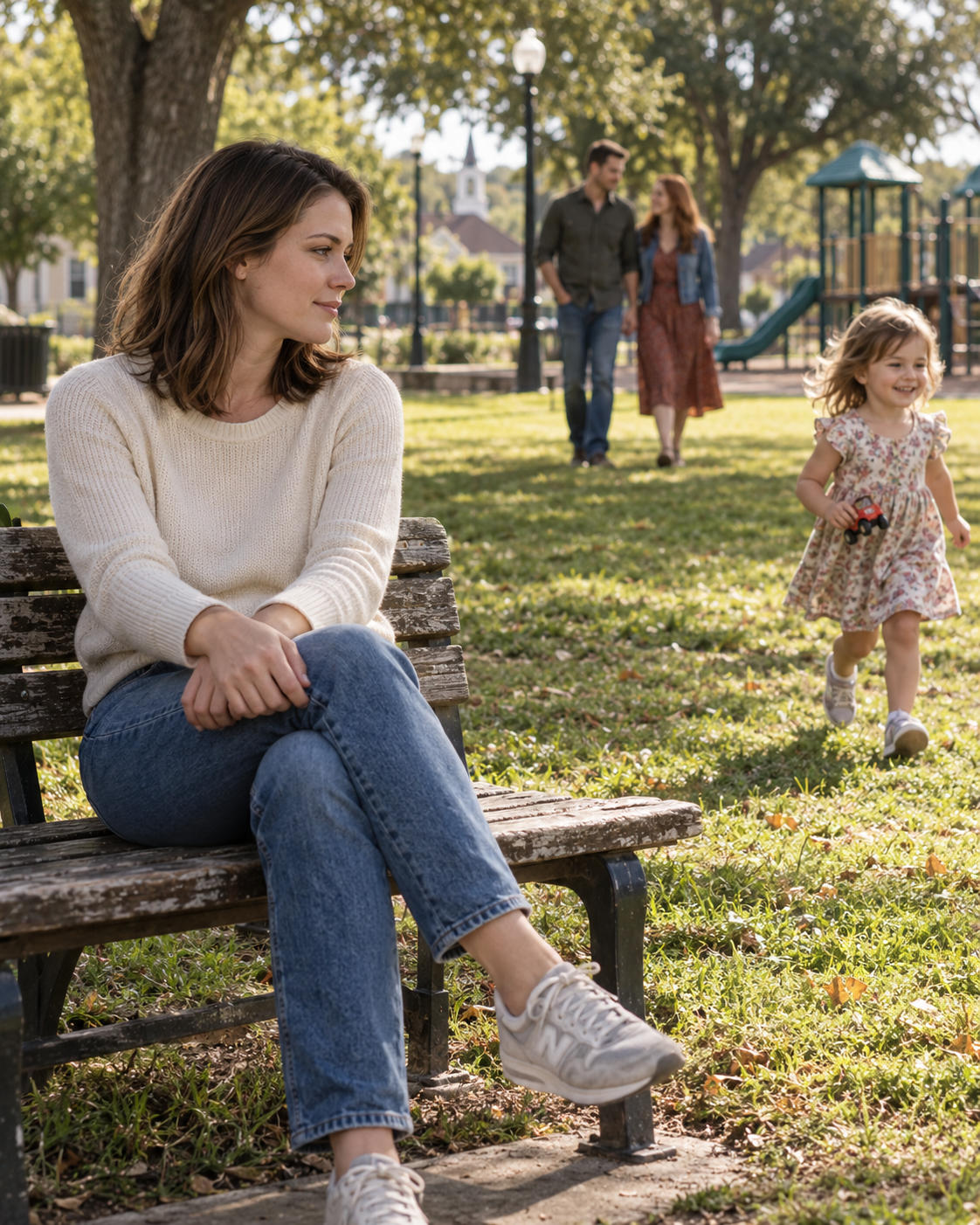
She was at the park with Emma when she noticed him across the grass.
He was holding hands with a red-haired woman.
Lisa recognized him immediately.
For a second, the old hurt returned.
Then Emma tugged at her hand.
“Mommy!”
Lisa looked down.
Emma was pointing toward a child with a toy car.
“Go ask if you can play,” Lisa said.
Emma ran across the grass.
Lisa watched her.
She didn’t follow Mark with her eyes.
She didn’t wonder where he was going.
She simply watched her daughter play.
A few days later, a letter arrived from the local housing office.
Lisa had been approved for a small apartment.
It wasn’t much.
One bedroom. One bathroom. A tiny kitchen.
But it was hers.
Her mother helped her pack. Her father loaded boxes into his car.
When they arrived, Lisa carried Emma inside.
The apartment smelled faintly of fresh paint.
Emma ran from room to room.
Lisa laughed.
“There’s not much to see.”
Emma didn’t care.
That night, they ate toast and drank tea while sitting on the floor because their table hadn’t arrived yet.
Emma dropped her spoon.
Lisa picked it up.
“This is our home now,” she said.
Emma smiled.
For the first time since Mark had left, Lisa realized she wasn’t waiting for her old life to return.
She was building a new one.
It was smaller than the life she’d imagined.
But it was real.
Their days settled into a routine.
Lisa woke early, made breakfast, took Emma to daycare, and went to work.
At night, she cooked simple meals and read bedtime stories.
Emma’s favorite was a book about a blue bear.
“Bear funny,” Emma would say.
“You think the bear is funny?”
Emma nodded seriously.
Then she’d laugh.
Lisa would kiss her forehead.
“You’re funny, too.”
Some nights, loneliness still found Lisa.
She missed having someone to talk to.
She missed being held.
But she no longer missed Mark.
What she wanted now was something simpler.
Peace.
Someone who stayed.
The Question She Couldn’t Avoid
By the time Emma was four, she had become an endlessly curious child.
She wanted to know why birds could fly.
Why the sky was blue.
Where the moon went during the day.
Why some people had dogs and others didn’t.
Lisa answered every question she could.
Then one Friday evening, Lisa came home late from work.
Her mother had picked Emma up from school and brought her home.
Emma ran to the door.
“Mommy!”
Lisa dropped her bag and hugged her.
“Hey, sweetheart.”
Her mother smiled.
“You two have a good night. I’ll see you tomorrow.”
After she left, Lisa made tea while Emma played on the floor with her doll.
The apartment was quiet.
Then Emma looked up.
“Mom?”
“Yeah?”
“Do I have a dad?”
Lisa stopped stirring her tea.
For a moment, the spoon touched the side of the mug without moving.
She sat down beside Emma.
“Why do you ask?”
“My friend Lucy’s dad picks her up from school.”
Emma looked at her mother.
“Does my dad pick me up?”
Lisa swallowed.
“No.”
“Why?”
There were a dozen answers Lisa could have given.
She could have said that Mark was complicated.
She could have said that adults sometimes made mistakes.
She could have avoided the truth.
Instead, she took Emma’s small hand.
“Your dad made a choice,” Lisa said carefully. “He decided not to stay with us.”
Emma was quiet.
“Did I do something?”
Lisa’s face changed immediately.
“No.”
She pulled Emma into her arms.
“Never. You didn’t do anything.”
Emma rested her head against Lisa’s chest.
“But I have you.”
Lisa closed her eyes.
“Yes.”
She held her daughter tighter.
“You have me. And I’m not going anywhere.”
That night, after Emma fell asleep, Lisa sat alone at the kitchen table.
She cried quietly.
Not because she wanted Mark back.
She didn’t.
She cried because she wished Emma had never had to wonder why her family looked different from other families.
But when the tears stopped, Lisa washed her face and went to check on her daughter.
Emma was sleeping sideways across the bed, one foot sticking out from beneath the blanket.
Lisa smiled.
The answer to everything she had been afraid of was lying right there.
The Morning She Finally Understood
Emma started school that year.
On her first morning, she wore a new uniform and carried a pink backpack covered in stars.
She held Lisa’s hand all the way to the classroom.
At the door, Emma looked up.
“Will you wait for me?”
Lisa smiled.
“Yes.”
“Promise?”
“Promise.”
Emma walked inside.
After a few steps, she turned around and waved.
Lisa waved back.
Then she sat on a bench outside.
Her eyes filled with tears.
A teacher passing by noticed.
“First day?”
Lisa nodded.
“It’s just… she’s growing so fast.”
The teacher smiled.
“She seems like a wonderful little girl.”
Lisa looked through the classroom window.
Emma was already talking to another child.
“She is,” Lisa said.
The teacher paused.
“And she seems very happy.”
Those words stayed with Lisa.
For years, she had measured her life by what was missing.
The husband.
The house.
The money.
The family she thought she was supposed to have.
But sitting there, watching Emma settle into her classroom, Lisa realized how much had quietly taken its place.
Her daughter was kind.
She was curious.
She laughed easily.
She trusted the people who loved her.
And somehow, despite everything, Lisa had given her that.
Their life was still difficult.
Lisa still worked long hours.
She still counted money carefully before paying bills.
There were still evenings when she was exhausted enough to eat dinner standing at the kitchen counter.
But she no longer looked at her life and saw an unfinished version of something else.
It was hers.
One Sunday afternoon, Lisa and Emma went back to the park.
Emma ran ahead, chasing bubbles another child had blown near the playground.
Lisa sat on a bench and watched.
A man sitting nearby glanced toward Emma.
“Is she your daughter?”
Lisa smiled.
“Yes.”
“She looks happy.”
Lisa watched Emma laugh as she tried to catch another bubble.
“She is.”
The man nodded.
“That’s all that matters.”
Lisa didn’t answer.
She simply watched her daughter run through the grass.
She remembered the apartment where she’d once cried alone.
The hospital room where she’d first held Emma.
The sleepless nights.
The doctor’s visits.
The old grocery-store uniform.
The tiny first steps.
The pink backpack.
The question at the kitchen table.
All of it was still part of her story.
But none of it was the whole story.
Emma suddenly turned around.
“Mom!”
Lisa lifted her hand.
“Right here!”
Emma ran back toward her.
Lisa opened her arms, and Emma climbed into them without hesitation.
For a moment, Lisa held her daughter against her chest and closed her eyes.
The future wasn’t the life she’d imagined at twenty-two.
It was smaller in some ways.
Harder in others.
But as Emma’s arms tightened around her neck, Lisa understood something she hadn’t been able to see years earlier.
She hadn’t lost her chance at a family.
She had already built one.
And when Emma pulled away and reached for her hand, Lisa stood up and went home with her.