Page Forty-Seven
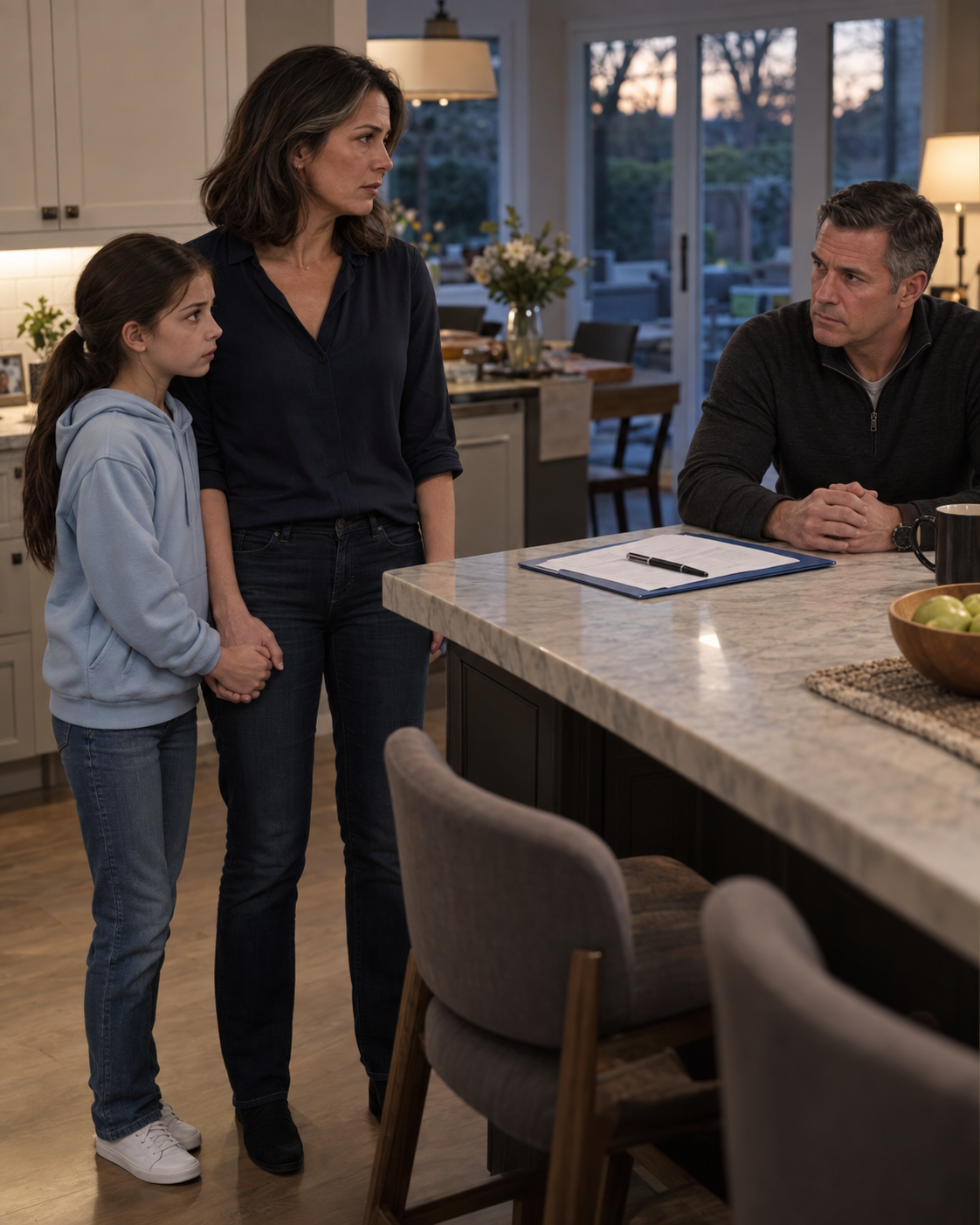
The divorce papers were already tabbed when Victor slid them across the kitchen island.
He had arranged everything with the same neatness he used when preparing bids for our equipment company: blue folder, black pen, highlighted figures, no wasted motion.
“Two hundred forty thousand,” he said. “Cash settlement. You keep your personal accounts. I keep the house, the vehicles, and Vance Equipment.”
I looked at the number.
Then at him.
Victor was forty-six, six feet tall, silver beginning at his temples, wearing the expensive quarter-zip he reserved for meetings with bank executives. We had been married eighteen years. I knew exactly how he looked when he believed he had already won.
“And the boys?” I asked.
His mouth tightened.
“You know where they stand.”
David was seventeen. Caleb was fifteen. Noah had just turned thirteen.
All three had stopped coming to my house months earlier.
David answered my calls with one-word texts. Caleb had blocked my number. Noah still looked at me sometimes when Victor wasn’t watching, but even that had become rare.
Victor tapped the papers.
“You’ve made this harder than it needed to be.”
“I’ve made it harder?”
“You walked away from the company.”
“I went to Fort Campbell for three months.”
“You chose the Army over your family.”
“I was deployed to coordinate emergency logistics after the tornadoes.”
He shrugged.
“That distinction doesn’t matter anymore.”
It mattered to me.
For twenty-one years, I’d served as an Army logistics officer. I’d spent more nights sleeping on folding cots and airport floors than I could count. When Victor and I started Vance Equipment, I was the one who understood procurement, inventory, shipping schedules, vendor contracts, and the unglamorous machinery that kept a business alive.
My inheritance from my grandmother had provided the first $62,000.
Victor had provided the name.
Together, we had built something worth millions.
Or so I’d thought.
Victor leaned back.
“You can have one of the boys,” he said. “David wants to stay with me. Caleb does too. Noah hasn’t made up his mind.”
For a second, I didn’t understand the sentence.
“You’re asking me to choose?”
“I’m offering you a realistic arrangement.”
I looked through the glass doors toward the backyard.
Chloe was sitting on the porch steps, eleven years old, swinging her sneakers against the wood. She was the only child who still moved between our two worlds without asking permission.
Victor picked up the pen.
“You’re emotional. I’m trying to be practical.”
I reached for the folder.
He smiled.
Then I pushed it back toward him.
“Keep them.”
His smile disappeared.
“All three.”
I took Chloe’s hand.
She looked up at me, confused.
“Mom?”
“We’re going home.”
Behind us, Victor muttered something about lawyers and consequences.
I didn’t turn around.
At the doorway, I stopped.
“Page forty-seven,” I said.
“What?”
“Make sure you sign page forty-seven.”
Then I walked out.
The Nineteen-Dollar Problem
Three weeks later, Victor sent me a Venmo request.
$19.14.
The note said: Chloe groceries.
I stared at it while sitting in my lawyer’s office.
“Is he serious?” my attorney, Mara Chen, asked.
“I think so.”
“Are you going to pay it?”
“No.”
She laughed once, then covered her mouth.
The ridiculousness of it would have been funny if everything else weren’t so ugly.
Victor had millions in company assets, a seven-figure house, three vehicles, and control of the business we’d built together.
Yet he wanted nineteen dollars from me for groceries.
I opened the transaction details.
“Wait.”
Mara leaned closer.
The Venmo account was connected to a bank account I didn’t recognize.
Not Victor’s usual personal account.
“What’s that?” she asked.
“I don’t know.”
I took a screenshot.
That night, I called our forensic accountant.
Two days later, she called me back.
“Do you know Cape Fear Equipment Holdings?”
“No.”
“Have you ever signed anything transferring company funds to it?”
“No.”
She was quiet.
Then she said, “Elena, we’re going to need access to the company records.”
Vance Equipment had started in our garage with three used forklifts and a borrowed trailer.
Over the next decade, we had grown into a regional equipment supplier serving construction companies throughout Tennessee, Kentucky, and Georgia.
I had always trusted Victor with the financial side.
That trust now looked less like marriage and more like a hole I had fallen through.
The forensic team found $486,000 transferred from company accounts into Cape Fear Equipment Holdings over eighteen months.
The entity had no employees.
No warehouse.
No visible operations.
Its registered address belonged to a small office building outside Raleigh.
Then came the document that changed everything.
Our original operating agreement.
I had signed it in 2012.
Victor had signed it too.
Buried in the ownership section was a provision protecting my original capital contribution and giving me a substantial ownership interest in the company regardless of future management changes.
Someone had later produced a 2017 amendment that supposedly eliminated those protections.
My signature appeared at the bottom.
I stared at it for a long time.
“I didn’t sign this,” I said.
Mara didn’t answer immediately.
“No,” she finally said. “I don’t think you did.”
What Caleb Brought Me
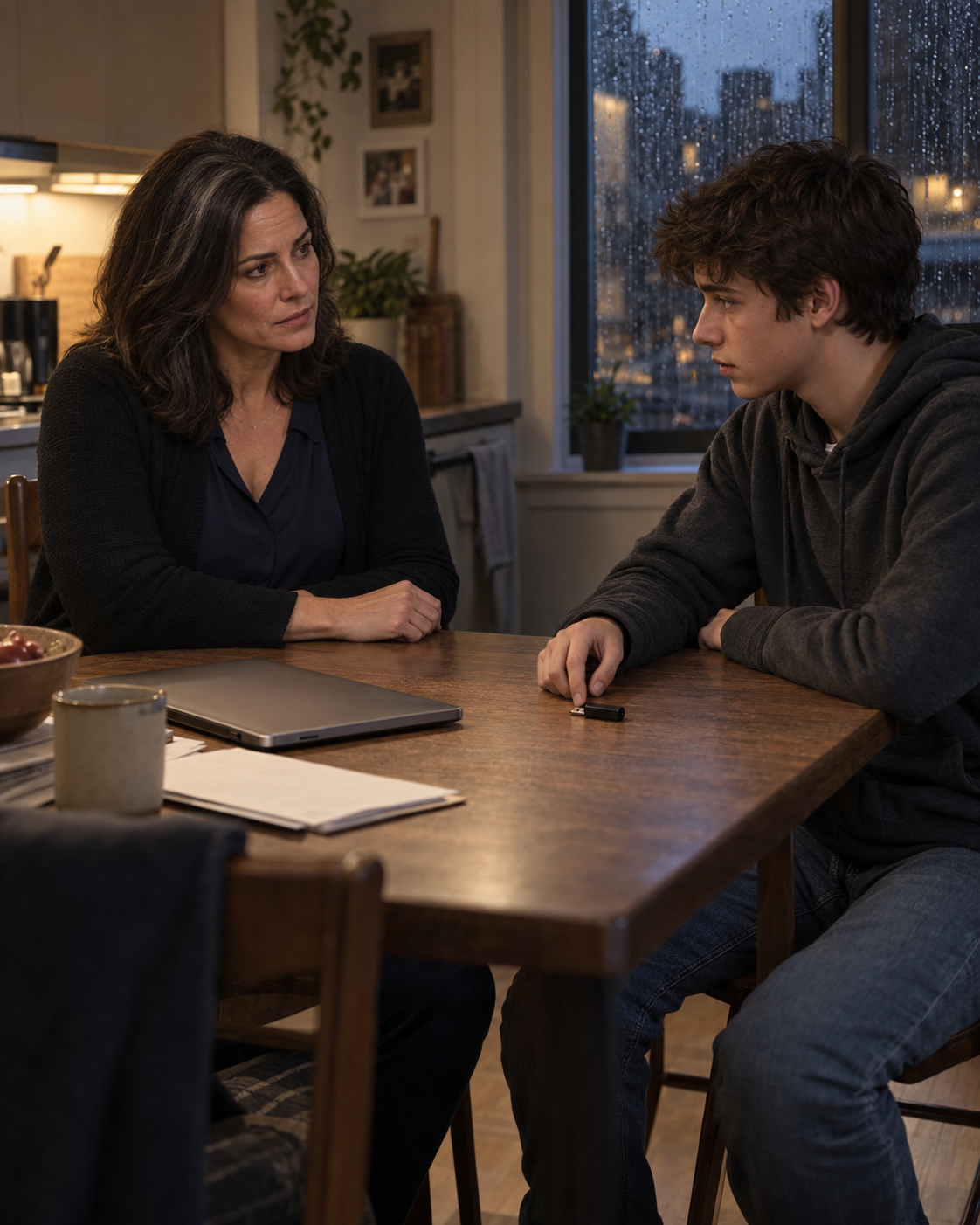
Caleb showed up at my apartment on a rainy Thursday.
He didn’t knock twice.
When I opened the door, he stood there with his hood pulled low, water dripping from the sleeves of his sweatshirt.
“Can I come in?”
I stepped aside.
He walked straight into the kitchen.
He was taller than I remembered, or maybe I had simply missed the changes because I hadn’t been allowed to watch him grow.
“Dad doesn’t know I’m here.”
I said nothing.
Caleb pulled a small black flash drive from his pocket.
“He told me to delete this.”
My stomach tightened.
“What’s on it?”
“I don’t know everything.”
“Caleb—”
“He thinks I won’t understand.”
He set it on the counter.
“I copied it before I deleted anything.”
I looked at my son.
His eyes were red.
Not from crying, exactly.
From trying not to.
“Why did you bring it to me?”
He stared at the floor.
“Because I think you were telling the truth.”
That sentence hurt more than anything Victor had said.
I pulled out a chair.
“Sit down.”
He did.
For several minutes, neither of us spoke.
Then Caleb whispered, “I shouldn’t have stopped talking to you.”
I reached across the table.
He hesitated.
Then he took my hand.
The flash drive contained spreadsheets, scanned invoices, internal emails, and a series of payment records.
Some transfers matched the money our forensic team had already found.
Others revealed equipment sales routed through companies Victor controlled.
There were emails discussing “restructuring exposure.”
There was even a message from Victor to an outside accountant asking whether the 2017 amendment would “hold up if challenged.”
Mara read everything twice.
Then she looked at me.
“This isn’t just a divorce dispute anymore.”
“No,” I said.
She closed the laptop.
“It’s a business fraud case.”
Page Forty-Seven
Victor’s lawyer pushed for a settlement conference.
Mara told me not to expect an apology.
“I don’t.”
“Good.”
“What do you expect?”
She looked at me over her glasses.
“I expect him to believe he’s smarter than everyone in the room.”
She was right.
Victor arrived twenty minutes late.
He shook hands with the mediator, apologized for “a scheduling conflict,” and barely looked at me.
His attorney carried a thick binder.
Victor carried nothing.
He didn’t need to.
He believed the outcome belonged to him already.
The mediator reviewed the proposed agreement.
House to Victor.
Vehicles to Victor.
Business to Victor.
I would receive $240,000.
The boys would remain primarily with Victor, with custody arrangements determined separately.
Then Mara said, “We have an amended proposal.”
Victor finally looked at her.
“We’ve already negotiated this.”
“No,” Mara said. “You negotiated it.”
She placed a document on the table.
“Exhibit F.”
Victor frowned.
It was a certification attached to the settlement.
It required both parties to affirm that all business entities, transfers, assets, debts, and ownership interests had been fully disclosed.
Victor laughed.
“This is ridiculous.”
“Then it should be easy to sign.”
His attorney leaned toward him.
They whispered.
Victor glanced at me.
“You really think this changes anything?”
I looked down at my hands.
The wedding ring was gone.
The faint pale line where it had been was still visible.
“I think the truth changes things.”
His jaw tightened.
The mediator explained that signing the certification would formally represent that his disclosures were complete.
Victor looked irritated.
He had been in meetings like this for years.
Documents were obstacles.
Signatures were rituals.
Pages were meant to be turned.
He picked up the pen.
His attorney started to say something.
Victor waved him off.
“I’ve disclosed everything.”
He signed.
Then he turned the page.
Mara didn’t move.
Victor’s attorney suddenly went still.
“Victor,” he said quietly.
Victor looked back.
“What?”
His attorney pointed to the certification.
Victor read it again.
His face changed.
Not dramatically.
Just enough.
The confidence drained from his eyes.
Mara placed the forensic report beside the signed document.
“Cape Fear Equipment Holdings.”
Victor said nothing.
“Four hundred eighty-six thousand dollars.”
Still nothing.
“Undisclosed transfers. Related-party transactions. A disputed 2017 amendment. Internal communications discussing the restructuring of company assets.”
Victor’s face had gone pale.
His lawyer closed his eyes.
“You signed a certification stating those disclosures were complete.”
Victor looked at me.
For the first time in years, he looked uncertain.
“You set me up.”
“No,” I said.
I nodded toward the papers.
“You signed.”
What Stayed
The case took months to resolve.
There was no dramatic courtroom confession.
No shouting.
No handcuffs.
Real life was slower than that.
There were depositions, subpoenas, accountants, attorneys, amended filings, and long afternoons sitting in rooms where people discussed my marriage as if it were a balance sheet.
In the end, the original operating agreement was upheld.
The 2017 amendment was rejected.
The hidden transfers became part of the financial settlement.
Vance Equipment was divided according to the ownership interests Victor had tried to erase, and I received control of the logistics and distribution operations.
The house was sold.
The cars were divided.
The $240,000 offer disappeared into the history of the case.
But none of that was the part I remembered most.
It was Caleb’s flash drive sitting on my kitchen table.
It was Noah calling me one Saturday and asking if he could come over.
It was David, six months later, standing awkwardly in my doorway with a duffel bag over his shoulder.
“I heard you bought another warehouse.”
I smiled.
“I did.”
“Is it ugly?”
“Extremely.”
He laughed.
It was the first time I’d heard that laugh in nearly a year.
Chloe was in the garage painting a wooden sign for her room. She had gotten paint on both hands and one cheek.
When David walked in, she ran to him.
Caleb followed.
Noah came last.
For a moment, the four of them stood together beneath the fluorescent lights, arguing about pizza toppings like no time had passed.
I stayed near the doorway.
I didn’t interrupt.
My life was not magically repaired.
The boys still carried things they couldn’t put into words.
I did too.
There were apologies that came late and apologies that never came.
There were memories we would probably disagree about forever.
But that night, when I locked the garage, I saw something sitting on the workbench.
The black flash drive.
Caleb had left it there.
I picked it up and turned it over in my palm.
A tiny, ordinary piece of plastic had once carried evidence capable of breaking apart everything Victor had built in secret.
But what mattered to me now wasn’t what it had exposed.
It was what it had brought home.
I slipped the drive into the drawer beside the keys to my new warehouse.
Then I heard Chloe calling from the kitchen.
“Mom! David says pineapple belongs on pizza!”
I laughed.
“Tell David he’s wrong.”
From the other room, David shouted, “I heard that!”
And for the first time in a long time, the house sounded full again.